Korail Class 200000
The Korail Class 200000 or TEC (Trunk line electric car) is an electric vehicle introduced in 2008. Two flights were converted into central inland circulation trains, and one was scrapped due to the Taebaek Line train crash, and one was operated as the train. Trains continue to operate.
| Korail Class 200000 | |
|---|---|
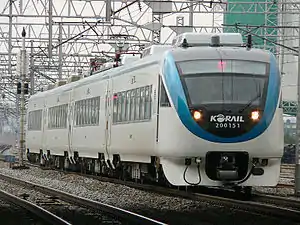 | |
| Built at | Hitachi |
| Constructed | 2008 |
| Operator(s) | Korail |
| Line(s) served | Nuriro |
| Specifications | |
| Car body construction | Aluminum |
| Maximum speed | 150km/h (service) 165km/h (design) |
| Power output | 2,000 kW (3,800 hp) |
| Deceleration | 3.5km/h/s (service) 4.5km/h (emergency) |
| Electric system(s) | AC 25000V |
| Safety system(s) | ATS, ATP |
History
The last Mugunghwa-ho passenger cars in were installed 2003. The Korea Railroad Corporation established a plan to replace Mugunghwa-ho with electric vehicles by 2020. In December 2006, companies such as Hyundai Rotem and Hitachi Manufacturing Co., Ltd. participated in the bidding, and won orders at Hitachi Manufacturing Co., rather than Hyundai Rotem, which monopolized the production of railway vehicles in Korea at the time. The contract was signed in early 2007, known as HEMU (Hitachi Electric Multiple Unit) or 'Onyang Line 32 Cargo Project'. Spheres, electrical equipment, and vehicles produced by Hitachi Manufacturing Plant were transferred to Korea in March 2008, and air conditioners, train information control devices, signal devices, auxiliary power supplies, and braking devices were created and assembled at SLS Heavy Industries' Changwon plant.
It was scheduled to deliver vehicles in the summer of 2008 and start operation on December 15 of the same year with the extension of metropolitan subway line 1. Due to the financial crisis, the amount of foreign currency delivery more than doubled from the time of contract. The first program was released on January 9, 2009, and the trial operation began on February 6. On June 1, 2009, operation began on Nuriro.[1]
Technical specifications
Application of A-Train technology
Hitachi Manufacturing applied the design concept of A-Train using aluminum beginning in 1999. This was to reduce design costs and manufacturing costs, as the basic sphere used an aluminum double skin structure to enable the FSW welding method. A modular design was applied according to the vehicle purpose.
140km/h class train
Loans use a link arm lightweight Volsterless vehicle KH-221, which is already used in large numbers. In order to secure 140km/h semi-high-speed performance, the braking system adopts a wheel disc method and a yaw damper. The current collector uses the same single-arm pantograph as the 8200 electric locomotive, and the controller adopts a 1C2M method that controls two motors using a two-level converter/inverter that uses Hitachi's IGBT device, and can be electrically braked. The braking system is supplied by Eugene Air, the auxiliary power supply is supplied by Woojin Electric Power Plant, the air conditioner is supplied by Namji Air Conditioner, and the train information control system employs Woojin Electric TCMS, and the one-handle mask is adopted in the operating room.
Interior configuration
The interior uses sheets ordered by the Korea Railroad Corporation and supplied by Hitachi Manufacturing. The overall sheet width and pitch are slightly wider than Mugunghwa Lake, has intermediate armrests and tables, and is designed to suit the shape of Koreans. HVAC was adopted for the first time. A TV broadcasting device that uses LCD monitors is included (originally it displayed Korail marks, but later was upgraded to display videos). Dynamic glass can switch between opaque and transparent separated the leading car's driving room and the rooms. Toilets and washbasins. but not restaurant cars, cafe passenger cars, and food and beverage vending machines were included.
Combination of low-floor and high-floor platforms
The Janghang Line line was part of the metropolitan subway line 1 at the time. It was equipped with a hydraulic lift device to allow boarding and getting off at both low and high-rise homes, and the second car was equipped with a ramp for the disabled for barrier-free. Inside the yellow part of the elevator, a sensor lowers the stairs when stopping at the low-rise home. On the other hand, it is impossible to handle passengers on platforms with screen doors because the length of the vehicle is different from that of general commuter trains, and the location of the screen doors and doors and doors are different.
References
- 시속 150km 친환경전동기차 ‘누리로’ 첫선, 《동아일보》, 2009.06.02.
 Rolling stock of Korail Rolling stock of Korail | |||||||||||||||||||||
|---|---|---|---|---|---|---|---|---|---|---|---|---|---|---|---|---|---|---|---|---|---|
| Current/Active |
| ||||||||||||||||||||
| Future |
| ||||||||||||||||||||
| Retired/Withdrawn |
| ||||||||||||||||||||
| Experimental |
| ||||||||||||||||||||
See also Category:Rolling stock of South Korea | |||||||||||||||||||||