Korail Class 3000
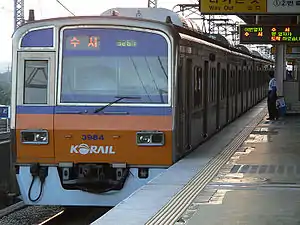
The Koail Class 3000 train is a commuter train introduced by the Korea Railroad Corporation with the opening of the Ilsan Line in 1996. Currently, it operates directly on Seoul Subway Line 3, and this train is the only commuter train of the Korea Railroad Corporation dedicated to 1,500V DC, which is managed and operated by the Seoul Metro, and cannot operate the exchange section. Currently, a total of 16 units (160 units) of 10 units are in operation.
| Korail Class 3000 | |
|---|---|
 | |
| Built at | Changwon |
| Constructed | 1995 ~ 1997 |
| Formation | 10 cars per train TC-M'-M'-M'-M'-M'-M'-M'-M'-TC |
| Operator(s) | Korail |
| Depot(s) | Jichuk |
| Line(s) served | Seoul Subway Line 3 |
| Specifications | |
| Maximum speed | 80km/h (service) 110km/h (design) |
| Power output | 4,400 kW (5,900 hp) |
| Deceleration | 3.5km/h/s (service) 4.5km/h (emergency) |
| Electric system(s) | DC 1500V |
| Safety system(s) | ATC[1] |
The first VVVF train on Seoul Subway Line 3
The Ilsan Line, which opened in 1996, was constructed in accordance with the Urban Railroad Act to solve problems in vehicles, operations, and facilities caused by confusion in the left, right traffic and direct and alternating electricity supply methods. This eliminates the need for direct and alternating vehicles because of the adoption of DC 1,500V and Automatic Train Control (ATC). In particular, Seoul Transportation Corporation did not install heavy inspection facilities for VVVF control vehicles on Line 4 due to lack of land. As a result, the Korea Railroad Corporation did not need to build a separate vehicle base, and the efficiency of common parts between each other was further improved just by expanding the size of the land vehicle business.
Technical specifications
The basic specifications are the same as 101-106 out of Seoul Metro 1000 series (VVVF) and 401 to 409, 451 to 463 out of Seoul Metro 4000 series. However, since the design maximum speed is 110km/h, which is 10km/h higher, and is operated by the crew of the Korea Railroad Corporation, the gear ratio is adjusted to be as similar as possible to the responsiveness and acceleration of other Korea Railroad trains. And there are speculations that the gear cost has actually changed a lot from the original value after receiving consignment management from the Seoul Transportation Corporation for over 20 years. A reverse passage prevention device is installed in the vehicle, but is not used. The TGIS was newly replaced with a 4-bit TGIS on a 1-bit screen. The layout remains the same, but the functions have become a little more diverse.
References
 Rolling stock of Korail Rolling stock of Korail | |||||||||||||||||||||
|---|---|---|---|---|---|---|---|---|---|---|---|---|---|---|---|---|---|---|---|---|---|
| Current/Active |
| ||||||||||||||||||||
| Future |
| ||||||||||||||||||||
| Retired/Withdrawn |
| ||||||||||||||||||||
| Experimental |
| ||||||||||||||||||||
See also Category:Rolling stock of South Korea | |||||||||||||||||||||