Krnov
Krnov (Czech pronunciation: [ˈkr̩nof]; German: Jägerndorf, Polish: Karniów or Krnów, Latin: Carnovia, Silesian: Karniōw) is a town in Bruntál District in the Moravian-Silesian Region of the Czech Republic. It has about 23,000 inhabitants.
Krnov | |
|---|---|
Town | |
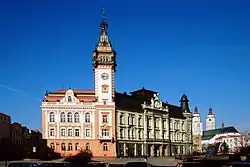 Town Hall | |
 Flag  Coat of arms | |
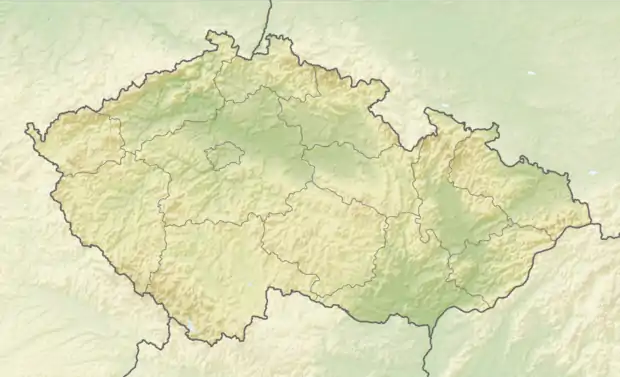  Krnov Location in the Czech Republic | |
| Coordinates: 50°5′26″N 17°41′55″E | |
| Country |  Czech Republic Czech Republic |
| Region | Moravian-Silesian |
| District | Bruntál |
| First mentioned | 1240 |
| Government | |
| • Mayor | Tomáš Hradil |
| Area | |
| • Total | 44.29 km2 (17.10 sq mi) |
| Elevation | 316 m (1,037 ft) |
| Population (2020-01-01[1]) | |
| • Total | 23,257 |
| • Density | 530/km2 (1,400/sq mi) |
| Time zone | UTC+1 (CET) |
| • Summer (DST) | UTC+2 (CEST) |
| Postal code | 794 01 |
| Website | www |
Geography
Krnov lies in the historical region of Upper Silesia, at the confluence of the rivers Opava and Opavice, near the Polish border. The highest peak of the municipal area is Bednářský vrch (588 m).
Administrative parts
The town is made up of town parts of Pod Bezručovým vrchem and Pod Cvilínem, and of village of Krásné Loučky.
History
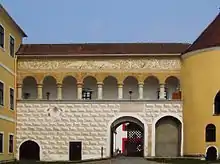
The area has been inhabited almost without interruption since the Stone Age. Its history stretches back to the 13th century when Krnov acquired town rights. The town was first mentioned in 1240 and served as the capital of the Duchy of Krnov from 1377 to 1523, under Bohemian (Czech) suzerainty. It remained part of the Bohemian Crown until 1918, since 1867 within the Austrian-ruled part of Austria-Hungary. Following World War I and the dissolution of Austria-Hungary, it formed part of Czechoslovakia.
According to the Austrian census of 1910, the town had 16,681 inhabitants, 15,647 of whom had permanent residence there. The census had asked people for their native language; 15,390 (98.4%) were German-speaking and 247 (1.5%) were Czech-speaking. Jews were not allowed to declare Yiddish, thus most of them declared German as their native language. The most populous religious groups were Roman Catholics with 15,290 (91.7%), followed by Protestants with 885 (5.3%) and the Jews with 459 (2.8%).[2]
From 1938 to 1945 it was occupied by Germany, administratively it was made one of the municipalities in Sudetenland. During World War II, the Germans operated a Gestapo prison,[3] and four forced labour subcamps of the Stalag VIII-B/344 prisoner-of-war camp in the town.[4] After the war, the German population was expelled in 1945-46, in accordance to the Potsdam Agreement.
Economy
Krnov is industrial center of the Upper-Silesian region. A factory producing the cola-based drink Kofola is located in the town. Another one of the largest local companies is the company Rieger–Kloss which manufactures pipe organs. Notable is also textile industry (especially woolens production).
Tourism is significant for Krnov. The town is a summer resort and a winter sport area with close access to the Jeseníky Mountains, the second-highest mountain range in the country.
Sights
Krnov has an 18th-century castle, several churches and abbeys as well as a lookout tower from 1903. The Krnov Synagogue is one of the few large synagogues to have survived the Nazi German occupation of Europe.
Transport
Krnov has two railway stations, a central station and a rail station called Cvilín.
Notable people
- Franz Rieger (1812–1886), Austrian pipe organ builder and entrepreneur
- Carol Benesch (1822–1896), architect
- Charles Louis Fleischmann (1835–1897), Austrian inventor and distiller
- Grete Berger (1883–1944), Austrian-German actress
- Robert Hohlbaum (1886–1955), Austrian-German librarian, writer and playwright
- Liesl Herbst (1903–1990), Austrian tennis player
- Norbert Riedel (1912–1963), Austrian engineer and entrepreneur
- Hanns Cibulka (1920–2004), German poet
- Edith Ballantyne (born 1922), Canadian activist
- Jiří Georg Dokoupil (born 1954), Czech-German painter and graphic artist
- Zdeňka Šilhavá (born 1954), discus thrower
- Leon Koudelak (born 1961), classical guitarist
- Jaroslav Sakala (born 1969), ski jumper
- Radek Bonk (born 1976), ice hockey player
- Karel Sedláček (born 1979), darts player
Twin towns – sister cities
 Głubczyce, Poland
 Karben, Germany
 Lykovrysi-Pefki, Greece
- Mińsk Mazowiecki, Poland
 Nadvirna, Ukraine
- Prudnik, Poland
 Rajec, Slovakia
 Saint-Égrève, France
 Telšiai, Lithuania
Gallery
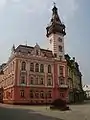 Town hall
.JPG.webp) Krnov Castle
Krnov Castle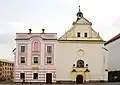 Church of the Holy Spirit
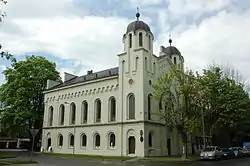 Krnov Synagogue
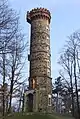 Observation tower
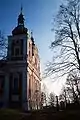 Church of the Virgin Mary on Cvilín Hill
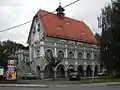 Shooting house
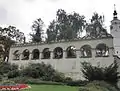 Swedish wall
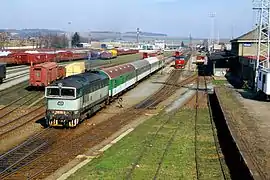 Main train station
References
- "Population of Municipalities – 1 January 2020". Czech Statistical Office. 2020-04-30.
- Ludwig Patryn (ed): Die Ergebnisse der Volkszählung vom 31. Dezember 1910 in Schlesien, Troppau 1912.
- "Gestapogefängnis Jägerndorf". Bundesarchiv.de (in German). Retrieved 12 November 2021.
- "Working Parties". Lamsdorf.com. Archived from the original on 29 October 2020. Retrieved 12 November 2021.
- "Partnerská města". krnov.cz (in Czech). Město Krnov. Retrieved 2020-08-24.
External links
 |
Wikimedia Commons has media related to Krnov. |
- Official website (in Czech)
- Town information center (in Czech)
- Sudeten German homeland district of Jägerndorf (in German)
- Documents on the Expulsion of the Sudeten Germans from Krnov
- Klub přátel starého Krnova (Krnov Friends' Club) (in Czech)
Authority control  | |
|---|---|
| General | |
| National libraries | |