Slezské Rudoltice
Slezské Rudoltice (German: Rosswald) is a village in Bruntál District, Moravian-Silesian Region, Czech Republic. Slezské Rudoltice municipality is situated where the Jindřichov upland meets Osoblaha plains. There is the narrow-gauge railway running through the village having three stops within the municipality borders – in Amalín, Slezské Rudoltice and Koberno. The first mention of the village is from 1255 as in 1676 it was promoted to a town.
Slezské Rudoltice
Rosswald | |
|---|---|
Village | |
.JPG.webp) Chateau Slezské Rudoltice | |
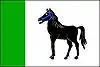 Flag  Coat of arms | |
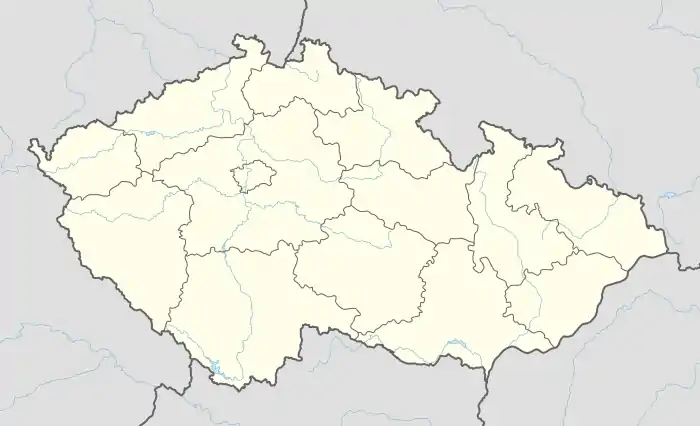  Slezské Rudoltice Location in the Czech Republic | |
| Coordinates: 50°12′24.86″N 17°40′51.94″E | |
| Country |  Czech Republic Czech Republic |
| Region | Moravian-Silesian Region |
| District | Bruntál District |
| First mentioned | 1255 |
| Area | |
| • Total | 23.2 km2 (9.0 sq mi) |
| Elevation | 275 m (902 ft) |
| Population (2019)[1] | |
| • Total | 542 |
| • Density | 23/km2 (61/sq mi) |
| Time zone | UTC+1 (CET) |
| • Summer (DST) | UTC+2 (CEST) |
| Website | http://www.slezskerudoltice.cz/ |
The dominant feature of the town is a chateau with a rich history. A renaissance chateau was built in the middle of the 16th century on the place of a former fortress during the reign of Sup family of Fulštejn. In 1630 the chateau belonged to George of Hodice and during the reign of Albert of Hodice (born in 1706) the chateau experienced the most famous moments. Albert from Hodice loved luxury and he fitted up his chateau and also the park accordingly. During his reign the Rudoltice chateau became the cultural centre of Silesia. In this time there were Karl Hanke and Karl Ditters from Dittersdorf playing in the chateau band. The chateau was visited by famous French philosopher Voltaire, the Prussian king Frederick II and the Austrian emperor Joseph II. After the death of the Hodice family the chateau fame came to an end – decorations were stolen or sold. After World War II the chateau was nationalized by the Czechoslovak government, and since 2008 it has belonged to the municipality which opened it to public.
The Neo-Romanesque Church of St. Catherine situated in Slezské Rudoltice is where the remains of the Hodice family (inc. Albert of Hodice) are kept. The Statue of the Virgin Mary from the Hodice era stands on the local square.
Nearby there is the abandoned village of Pelhřimovy situated just on the Czech-Polish border. In 1742 after the war between Austria and Prussia, the village was divided into the Prussian and Austrian territory along the stream Große Bach/Hrozová/Wielki Potok (sometimes also called Potok Grozowy or Trója).
After World War II, German population was expelled from the village. Due to mutual distrust between communist Czechoslovakia and Poland almost all the houses on the Czech side of the village were razed except two - original gothic Church of St. George with a cemetery around it. In the Polish part of village, it is possible to visit a chateau accessible by a bridge over the stream Hrozová/Wielki Potok by the chateau chapel.
References
- "Population of municipalities of the Czech Republic". Czech Statistical Office. 1 January 2019.
External links
 |
Wikimedia Commons has media related to Slezské Rudoltice. |
- (in Czech) Official website
Authority control: National libraries  |
|---|