Lepidopterology
Lepidopterology (from Ancient Greek λεπίδος (lepídos) 'scale', πτερόν (pterón) 'wing', and -λογία (-logia),[1] is a branch of entomology concerning the scientific study of moths and the three superfamilies of butterflies. Someone who studies in this field is a lepidopterist or, archaically, an aurelian.

_-_Muzeum_Gornoslaskie%252C_Bytom%252C_Poland.jpg.webp)
Origins
Post-Renaissance, the rise of the "lepidopterist" can be attributed to the expanding interest in science, nature and the surroundings. When Linnaeus wrote the tenth edition of the Systema Naturae in 1758, there was already "a substantial body of published work on Lepidopteran natural history" (Kristensen, 1999).[2]
These included:[2]
- Insectorum sive Minimorum Animalium Theatrum – Thomas Mouffet (1634)
- Metamorphosis Naturalis – Jan Goedart (1662–67 )
- Metamorphosis insectorum Surinamensium – Maria S. Merian (1705), whose work included illustrated accounts of European Lepidoptera
- Historia Insectorum – John Ray (1710)
- Papilionum Brittaniae icones – James Petiver (1717)
History
Scholars
1758–1900 was the era of the gentleman scientist. Following Linnaeus' descriptions in Systema Naturae and with Boas Johansson in Centuria Insectorum, the Austrian Nikolaus Poda von Neuhaus wrote Insecta Musei Graecensis (1761) and Johann Christian Fabricius described very many more species in a series of major works.
During this period, Ignaz Schiffermüller wrote a systematic catalogue of the butterflies of the districts around Vienna Systematische Verzeichnis der Schmetterlinge der Wienergegend herausgegeben von einigen Lehrern am k. k. Theresianum (1775). In Germany Eugenius Johann Christoph Esper in collaboration with Toussaint de Charpentier published Die europäischen Schmetterlinge (European butterflies online here) and Die ausländischen Schmetterlinge (World butterflies online here).
Between 1806–1834 Jacob Hübner wrote Sammlung exotischer Schmetterlinge ["Collection of exotic butterflies"] (2 vols.), Augsburg with Carl Geyer and Gottlieb August Wilhelm Herrich-Schäffer. During the years of 1806–1824 Hübner added Geschichte europäischer Schmetterlinge ["History of European butterflies"]. Herrich-Schäffer expanded this as Systematische Bearbeitung der Schmetterlinge von Europa, Zugleich als Text, Revision und Supplement zu Jacob Hubner’s Sammlung europäischer Schmetterlinge(6 Volumes, 1843–1856).
In France Jean Baptiste Boisduval, Jules Pierre Rambur and Adolphe Hercule de Graslin wrote Collection iconographique et historique des chenilles; ou, Description et figures des chenilles (larvae) d'Europe, avec l'histoire de leurs métamorphoses, et des applications à l'agriculture, Paris, Librairie encyclopédique de Roret, 1832 and with John Eatton Le Conte, 1829–1837 Histoire général et iconographie des lepidoptérès et des chenilles de l’Amerique septentrionale (General history and illustrations of the Lepidoptera and caterpillars of Northern America) which was published in Paris. Boisduval also described Lepidoptera from the expedition ship Astrolabe of Jean-François de Galaup, comte de La Pérouse and the Coquille, that of Louis Isidore Duperrey.
In Italy Giovanni Antonio Scopoli wrote Entomologia Carniolica published in Vienna. In the mid-century period, the expert knowledge of Lepidoptera dealers such as Otto Staudinger, Emile Deyrolle, Orazio Querci and Peter Godeffroy contributed to the field.
In Russia, from approximately 1906-1914, Andrey Avinoff, of Russian nobility and a member of Czar Nicholas II's court and one of his advisors, self financed dozens of butterfly expeditions through Russia and into Asia into the Himalayas. He supposedly amassed the world's largest collection of butterflies at approximately 80,000, by 1914. The collection was appropriated by Soviet Union and resides at the Zoological Museum of St. Petersburg.
Explorers
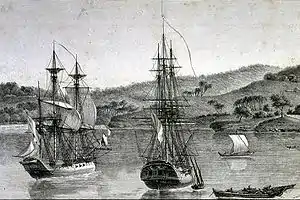
Expeditions continued to be major sources of specimens. The Baudin expedition to Australia (1800 to 1803) with two laboratory equipped ships Géographe and Naturaliste had nine zoologists and botanists on board. They brought back to France, according to Antoine François, comte de Fourcroy, the largest collection Muséum national d'Histoire naturelle had ever received including 44 crates of zoological specimens. The Österreichische Brasilien-Expedition explored the Botany, Zoology and Ethnography of Brazil. It was organized and financed for Austrian Empire and ran from 1817 to 1835. SMS Novara, under the command of Commodore Bernhard von Wüllerstorf-Urbair, made a voyage of exploration in 1857–1859. Baron Cajetan von Felder and his son Rudolf Felder amassed a huge entomological collection from the Novara that is deposited in the Naturhistorisches Museum in Vienna and the Natural History Museum in London. The butterflies were described in Reise Fregatte Novara: Zoologischer Theil., Lepidoptera, Rhopalocera (Journey of the Frigate Novara...) in three volumes (1865–1867). Andrey Avinoff and/or some of his benefactors also financed numerous expeditions from approximately 1906-1940.
Collectors
Wealthy collectors played a major role: Aimée Fournier de Horrack in Paris, Walter Rothschild and James John Joicey in England and in Russia Grand Duke Nicholas Mikhailovich of Russia who funded Sergei Alphéraky and edited Mémoires sur les Lépidoptères. The British Empire provided opportunities to Frederic Moore author of Lepidoptera Indica. The Carnegie and Mellon families financed the collection and acquisition of butterfly collections through their investments into the newly-created Carnegie Museum of Natural History and its director, Andrey Avinoff, from approximately 1924-1948.
Museums
In the nineteenth century large collections of Lepidoptera were amongst the natural history specimens then flooding into Europe. Most of the largest and most specimens of new species are in Musée royal de l'Afrique centrale (Belgian Congo), Muséum national d'Histoire naturelle (French colonial empire), Museum für Naturkunde (German colonial empire), British Museum (Natural History) (British colonial Empire), Zoological Museum in St. Petersburg, and Rijksmuseum van Natuurlijke Historie (Dutch Empire). Museum lepidopterists have included Samuel Constantinus Snellen van Vollenhoven. Francis Walker, Alois Friedrich Rogenhofer, František Antonín Nickerl, Lionel de Nicéville, Carl Heinrich Hopffer and Arthur Gardiner Butler.
Notable lepidopterists
Some notable lepidopterists are or have been:
- Per Olof Christopher Aurivillius of Sweden: butterflies of Africa
- Andrey Avinoff[3] of Russia and the U.S.A: butterflies of eastern Asia and Jamaica
- Henry Tibbats Stainton of England: Microlepidoptera
- Jules Léon Austaut of France: specialised in Parnassius
- Otto Vasilievich Bremer of Russia: butterflies of Siberia and Amur
- John Henry Leech of England: butterflies of China
- Shōnen Matsumura of Japan: butterflies of Japan
- Hans Rebel of Austria: butterflies of the Palearctic
- Ruggero Verity of Italy: butterflies of the Palearctic
- Hans Fruhstorfer of Germany: world butterflies, but especially Java
- Edward Meyrick of England: Microlepidoptera
- Herman Strecker of the U.S.A.: butterflies of the Americas
- Anthony Valletta of Malta: butterflies of Malta
- Margaret Fountaine of England: Europe, South Africa, India, Tibet, America, Australia and the West Indies.
- Edna Mosher of Canada: A Classification of the Lepidoptera based on characters of the pupae
Collections and illustrations
As the chief mode of study of butterflies was through pinned specimen collections, it was difficult to catalogue and communicate names and descriptions widely. Books on butterflies with plates that were either hand-painted, lithographed and printed have been a major tool in lepidopterology. These include the massive works by Adalbert Seitz.
Unusual works like the Butterfly Fauna of Ceylon (1942) by Lionel Gilbert Ollyett Woodhouse (1888–1965) and Moths and Butterflies of the United States East of the Rocky Mountains (1900) by Sherman F. Denton made use of butterfly wing-prints where the illustrations incorporated the scales of the wings.[4]
The illustrious Russian writer, Vladimir Nabokov was a noted lepidopterist, having discovered the passion at the age of seven. He would later write about butterflies, collect, and illustrate them.[5] Nabokov volunteered at Harvard's Museum of Comparative Zoology in the Entomology Department,[6] where he would organize specimens for as much as 14 hours a day.[5]
Andrey Avinoff, a fellow Russian Immigrant and close associate of Nabokov, was the director of Carnegie Museum of Natural History from 1926-1946 and who may have perhaps created the world's largest butterfly collections, twice. While in Europe before the October Revolution, Avinoff was Russian nobility with a position on the court of Czar Nicholas II and travelled through the mountainous areas in Europe and Asia collecting butterflies. Avinoff would trace their genetic evolution through valleys, since the mountains separating those valleys prevented different butterflies from mating. He found the Himalayas to be the ultimate proving ground. Avinoff's collection of Rhopalocera from the Pamir Mountains and Central Asia currently resides in the Zoological Museum in St. Petersburg. This collection of some eighty thousand specimens was appropriated by the Soviet government. Avinoff emigrated to the United States in 1917. Following World War II, the Mellon family asked to retrieve the collection but was refused.
Avinoff was a generation older than the famed Russian-born novelist Vladimir Nabokov. Avinoff's older brother, Nika, worked to convert Russia to a constitutional monarchy with Nabokov's father. Nabokov senior's family eventually fled to Berlin, outlined in Alex Shoumatoff's book Russian Blood. According to Kurt Johnson and Steve Coates's book Nabokov's Blues (1999), Avinoff was one of the first people Nabokov contacted when he came to the United States. In Nabokov's novel (“The Gift”), Nabokov largely based the character Konstantin Godunov-Cherdyntsev, a formidable Central Asian butterfly collector, on Avinoff.
Once in America, Avinoff began recollecting many of his specimens to supposedly another 80,000 units, and also created a definitive guide of lepidopterology in Jamaica, primarily in the 1930s with the son of his sister, Nicholas Shoumatoff. This collection is housed at the Carnegie Museum of Natural History and at the New York Museum of Natural History. Avinoff was also close friends with the biologist and sex researcher Alfred Kinsey, largely due to their similar interest in insects from Kinsey's work with gall wasps and they collaborated on a number of initiatives.
Lepidopterological societies
Lepidopterists are served by a number of national and international scientific societies. They promote research in lepidopterology and dissemination of the findings through conferences such as the biennial European Congresses of Lepidopterology or the TILS Leps Talk. These societies include:
- Lepidopterists' Society
- Societas Europaea Lepidopterologica
- Lepidoptera Research Foundation
- North American Butterfly Association
- Association for Tropical Lepidoptera
- International Lepidoptera Survey
- Lepidopterological Society of Denmark
- Lepidopterological Society of Finland
- Lepidopterological Society of Japan
- Sicilian Lepidopterological Association
- Southern Lepidopterists' Society
- Study Group of Hessian Lepidopterologists
- Lepidopterists' Society of Africa
Lepidopterological journals
- Journal of Research on the Lepidoptera
- Metamorphosis
- The Taxonomic Report
- Nota lepidopterologica
See also
References
- Harper, Douglas. "lepidoptera". Online Etymology Dictionary. Retrieved 8 February 2011.
- Kristensen, Niels P. (1999). "Historical Introduction". In Kristensen, Niels P. (ed.). Lepidoptera, moths and butterflies: Evolution, Systematics and Biogeography. Volume 4, Part 35 of Handbuch der Zoologie:Eine Naturgeschichte der Stämme des Tierreiches. Arthropoda: Insecta. Walter de Gruyter. p. 1. ISBN 978-3-11-015704-8. Retrieved 30 November 2010.
- https://carnegiemuseums.org/magazine-archive/2009/spring/feature-128.html#:~:text=Avinoff%20began%20collecting%20butterflies%20as,Petersburg.
- Cowan, C.F. (1968). "Butterfly wing-prints". J. Soc. Biblphy Nat. Hist. 4 (7): 368–369. doi:10.3366/jsbnh.1968.4.7.368.
- Batuman, Elif (2016-03-23). "Vladimir Nabokov, Butterfly Illustrator". The New Yorker. ISSN 0028-792X. Retrieved 2017-12-18.
- "Lepidoptera Love: Nabokov's Untold Story". library.mcz.harvard.edu. Retrieved 2017-12-18.
External links
 Media related to Lepidopterology at Wikimedia Commons
| |||||||||||||||||
| |||||||||||||||||
| |||||||||||||||||


Authority control  | |
|---|---|
| General | |
| National libraries | |
| Other | |