Matiari District
Matiari District (Sindhi: ضلعو مٽیاري, Urdu: ضلع مٹیاری) is a district in the Pakistani province of Sindh. Located on the left bank of the Indus River, Matiari became an independent district in 2004 under the military regime of Pervez Musharraf, when Hyderabad was divided into four districts — Tando Allahyar, Matiari, Tando Mohammad Khan and Hyderabad.[2]
Matiari District
| |
|---|---|
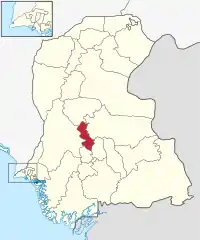 Map of Sindh with Matiari District highlighted | |
| Country |  Pakistan Pakistan |
| Province |  Sindh Sindh |
| Established | 2005 |
| Headquarters | Matiari |
| Area | |
| • Total | 1,417 km2 (547 sq mi) |
| Population (2017)[1] | |
| • Total | 769,349 |
| • Density | 540/km2 (1,400/sq mi) |
| Time zone | UTC+5 (PKT) |
| Number of Tehsils | 3 |
| Website | http://www.matiari.net/ |
Etymology
The word Matiari is derived from two Sindhi words "Mat" and "yari", which means 'change friendship'.
According to culture, the Main Bus Stop at Matiari Main Road was where a Lady sat in a hut a long time ago. It is where she keeps a mud pot of water. People of Matiari tell the bus conductor "Mat Wari Maai" (Make Stop at Old Women's Hut Where She Keeps Mud Pot of Water). This is apparently why it the district is called Matiari.
History and Administration
Matiari district was carved out of Hyderabad district along with Tando Allahyar and Tando Muhammad Khan districts in 2005.[3] Matiari district is part of the Hyderabad division. The district is administratively subdivided into three talukas:[4]
There are 30 union councils in the district as tabulated below:[5]
| UC
No. |
Name | UC
No. |
Name | UC
No. |
Name | UC
No |
Name | UC
No. |
Name | UC
NO. |
Name |
|---|---|---|---|---|---|---|---|---|---|---|---|
| 1 | Matiari | 6 | Bau Khan
Pathan |
11 | Oderolal | 16 | Bhanoth | 21 | Makhdooman
Jon Landhiyoon |
26 | Bhaledino
Kaka |
| 2 | Jiandal Kot | 7 | Palijani | 12 | Nobat Marri | 17 | Khandu | 22 | Karam Khan
Nizamani |
27 | Sikenderabad |
| 3 | Shah Alam
Ji Wasi |
8 | Oderolal | 13 | Sher Muhammad
Thorra/Kheber |
18 | Fateh
Muhammad Shah Ajnani |
23 | Shahmir
Rahu |
28 | Zair Peer |
| 4 | Shahpur/
Arif Khatian |
9 | Bau Dero | 14 | Faqir Nooh
Hothiani |
19 | Ajan Shah | 24 | Faqirabad | 29 | Abdul Wahid
Borero |
| 5 | Tajpur | 10 | Sekhat | 15 | Muhammad
Hussain Hingoro |
20 | Bhit Shah | 25 | Saeedabad
Old |
30 | Muhammad
Ramzan Unar |
Demography
The total population of district was according to 2017 census 769,349. In the 1998 census, Sindhi was the first language of 92% of the population in the talukas of Hala and Matiari, while Urdu had 3.6%.[6]
Religion
Religion in Matiari district (2017 Census)[7][lower-alpha 1]
Islam(84%) is the dominant religion in Matiari district. Hindus form about 17 % of the population, according to the 2017 Census.[7]
Notable places
The shrines of Pir Rukun-Din-Shah, Makhdoom Sarwar Nooh, Shah Abdul Latif Bhittai, Sakhi Hashim Shah pir Haider shah, and others are located in Matiari district. Miani forest and the battleground of Sir Charles Napier and Talpur rulers of Sindh and Miani jo Maidan are also situated in Matiari district.
Syed Rukun-Din-Shah also fought a battle with the Arguns dynasty with seven bilalis of sindh.
At Khuda aabad, one can find the graves and the tombs of Mughal Empires era. There is a Masjid (Praying Place) and a well of water.
The Indus River is also there.
Agriculture
Matiari district is one of the most fertile districts of Sindh. The main crops cultivated are cotton, banana, mango, wheat, onions and sugarcane.
Politics
The elected representatives from Matiari district are
- MNA Makhdoom Jameel-uz-Zaman (PPPP) NA 223
- MPA Makhdoom Mehboob Zaman (PPPP) PS 58
- MPA Makhdoom Rafique Zaman (PPPP) PS 59
List of Dehs
The following is a list of Matiari District's Dehs, organised by Taluka:[8]
- Hala Taluka (35 Dehs)
- Matiari Taluka (49 Dehs)
- Abrejani
- Arain
- Barechani
- Baudero
- Bhanoki
- Bhorko
- Buhryoon
- Chharao
- Dhando
- Ganag Rayati
- Gang Jagir
- Hakra
- Jaheki
- Kaindal Kot
- Jakhri Jagir
- Jakhri Joya
- Jakhri Rayati
- Ketti
- Khorkhani
- Khudi
- Khyberani
- Koheki
- Lutryoon
- Mari
- Matiari
- Mubarak Wah
- Nindero
- Oderolal
- Palijani
- Panhwarki
- Pano
- Porath
- Reechal
- Sadri
- Saeedpur
- Sahib Saman
- Sattar
- Sekhat
- Shahpur
- Sipki Jagir
- Sipki Rayati
- Sohiki
- Soomra
- Sultanpur
- Tajpur
- Thano
- Thorha
- Vesro
- Wassan
- Saeedabad Taluka (28 Dehs)
- Ahano
- Amin Lakho
- Bawri
- Chhachhri
- Chhapar Kahan
- Chitori
- Dalo Keti
- Dethki
- Fatehpur
- Gadali
- Giss
- Jamali
- Kaka
- Khatoori
- Khuteero
- Koonar
- Larh
- Manahi
- Odiyanoo
- Panjmoro
- Peengharo Jagir
- Peengharo Raieti
- Rahoo
- Rahooki
- Ranoo
- Saeedabad
- Suhrabpur
- Zairpir
Notes
- Hinduism includes Scheduled Caste Hindus and Islam includes Ahmadiyya; which are counted separately in the Census
References
- "DISTRICT WISE CENSUS RESULTS CENSUS 2017" (PDF). www.pbscensus.gov.pk. Archived from the original (PDF) on 2017-08-29.
- Khan, Mohammad Hussain (2021-09-13). "The vibrant district of Matiari". DAWN.COM. Archived from the original on 2021-10-07. Retrieved 2021-10-08.
- "Three new districts carved out of Hyderabad". TheDawn. 5 April 2005. Archived from the original on 31 July 2021. Retrieved 31 July 2021.
- "NRB: Local Government Elections". nrb.gov.pk. Archived from the original on 26 March 2012. Retrieved 27 January 2012.
- "Matiari District UC List, MNA MPA Seats مٹیاری ضلع کی یونین کونسلز". Political, Sports Workers Helpline. 2017-03-02. Archived from the original on 2019-04-21. Retrieved 2020-02-16.
- PCO 1999, p. 117–119.
- "Matiari District". Archived from the original on 5 August 2021. Retrieved 5 August 2021.
- "List of Dehs in Sindh" (PDF). Sindh Zameen. Archived (PDF) from the original on 26 February 2021. Retrieved 22 March 2021.
Bibliography
- 1998 District census report of Hyderabad. Census publication. 59. Islamabad: Population Census Organization, Statistics Division, Government of Pakistan. 1999.
External links
 |
Wikimedia Commons has media related to Matiari District. |
Provincial capital: Karachi | ||
| Banbhore |  | |
| Hyderabad | ||
| Karachi | ||
| Larkana | ||
| Mirpur Khas | ||
| Sukkur | ||
| Shaheed Benazir Abad | ||
Authority control  | |
|---|---|
| General | |
| National libraries | |