Municipal District of Opportunity No. 17
The Municipal District of Opportunity No. 17 is a municipal district (MD) occupying a remote area in central northern Alberta, Canada. Located in Census Division 17 north of the Town of Athabasca, its municipal office is located in the Hamlet of Wabasca.
Municipal District of Opportunity No. 17 | |
|---|---|
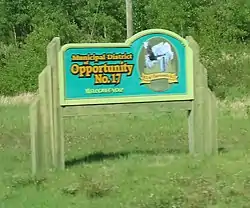 Welcome sign | |
 Location within Alberta | |
| Country | Canada |
| Province | Alberta |
| Region | Northern Alberta |
| Census division | 17 |
| Established | 1995 |
| Incorporated | 1995 |
| Government | |
| • Reeve | Marcel Auger |
| • Governing body | MD of Opportunity Council |
| • Administrative office | Wabasca |
| Area (2016)[2] | |
| • Land | 29,142.1 km2 (11,251.8 sq mi) |
| Population (2016)[2] | |
| • Total | 3,181 |
| • Density | 0.1/km2 (0.3/sq mi) |
| • Municipal census (2016) | 2,639[3] |
| Time zone | UTC−7 (MST) |
| • Summer (DST) | UTC−6 (MDT) |
| Website | mdopportunity.ab.ca |


History
The MD of Opportunity No. 17 was established on August 1, 1995 from the former Improvement District No. 17 East (North).
Geography
Communities and localities
|
The following urban municipalities are surrounded by the MD of Opportunity No. 17.[4]
The following hamlets are located within the MD of Opportunity No. 17.[4]
|
The following localities are located within the MD of Opportunity No. 17.[5]
|
Demographics
In the 2016 Census of Population conducted by Statistics Canada, the MD of Opportunity No. 17 recorded a population of 3,181 living in 1,002 of its 1,554 total private dwellings, a 3.5% change from its 2011 population of 3,074. With a land area of 29,142.1 km2 (11,251.8 sq mi), it had a population density of 0.1/km2 (0.3/sq mi) in 2016. The population of the MD is 69.4% First Nations and 10.1% Métis, making it the only predominantly Indigenous MD in Alberta.[2]
The population of the MD of Opportunity No. 17 according to its 2016 municipal census is 2,639,[3] a -17.9% change from its 2015 municipal census population of 3,214.[10]
In the 2011 Census, the MD of Opportunity No. 17 had a population of 3,074 living in 974 of its 1,430 total dwellings, an 8% change from its 2006 population of 2,847. With a land area of 29,140.78 km2 (11,251.32 sq mi), it had a population density of 0.1/km2 (0.3/sq mi) in 2011.[11]
Economy
The economy of the MD of Opportunity No. 17 includes oil and gas production, forestry, as well as diamond exploration. The municipality also offers the lowest residential tax rate in the Province of Alberta as part of its efforts to attract and retain residents.[12] Tourism is also a growing segment of the economy in the M.D. Calling Lake Provincial Park in the south, along with North Wabasca Lake provide numerous opportunities for outdoor recreation year round.[13]
References
- Alberta Municipal Affairs: Municipal Officials Search
- "Population and dwelling counts, for Canada, provinces and territories, and census subdivisions (municipalities), 2016 and 2011 censuses – 100% data (Alberta)". Statistics Canada. February 8, 2017. Retrieved February 8, 2017.
- "2016 Municipal Affairs Population List" (PDF). Alberta Municipal Affairs. ISBN 978-1-4601-3127-5. Archived from the original (PDF) on January 16, 2017. Retrieved January 28, 2017.
- "Specialized and Rural Municipalities and Their Communities" (PDF). Alberta Municipal Affairs. January 6, 2021. Retrieved September 29, 2021.
- "Standard Geographical Classification (SGC) 2006, Economic Regions: 4817031 - Opportunity No. 17, geographical codes and localities, 2006". Statistics Canada. 2010-03-05. Retrieved 2012-08-11.
- Geo-Administrative Areas (Hamlet, Locality and Townsite Culture Points) (Geodatabase layer) (Map). AltaLIS. October 26, 2020. Retrieved October 2, 2021.CS1 maint: date and year (link)
- "Population and Dwelling Counts, for Canada, Provinces and Territories, and Census Divisions, 2001 and 1996 Censuses – 100% Data (Alberta)". Statistics Canada. Retrieved 2019-05-28.
- "Population and dwelling counts, for Canada, provinces and territories, and census subdivisions (municipalities), 2006 and 2001 censuses – 100% data (Alberta)". Statistics Canada. January 6, 2010. Retrieved 2019-05-28.
- "Census Profile, 2016 Census". Statistics Canada. February 8, 2017. Retrieved 2019-05-28.
- "2015 Municipal Affairs Population List" (PDF). Alberta Municipal Affairs. ISBN 978-1-4601-2630-1. Retrieved January 28, 2017.
- "Population and dwelling counts, for Canada, provinces and territories, and census subdivisions (municipalities), 2011 and 2006 censuses (Alberta)". Statistics Canada. February 8, 2012. Retrieved February 8, 2012.
- Stepher Scriver, AAMDC: The 100-Year Story of Alberta's Rural Cornerstone (2008: AADMC: Edmonton), at p. 65
- "Fishing & Lakes | Land of Opportunity". www.mdopportunity.ab.ca. Retrieved 2021-04-19.
External links

Places adjacent to Municipal District of Opportunity No. 17 | ||||||||||||||||
|---|---|---|---|---|---|---|---|---|---|---|---|---|---|---|---|---|
| ||||||||||||||||



.svg.png.webp)
