Novobayazet Uyezd
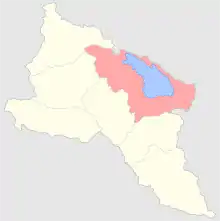
The Novobayazet Uyezd (Russian: Новобаязетский уезд; Armenian: Նոր Բայազետի գավառ) was a county of the Erivan Governorate of the Caucasus Viceroyalty of the Russian Empire. It bordered the governorate's Aleksandropol Uyezd to the north, the Echmiadzin and Erivan Uyezds to the west, the Sharur-Daralagez Uyezd to the south, and the Kazakh, Elisabethpol, and Jevanshir Uyezds of the Elisabethpol Governorate to the east. Centered on Lake Sevan, the Novobayazet Uyezd included most of the contemporary province of Gegharkunik and northern parts of the province of Kotayk in the Republic of Armenia. The administrative center of the uyezd was the city of Novobayazet (Gavar) for which the district was eponymously named.[1]
Novobayazet Uyezd
Новобаязетский уезд | |
|---|---|
.png.webp) Coat of arms | |
 | |
| Country | Russia |
| Political status | Uyezd |
| Region | Caucasus |
| Established | 1849 |
| Abolished | 1918 |
| Area | |
| • Total | 4,730 km2 (1,830 sq mi) |
| Population (1916) | |
| • Total | 188,859 |
| • Density | 40/km2 (100/sq mi) |
Administrative Divisions
The Novobayazet Uyezd was split into 4 unnamed contiguous uchastki (subcounties):
- 1-iy
- 2-iy
- 3-iy
- 4-iy
Demographics
According to the 1897 Russian Empire Census, the population of the district was 122,573, the majority of which were Armenians (66.4%). Minorities included Tatars (modern Azerbaijanis; 28.5%), East Slavs (Russians, Ukrainians, and Belarusians; 2.2%), and Kurds (2.4%).[2] The largest city in the district was Novobayazet, which had a total population of 8,486, of which the overwhelming majority (95%) were Armenians.[3]
Caucasian Calendar of 1917
The 1917 Caucasian Calendar which produced statistics of 1916 indicates 205,617 residents in the Novobayazet Uyezd, including 97,864 men and 90,995 women, 174,879 of whom were the permanent population, and 13,980 were temporary residents. The statistics indicated the city of Novobayazet and its peripheries to be overwhelmingly ethnic Armenian, with sizeable Azerbaijani, Kurdish and Russian minorities, the Azerbaijanis of which were mainly concentrated near the southeastern section of the uyezd:[4]
| Area | Russians | Other
Europeans |
Armenians | Kurds | Other Asian Nationalities | Jews | TOTAL | ||||
|---|---|---|---|---|---|---|---|---|---|---|---|
| Orthodox | Sectarian | Muslim | Yezidi | Christian | Shia Muslim | Sunni Muslim | |||||
| Novobayazet | 70 | 13 | 11 | 14,350 | 238 | ... | 64 | ... | ... | 2 | 14,748 |
| Rural | 90 | 4,752 | 387 | 114,997 | 2,726 | 408 | 38 | 46,901 | 3,812 | ... | 174,111 |
| TOTAL | 160 | 4,765 | 398 | 129,347 | 2,964 | 408 | 102 | 46,901 | 3,812 | 2 | 188,859 |
| 0.1% | 2.5% | 0.2% | 68.5% | 1.6% | 0.2% | 0.1% | 24.8% | 2.0% | 0.0% | 100.0% | |
References
- Tsutsiev, Arthur (2014). Atlas of the Ethno-Political History of the Caucasus. Translated by Nora Seligman Favorov. New Haven: Yale University Press. p. 59. ISBN 9780300153088.
- (in Russian) 1897 Census, Novobayazetsky Uyezd Demoscope Weekly
- (in Russian) 1897 Census, Novobayazet City Demoscope Weekly
- Кавказский календарь .... на 1917 год (in Russian). pp. 367–370.
Administrative divisions of the Erivan Governorate | ||
|---|---|---|
| ||
Italics indicates abolished uyezds. | ||