Olrat language
Olrat [ʊlrat] is a moribund Oceanic language spoken on Gaua island in Vanuatu.
| Olrat | |
|---|---|
| Native to | Vanuatu |
| Region | Gaua |
Native speakers | 3 (2012)[1] |
| Language codes | |
| ISO 639-3 | olr |
| Glottolog | olra1234 |
| ELP | Olrat |
Name
The name Olrat is an endonym. Sidney Ray mentions the language briefly in 1926 ‒ under its Mota name Ulrata ‒ but provides no linguistic information.[2] Preliminarily, the two forms can be derived from the Proto-Torres-Banks form *ul(i,u)rata.
The language
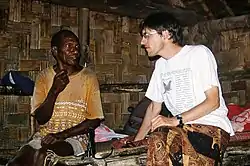
In 2003, only three speakers of Olrat remained, who lived on the middle-west coast of Gaua.[3] Their community had left their inland hamlet of Olrat in the first half of the 20th century, and merged into the larger village of Jōlap where Lakon is dominant.[1]
Alexandre François identifies Olrat as a distinct language from its immediate neighbor Lakon, on phonological,[4] grammatical,[5] and lexical[6] grounds.
Phonology
Olrat has 14 phonemic vowels. These include 7 short /i ɪ ɛ a ɔ ʊ u/ and 7 long vowels /iː ɪː ɛː aː ɔː ʊː uː/.[7]
| Front | Back | |
|---|---|---|
| Near-close | i ∙ iː | u ∙ uː |
| Close-mid | ɪ ∙ ɪː | ʊ ∙ ʊː |
| Open-mid | ɛ ∙ ɛː | ɔ ∙ ɔː |
| Open | a ∙ aː | |
Historically, the phonologization of vowel length originates in the compensatory lengthening of short vowels when the voiced velar fricative /ɣ/ was lost syllable-finally.[8]
Grammar
The system of personal pronouns in Olrat contrasts clusivity, and distinguishes four numbers (singular, dual, trial, plural).[9]
Spatial reference in Olrat is based on a system of geocentric (absolute) directionals, which is typical of Oceanic languages.[10]
References
- François (2012).
- Sidney Ray (1926), A Comparative Study of the Melanesian Island Languages, CUP, page 428.
- List of Banks islands languages.
- François (2005)
- François (2007)
- François (2011)
- François (2005:445), François (2011:194).
- François (2005:461).
- François (2016).
- François (2015).
Bibliography
- François, Alexandre (2007), "Noun articles in Torres and Banks languages: Conservation and innovation" (PDF), in Siegel, Jeff; Lynch, John; Eades, Diana (eds.), Language Description, History and Development: Linguistic indulgence in memory of Terry Crowley, Creole Language Library 30, Amsterdam: Benjamins, pp. 313–326
- François, Alexandre (2011), "Social ecology and language history in the northern Vanuatu linkage: A tale of divergence and convergence" (PDF), Journal of Historical Linguistics, 1 (2): 175–246, doi:10.1075/jhl.1.2.03fra, hdl:1885/29283.
- François, Alexandre (2012), "The dynamics of linguistic diversity: Egalitarian multilingualism and power imbalance among northern Vanuatu languages" (PDF), International Journal of the Sociology of Language, 2012 (214): 85–110, doi:10.1515/ijsl-2012-0022, S2CID 145208588
- François, Alexandre (2015). "The ins and outs of up and down: Disentangling the nine geocentric space systems of Torres and Banks languages" (PDF). In Alexandre François; Sébastien Lacrampe; Michael Franjieh; Stefan Schnell (eds.). The languages of Vanuatu: Unity and diversity. Studies in the Languages of Island Melanesia. Canberra: Asia-Pacific Linguistics. pp. 137–195. hdl:1885/14819. ISBN 978-1-922185-23-5.
- François, Alexandre (2016), "The historical morphology of personal pronouns in northern Vanuatu" (PDF), in Pozdniakov, Konstantin (ed.), Comparatisme et reconstruction : tendances actuelles, Faits de Langues, 47, Bern: Peter Lang, pp. 25–60