PS Keystone State
PS Keystone State (also spelled Key Stone State) was a wooden-hulled American paddle steamer in service between 1849 and 1861. She was built in 1848 in Buffalo, New York, by Bidwell & Banta for Charles M. Reed of Erie, Pennsylvania, and operated as part of his "Chicago Line". She operated between Buffalo and Chicago, Illinois, while also making stops at various other ports. She frequently carried European immigrants who desired to settle in the Midwestern United States. Due to the Panic of 1857, Keystone State and several other paddle steamers were laid up. When the American Civil War began in 1861, she was refurbished, and put back into service.
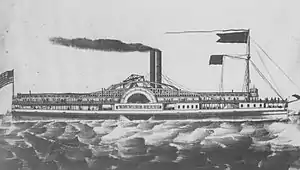 Empire State, a paddle steamer of a similar age and size to Keystone State | |
| History | |
|---|---|
.svg.png.webp) United States United States | |
| Name | Keystone State |
| Namesake | A nickname for the Commonwealth of Pennsylvania |
| Owner |
|
| Port of registry | Presque Isle, Pennsylvania |
| Builder | Bidwell & Banta of Buffalo, New York |
| Launched | November 11, 1848 |
| In service | May 1849 |
| Out of service | November 9 or 10, 1861 |
| Fate | Sank in a storm on Lake Huron |
| General characteristics | |
| Class and type | Paddle steamer |
| Tonnage | 1,354 GRT |
| Length | 288 feet (87.8 m) |
| Beam |
|
| Depth | 14 feet (4.3 m) |
| Installed power |
|
| Propulsion | 2 × paddle wheels almost 40 feet (12.2 m) in diameter |
| Capacity |
|
On November 8, 1861, Keystone State left Detroit for Milwaukee, Wisconsin, under the command of Captain Wilkes Travers. Although her cargo manifest listed her cargo as farm machinery, it was rumored that she was carrying gold and military supplies. She was last seen off Port Austin, Michigan, struggling in a storm, eventually sinking with the loss of all 33 people on board. Keystone State's fate was unknown for over a week, until pieces of wreckage from her washed ashore.
The location of Keystone State's wreck remained a mystery for 151 years, until it was found in July 2013 by shipwreck hunter David Trotter. The wreck rests in nearly 175 feet (53.3 m) of water northeast of Harrisville, Michigan, about 40 to 50 miles (64.4 to 80.5 km) from where Keystone State was last seen afloat.
History
Design and construction
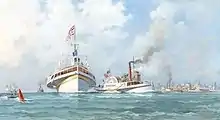
Keystone State (also spelled Key Stone State) was built in 1848 by Bidwell & Banta of Buffalo, New York. By the time she was completed, Keystone State was the second largest ship on the Great Lakes, after the paddle steamer Empire State.[1][2][3] She was named in honor of the Commonwealth of Pennsylvania.[4] Keystone State was a so-called palace steamer, a class of Great Lakes paddle steamers known for their lavish interiors. Maritime historian Robert McGreevy wrote that the interiors of palace steamers "were made to look like the finest hotels", and had "leaded glass windows and carved arches and mahogany trim".[5] Keystone State had two funnels, a 16 foot (4.9 m) by 230 foot (70.1 m) dining room, 70 large state rooms, and could accommodate 800 passengers and 6,000 barrels of freight.[1][6][7] The joiner work for Keystone State was done by John M. Smith. Newspapers reported that her main cabin was designed by Captain E. Powers, however, Smith later stated that he designed it.[7]
Keystone State's wooden hull was 288 feet (87.8 m) (some sources state 279 feet (85.0 m) or 278.10 feet (84.8 m)) long.[1][6][8] Her beam was 35 feet (10.7 m) (one source states 34.95 feet (10.7 m)) wide.[1][6][7] At her main deck, Keystone State had overhanging hull guards, which brought her over all beam to 63 feet (19.2 m).[7] Her hull was 14 feet (4.3 m) (one source states 14.4 feet (4.4 m)) deep.[1][6][7] She had a gross tonnage of 1354 (also given as 13549⁄95) tons.[1][6][7][8][9]
She was powered by a 500 hp (370 kW) single cylinder walking beam engine, the cylinder of which was 65 inches (165.1 cm) in diameter, and had a stroke of 10 feet (3.0 m).[1][7] The engine was manufactured in New York City. Steam for the engine was provided by two firebox boilers.[1][7] Keystone State was propelled by two paddle wheels that were nearly 40 feet (12.2 m) in diameter.[5][10] She was launched on November 11, 1848.[1][6]
Service history
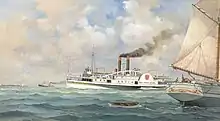
In 1849, Keystone State was enrolled in Presque Isle, Pennsylvania, which was also her home port.[1][7][6] Built for Charles M. Reed of Erie, Pennsylvania, Keystone State became part of his "Chicago Line".[1][7][6] Beginning in May 1849, Keystone State began travelling between Buffalo and Chicago, Illinois, while also making stops at other ports such as Sandusky, Ohio, and Milwaukee, Wisconsin. She frequently carried European immigrants who desired to settle in the Midwestern United States.[1][5][7] Throughout her career, she was involved in multiple accidents.[1]
In October 1849, Keystone State was damaged and disabled in a gale on Lake Michigan.[1][11][12] She sustained $4600 (equivalent to $115,000 in 2019[13]) worth of damage, including a broken "hogging arch". She was docked in Buffalo for repairs.[1][11][12] On April 13, 1850, Keystone State rescued the passengers of the paddle steamer Atlantic, after the latter ran aground on Point Pelee.[14] On June 8 that same year, Keystone State collided with the schooner Comfort Ann off Rocky River, Ohio.[1][15] Keystone State rescued the crew of the schooner S.F. Gale, which sank in a collision in the Detroit River on November 11, 1850.[16]
Keystone State made an excursion to Put-in-Bay, Ohio, on August 6, 1851.[1][17] On December 17 that same year, while running between Buffalo, Dunkirk, New York, and Detroit, Michigan, with 3,500 barrels of flour and 1,000 dressed pigs, Keystone State became trapped in ice at Malden, Ontario.[1][18] She began making regular trips between Dunkirk and Detroit in 1852.[19][20] On November 12, 1852, the crew of Keystone State sighted the steamboat Oneida 9 miles (14.5 km) off Dunkirk, before she was lost with all hands.[21] The following day, Keystone State and another paddle steamer, Lady Elgin were damaged while attempting to enter Dunkirk harbour.[22] On November 18, the Daily News of Kingston, Ontario, reported that Keystone State and another paddle steamer, Empire State, collided near Erie. However, they were unable to confirm it.[23]
On October 10, 1853, one of Keystone State's boilers exploded in the lower Detroit River. She did not sustain major damage, and was towed to Detroit for repairs by the paddle steamer Mayflower.[1][24] In December 1854, Keystone State arrived in buffalo with a bad leak. She sustained $3,000 (equivalent to $69,000 in 2019[13]) worth of damage.[25] In 1855, Keystone State ran between Collingwood, Ontario, and Chicago, while also making stops in Sault Ste. Marie, Michigan.[1] On July 3, 1855, she towed the leaking schooner May Queen into Milwaukee.[26] Keystone State lost her anchor and chain off Erie in November, that same year. She sustained $300 (equivalent to $7,000 in 2019[13]) worth of damage.[27] On December 6, she was towing the schooner Columbia out of Buffalo. Soon after leaving the port, Columbia broke loose and drifted ashore near the south pier of Buffalo harbour.[28]
While running between Collingwood and Chicago, Keystone State sprang a leak in a gale on Lake Michigan on September 18, 1856; her starboard cabin was also smashed in. She was repaired in Detroit.[29] Due to the Panic of 1857, Keystone State and several other paddle steamers were laid up. When the American Civil War began in 1861, she was refurbished, and put back into service.[5][6] She was sold to G. Ritter of Buffalo on October 30, 1861.[1] Keystone State arrived in Detroit on November 7.[8][30]
Final voyage
On November 8, 1861, Keystone State left Detroit for Milwaukee under the command of Captain Wilkes Travers.[31][32] Although her cargo manifest listed her cargo as farm machinery, it was believed that it had been intentionally mislabeled, and she was carrying military supplies intended to be used in the Civil War.[3][5][33] It was also rumored that there was gold on board.[8][33] She was last seen by the schooner Bronson off Port Austin, Michigan, rolling in a storm, and appeared to be disabled.[3][31][33][34] She sank on either November 9 or 10, with the loss of all 33 of her crew.[3][33] No bodies from Keystone State were ever recovered.[35]
Keystone State's fate was unknown for over a week, until pieces of her wreck were spotted on November 21.[3][8][33] On November 23, the Detroit Free Press reported that while off Pointe Aux Barques, the steamer City of Cleveland had passed through "large quantities of what they took to be the upper works of some wrecked steamer", later determined to be from Keystone State.[31][34] A day later, they reported that "part of a guard rail, part of a wheel and a portion of a paddle box of a large steamer" had washed ashore at White Rock, Michigan.[31][34] The schooner Lookout encountered wreckage such as cabins and a pilot house off Pointe Aux Barques on November 23.[36] The pilot house washed ashore near Lexington, Michigan.[5][8]
Keystone State wreck
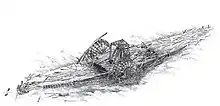
Shipwreck hunter David Trotter of Canton, Michigan, located the wreck of Keystone State on the weekend of July 6–7, 2013, using side-scan sonar.[3][5][37] The wreck was found 25 miles (40.2 km) to 30 miles (48.3 km) northeast of Harrisville, Michigan, (roughly 40 miles (64.4 km) to 50 miles (80.5 km) north of where she was last seen), in nearly 175 feet (53.3 m) of water.[3][5] Trotter and his team, Undersea Research Associates, were able to identify Keystone State's wreck based on her size and features, as she was the only paddle steamer of that size still missing in Lake Huron.[33] The wreck is in a semi-collapsed state, encrusted with zebra mussels.[3][5][37] Keystone State's stern is relatively broken up, while her engine, boilers and paddle wheels are all still standing, and are in relatively good condition.[3][5][33] Trotter and his dive team were unable to find any of the farm machinery or rumored gold, speculating that Keystone State's crew jettisoned the cargo in an attempt to keep her afloat.[3][5][33] The wreck is surrounded by a large debris field.[3][33]
References
- Alpena County George N. Fletcher Public Library (2021).
- Maritime History of the Great Lakes (1) (1849).
- Ellison (2013).
- Pennsylvania Historical and Museum Commission (2001).
- Zaniewski (2013).
- Berry (2021).
- Maritime History of the Great Lakes (2) (1849).
- Swayze (2001).
- Directory of Buffalo (1849), p. 66.
- Associated Press (2013).
- Maritime History of the Great Lakes (3) (1849).
- Milwaukee Sentinel (1850).
- Thomas, Ryland & Williamson, Samuel H. (2020). "What Was the U.S. GDP Then?". MeasuringWorth. Retrieved September 22, 2020. United States Gross Domestic Product deflator figures follow the Measuring Worth series.
- The Daily British Whig (1850).
- Maritime History of the Great Lakes (1850).
- The Kingston Argus (1850).
- Maritime History of the Great Lakes (1) (1851).
- Maritime History of the Great Lakes (2) (1851).
- Maritime History of the Great Lakes (1) (1852).
- Daily News (1) (1852).
- Maritime History of the Great Lakes (2) (1852).
- Daily News (2) (1852).
- Daily News (3) (1852).
- Maritime History of the Great Lakes (1853).
- Maritime History of the Great Lakes (1854).
- Maritime History of the Great Lakes (1) (1855).
- Maritime History of the Great Lakes (2) (1855).
- Maritime History of the Great Lakes (3) (1855).
- Maritime History of the Great Lakes (1856).
- Detroit Free Press (1861).
- Maritime History of the Great Lakes (1861).
- Daily News (1861).
- Gardner (2013).
- Buffalo Commercial Advertiser (1861).
- Michigan Radio (2013).
- Wisconsin Historical Society (2015), p. 6.
- United Press International (2013).
Sources
- Alpena County George N. Fletcher Public Library (2021). "Keystone State (1849, Steamer)". Alpena, Michigan: Alpena County George N. Fletcher Public Library. Retrieved October 23, 2021.
- Associated Press (2013). "Shipwreck hunter reports finding steamer Keystone State that sank in 1861 in Lake Huron". Toledo, Ohio: The Blade. Retrieved October 18, 2021.
- Berry, Sterling (2021). "Keystone State". Detroit, Michigan: Great Lakes Vessel Histories. Retrieved October 23, 2021.
- Buffalo Commercial Advertiser (1861). "Marine Intelligence". Buffalo, New York: Buffalo Commercial Advertiser. Retrieved October 31, 2021.
- Daily News (1) (1852). "Daily News (Kingston, ON), Feb. 25, 1852". Kingston, Ontario: Daily News. Retrieved October 31, 2021.
- Daily News (2) (1852). "Daily News (Kingston, ON), Nov. 13, 1852". Kingston, Ontario: Daily News. Retrieved October 31, 2021.
- Daily News (3) (1852). "Daily News (Kingston, ON), Nov. 18, 1852". Kingston, Ontario: Daily News. Retrieved October 31, 2021.
- Daily News (1861). "Daily News (Kingston, ON), Nov. 28, 1861". Kingston, Ontario: Daily News. Retrieved October 31, 2021.
- Detroit Free Press (1861). "The Steamers Keystone State and Baltic". Detroit, Michigan: Detroit Free Press. Retrieved October 31, 2021.
- Directory of Buffalo (1849). "The Commercial Advertiser Directory for the City of Buffalo". Buffalo, New York: Thomas Jewett & Company. Retrieved October 31, 2021.
- Ellison, Garret (2013). "Remains of Civil War-era shipwreck rumored to carry gold found in Lake Huron". Grand Rapids, Michigan: Booth Newspapers. Retrieved October 18, 2021.
- Gardner, Don (2013). "Civil War-era shipwreck discovered in Lake Huron". Troy, Michigan: The Oakland Press. Retrieved October 18, 2021.
- Maritime History of the Great Lakes (1) (1849). "Keystone State (Steamboat), 31 Mar 1849". Ontario, Canada: Maritime History of the Great Lakes. Retrieved October 25, 2021.
- Maritime History of the Great Lakes (2) (1849). "Keystone State (Steamboat), 1 May 1849". Ontario, Canada: Maritime History of the Great Lakes. Retrieved October 25, 2021.
- Maritime History of the Great Lakes (3) (1849). "Keystone State (Steamboat), disabled, 1 Oct 1849". Ontario, Canada: Maritime History of the Great Lakes. Retrieved October 25, 2021.
- Maritime History of the Great Lakes (1850). "Keystone State (Steamboat), collision, 8 Jun 1850". Ontario, Canada: Maritime History of the Great Lakes. Retrieved October 31, 2021.
- Maritime History of the Great Lakes (1) (1851). "Keystone State (Steamboat), 5 Aug 1851". Ontario, Canada: Maritime History of the Great Lakes. Retrieved October 31, 2021.
- Maritime History of the Great Lakes (2) (1851). "Keystone State (Steamboat), 17 Dec 1851". Ontario, Canada: Maritime History of the Great Lakes. Retrieved October 31, 2021.
- Maritime History of the Great Lakes (1) (1852). "Keystone State (Steamboat), 9 Mar 1852". Ontario, Canada: Maritime History of the Great Lakes. Retrieved October 31, 2021.
- Maritime History of the Great Lakes (2) (1852). "Oneida (Propeller), capsized, 12 Nov 1852". Ontario, Canada: Maritime History of the Great Lakes. Retrieved October 31, 2021.
- Maritime History of the Great Lakes (1853). "Keystone State (Steamboat), boiler exploded ?, 1853". Ontario, Canada: Maritime History of the Great Lakes. Retrieved October 31, 2021.
- Maritime History of the Great Lakes (1854). "Keystone State (Steamboat), leak, 1 Dec 1854". Ontario, Canada: Maritime History of the Great Lakes. Retrieved October 31, 2021.
- Maritime History of the Great Lakes (1) (1855). "May Queen (Schooner), leak, 1 Jul 1855". Ontario, Canada: Maritime History of the Great Lakes. Retrieved October 31, 2021.
- Maritime History of the Great Lakes (2) (1855). "Keystone State (Steamboat), lost anchor & chain, 1 Nov 1855". Ontario, Canada: Maritime History of the Great Lakes. Retrieved October 31, 2021.
- Maritime History of the Great Lakes (3) (1855). "Columbia (Schooner), aground, 6 Dec 1855". Ontario, Canada: Maritime History of the Great Lakes. Retrieved October 31, 2021.
- Maritime History of the Great Lakes (1856). "Keystone State (Steamboat), leak, 18 Sep 1856". Ontario, Canada: Maritime History of the Great Lakes. Retrieved October 31, 2021.
- Maritime History of the Great Lakes (1861). "Keystone State (Steamboat), sunk, 24 Nov 1861". Ontario, Canada: Maritime History of the Great Lakes. Retrieved October 31, 2021.
- Michigan Radio (2013). "After 150 years, Keystone State steamer discovered in the Lake Huron". Ann Arbor, Michigan: University of Michigan. Retrieved October 18, 2021.
- Milwaukee Sentinel (1850). "Milwaukee Sentinel (Milwaukee, WI), 15 Jan, 1850". Milwaukee, Wisconsin: Milwaukee Sentinel. Retrieved October 31, 2021.
- Pennsylvania Historical and Museum Commission (2001). "Symbols of Pennsylvania". Harrisburg, Pennsylvania: Pennsylvania Historical and Museum Commission. Archived from the original on September 14, 2001. Retrieved September 12, 2021.
- Swayze, David (2001). "Great Lakes Shipwrecks – K". Port Huron, Michigan: Boatnerd. Archived from the original on April 17, 2002. Retrieved September 12, 2021.
- The Daily British Whig (1850). "The Daily British Whig (Kingston, ON), April 16, 1850". Kingston, Ontario: The Daily British Whig. Retrieved October 31, 2021.
- The Kingston Argus (1850). "The Kingston Argus (Kingston, ON), Nov. 19, 1850". Kingston, Ontario: The Kingston Argus. Retrieved October 31, 2021.
- United Press International (2013). "Civil War-era steamship Keystone State found in Lake Huron". Boca Raton, Florida: United Press International. Retrieved October 18, 2021.
- Wisconsin Historical Society (2015). "Lookout Shipwreck (Schooner)" (PDF). Madison, Wisconsin: Wisconsin Historical Society. Retrieved October 31, 2021.
- Zaniewski, Ann (2013). "Great Lakes shipwreck hunter finds Keystone State, lost in Lake Huron for 152 years". Detroit, Michigan: Detroit Free Press. Archived from the original on December 9, 2013. Retrieved September 12, 2021.


