SS Cayuga
SS Cayuga was a steel-hulled American package freighter in service between 1889 and 1895. She was built in 1889 in Cleveland, Ohio by the Globe Iron Works Company for the Lehigh Valley Transit Company of Buffalo, New York. One of five identical sister ships, Cayuga entered service later in 1889, carrying package freight between Buffalo, and Chicago, Illinois, while also making stops in Milwaukee, Wisconsin and Gladstone, Michigan. Throughout her brief career, Cayuga was involved in multiple accidents and incidents.
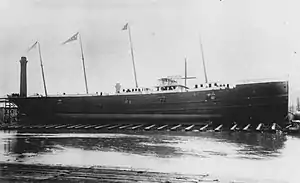 Cayuga on the ways, prior to her launching | |
| History | |
|---|---|
.svg.png.webp) United States United States | |
| Name | Cayuga |
| Namesake | Cayuga Creek |
| Operator |
|
| Port of registry | Buffalo, New York, United States |
| Builder | Globe Iron Works Company of Cleveland, Ohio |
| Yard number | 24 |
| Launched | April 2, 1889 |
| In service | 1889 |
| Out of service | May 10, 1895 |
| Identification | US official number 126556 |
| Fate | Sank in a collision on Lake Michigan |
| General characteristics | |
| Class and type | Package freighter |
| Tonnage | |
| Length | |
| Beam | 40.66 feet (12.4 m) |
| Draught | 16.5 feet (5.0 m) |
| Depth | 23.5 feet (7.2 m) |
| Installed power |
|
| Propulsion | 1 × 4–bladed fixed pitch propeller |
| Speed | c. 14 miles per hour (12.2 kn) |
| Capacity | c. 2,953 long tons (3,307 short tons; 3,000 t) |
| Crew | 30 |
On the morning of May 10, 1895, Cayuga was bound for Buffalo with a cargo of oats, flour and general merchandise, while the 26-year-old wooden freighter Joseph L. Hurd was bound from Duluth, Minnesota, for Chicago, with a cargo of lumber. As Cayuga and Joseph L. Hurd neared each other near Ile Aux Galets, their lights were visible to the crews of both vessels when they were about 10 miles (16 km) apart. A thick fog prevented the vessels' crews from noticing each other, while the wind distorted the sound of their fog whistles, making it difficult to pinpoint the exact location of the vessels. Cayuga and Joseph L. Hurd were less than 250 feet (76 m) apart when their collision course was noticed. Cayuga's engine was reversed, however, this only slowed her down instead of stopping her. At 4:00 or 4:30 a.m., Joseph L. Hurd struck Cayuga on her starboard side, tearing a hole in her hull; Joseph L. Hurd lost her bow, but was kept afloat by her cargo, while Cayuga sank 25 minutes later. The passing freighter Manola rescued the crews of the two vessels. The steward/cook of Joseph L. Hurd was only one casualty. Joseph L. Hurd was repaired and returned to service.
The wreck of Cayuga was located later in 1895. Due to her value, multiple attempts were made to raise her between 1896 and 1900 by Captain James Reid of Bay City, Michigan. His efforts were plagued by problems such as decompression sickness, the loss of several steel pontoons, a derrick barge and the death of a hard-hat diver. Cayuga's wreck was re-discovered in the spring of 1969 by John Steele and Gene Turner.
History
Background
In 1843, the gunship USS Michigan, built in Erie, Pennsylvania, became the first iron-hulled vessel built on the Great Lakes.[1] Beginning in the mid-1840s, Canadian companies began importing iron vessels, prefabricated by shipyards in the United Kingdom. However, it would not be until 1862 that the first iron-hulled merchant ship, Merchant, was built on the Great Lakes.[1] Despite the success of Merchant, wooden vessels remained preferable to iron ones until the 1880s, due to their inexpensiveness, and the abundance of timber.[2][3][4] In the early 1880s, shipyards around the Great Lakes began to construct iron ships on a relatively large scale; in 1882, Onoko, an iron freighter, temporarily became the largest ship on the lakes.[4][5] In 1884, the first steel freighters were built on the Great Lakes, and by the 1890s, the majority of ships constructed on the lakes were made of steel.[6][7]
Design and construction
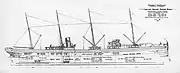
Cayuga (US official number 126556) was built on the banks of the Cuyahoga River in 1889 in Cleveland, Ohio, by the Globe Iron Works Company.[8][9][10] The second of five identical sister ships built between 1888 and 1890, she was one of the first steel freighters built on the Great Lakes, as well as the fourteenth steel ship built by the Globe Iron Works Company.[11][12][13][upper-alpha 1] Cayuga was named after Cayuga Creek, a stream in western New York.[18][upper-alpha 2]
Cayuga's hull had an overall length 308.8 feet (94.1 m) (some sources state 306.8 feet (93.5 m) or 308 feet (93.9 m)) and a length between perpendiculars of 290 feet (88.4 m) (one source states 292.2 feet (89.1 m)).[8][10][19][20] Her beam was 40.66 feet (12.4 m) (some sources state 40.8 feet (12.4 m) or 41 feet (12.5 m)) wide, while her hull was 23.5 feet (7.2 m) (some sources state 22.6 feet (6.9 m) or 25.5 feet (7.8 m)) deep.[8][9][19][10] Cayuga had a gross tonnage of 2,669. (or 2,669.47 tons), and a net tonnage of 1,939 (or 1,939.26) tons.[8][9][19][21] She had a cargo capacity of about 2,953 long tons (3,307 short tons; 3,000 t); when Cayuga was fully loaded, she had a draught of 16.5 feet (5.0 m).[10]
She was powered by a 1,500 hp (1,100 kW) 85 rpm triple expansion steam engine; the cylinders of the engine were 24 inches (61.0 cm), 38 inches (96.5 cm) and 61 inches (154.9 cm) in diameter, and had a stroke of 42 inches (110 cm).[9][19] Steam for the engine was provided by two 11.1 feet (3.4 m) by 12 feet (3.7 m) 160 pounds per square inch (1,100 kPa) Scotch marine boilers.[9][22] Cayuga's engine and boilers were both built by the Globe Iron Works Company. She was propelled by a single, four-bladed fixed-pitch propeller, and had a top speed of about 14 miles per hour (12.2 kn).[9][10][11][22] She cost $250,000 (equivalent to $6.62 million in 2019[23]) to build.[20][24][25]
Service history
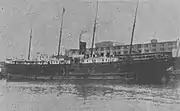
Commissioned by the Lehigh Valley Transit Company of Buffalo, New York; the Lehigh Valley fleet was managed by John Gordon and later W.P. Henry[26][27] Cayuga was launched on April 2, 1889, as yard number 24, and made her maiden voyage in May, that same year.[8][19][28] Although her home port was Buffalo, she was initially enrolled in Cleveland, Ohio, on May 31, 1889.[19][29] She was re-enrolled in Buffalo on June 3 of that same year.[19] She carried package freight on her regular route between Buffalo and Chicago, Illinois, while also making stops in Milwaukee, Wisconsin, and Gladstone, Michigan.[9][11][19][20] Throughout her career, Cayuga was involved in several accidents.[9]
The first serious incident in Cayuga's career occurred on April 9, 1889.[9][25] She was unladen, and left Buffalo harbour at around 4:00 p.m. in tow of the tug S.W. Gee. There was a strong gale blowing, and as soon as they cleared the breakwater, Cayuga became unmanageable.[25] She drifted onto a shoal, broke free and drifted onto the rocks at the foot of Georgia Street.[25] The poor weather made unfeasible for the life saving crew to shoot a breeches buoy to Cayuga until the water had receded, and her stern was firmly aground.[25] Cayuga was freed at around 9:00 a.m. by six tugs.[25] Several of her keel plates were damaged, all of her propeller blades broke off, and she lost her rudder shoe.[9][25]
In November 1891, Cayuga collided with the wooden package freighter Delaware off Cheboygan, Michigan.[9]
Final voyage
On May 10, 1895, Cayuga, under the command of Captain George Graser was bound for Buffalo, with a cargo of 35,000 or 38,000 bushels oats, flour and 1,500 pounds (680.4 kg) of general merchandise.[9][20][30][31] Sources differ whether Cayuga was heading to Buffalo from Chicago or Milwaukee.[20][30][32] One source states she left Buffalo for Milwaukee on May 5, and left Milwaukee at 8:00 a.m. on May 9.[20][30][32][33] Meanwhile, the wooden freighter Joseph L. Hurd, commanded by Captain Charles E. Wilson, was bound from Duluth, Minnesota for Chicago with a cargo of lumber (specifically pine boards) and package freight.[18][20][30]
A thick fog heavily obscured visibility, while the wind distorted the sound of the vessels' fog whistles.[30][32] As Cayuga and Joseph L. Hurd neared each other near Ile Aux Galets, they spotted each other's lights as they were about 10 miles (16.1 km) apart.[30] However, the fog soon concealed the vessels from each other.[30] At 4:00 or 4:30 a.m., when Cayuga and Joseph L. Hurd were less than 250 feet (76.2 m) apart, their collision course was noticed.[18][20][30] Cayuga's engine was reversed, this only slowed her down, instead of stopping her.[18][20][30] Joseph L. Hurd crashed into Cayuga, tearing a hole 2 feet (0.6 m) wide and 6 feet (1.8 m) deep into her starboard side.[20][34] Joseph L. Hurd lost 15 feet (4.6 m) of her bow, but was kept afloat by her cargo of pine boards.[18][20][32][34] The force of the collision caused Cayuga to roll to port; she then righted herself, and began to sink.[20] Cayuga sank in 25 minutes.[20][34]
Aftermath
The crew of Cayuga and Joseph L. Hurd escaped in the lifeboats, and were picked up by the bulk freighter Manola.[20][33][34] The only casualty of the accident was Joseph L. Hurd's cook/steward George Johnson, who fell overboard and drowned.[24] The day after the collision, Joseph L. Hurd was towed to Harbor Springs, Michigan by the wrecking tug Favorite.[24] She was repaired and returned to service.[24] Cayuga was insured for $175,000 (equivalent to $4.81 million in 2019[23]) and her cargo was insured for $90,000 (equivalent to $2.47 million in 2019[23]).[30][35]
Lloyd's of London libeled Joseph L. Hurd's owners for $200,000 (equivalent to $5.49 million in 2019[23]).[36] The collision was determined to have been caused by mistaken passing signals.[37] Captain Graser stated in a letter to supervising Inspector general James Dumont that if Joseph L. Hurd had also reversed her engine, the collision would not have occurred.[38][39]
Cayuga wreck
Salvage attempts
The day after Cayuga sank, the Chicago Tribune stated that:
Among practical marine men, it was believed that the steamer [Cayuga] could ultimately be got afloat again, but it was thought the expense would amount to nearly all she was worth. The work must be done with pontoons, and will be a long, tedious job.[24]
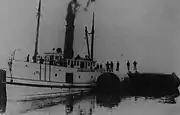
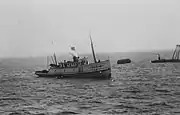
The first expedition that attempted to locate Cayuga on May 13 was cancelled due to a gale.[20] Several people embarked on a search for Cayuga after she sank.[20][24] Five days after Cayuga sank, Captain Cyrus H. Sinclair of the Chicago based C.A. McDonald & Company spent a day unsuccessfully searching for her.[24][40][41][42] He concluded that her wreck lay in between 102 feet (31.1 m) and 120 feet (36.6 m) of water, and doubted whether she could be raised.[24] By June, the underwriters had offered a $1,000 (equivalent to $27,469 in 2019[23]) reward to anyone who could find Cayuga's wreck.[43] On June 18, Captain Wilbur of the package freighter City of Grand Haven abandoned his search for Cayuga after ten days.[20]
On June 28, Captain Sinclair travelled to Cheboygan, Michigan to begin a new search.[41] Using the tug George W. Cuyler, he travelled to the bearings recorded by Captain Martin Swain of the wrecking tug Favorite on June 30.[41] Sinclair planned to locate by dragging George W. Cuyler's anchor.[41] A few minutes after Sinclair began searching for Cayuga, he managed to locate her, and planted a buoy at the wreck site.[41] The following day, George W. Cuyler and the tug Major Dana recovered a flagpole, a boom and portions of Cayuga's bulwarks and rigging.[41] For his efforts, Captain Sinclair was paid $2,000 (equivalent to $54,939 in 2019[23]) by the underwriters.[44]
By August 22, the underwriters had received bids from the Murphy Wrecking Company of Detroit, Michigan and James Reid & Sons of Bay City, Michigan to raise the wreck.[24][45][46] On September 12, Captain James Reid signed a contract with the underwriters to raise Cayuga's wreck for $100,000 (equivalent to $2.75 million in 2019[23]).[24] Reid planned to start work on Cayuga in 1896, once the ice on Lake Michigan had melted.[47]
Captain Reid planned to position eighteen 8 inches (20.3 cm) thick cables under Cayuga's hull, which would then be attached to a scow with a carrying capacity of 984 long tons (1,102 short tons; 1,000 t).[33][48][49] He also planned to attach eight steel pontoons (25 feet (7.6 m) (or 30 feet (9.1 m)) long and 13 feet (4.0 m) wide, with a lifting capacity of about 492 long tons (551 short tons; 500 t)) to Cayuga's wreck with thick cables, partially fill them with enough air to lift the wreck 8 feet (2.4 m) to 10 feet (3.0 m) off the lake bottom, and then tow it into shallow water in Little Traverse Bay where it would be patched up and pumped out.[18][24][33][48][50] Most of the oats in Cayuga's cargo hold were recovered.[33][48] In November, Captain Reid suspended the salvage operations, but claimed he would resume them in the spring of 1897.[51] By February 1897, Captain Reid claimed to have spent more than $40,000 (equivalent to $1.09 million in 2019[23]) on his salvage efforts.[33][52] On June 9, Captain Reid managed to break Cayuga free from the mud she was embedded in.[33][53] Captain Reid continued to work on Cayuga's wreck until 1900, when he abandoned the salvage attempts.[21][32][54][55]
The salvage of Cayuga's wreck attempted by Captain Reid was plagued by problems.[18][24] The pontoons attached to her hull frequently broke free.[18] Captain Reid and several of his divers sustained severe injuries, such as decompression sickness.[24][33] One diver died when a derrick barge reportedly sank on top of him.[18][56] The barge sank when one of the air-filled pontoons broke free and shot to the surface.[11][18] One tug used in the salvage operation burned.[57] The salvage attempts almost bankrupted Captain Reid's company.[11][18][19][32]
Cayuga today
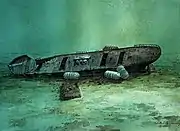
The wreck of Cayuga was re-discovered in the spring of 1969 by John Steele and Gene Turner of Illinois.[11] Her wreck rests with a 35° list to port in 102 feet (31 m) of water to the lake bottom, and 75 feet (23 m) to her deck, southwest of Grays Reef Light, near Ile Aux Galets.[11][58][59][60] Her cabins are no longer present.[58] The wreck is partially collapsed forward of the engine room, while the bow has broken away, and is lying on its port side. Her stern is intact.[12][61] The remains of Cayuga's cargo are still present in her hold.[62] There are also two spare propeller blades within the hull.[12][63] Four of the pontoons used during the salvage attempts are still attached to Cayuga's hull, and the sunken derrick barge lies off her port side.[11][12][18][58] The air hose of the lost diver was reportedly still poking out from under the derrick barge when the wreck was found.[56] Cayuga's wreck is protected by the 148-square-mile (380 km2) Straits of Mackinac Shipwreck Preserve as part of an underwater museum.[12]
Notes
References
- Bugbee (1) (1962), p. 24.
- Bugbee (1) (1962), p. 26.
- Bowlus (2010), p. 85.
- Thompson (1994), p. 32.
- Bugbee (2) (1962), p. 48.
- Bugbee (2) (1962), p. 49.
- Bugbee (2) (1962), p. 51.
- Bowling Green State University (2021).
- Alpena County George N. Fletcher Public Library (1) (2021).
- The Marine Record (1) (1889), p. 4.
- Kohl (2005), p. 284.
- Straits of Mackinac Shipwreck Preserve (2021).
- Colton (2021).
- Berry (2) (2021).
- Berry (3) (2021).
- Berry (4) (2021).
- Berry (5) (2021).
- McGreevy (2014).
- Berry (1) (2021).
- Maritime History of the Great Lakes (1) (1895).
- Swayze (2001).
- Alpena County George N. Fletcher Public Library (2) (2021).
- Thomas, Ryland & Williamson, Samuel H. (2020). "What Was the U.S. GDP Then?". MeasuringWorth. Retrieved September 22, 2020. United States Gross Domestic Product deflator figures follow the Measuring Worth series.
- Kohl (2005), p. 281.
- Maritime History of the Great Lakes (1890).
- The Marine Review (2) (1892), p. 5.
- The Marine Review (1) (1895), p. 10.
- The Marine Record (2) (1889), p. 1.
- Inland Lloyd's (1894), p. 10.
- Kohl (2005), p. 279.
- The Marine Review (1) (1892), p. 6.
- Harrington (1998), p. 254.
- Maritime History of the Great Lakes (2) (1895).
- Kohl (2005), p. 280.
- The Marine Record (1) (1895), p. 6.
- The Marine Record (3) (1895), p. 2.
- The Marine Record (2) (1895), p. 6.
- The Marine Review (2) (1895), p. 11.
- The Marine Record (3) (1895), p. 4.
- The Marine Review (2) (1895), p. 3.
- The Marine Review (4) (1895), p. 5.
- The Marine Review (1) (1896), p. 15.
- The Marine Record (4) (1895), p. 2.
- The Marine Review (4) (1895), p. 10.
- The Marine Review (5) (1895), p. 11.
- The Marine Review (6) (1895), p. 23.
- The Marine Review (1) (1896), p. 10.
- The Marine Review (3) (1896), p. 13.
- The Marine Review (4) (1896), p. 11.
- The Marine Review (5) (1896), p. 13.
- The Marine Review (6), p. 14.
- The Marine Review (1) (1897), p. 11.
- The Marine Review (2) (1897), p. 13.
- The Marine Review (3) (1897), p. 11.
- The Marine Review (1898), p. 14.
- Kohl (2005), pp. 281–284.
- The Marine Record (1899), p. 3.
- Harrington (1998), p. 255.
- Hanakova (2021).
- The Marine Review (3) (1895), p. 11.
- Beaver Island History (2021), p. 3.
- Beaver Island History (2021), p. 4.
- Beaver Island History (2021), p. 6.
Sources
- Alpena County George N. Fletcher Public Library (1) (2021). "Cayuga (1889, Package Freighter)". Alpena, Michigan: Alpena County George N. Fletcher Public Library. Retrieved May 20, 2021.
- Alpena County George N. Fletcher Public Library (2) (2021). "Cayuga (1889, Package Freighter)". Alpena, Michigan: Alpena County George N. Fletcher Public Library. Retrieved May 20, 2021.
- Amherstburg Echo (1895–1896). "Echo Soundings: Marine News of 1895–96". Amherstburg, Ontario: Marsh Collection Society. Retrieved August 6, 2021.
- Beaver Island History (2021). "Cayuga" (PDF). Beaver Island, Michigan: Beaver Island Historical Society.
- Berry (1), Sterling (2021). "Cayuga". Detroit, Michigan: Great Lakes Vessel Histories. Retrieved May 20, 2021.
- Berry (2), Sterling (2021). "E.P. Wilbur". Detroit, Michigan: Great Lakes Vessel Histories. Retrieved May 20, 2021.
- Berry (3), Sterling (2021). "Seneca". Detroit, Michigan: Great Lakes Vessel Histories. Retrieved May 20, 2021.
- Berry (4), Sterling (2021). "Saranac". Detroit, Michigan: Great Lakes Vessel Histories. Retrieved May 20, 2021.
- Berry (5), Sterling (2021). "Tuscarora". Detroit, Michigan: Great Lakes Vessel Histories. Retrieved May 20, 2021.
- Bowling Green State University (2021). "Cayuga". Bowling Green, Ohio: Bowling Green State University. Retrieved May 20, 2021.
- Bowlus, W. Bruce (2010). Iron Ore Transport on the Great Lakes: The Development of a Delivery System to Feed American Industry. Jefferson, North Carolina: McFarland & Company, Inc. ISBN 9780786486557. Retrieved March 3, 2021.
- Bugbee (1), Gordon P. (1962). "Iron Merchant Ships: An Upper Lakes Centennial - Part One" (PDF). Detroit, Michigan: Great Lakes Maritime Institute. Retrieved February 21, 2021.
- Bugbee (2), Gordon P. (1962). "Iron Merchant Ships: An Upper Lakes Centennial – Part Two" (PDF). Detroit, Michigan: Great Lakes Maritime Institute. Retrieved February 21, 2021.
- Colton, Tim (2021). "Globe Iron Works, Cleveland OH". Shipbuilding History. Retrieved April 3, 2021.
- Hanakova, Jitka (2021). "Freighter Cayuga". Milwaukee, Wisconsin: Shipwreck Explorers. Retrieved May 21, 2021.
- Harrington, Steve (1998). Divers Guide to Michigan. St. Ignace, Michigan: Maritime Press & Great Lakes Diving Council, Inc. ISBN 0-9624629-8-5. Retrieved July 17, 2021.
- Inland Lloyd's (1894). "The Inland Lloyds Vessel Register, 1894". Cleveland, Ohio: W. R. Smellie. Retrieved August 1, 2021.
- Kohl, Cris (2005). The 100 Best Great Lakes Shipwrecks – Volume II. West Chicago, Illinois: Seawolf Communications. ISBN 978-0-9679-9766-7. Retrieved January 31, 2021.
- Maritime History of the Great Lakes (1890). "Cayuga (Propeller), aground, 9 Apr 1890". Ontario, Canada: Maritime History of the Great Lakes. Retrieved August 1, 2021.
- Maritime History of the Great Lakes (1) (1895). "Cayuga (Propeller), U126556, sunk by collision, 10 May 1895". Ontario, Canada: Maritime History of the Great Lakes. Retrieved August 1, 2021.
- Maritime History of the Great Lakes (2) (1895). "Two Steamers Collide, 13 May 1895". Ontario, Canada: Maritime History of the Great Lakes. Retrieved August 1, 2021.
- McGreevy, Robert (2014). "The Cayuga". Michigan: Lakeshore Guardian. Retrieved May 20, 2021.
- Straits of Mackinac Shipwreck Preserve (2021). "Cayuga". Michigan: Straits of Mackinac Shipwreck Preserve. Retrieved May 20, 2021.
- Swayze, David (2001). "Great Lakes Shipwrecks – C". Port Huron, Michigan: Boatnerd. Archived from the original on April 16, 2002. Retrieved January 25, 2021.
- The Marine Record (1) (1889). "The Marine Record, April 4, 1889". Cleveland, Ohio: The Marine Record. Retrieved August 1, 2021.
- The Marine Record (2) (1889). "The Marine Record, May 16, 1889". Cleveland, Ohio: The Marine Record. Retrieved August 1, 2021.
- The Marine Record (1) (1895). "The Marine Record (Cleveland, OH1883), May 16, 1895". Cleveland, Ohio: The Marine Record. Retrieved August 6, 2021.
- The Marine Record (2) (1895). "The Marine Record (Cleveland, OH1883), May 23, 1895". Cleveland, Ohio: The Marine Record. Retrieved August 6, 2021.
- The Marine Record (3) (1895). "The Marine Record (Cleveland, OH1883), June 13, 1895". Cleveland, Ohio: The Marine Record. Retrieved August 6, 2021.
- The Marine Record (4) (1895). "The Marine Record (Cleveland, OH1883), June 27, 1895". Cleveland, Ohio: The Marine Record. Retrieved August 6, 2021.
- The Marine Record (1899). "The Marine Record (Cleveland, OH1883), June 15, 1899". Cleveland, Ohio: The Marine Record. Retrieved August 6, 2021.
- The Marine Review (1) (1892). "The Marine Review (Cleveland, OH), 7 Apr 1892". Cleveland, Ohio: The Marine Review. Retrieved August 6, 2021.
- The Marine Review (2) (1892). "The Marine Review (Cleveland, OH), 20 Oct 1892". Cleveland, Ohio: The Marine Review. Retrieved August 6, 2021.
- The Marine Review (1) (1895). "The Marine Review (Cleveland, OH), 23 May 1895". Cleveland, Ohio: The Marine Review. Retrieved August 6, 2021.
- The Marine Review (2) (1895). "The Marine Review (Cleveland, OH), 30 May 1895". Cleveland, Ohio: The Marine Review. Retrieved August 6, 2021.
- The Marine Review (3) (1895). "The Marine Review (Cleveland, OH), 4 Jul 1895". Cleveland, Ohio: The Marine Review. Retrieved August 6, 2021.
- The Marine Review (4) (1895). "The Marine Review (Cleveland, OH), 11 Jul 1895". Cleveland, Ohio: The Marine Review. Retrieved August 6, 2021.
- The Marine Review (5) (1895). "The Marine Review (Cleveland, OH), 22 Aug 1895". Cleveland, Ohio: The Marine Review. Retrieved August 6, 2021.
- The Marine Review (6) (1895). "The Marine Review (Cleveland, OH), 12 Sep 1895". Cleveland, Ohio: The Marine Review. Retrieved August 6, 2021.
- The Marine Review (1) (1896). "The Marine Review (Cleveland, OH), 27 Feb 1896". Cleveland, Ohio: The Marine Review. Retrieved August 6, 2021.
- The Marine Review (2) (1896). "The Marine Review (Cleveland, OH), 19 Mar 1896". Cleveland, Ohio: The Marine Review. Retrieved August 6, 2021.
- The Marine Review (3) (1896). "The Marine Review (Cleveland, OH), 9 Jul 1896". Cleveland, Ohio: The Marine Review. Retrieved August 6, 2021.
- The Marine Review (4) (1896). "The Marine Review (Cleveland, OH), 23 Jul 1896". Cleveland, Ohio: The Marine Review. Retrieved August 6, 2021.
- The Marine Review (5) (1896). "The Marine Review (Cleveland, OH), 30 Jul 1896". Cleveland, Ohio: The Marine Review. Retrieved August 6, 2021.
- The Marine Review (6) (1896). "The Marine Review (Cleveland, OH), 19 Nov 1896". Cleveland, Ohio: The Marine Review. Retrieved August 6, 2021.
- The Marine Review (1) (1897). "The Marine Review (Cleveland, OH), 18 Feb 1897". Cleveland, Ohio: The Marine Review. Retrieved August 6, 2021.
- The Marine Review (2) (1897). "The Marine Review (Cleveland, OH), 17 Jun 1897". Cleveland, Ohio: The Marine Review. Retrieved August 6, 2021.
- The Marine Review (3) (1897). "The Marine Review (Cleveland, OH), 1 Jul 1897". Cleveland, Ohio: The Marine Review. Retrieved August 6, 2021.
- The Marine Review (1898). "The Marine Review (Cleveland, OH), 13 Jan 1898". Cleveland, Ohio: The Marine Review. Retrieved August 6, 2021.
- Thompson, Mark L. (1994). Queen of the Lakes. Detroit, Michigan: Wayne State University Press. ISBN 0-8143-2393-6. Retrieved February 24, 2021.


