Pholidophorus
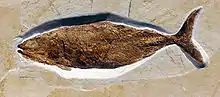
Pholidophorus is an extinct genus of stem-teleost fish from the Triassic period of Africa, Europe, and South America.
| Pholidophorus Temporal range: | |
|---|---|
 | |
Scientific classification  | |
| Kingdom: | Animalia |
| Phylum: | Chordata |
| Class: | Actinopterygii |
| Infraclass: | Teleostei |
| Order: | †Pholidophoriformes |
| Family: | †Pholidophoridae |
| Genus: | †Pholidophorus Agassiz, 1832 |
| Species | |
| |
Taxonomy
The genus Pholidophorus for a long time served as a wastebasket taxon containing various unrelated species of basal stem-teleosts. Over the years, several of these have been moved to separate genera. The Late Jurassic nominal species "Pholidophorus" purbeckensis was renamed Ichthyokentema by Arthur Woodward in 1941.[1] Likewise, the Early Jurassic form "Pholidophorus" bechei was renamed Dorsetichthys and moved to its own family, Dorsetichthyidae, by Arratia (2013).[2] The nominal species "Pholidophorus" friedeni Delsate, 1999 and "Pholidophorus" gervasuttii Zambelli, 1980 were renamed Luxembourgichthys and Lombardichthys by Taverne and Steurbaut (2017) and Arratia (2017) respectively.[3][4]
Description
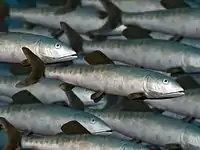
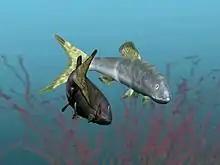
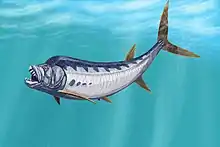
Pholidophorus was a herring-like fish about 40 centimetres (16 in) long, although it was not closely related to modern herring. Like them, however, it had a single dorsal fin, a symmetrical tail, and an anal fin placed towards the rear of the body. It had large eyes and was probably a fast-swimming predator, hunting planktonic crustaceans and smaller fish.[5]
A very early teleost, Pholidophorus had many primitive characteristics such as ganoid scales and a spine that was partially composed of cartilage, rather than bone.[5]
References
- Griffith, J.; Patterson, C. (1963). "The structure and relationships of the Jurassic fish Ichthyokentema purbeckensis". Bulletin of the British Museum (Natural History), Geology. 8 (1): 1–43. doi:10.5962/p.313875.
- Arratia, G. (2013). "Morphology, taxonomy, and phylogeny of Triassic pholidophorid fishes (Actinopterygii, Teleostei)". Journal of Vertebrate Paleontology. 33 (sup1): 1–138. doi:10.1080/02724634.2013.835642. S2CID 86605978.
- Taverne, L.; Steurbaut, E. (2017). "Osteology and relationships of Luxembourgichthys ("Pholidophorus") friedeni gen. nov. (Teleostei, "Pholidophoriformes") from the Lower Jurassic of Belgium and the Grand Duchy of Luxembourg". Geologica Belgica. 20 (1–2): 53–67. doi:10.20341/gb.2017.003.
- Arratia, G. (2017). "New Triassic teleosts (Actinopterygii, Teleosteomorpha) from northern Italy and their phylogenetic relationships among the most basal teleosts". Journal of Vertebrate Paleontology. 37 (2): e1312690. doi:10.1080/02724634.2017.1312690. S2CID 89773927.
- Palmer, D., ed. (1999). The Marshall Illustrated Encyclopedia of Dinosaurs and Prehistoric Animals. London: Marshall Editions. pp. 38–39. ISBN 1-84028-152-9.
 Paleontology portal
Teleosteomorpha / Pan-Teleostei (Teleostei sensu de Pinna, 1996) | |||||||||||||||||||||||||||||||||||||||||||||||
|---|---|---|---|---|---|---|---|---|---|---|---|---|---|---|---|---|---|---|---|---|---|---|---|---|---|---|---|---|---|---|---|---|---|---|---|---|---|---|---|---|---|---|---|---|---|---|---|
| |||||||||||||||||||||||||||||||||||||||||||||||
| |||||||||||||||||||||||||||||||||||||||||||||||
| |||||||||||||||||||||||||||||||||||||||||||||||
| |||||||||||||||||||||||||||||||||||||||||||||||
.jpg.webp)