Prohalecites
Prohalecites is an extinct genus of prehistoric ray-finned fish from the Ladinian and possibly Carnian (Triassic) of Italy, Switzerland and Austria.[1][2] It is the oldest known teleosteomorph, a group that includes extant teleosts and their close fossil relatives.[3]
| Prohalecites Temporal range: | |
|---|---|
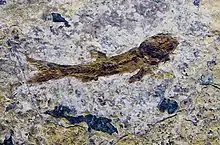 | |
| Prohalecites sp. fossil | |
| Scientific classification | |
| Kingdom: | |
| Phylum: | |
| Class: | |
| Order: | |
| Genus: | †Prohalecites Deecke, 1889 |
| Type species | |
| †Prohalecites porroi (Bellotti, 1857) | |
| Other species | |
| |
The type species Prohalecites porroi was first described as "Pholidophorus porro" by Cristoforo Bellotti, but it was later accommodated in its own genus by Wilhelm Deecke.
Species of Prohalecites are small, often measuring not more than 4 centimetres (1.6 in) in body length.[4]
References
- Sepkoski, Jack (2002). "A compendium of fossil marine animal genera". Bulletins of American Paleontology. 364: 560. Retrieved 2009-02-27.
- "Pachycormiformes". Paleobiology Database. Retrieved November 11, 2012.
- Arratia, G. (2015). "Complexities of early teleostei and the evolution of particular morphological structures through time". Copeia. 103 (4): 999–1025. doi:10.1643/CG-14-184.
- Romano, Carlo; Koot, Martha B.; Kogan, Ilja; Brayard, Arnaud; Minikh, Alla V.; Brinkmann, Winand; Bucher, Hugo; Kriwet, Jürgen (February 2016). "Permian-Triassic Osteichthyes (bony fishes): diversity dynamics and body size evolution". Biological Reviews. 91 (1): 106–147. doi:10.1111/brv.12161. PMID 25431138. S2CID 5332637.
Teleosteomorpha / Pan-Teleostei (Teleostei sensu de Pinna, 1996) | |||||||||||||||||||||||||||||||||||||||||||||||
|---|---|---|---|---|---|---|---|---|---|---|---|---|---|---|---|---|---|---|---|---|---|---|---|---|---|---|---|---|---|---|---|---|---|---|---|---|---|---|---|---|---|---|---|---|---|---|---|
| |||||||||||||||||||||||||||||||||||||||||||||||
| |||||||||||||||||||||||||||||||||||||||||||||||
| |||||||||||||||||||||||||||||||||||||||||||||||
| |||||||||||||||||||||||||||||||||||||||||||||||
.jpg.webp)
This article is issued from Wikipedia. The text is licensed under Creative Commons - Attribution - Sharealike. Additional terms may apply for the media files.