Provincial Assembly (Nepal)
The Provincial Assembly (Nepali: प्रदेश सभा; Pradesh Sabha) is the unicameral legislative assembly for a federal province of Nepal.[1]
| Provincial Assembly प्रदेश सभा Pradesh Sabha |
|---|
| Chambers |
| Parliament |
| Legislatures by country |
.svg.png.webp) |
|---|
|
Executive:
Judiciary: |
 Nepal portal Nepal portal |

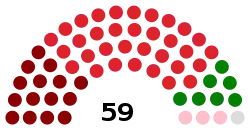
According to Article 176 of the Constitution of Nepal 2015, following the dissolution of the provincial assembly all the members forming the Provincial Assembly are elected. The term for the Provincial Assembly is five years, except when dissolved earlier.
Candidates for each constituency are chosen by the political parties or stand as independents. Each constituency elects one member under the first past the post system of election. Since Nepal uses a parallel voting system, voters cast another ballot to elect members through the party-list proportional representation. The current constitution specifies that sixty percent of the members should be elected from the first past the post system and forty percent through the party-list proportional representation system. Women should account for one third of total members elected from each party and if one-third percentage are not elected, the party that fails to ensure so shall have to elect one-third of total number as women through the party-list proportional representation.[2]
A party with an overall majority (more seats than all other parties combined) following an election forms the government. If a party has no outright majority, parties can seek to form coalitions.
The first provincial assembly elections in Nepal was held in two phase on 26 November 2017 and on 7 December 2017.[3]
There are 550 provincial seats in all of 7 provinces of Nepal. In which 330 (60%) of Provincial seats will be elected through first past the post and 220 (40%) of seats will be elected through proportional representation.[4]
List of provincial assemblies
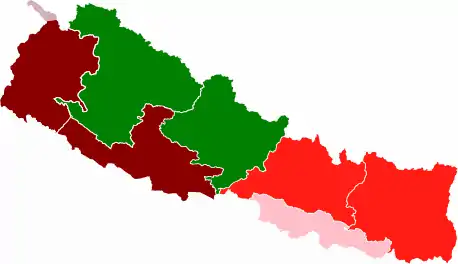
| Province | FPTP Seats | PR Seats | Total seats | Location | Governing party | |
|---|---|---|---|---|---|---|
| Province No. 1 | 56 | 37 | 93 | Biratnagar | Communist Party of Nepal (Unified Socialist) | |
| Province No. 2 | 64 | 43 | 107 | Janakpur | People's Socialist Party, Nepal | |
| Bagmati Province | 66 | 44 | 110 | Hetauda | Communist Party of Nepal (Unified Socialist) | |
| Gandaki Province | 36 | 24 | 60 | Pokhara | Nepali Congress | |
| Lumbini Province | 52 | 35 | 87 | Deukhuri | Communist Party of Nepal (Maoist Centre) | |
| Karnali Province | 24 | 16 | 40 | Birendranagar | Nepali Congress | |
| Sudurpashchim Province | 32 | 21 | 53 | Godawari | Communist Party of Nepal (Maoist Centre) | |
| Total | 330 | 220 | 550 | - | - | |
Seat distribution
Few seats across provincial assemblies are vacant following the split in NCP, CPN (UML) and PSP-N, and are yet to be filled via by-elections.
| Legislature | Seats | |||||||||||||
|---|---|---|---|---|---|---|---|---|---|---|---|---|---|---|
| CPN (UML) | NC | CPN (MC) | CPN (US) | PSP-N | LSP-N | RPP | BS | RJM | NMKP | NFSP | SLRM | Ind. | Total | |
| Provincial Assembly of Province No. 1[5] | 41 | 21 | 15 | 10 | 3 | 0 | 1 | 0 | 0 | 0 | 0 | 1 | 0 | 93 |
| Provincial Assembly of Province No. 2[6] | 8 | 19 | 8 | 13 | 39 | 16 | 0 | 0 | 0 | 0 | 1 | 0 | 0 | 107 |
| Provincial Assembly of Bagmati Province[7] | 43 | 22 | 23 | 13 | 1 | 0 | 2 | 3 | 0 | 2 | 0 | 0 | 0 | 110 |
| Provincial Assembly of Gandaki Province[8] | 27 | 15 | 12 | 0 | 2 | 0 | 0 | 0 | 2 | 0 | 0 | 0 | 1 | 60 |
| Provincial Assembly of Lumbini Province[9] | 37 | 19 | 19 | 1 | 4 | 0 | 0 | 0 | 1 | 0 | 0 | 0 | 1 | 87 |
| Provincial Assembly of Karnali Province[10] | 13 | 6 | 12 | 3 | 0 | 0 | 1 | 0 | 0 | 0 | 0 | 0 | 0 | 40 |
| Provincial Assembly of Sudurpashchim Province[11] | 11 | 12 | 13 | 14 | 1 | 1 | 0 | 0 | 0 | 0 | 0 | 0 | 0 | 53 |
| Total | 180 | 114 | 102 | 54 | 50 | 17 | 4 | 3 | 3 | 2 | 1 | 1 | 2 | 550 |
Province No. 1 Provincial Assembly
As per the Constituency Delimitation Commission report, Province No. 1 has 56 provincial seats under the FPTP (First-Past-the-Post) spread in 14 districts.[12]
Province No. 2 Provincial Assembly
Each district of Province No. 2 have 8 Provincial Assembly seats. Province No. 2 has total 64 provincial seats under the FPTP (First past the post) spread in 8 districts.[12]: 7
| Districts | Constituencies |
|---|---|
| Saptari District | 8 |
| Siraha District | 8 |
| Dhanusha District | 8 |
| Mahottari District | 8 |
| Sarlahi District | 8 |
| Rautahat District | 8 |
| Bara District | 8 |
| Parsa District | 8 |
Bagmati Province Provincial Assembly
Bagmati has 66 provincial assembly seats under FPTP.
Gandaki Province Provincial Assembly
Gandaki has 36 provincial assembly seats under FPTP.
Lumbini Province Provincial Assembly
Lumbini has 52 provincial assembly seats under FPTP.
Karnali Province Provincial Assembly
Karnali has 24 provincial assembly seats under FPTP.
Sudurpashchim Province Provincial Assembly
Sudurpashchim has 32 provincial assembly seats under FPTP.
| Districts | Constituencies |
|---|---|
| Bajura District | 2 |
| Bajhang District | 2 |
| Achham District | 4 |
| Doti District | 2 |
| Kailali District | 10 |
| Kanchanpur District | 6 |
| Dadeldhura District | 2 |
| Baitadi District | 2 |
| Darchula District | 2 |
First provincial assembly election
The first provincial legislative assembly elections in Nepal were held on 26 November and 7 December 2017.
References
- "CA approves ceremonial prez, bicameral legislature". Kanptipur Media Group. 16 September 2015. Retrieved 8 December 2017.
Provincial parliaments will be unicameral. "The CA also approved a mixed electoral system for parliamentary election with 60 percent directly elected and 40 percent proportionally elected."
- "NEPAL: Diluted proportional electoral system". scoop.co.nz. Scoop world. 16 October 2017. Retrieved 8 December 2017.
- "Election programme announced for HoR and Provincial Assembly". corporatenepal.com. 12 September 2017. Retrieved 8 December 2017.
- "Infra for provincial assemblies: Govt preparation far from satisfactory". Kantipur Media Group. 15 September 2017. Retrieved 8 December 2017.
There will be 550 members in all seven provinces after the elections, with Province 3 having the highest number of members (110). Province 7 will have the lowest number of members of 53.
- "प्रदेश सभा सदस्यहरु". प्रदेश सभा सचिवालय, प्रदेश नं.१, विराटनगर (in Nepali). Retrieved 2021-11-29.
- "संसदीय दलहरु". प्रदेश सभा सचिवालय, प्रदेश नं.२, जनकपुरधाम (in Nepali). Retrieved 2021-11-29.
- "प्रदेश सभाका सदस्य". प्रदेश सभा सचिवालय, बागमती प्रदेश, हेटौडा (in Nepali). Retrieved 2021-11-29.
- "प्रदेश सभा, गण्डकी प्रदेशमा प्रतिनिधित्व गर्ने राजनीतिक दलहरु". प्रदेश सभा सचिवालय, प्रदेश नं. ४, पोखरा (in Nepali). Retrieved 2021-11-29.
- "राजनीतिक दलहरु". प्रदेश सभा सचिवालय, लुम्बिनी प्रदेश, बुटवल (in Nepali). Retrieved 2021-11-29.
- "राजनीतिक दलहरु". प्रदेश सभा सचिवालय, कर्णाली प्रदेश, वीरेन्द्रनगर (in Nepali). Retrieved 2021-11-29.
- "माननीयहरुको विवरण". प्रदेश सभा सचिवालय, सुदूरपश्चिम प्रदेश, धनगढी (in Nepali). Retrieved 2021-11-29.
- "EDITORIAL: Important step". The Himalayan Times. 1 September 2017. Retrieved 5 September 2017.
External links
| Federal Parliament of Nepal |
| ||||
|---|---|---|---|---|---|
| Provincial Assemblies | |||||
| Former legislatures | |||||
| Constitution | | |
|---|---|---|
| Executive | ||
| Legislative | ||
| Judiciary |
| |