Qasr-e Shirin
Qasr-e Shirin (Persian: قصرشيرين; also Romanized as Qaşr-e Shīrīn and Qasr-ī-Shīrīn; also known as Ghasr-ī-shīrīn and Ghasr-shīrīn, Kurdish: قەسری شیرین)[2] is a city and capital of Qasr-e Shirin County, Kermanshah Province, Iran. At the 2006 census, its population was 15,437, in 3,893 families.[3] The city is populated by Kurds.[4]
Qasr-e Shirin
قصرشيرين | |
|---|---|
City | |
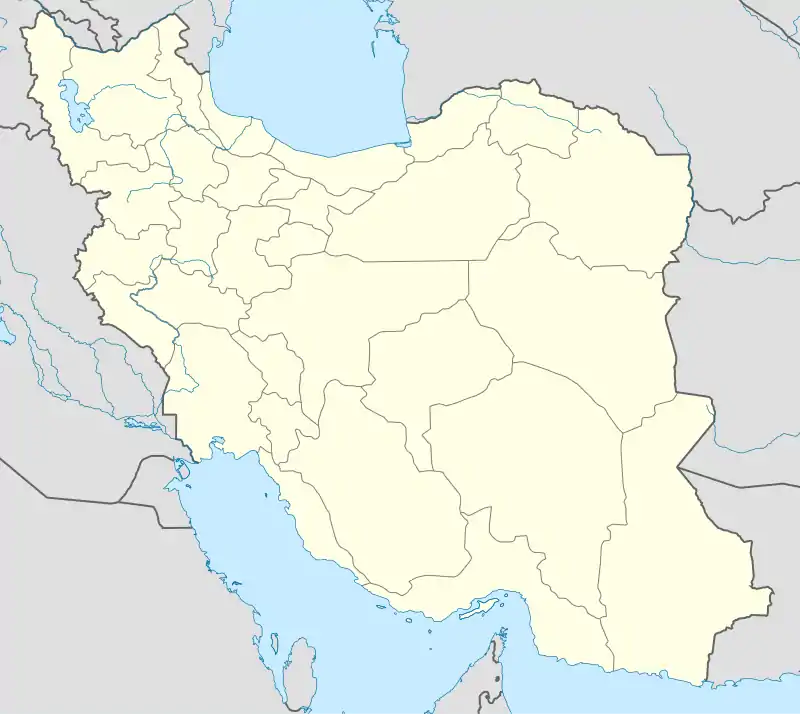  Qasr-e Shirin | |
| Coordinates: 34°30′56″N 45°34′45″E | |
| Country |  Iran Iran |
| Province | Kermanshah |
| County | Qasr-e Shirin |
| Bakhsh | Central |
| Established date | 7th century |
| Government | |
| • Mayor | Abbas Karami |
| Elevation | 333 m (1,093 ft) |
| Population (2016 Census) | |
| • Total | 18,473 [1] |
| • Demonym | Qasri |
| Time zone | UTC+3:30 (IRST) |
| • Summer (DST) | UTC+4:30 (IRDT) |
| Postal code | 67817 |
| Area code(s) | 0835 |
Name
The city is named after Shirin, the Christian wife of the Sasanian King of Kings (shahanshah) Khosrow II (r. 590–628).[5]
History
In June 2006, archaeological excavations in Shirin's castle resulted in the discovery of the dais of the castle which was used as the seat of the king.[6]
Climate
The city is well known for its agricultural productivity due to rich soil and plentiful water from the Hulwan (Alwand) River which runs through the city. The weather is mild in winter but hot and dry during the summer.
Recent excavations
The site of Qasr-e shirin was searched for the first time in 1891 and again in 1910. Excavations in 2006 led to the discovery of a wall of forty miles long, built by Khosrow II to protect the city. This wall extends beyond the border with Iraq. A canal dug at the time of the Sassanids, ends in Iraq. The water of the river Hulwan (Alwand) entered the channel by a trench and then led the water to Iraq. This canal covered with stucco stone is considered one of the masterpieces of civil engineering in irrigation.
Economy
Qasr-e Shirin has for long played an important economical role in the region. A large share of the country's exports is done via Qasr-e Shirin with its two main border points Khosravi and Parviz Khan border crossing.[8]
Qasr-e Shirin has many modern and chic restaurants, with four three-star hotels and many other two-star hotels, serving both pilgrims to Iraq's holy Shia shrines and tourists and businessmen visiting the city. In fact, it is the city of hotels and restaurants.[9]
Transportation
The city is near a railway route under construction called Rahahane Gharb (Iran west railway) planned to connect Iran to Iraqi railway system and ultimately to the Syrian Mediterranean port city of Latakia. Its construction is due to be completed by 1403 Iranian year through Kermanshah–Khosravi line.[10]
Health systems
Hazrate abolfazl abbas is the hospital that serves the town and people from Iraq.https://www.magiran.com/paper/495983/?lang=en
Notable people
See Kermanshahis
See also
References
- "Statistical Center of Iran > Home". www.amar.org.ir.
- Qasr-e Shirin can be found at GEOnet Names Server, at this link, by opening the Advanced Search box, entering "-3079964" in the "Unique Feature Id" form, and clicking on "Search Database".
- "Census of the Islamic Republic of Iran, 1385 (2006)" (Excel). Statistical Center of Iran. Archived from the original on 2011-11-11.
- "Language distribution: Kermanshah Province". Iran Atlas. Retrieved 27 March 2021.
- Wiesehöfer 2006.
- https://web.archive.org/web/20070907185702/http://www.chnpress.com/news/?section=2&id=6433
- "Language distribution: Ilam Province". Iran Atlas. Retrieved 25 September 2021.
- http://www.iran-daily.com/1389/4/24/MainPaper/3727/Page/4/Index.htm
- "Archived copy". Archived from the original on 2012-10-02. Retrieved 2012-05-20.CS1 maint: archived copy as title (link)
- https://web.archive.org/web/20130618044157/http://www.mrud.ir/portal/Home/ShowPage.aspx?Object=News&CategoryID=d9d14b9e-d8b4-4ce9-93e7-a4454dbb201e&WebPartID=3fa37f90-2292-49e1-aed6-20ff38217d11&ID=e08985e7-6b25-4368-ac67-b79f4f338591
Sources
- Wiesehöfer, Josef (2006). "Qaṣr-e Šīrīn". In Salazar, Christine F.; Landfester, Manfred; Gentry, Francis G. (eds.). Brill's New Pauly. Brill Online.
External links
| Capital | 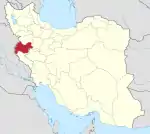 | |
|---|---|---|
| Counties and cities | ||
| Sights |
| |
| populated places | ||
| Capital | |||||||||||||||||||||
|---|---|---|---|---|---|---|---|---|---|---|---|---|---|---|---|---|---|---|---|---|---|
| Districts |
| ||||||||||||||||||||
Authority control  | |
|---|---|
| General | |
| National libraries | |