Röddinge Formation
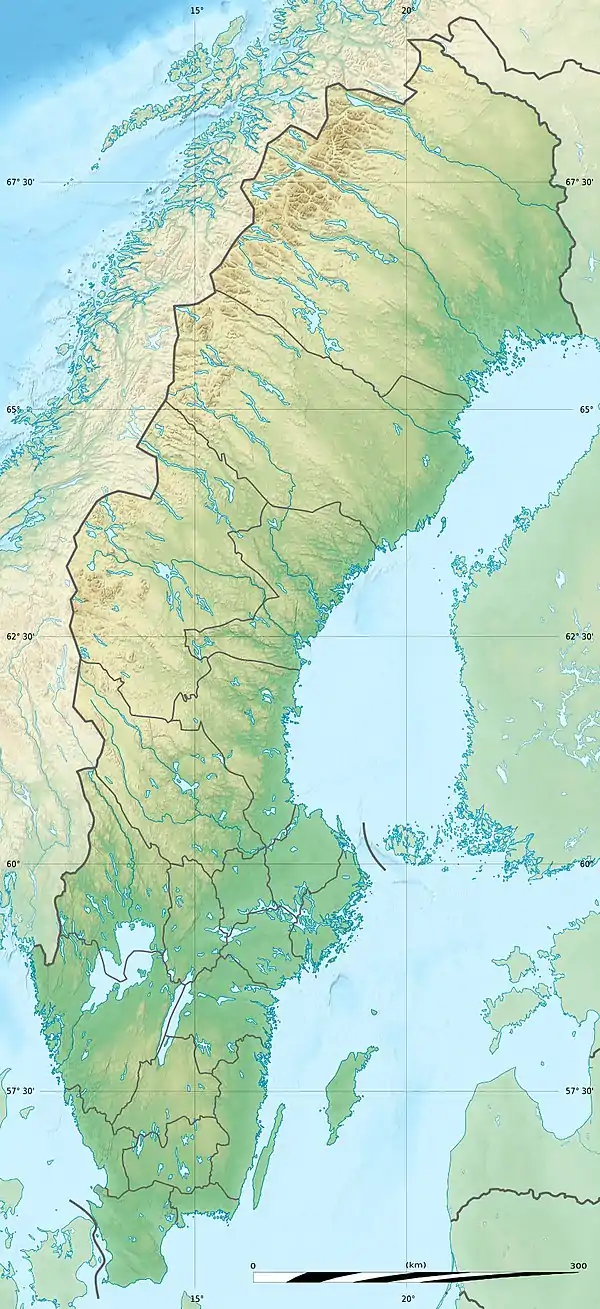
The Röddinge Formation is a geologic formation in Skåne County, southern Sweden. It is Early Jurassic (Sinemurian-Toarcian) in age.[1] It is a unit with a limited degree of exposure, being identified mostly by its deposits on the Fyledalen Fault Zone, specially on Kurremölla, where is present the main fossil deposit.[2] It is a unit known mostly for large museum collections and estimated to have a thickness of several hundreds of meters.[3] It is also known for its large iron deposits.[2] It is correlated with the mostly marine Rya Formation of western Skåne County, the Volcanic deposits of the Djupadal Formation and specially the Sorthat Formation of Bornholm.[4][5]
| Röddinge Formation Stratigraphic range: Late Sinemurian-Late Toarcian ~ | |
|---|---|
| Type | Formation |
| Unit of | Vomb Trough |
| Underlies |
|
| Overlies | Unknow Hettangian deposits |
| Thickness | Up to 300 m (980 ft) |
| Lithology | |
| Primary | Limonite and Chamosite-cemented Quartz arenites containing abundant chamosite ooids. |
| Other | Berthierine, Siderite and Iron ooids. |
| Location | |
| Region | East Skåne County |
| Country |  Sweden Sweden |
| Type section | |
| Named for | Röddinge |
  Röddinge Formation (Sweden) | |
Lithology
A profile up to 300 m thick was described on 1968 from the Eriksdal-Kurremölla area, dated Pliensbachian-Toarcian.[6] The Pliensbachian levels where dominated by sands and sandstones of marine origin, hosting a highly fossiliferous bed containing a rich mollusc fauna.[6] A Sinemurian layer assigned to the formation was also found on other works.[3] The Röddinge formation has a great abundance of Limonite and Chamosite quartz arenites, fine-to medium-grained, with subordinate thin conglomerates.[1] Sediments related to the unit are found consolidated by Berthierine or Siderite cement, with berthierine oolites being common on the layers.[1] These ooids are rather small on most of the successions, around 0.3 mm in diameter and ellipsoidal in shape, having cores composed by detrital quartz or heavy minerals.[1] The deposits of the formation evidence strong degradation by modern weathering and have a red, brown or yellow stain (iron hydroxides).[1] The deposits not affected by erosion are known from boreholes and host greyish dark green facies due to the content of berthierine and siderite.[1] The iron contents differ based on the weathering grade of the layers: on weathered sandstones is about a 8–10%, then is in up to 20% in the oolites, and finally at the major fossiliferous deposit on Kurremölla a 1.7 m thick oolite bed has an iron content of up to 35%.[1] Owing to this high content in iron, the Kurremölla locality was mined from 1930 to 1937, although there was not enough iron supply and enrichments were too dispersed in the source rock, which led to it not being economically viable to maintain the mining process for very long.[7][8] The presence of mostly poor exposures has made mostly impossible to do detailed facies analysis, although is suggested that the sediments come from prolonged reworking.[1]
Fossils
The Röddinge formation is considered mostly a coeval developing unit with the Jurassic formations of Bornholm, as both where connected as part of the Fennoscandian mainland.[5] The unit is considered to be part of the fluvial to deltaic system found also or Bornholm.[5] However, as happened on the Hasle Formation, the Röddinge formation hosted a major marine ingression at least on the Lower-Middle Pliensbachian (jamesoni subzone).[9] The main fossiliferous content of the formation comes from marine influence, clearly indicated by finds of ammonites and crinoids.[7] After this event, in the Toarcian the formation developed along the Sorthat Formation, forming both part of the large deltaic system that ended on northern Germany.[10] There is also suggestions that towards the west a lake system was developed, covering the marine basin after the local Late Pliensbachian-Lower Toarcian regression.[2] This lake system is evidenced on several boreholes, and was probably developed on the western lateral of the major fluvial system recorded locally and on Bornholm.[2] Like the Sorthat Formation, this upper unit also hosts possible coal beds.[2] Both, the lake and the fluvial system layers host iron ooids that indicate diagenetic precipitation, prior to and during sediment compaction.[1] This is also found on the Rydebäck and Katslösa Members of the Rya Formation, and has been suggested that the volcanic activity developed on the coeval Djupadal Formation may have stimulated the process.[1]
Annelida
| Genus | Species | Location | Level | Environment | Material | Notes | References | Images |
|---|---|---|---|---|---|---|---|---|
|
|
Jamesoni Zone, Lower Pliensbachian |
High energy marginal marine derived from sea ingression |
Trace fossils; polychaete encrusters in rock |
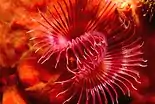
A sessile, marine annelid tube worm of the family Serpulidae. The holotype of this species was found on this layers, is also recovered on coeval strata of the Rya Formation. |
 Head of a modern Serpula vermicularis | ||
Echinodermata
| Genus | Species | Location | Level | Environment | Material | Notes | References | Images |
|---|---|---|---|---|---|---|---|---|
|
|
Jamesoni Zone, Lower Pliensbachian |
High energy marginal marine derived from sea ingression |
Columnals |
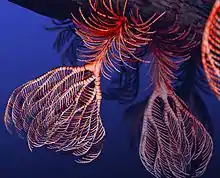
A Crinoid, type member of the family Pentacrinitidae inside Isocrinida. A great amount of specimens are know from the layers, showing mostly of them signs of being washed by marine currents. |
 Reconstructed specimens | ||
Bivalves
| Genus | Species | Location | Level | Environment | Material | Notes | References | Images |
|---|---|---|---|---|---|---|---|---|
|
Palaeoneilo |
|
|
Jamesoni Zone, Lower Pliensbachian |
High energy marginal marine derived from sea ingression |
Shells |
A marine clam, incertade sedis inside Nuculanida. This species is know from Kurremölla and Kullemölla as well as on the Hasle Formation of the island of Bornholm, correlating both coeval deposits. |
||
|
|
Jamesoni Zone, Lower Pliensbachian |
High energy marginal marine derived from sea ingression |
Shells |
A marine clam, incertade sedis inside Nuculanida. A lower jurassic genus pretty abundant on Kurremölla, more than on any other deposit on Skane. |
|||
|
|
Cardium Bank, Middle Pliensbachian |
Low energy and scarce depth nearshore settings |
Shells |
A marine clam, type member of the family Trigoniidae inside Trigoniida. Was first identified from Kurremölla but named from coeval specimens found on the Rya Formation. |
|||
|
|
Cardium Bank, Middle Pliensbachian |
Low energy and scarce depth nearshore settings |
Shells |
A marine clam, type member of the family Astartidae inside Carditida. The holotype of A. angelini and A. deltoidea was identified on Kurremölla. |
|||
|
Tancredia |
|
|
Jamesoni Zone, Lower Pliensbachian |
High energy marginal marine derived from sea ingression |
Shells |
A marine clam, type member of the family Tancrediidae inside Carditida. |
||
|
Sphaeriola |
|
|
Jamesoni Zone, Lower Pliensbachian |
High energy marginal marine derived from sea ingression |
Shells |
A marine clam, member of the family Lucinidae inside Lucinida. As the species name suggest, was found first on Kurremölla |
||
|
Homomya |
|
|
Jamesoni Zone, Lower Pliensbachian |
High energy marginal marine derived from sea ingression |
Shells |
A marine clam, member of the family Pholadomyidae inside Pholadomyida. |
||
|
Grammatodon |
|
|
Cardium Bank, Middle Pliensbachian |
Low energy and scarce depth nearshore settings |
Shells |
A marine clam, member of the family Parallelodontidae inside Arcida. |
||
|
|
Cardium Bank, Middle Pliensbachian |
Low energy and scarce depth nearshore settings |
Shells |
A marine clam, member of the family Carditidae inside Carditida. Mistake as Cardium sp., is the most abundant genus on the layer of the same name. |
|||
|
Terquemia |
|
|
Cardium Bank, Middle Pliensbachian |
Low energy and scarce depth nearshore settings |
Shells |
A marine scallop, member of the family Prospondylidea inside Pterioida. |
||
|
|
Jamesoni Zone, Lower Pliensbachian |
High energy marginal marine derived from sea ingression |
Shells |
A marine scallop, type member of the family Oxytomidae inside Pectinida. |
|||
|
Entolium |
|
|
Cardium Bank, Middle Pliensbachian |
Low energy and scarce depth nearshore settings |
Shells |
A marine scallop, type member of the family Entoliidae inside Pectinida. |
||
|
Pseudomonotis |
|
|
Cardium Bank, Middle Pliensbachian |
Low energy and scarce depth nearshore settings |
Shells |
A marine scallop, type member of the family Pseudomonotidae inside Pectinida. |
||
|
Avicula |
|
|
Cardium Bank, Middle Pliensbachian |
Low energy and scarce depth nearshore settings |
Shells |
A marine pearl oyster, member of the family Pteriidae inside Ostreida. |
||
Gastropoda
| Genus | Species | Location | Level | Environment | Material | Notes | References | Images |
|---|---|---|---|---|---|---|---|---|
|
|
Jamesoni Zone, Lower Pliensbachian |
High energy marginal marine derived from sea ingression |
Shells |
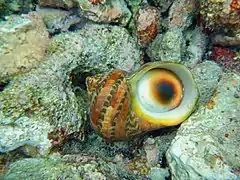
A marine Snail, type member of the family Turbinidae inside Turbinoidea. |
| ||
Cephalopoda
| Genus | Species | Location | Level | Environment | Material | Notes | References | Images |
|---|---|---|---|---|---|---|---|---|
|
|
Jamesoni Zone, Lower Pliensbachian |
High energy marginal marine derived from sea ingression |
Shells |
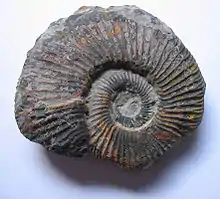
An ammonite, member of the family Polymorphitidae inside Ammonitida. The main indicator of a coeval sea ingression. |
| ||
|
Polymorphites |
|
|
Jamesoni Zone, Lower Pliensbachian |
High energy marginal marine derived from sea ingression |
Shells |
An ammonite, type member of the family Polymorphitidae inside Ammonitida. |
||
|
|
Jamesoni Zone, Lower Pliensbachian |
High energy marginal marine derived from sea ingression |
Shells |
An belemnite, member of the family Passaloteuthididae inside Belemnitida. |
|||
Chondrichthyes
| Genus | Species | Location | Level | Environment | Material | Notes | References | Images |
|---|---|---|---|---|---|---|---|---|
|
|
Jamesoni Zone, Lower Pliensbachian |
High energy marginal marine derived from sea ingression |
Teeth |
An marine/brackish shark, type member of the family Acrodontidae inside Hybodontiformes. Indicator of marine conditions locally |
| ||
Palynology
| Genus | Species | Location | Level | Environment | Material | Notes | References | Images |
|---|---|---|---|---|---|---|---|---|
|
|
Late Pliensbachian-Lower Toarcian |
Low energy lacustrine Shore |
Miospores |
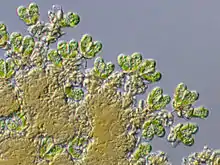
Type Genus of the Botryococcaceae inside Trebouxiales. A colonial green microalga related with freshwater and brackish ponds and lakes around the world, where it often can be found in large floating masses. |
 Extant specimens | ||
|
Campenia |
|
Lower Toarcian |
Temporal Brackish Ingression on Lacustrine Body |
Miospores |
Affinities with the Prasinophyceae inside Chlorophyta. A Green algae associated with marine settings. |
|||
|
Densoisporites |
|
Late Pliensbachian-Lower Toarcian |
Low energy lacustrine Shore |
Miospores |
Affinities with Pleuromeiaceae, Selaginellaceae and Lycopodiaceae inside Lycopodiopsida. |
|||
|
Calamospora |
|
Late Pliensbachian-Lower Toarcian |
Low energy lacustrine Shore |
Miospores |
Affinities with the Calamitaceae inside Equisetales. Horsetails, herbaceous flora related to high humid environments, flooding tolerant plants. |
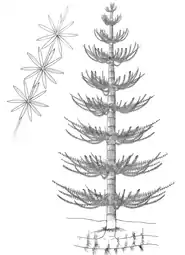 Recosntruction of the Genus Calamites, found associated with Calamospora | ||
|
Ischyosporites |
|
Late Pliensbachian-Middle Toarcian |
|
Miospores |
Incertade Sedis affinities with the Pteridophyta. Uncertain Pteridophyte origin |
|||
|
Klukisporites |
|
Late Pliensbachian-Middle Toarcian |
|
Miospores |
Affinities with the family Lygodiaceae inside Polypodiopsida. Climbing fern spores |
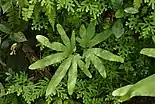 Example of extant Lygodium, Klukisporites come probably from similar genera or maybe a species from the genus | ||
|
Contignisporites |
|
Late Pliensbachian-Middle Toarcian |
|
Miospores |
Affinities with the Pteridaceae inside Polypodiopsida. Forest Ferns from humid ground locations |
.jpg.webp) Example of extant Pityrogramma specimens, Contignisporites come probably from similar genera or maybe a species from the genus | ||
|
Baculatisporites |
|
Late Pliensbachian-Middle Toarcian |
|
Miospores |
Affinities with the family Osmundaceae inside Polypodiopsida. Near Fluvial currents ferns, reted to the modern Osmunda Regalis. |
_-_Cape_St._Mary's_Ecological_Reserve%252C_Newfoundland_2019-08-10.jpg.webp) Example of extant Osmunda specimens, Baculatisporites come probably from similar genera or maybe a species from the genus | ||
|
Todisporites |
|
Late Pliensbachian-Middle Toarcian |
|
Miospores |
Affinities with the family Osmundaceae inside Polypodiopsida. Near Fluvial currents ferns, reted to the modern Osmunda Regalis. |
|||
|
Matonisporites |
|
Late Pliensbachian-Late Toarcian |
|
Miospores |
Affinities with the Matoniaceae inside Polypodiopsida. Fern spores from lower herbaceous flora |
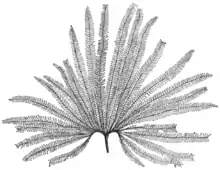 Example of extant Matonia specimens, Matonisporites come probably from similar genera | ||
|
Cyathidites |
|
Late Pliensbachian-Late Toarcian |
|
Miospores |
Affinities with the family Cyatheaceae inside Cyatheales. Arboreal Fern Spores |
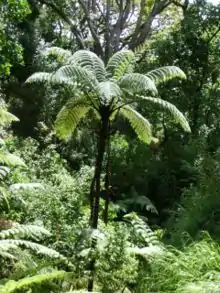 Example of extant Cyathea, Cyathidites come probably from similar genera | ||
|
Alisporites |
|
Late Pliensbachian-Lower Toarcian |
Low energy lacustrine Shore |
Pollen |
Affinities with the families Peltaspermaceae, Corystospermaceae or Umkomasiaceae inside Peltaspermales. Pollen of Uncertain provenance, that can be derived from any of the members of the Peltaspermales. |
|||
|
Vitreisporites |
|
Lower Toarcian |
Low energy lacustrine Shore |
Pollen |
Pollen from the Family Caytoniaceae inside Caytoniales. Caytoniaceae are a complex group of Mesozoic Fossil floras, that can be related to both Peltaspermales and Ginkgoaceae. |
|||
|
Chasmatosporites |
|
Late Pliensbachian-Lower Toarcian |
Low energy lacustrine Shore |
Pollen |
Affinities with the family Cycadaceae inside Cycadales. Is among the most abundant flora recovered on the upper section of the coeval Rya Formation, and was found to be similar to the pollen of the extant Encephalartos laevifolius.[14] |
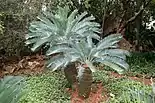 Extant Encephalartos laevifolius. Chasmatosporites maybe come from a related plant | ||
|
Clavatipollenites |
|
Lower Toarcian |
Low energy lacustrine Shore |
Pollen |
Affinities with Gnetopsida and probably Gnetophyta. Has Been considered Pollen of Chloranthaceae. However, it is to old for belonging to advanced Angiosperms. It probably comes from cones related to the Genera Piroconites kuesperti from the Lowermost Jurassic of Germany, resembling pollen of extant Ephedra and Welwitschia. |
 Closer Look of Ephedra cones, a common Gnetal. Clavatipollenites maybe come from a related plant | ||
|
Ginkgocycadophytus |
|
Late Pliensbachian-Lower Toarcian |
Low energy lacustrine Shore |
Pollen |
Affinities with Ginkgoales inside Ginkgophyta. |
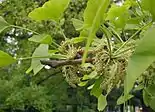 Extant Ginkgo, only surviving example of the Ginkgoaceae. Ginkgocycadophytus Pollen is pretty similar to the extant ones of this genus | ||
|
Cerebropollenites |
|
Lower-Middle Toarcian |
|
Pollen |
Affinities with the family Pinaceae inside Pinopsida. Conifer pollen from medium to large arboreal plants |
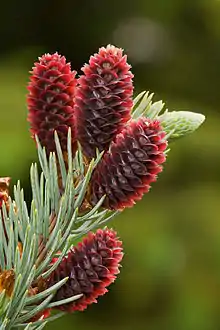 Extant Picea. Cerebropollenites maybe come from a related plant | ||
|
Parvisaccites |
|
Lower-Middle Toarcian |
|
Pollen |
Affinities with the Podocarpaceae inside Pinopsida. Conifer pollen from medium to large arboreal plants |
.jpg.webp) Extant Podocarpus. Parvisaccites maybe come from a related plant | ||
|
Podocarpidites |
|
Late Pliensbachian-Late Toarcian |
|
Pollen |
Affinities with the Podocarpaceae inside Pinopsida. Conifer pollen from medium to large arboreal plants |
|||
|
Perinopollenites |
|
Lower-Middle Toarcian |
|
Pollen |
Affinities with the family Cupressaceae inside Pinopsida. Pollen that resembles extant genera such as the Genus Actinostrobus and Austrocedrus, probably derived from Dry environments. Is the most abundant Pollen found locally, as on the coeval Djupadal Formation |
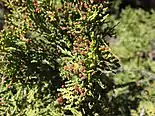 | ||
|
Classopollis |
|
Late Pliensbachian-Late Toarcian |
|
Pollen |
Affinities with the Hirmeriellaceae inside Pinopsida. Indicative of dry environments, increases after the start of the Toarcian locally. |
|||
|
Araucariacites |
|
Late Pliensbachian-Lower Toarcian |
Low energy lacustrine Shore |
Pollen |
Affinities with the family Araucariaceae inside Pinales. Conifer Pollen from medium to large Arboreal Plants |
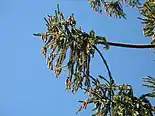 Extant Araucaria. Araucariacites maybe come from a related plant | ||
See also
- List of fossiliferous stratigraphic units in Sweden
- Kristianstad Basin
- Toarcian formations
- Rya Formation, Sweden
- Marne di Monte Serrone, Italy
- Calcare di Sogno, Italy
- Sachrang Formation, Austria
- Saubach Formation, Austria
- Posidonia Shale, Lagerstätte in Germany
- Ciechocinek Formation, Germany and Poland
- Krempachy Marl Formation, Poland and Slovakia
- Lava Formation, Lithuania
References
- Ahlberg, A., Sivhed, U., & Erlström, M. (2003). The Jurassic of Skåne, southern Sweden. Geological Survey of Denmark and Greenland (GEUS) Bulletin, 1, 527-541.
- Norling, E., Ahlberg, A., Erlström, M. & Sivhed, U. 1993: Guide to the Upper Triassic and Jurassic geology of Sweden. Sveriges Geologiska Undersökning Serie Ca 82, 71 pp.
- Reyment, R. 1959: On Liassic ammonites from Skåne, southern Sweden. Stockholm Contributions in Geology 2(6), 103–157.
- Vajda, V., & Wigforss-Lange, J. (2009). Onshore Jurassic of Scandinavia and related areas. GFF, 131(1-2), 5-23.
- Michelsen, O., Nielsen, L. H., Johannessen, P. N., Andsbjerg, J., & Surlyk, F. (2003). Jurassic lithostratigraphy and stratigraphic development onshore and offshore Denmark. Geological Survey of Denmark and Greenland (GEUS) Bulletin, 1, 145-216.
- Tralau (1968): Botanical investigations in the Fossil Flora of Eriksdal in Fyledalen, Scania. - Sver. geol. unders.C633, 185 pp. S tockholm.
- Hadding, A. 1933: Den järnmalmsförande lagerserien i sydöstra Skåne. Sveriges Geologiska Undersökning Serie C 376, 39 pp.
- Erlström, M. (2020). Chapter 24 Carboniferous–Neogene tectonic evolution of the Fennoscandian transition zone, southern Sweden. Geological Society, London, Memoirs, 50(1), 603–620. doi:10.1144/m50-2016-25
- Barth, G., Pieńkowski, G., Zimmermann, J., Franz, M., & Kuhlmann, G. (2018). Palaeogeographical evolution of the Lower Jurassic: high-resolution biostratigraphy and sequence stratigraphy in the Central European Basin. Geological Society, London, Special Publications, 469(1), 341-369.
- Sachs, S., Hornung, J. J., Lierl, H. J., & Kear, B. P. (2016). Plesiosaurian fossils from Baltic glacial erratics: evidence of Early Jurassic marine amniotes from the southwestern margin of Fennoscandia. Geological Society, London, Special Publications, 434(1), 149-163.
- Moberg, J.C. 1888: Om Lias i sydöstra Skåne. Sveriges Geologiska Undersökning Serie C 99, 86 pp.
- Troedsson, G., 1951: On the Hoganas Series of Sweden (Rhaeto-Lias). Lunds Univ. Arsskr.. N.F., 2 47(1)
- Guy-Ohlson, D. (1982) Biostratigraphy of the Lower Jurassic-Cretaceous unconformity at Kullemolla Southern Sweden. Sveriges Geologiska Undersжkning, Serie C Vol. 52 P. 1- 46
- Guy-Ohlson, D.. 1988. The use of dispersed palynomorphs referable to the form genus Chasmatosporites (Nilsson) Pocock and Jansonius, in Jurassic biostratigraphy. Congreso Argentino de Paleontologia y Bioestratigrafia 3. 5- 13.
| Ph |
| ||||||||||||||||||||||
|---|---|---|---|---|---|---|---|---|---|---|---|---|---|---|---|---|---|---|---|---|---|---|---|
 Mesozoic • Cretaceous • Jurassic • Triassic Mesozoic • Cretaceous • Jurassic • Triassic | |||||||||||||||||||||||