Djupadal Formation
The Djupadal Formation is a geologic formation in Skåne County, southern Sweden. It is Early Jurassic (probably Pliensbachian-Toarcian, or Late Toarcian) in age. It is part of the Central Skåne Volcanic Province, know by the discovery of basalt tuff layers, including Sandåkra, Korsaröd and Djupadal. An original analysis of the location of Korsaröd led to a Toarcian-Aalenian age,[3][4][5] but was dismissed in 2016, when a series of Palynogical samples recovered a Late Pliensbachian and probably Lower Toarcian age for the Korsaröd Outcrop.[6] The same year this result was also challenged by an in-depth study of the Lilla Hagstad neck that yield a Late Toarcian Age.[7] The formation was deposited in the Central Skane region, linked to the late early Jurassic volcanism. The Korsaröd member includes a volcanic-derived Lagerstatten with exceptional fern finds.[8] The data provided by fossilized wood rings showed that the location of Korsaröd hosted a middle-latitude Mediterranean-type biome in the late Early Jurassic, with low rainfall ratio, delayed to seasonal events. Superimposed on this climate were the effects of a local active Strombolian Volcanism and hydrothermal activity.[9]
| Djupadal Formation Stratigraphic range: Latest Pliensbachian-Toarcian(?) ~Nearby Volcanic neck suggest 176.7 ± 0.5 Ma, Middle-Late Toarcian Age | |
|---|---|
| Type | Formation |
| Unit of | Central Skåne Volcanic Province |
| Sub-units | Korsaröd Lagerstatten |
| Underlies | Cuaternary Sediments |
| Overlies | Höör Sandstone Formation, Brandsberga and Kolleberga erratics and probably the Sapropel at Sandåkra |
| Thickness | Up to 60 m (200 ft)[1] |
| Lithology | |
| Primary | Basalt Tuff, Veined Gneiss[1] |
| Other | Sandstone, Clay and Conglomerate |
| Location | |
| Coordinates | 55.98°N 13.63°E |
| Approximate paleocoordinates | Aprox. 35°N |
| Region | Central Skåne County |
| Country |  Sweden Sweden |
| Extent | 1,000 km2 (390 sq mi) |
| Type section | |
| Named for | Djupadalsmölla, Ljungbyhed |
| Named by | Carita Augustsson[2] |
| Year defined | 2001 |
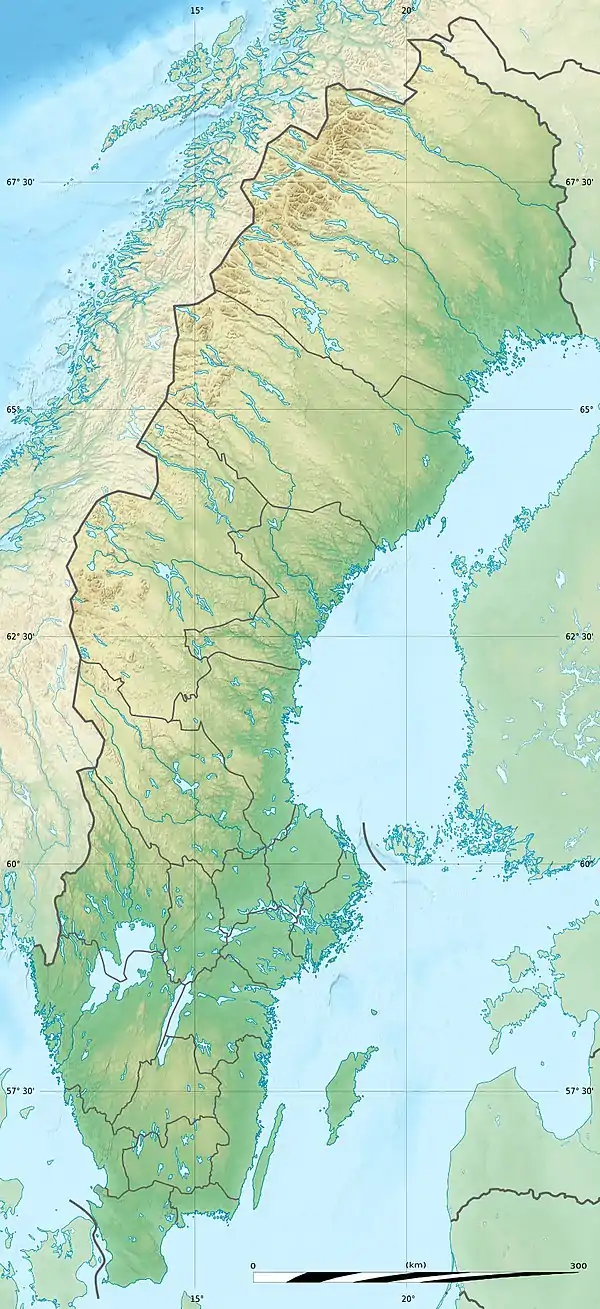  Djupadal Formation (Sweden) Korsaröd Lagerstätten Location | |
Description
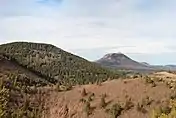
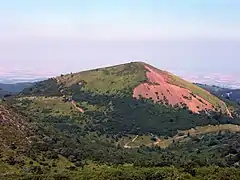
Djupadalsmölla, the original location has been known due to its volcanic Tuff and other volcanoclastic-derived facies.[12] It was originally described in 1826 as the local basalts where identified as coming from ancient volcanic eruptions.[13] The exposure of Anneklev, located near Höör was where the first volcanic neck was discovered, with other volcanic remnants mentioned on Jällabjär and Rallate along with the tuff at Djupadalsmölla.[14] These deposits were described as volcanic rocks composed mostly by tuff, that includes basaltic bombs (composed by Pyroxene and pseudomorphs from this, along with Olivine on adjacent pyroclastics), accidental lithics and occasional wood from conifers, in the form of small pieces to large logs.[15] At Djupadal the Rönne River has cut a 20 m deep valley mainly in the Precambrian basement, where Lower Jurassic strata (including volcanic tuff) form part of the southern valley side, and also occur in the valley northwestwards, indicating that the valley is partly an exhumed sub-Jurassic depression.[4] The modern strata of the Valley is over a Late Weichselian melt-water channel and it also contains eroded fluvioglacial deposits.[16] A nearby roadcut shows kaolinized basement beneath the Toarcian sediments and a nearby boring has penetrated 44 m of kaolinized Gneiss.[4] The Valley Bottom exposes small ridges and cupolas (in gneiss) and tors (mainly in Amphibolite).[4] The Djupadalsmölla pyroclastic reaches almost 10 m high and 20 m wide, with pyroclastics appearing also through the west more than 100 m, along the valley of the Rönne River.[17] It is composed by a 3 m thick sequence of jurassic rocks, starting overlying the kaolinized basement of Paleozoic Gneiss with 2 m of sandstone-claystone series ending with a single metre of green-brownish turfaceous rocks.[18] The strata is composed by mostly small Lapilli (around 30–50% of the content) and ash (-10 mm), with some samples being red in patches. Tuff concretions are recovered locally composed mostly of coarse ash, with rich amounts of Calcite and Wood pieces.[19] This composition indicates moderate explosivity on the genesis of the materials, relating the eruption products with short transport paths, as show little mechanical weathering, also corroborated by the thick layering and the low amount of basaltic bombs reported, while the correlation of wood and lapilli indicates a terrestrial deposition.[20] All together shows local Strombolian Volcanism, linked probably to a coeval rift, as recovered by the presence of more than 100 coeval volcanic necks in central Scania.[21] Dominating the Djupadal formation is moderately sorted lapilli tuff with abundant scoria, what indicates moderate explosivity, giving the eruption products short transport paths, preventing extensive mechanical weathering, that would create rounded fragments and large amounts of ash, that along thick layers and decimetre sized bsaltic bombs are clear signs of closeness to the volcanic source.[20] The presence of wood, together with the moderately sorted lapilli tuff, indicate a terrestrial depositional environment, probably influenced by freshwater deposits.[20] It as suggested to be deposited on a mash-freswater setting that was influeced by a debris flow, mixing plants and sediments on a downhill transport, probably from the nearby Äskekull Volcano, one and a half kilometers south.[22] Pyroclastic rain may have deposited material on slopes, with landslides to low areas as a result. Deposition in water normally creates more well-sorted deposits than those studied. However, zeolite has been enriched in Barium, which is often enriched in seawater, which probably circulated as hydrothermal flows in the lapilli tuft creating diagenetic changes, including deposition of Calcite and Zeolite.[23]
On Karup the exposed layer is 1-1.5 m high and about 5 m wide, with an unclear distribution of sediments beyond quaternary sediments superimpose the pyroclastic material, while the substrate is not exposed.[24] This exposed layer represents one of the outcrop where the major abundance of charred pieces of wood and also silicified, non-charred pieces of wood, occur.[25]
On Koholma, a 0.5 m of green-brown trufaceous rocks, composed mostly by large clasts of crystalline rocks along lapilli and abundant plant remains, all identical to those seen on Djupadalsmölla, and also suggested to be derived form silding flows from a nearby volcano.[22]
On Snälleröd (65 m thick, 44 m saprolite) samples taken, compared with the ones from the bottom of the road cut at Djupadal at 1.5 km NNE of this last one showed massive, soft lumps of a white, fine-grained material lacking any visually detectable grains of primary minerals, where only chemical data showed that this material is highly depleted in Calcium, Potassium and Sodium with significant kaolinization. The kaolinized rock has Kaolinite content exceeding 85%.[4] The samples taken at the NNE of Djudapal shows angular, gravel-sized material contains less altered granules of gneiss, remnant Feldspar and Quartz on a fraction dominated by Smectite, unlike the previous kaolinite-dominated ones, although this last one is also abundant.[4]
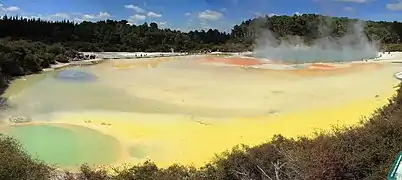
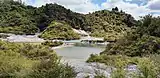
The Korsaröd Lagerstatten is located also on central Scania, and represents the best outcrop of the formation, leading to exquisitely preserved (with fossilized nuclei and chromosomes) specimens of ferns of the extant genus Osmundastrum.[26][27] This location was linked by Ulf Sivhed in 1984 with the Dajupadal Formation.[5] What was corroborated by recent studies.[28] It is also composed by volcaniclastic deposits, located at 380 m WNW of the nearest basaltic volcanic plug.[29] It is composed by mafic clasts agruped with agglomerates, oriented to this volcanic plug, coming probably from it or nearby ones.[29] Its clasts are angular and poorly sorted, recovered on a series of layers whose timing is uncertain, as there is no probe if represent discrete episodes separated by intervals of non-deposition or is result of variations due to a high-energy depositional setting.[29] Like in the Dajupadalsmölla type deposit, there is a great abundance of ash/mud content of the deposit filled with chaotic distributed wood fossil, what leds to the interpretation that this was a lahar deposit.[29] This location has been compared with modern Rotorua, New Zealand, considered an analogue for the type of environment represented in southern Sweden at this time.[30]
Eneskogen, Bonnarp and Säte volcanic necks are the main coeval of the Formation.[31] While Bonnarp (5–6 m height and covers roughly 5,000 square meters, covered by Jurassic sediments) is calculated to have at least 185.4+4.6 Ma (Middle Pliensbachian), Säte (Comprise two basalt pipes, each roughly 6–10 m high and some 10,000 square meters in area) yielded 180.0+0.7 Ma and Eneskogen (A large hill covered by quaternary sediments. Some few boulders and basalt pillars were exposed) 182.1+0.6 Ma, both Lower Toarcian in age.[32] It recovers one of the tree major mesozoic volcanic events on Skåne.[33] Säte & Bonnarp volcanic strata is composed by Basanite, being the first Glassy Facies, and the second microcrystalline, while Eneskogen also microcrystalline, is dominated by Melanephelinite.[34] Bonarp has a very special character, which differed considerably from the normal cone of a Stratovolcano.[35] At Bonarp, between the crystalline basement and the basalt tuff, a sedimentary layer sequence intervenes, alternating sandy and clayey layers.[35] The layers linked to the volcano consists of sand and clay stones with thin coal seams, with bottom redistributed disturbed layers of kaolin.[35] The overall appearance of the Bonarp volcano suggests that local tectonic movements were more or less complete when the eruption began.[35] The pre-basaltic weathering process was also a deep kaolinization of the crystalline basement (Knutshög, Djupadal). At Bonarp the basement is also deeply decomposed.[36]
The Brandsberga and Kolleberga erratics represent a series of Upper Pliensbachian sandstones, linked with the Bonnarp Volcano and deposited on a marginal marine to coastal setting, with a faunal composition dominated by Bivalves, as well Belemnnites and Bony Fish remains, yet the bivalves where the only indentificable to genus level.[37] This unit has traces of volcanoclastic elements on it, yet is dominated by sandstones, the same that are found in the associated Dinoflajellate-rich layers of the Bonnarp Volcano.[38] The unit is also the only part that recovers marine fauna, mostly molluscs.[39] The erratics suggest the presence of undiscovered solid rock in the immediate vicinity, and, like on the main volcanic layers, they´re abundant on large augular and rounded pieces of half-weathered Archaean sediments, probably either or result of exposed nearby layers of this period or result of the basement erosion due to coeval volcanism.[40] The deposit was part of a regresion trend where a embayment was formed in western central Skane, likely derived from the earlier Lower Pliensbachian major transgression. The presence of Kaolinite as well indeterminate Plant remains suggest the flow of terrestrial matter tought rivers from the east.[41]
Age and Correlations
Tralau (1973) measured the age for the local deposits, stablishing that where typical Middle Late Triassic to Lias strata, with absent Middle Jurassic sediments, with the exception of the volcanic event ejecting the tuffs in Korsaröd, stating that they took place in the Middle Toarcian.[42] Radiometric ages obtained by using K–Ar techniques scatter in a wide range between 171 and 179 Ma.[43] Following works on the 80s and 90s recovered also this original datation, putting this and the Dajupadalsmölla outcrop on the Toarcian-Aalenian boundary, as example of latest lower jurassic volcanism on the region. In 2006-2009 a depth study of the Volcanic Plugs led to stablish a range 191 –178 Ma based on 40Ar/39Ar whole-rock ages for samples derived from eight basanite–nephelinite plugs.[44][45] The Palynological studies on the 2014 tougth, changed the perspective of the age of the location, proposing a more fitting Late Pliensbachian.[46] In 2016 an in depth palynological study of the Korsaröd section led to stablish a Pliensbachian–early Toarcian(?) age, based on the high presence of the genus Perinopollenites elatoides (Pinales) and Eucommiidites troedsonii (Erdtmanithecales).[47] Other more recent works support that the outcrop is Toarcian in age, with a more recent work recovering a high-precision 40Ar/39Ar anorthoclase feldspar age of 176.7 ± 0.5 Ma (2-sigma), Late Toarcian.[48] This confirmed Tralau Original palynology results and the Paleomagnetic Studies done in 1993.[49] The formation overlies the Höor Sandstone Formation, and is time-equivalent with the Rydebäck and Katslösa members of the Rya Formation on NW Skane, the Röddinge Formation of the Vomb Trough and the Sorthat Formation of Denmark, with which it shares the abundance of Fern-derived material.[50] The formation also correlates with the Fjerritslev Formation of the Danish Basin, and the Gassum Formation of the Øresund Basin.[51]
The volcanic material was translated to the Continental margin by large fluvial channels, that ended on the sea deposits of the Green Series of Grimmen and Dobbertin, with the three-dimensional clay of this unit probably originated as the weathering product of this.[52] The Volcanic activity very likely eroded the underliying Hettangian-Sinemurian layers of the Höör Sandstone, deposited on the Fennoscandian coast as result of the weathering of the Precambrian-Paleozoic. This is seen as, after the inreased amount of clays with abundant volcanic materials, sands were repeatedly poured into the North German Basin from Skåne, as result of the erosion of the Höör sandstone.[53]
Pseudofungi
Color key
|
Notes Uncertain or tentative taxa are in small text; |
| Genus | Species | Location | Material | Notes | Images |
|---|---|---|---|---|---|
|
Peronosporomycetes Indeterminate |
|
|
A parasite/saprotroph Pseudofungal Protist, Incertade sedis inside Peronosporomycetes. Was recovered from the petiole of the holotype of Osmundastrum puchellum and interpreted as a peronosporomycete with parasitic or saprotrophic relation with this part of the plant. If the identification of the oogonia of peronosporomycetes is correct, then this implies regularly moist conditions for the growth of Osmundastrum pulchellum and this is consistent with the general habitat preferences of extant Osmundastrum.[54] |
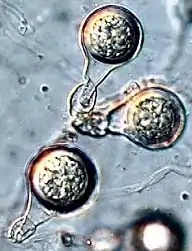 Extant Phytophthora, a Pseudofungal protist with sparsely bullate ornament, like the ones found Osmundastrum pulchellum | |
Fungi
| Genus | Species | Location | Material | Notes | Images |
|---|---|---|---|---|---|
|
Fungi Indeterminate |
|
|
A Fungus, Incertade sedis inside Fungi. From the petiole and the root of Osmundastrum puchellum where recovered thread-like structures, identified as derived from a pathogenic or saprotrophic fungus invading necrotic tissues of the host plant. The fungus' interaction with the plant was probably mycorrhizal.[54] |
_Gillet_845759.jpg.webp) Extant Microglossum, a saprotrophic fungus, whose Hypae are similar to the ones found Osmundastrum pulchellum | |
Palynology
| Genus | Species | Location | Material | Notes | Images |
|---|---|---|---|---|---|
|
Leiosphaera[55] |
|
|
|
An Acritarch, that can be both from Green/Red Algal origin. |
|
|
Leiofusa[55] |
|
|
|
An Acritarch, that can be both from Green/Red Algal origin. |
|
|
Micrhystridium[55] |
|
|
|
An Acritarch, that can be both from Green/Red Algal and Sphagnopsida origin. |
|
|
Nannoceratopsis[55] |
|
|
|
A Marine/Brackish Dinoflajellate, type member of the family Nannoceratopsiaceae. |
|
|
Cymatiosphaera[55] |
|
|
|
A Marine/Brackish Dinoflajellate, member of the family Pterospermopsidaceae inside Gonyaulacales. |
|
|
Botryococcus braunii |
|
|
A Freshwater Algae, type member of Botryococcaceae inside Chlorophyta. Goes from a 2%, being the most abundant algae on some samples to lack any presence on others.[56] |
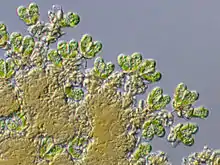 Extant Botryococcus | |
|
Pediastrum sp. |
|
|
A Freshwater Algae, member of Hydrodictyaceae inside Chlorophyceae. The less abundant algae sampled locally.[56] |
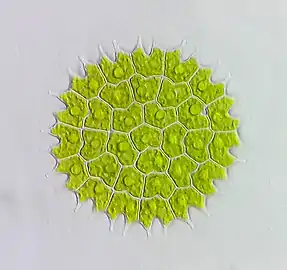 Extant Pediastrum | |
|
Lecaniella[56] |
Lecaniella sp. |
|
|
A Freshwater Algae, member of Zygnemataceae inside Charophyceae. On some samples is the only recovered algae, with a proportion of near a 3%.[56] |
|
|
|
|
A Miospore, member of Sphagnaceae inside Sphagnopsida. The major recovered Bryophyte spore, with less than 1.5% of the total samples.[57] |
 Extant Sphagnum, typical example of Sphagnaceae. Stereisporites probably come from a similar or a related Plant | |
|
Polycingulatisporites[57] |
Polycingulatisporites sp. |
|
|
A Miospore, related with the family Notothyladaceae inside Anthocerotopsida. Very scarce, with less than 1.1% on all the samples.[57] |
|
|
Neoraistrickia[57] |
Neoraistrickia sp. |
|
|
A Miospore, affinities with Selaginellaceae or Lycopodiaceae inside Lycopsida. The most abundant Lycopsid spore recovered locally, with near a 3.4% on some samples.[57] |
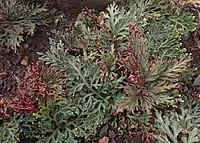 Extant Selaginella, typical example of Selaginellaceae. Neoraistrickia probably come from a similar or a related Plant |
|
Retitriletes[57] |
|
|
|
A Miospore, affinities with Lycopodiaceae inside Lycopsida. Diverse, but less abundant, with a ratio of 1% by sample.[57] |
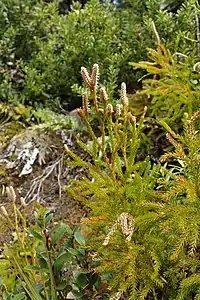 Extant Austrolycopodium, typical example of Lycopodiaceae. Retitriletes probably come from a similar or a related Plant |
|
Densoisporites[58] |
Densoisporites crassus |
|
|
A Miospore, affinities with Pleuromeiaceae, Selaginellaceae and Lycopodiaceae inside Lycopodiopsida. |
|
|
Calamospora[57] |
|
|
|
A Miospore, affinities with Equisetaceae inside Equisetales. Rare, with a 4.3% on a single sample.[57] |
.JPG.webp) Extant Equisetum cone, the typical example of the Equisetopsida. Calamospora spores are pretty similar to the extant ones |
|
Conbaculatisporites[57] |
Conbaculatisporites mesozoicus |
|
|
A Miospore, incertade sedis inside Filicopsida. Scarce, with less than 2.3% on the samples.[57] |
|
|
Striatella seebergensis |
|
|
A Miospore, affinities with Pteridaceae inside Filicopsida. Very scarce, with less than 1.5% on all the samples.[57] |
||
|
Lycopodiacidites[59] |
Lycopodiacidites rugulatus |
|
|
A Miospore, affinities with Ophioglossaceae inside Filicopsida. |
.jpg.webp) Extant Ophioglossum, typical example of the Ophioglossaceae. Lycopodiacidites may have come from a similar genus |
|
Marattisporites scabratus |
|
|
A Miospore, affinities with Marattiaceae inside Filicopsida. The second most abundant spore recovered on the location, with 3-14% on the samples.[57] |
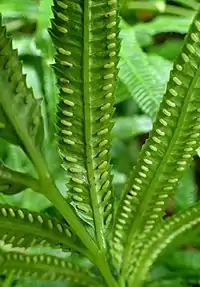 Extant Marattia, typical example of the Marattiaceae. Camptotriletes may have come from a similar genus | |
|
Osmundacidites wellmanii |
|
|
A Miospore, affinities with Osmundaceae inside Filicopsida. Can reach a 10% on some samples.[57] |
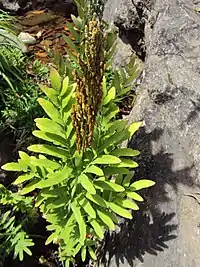 Extant Osmunda, typical example of the Osmundaceae. Osmundacidites may have come from a similar genus | |
|
|
|
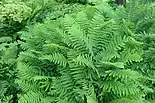
A Miospore, affinities with Osmundaceae inside Filicopsida. Very scarce, with less than 1–3.1% on all the samples.[56] |
 | |
|
Baculatisporites[60] |
|
|
|
A Miospore, affinities with Osmundaceae or Hymenophyllaceae inside Filicopsida. |
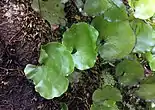 Extant Hymenophyllum, typical example of the Hymenophyllaceae. Baculatisporites may have come from a similar genus |
|
Deltoidospora toralis |
|
|
A Miospore, related with Cyatheaceae, Dicksoniaceae, Gleicheniaceae and Schizaeaceae inside Filicopsida. Recovered on the petiole and the root of Osmundastrum puchellum.[61] |
||
|
Gleicheniidites[55] |
Gleicheniidites sp. |
|
|
A Miospore, related with Gleicheniaceae inside Filicopsida. |
|
|
Concavisporites[55] |
Concavisporites sp. |
|
|
A Miospore, related with Cibotiaceae, Gleicheniaceae, Matoniaceae and Dipteridaceae inside Filicopsida. |
|
|
Cibotiumspora jurienensis |
|
|
A Miospore, related with Cyatheaceae and Dicksoniaceae inside Filicopsida. Recovered on the petiole and the root of Osmundastrum puchellum.[61] Present on various samples with ratios from 1-1.5%.[57] |
||
|
Zebrasporites[62] |
|
|
|
A Miospore, related with Cyatheaceae inside Filicopsida. Arboreal Fern Miospores. |
_Domin_(11453662625).jpg.webp) Extant Cyathea, typical example of the Cyatheaceae. Zebrasporites may have come from a similar genus |
|
|
|
A Miospore, related with Cyatheaceae or Adiantaceae inside Filicopsida. Recovered on the petiole and the root of Osmundastrum puchellum.[61] It is the most common independent palynologycal residue recovered on Korsaröd, with Cyathidites spp. occuping a 21%.[57] Cyathidites minor almost certainly belong to well known Mesozoic species Coniopteris hymenophylloides and to other fossil cyatheaceous or dicksoniaceous ferns such as Eboracia lobifolia and Dicksonia mariopteri. |
_(14820801765).jpg.webp) | |
|
Contignisporites[63] |
Contignisporites problematicus |
|
|
A Miospore, related with Cibotiaceae inside Filicopsida. |
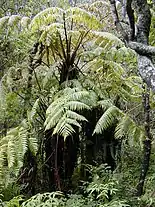 Extant Cibotium, typical example of the Cibotiaceae. Contignisporites may have come from a similar genus |
|
|
|
A Pollen Grain, afinnities with Caytoniales inside Gymnospermopsida. Scarce, with around a 1% on all samples.[57] |
||
|
|
|
A Pollen Grain, affinities with Umkomasiaceae, Peltaspermaceae, Corystospermaceae and Caytoniaceae inside Pteridospermae, but also Voltziaceae inside Coniferophyta. A. grandis reaches near a 10% on some samples.[56] |
||
|
Ovalipollis |
|
|
|
A Pollen Grain, affinities with Peltaspermaceae inside Pteridospermae. |
|
|
|
|
A Pollen Grain, afinnities with Erdtmanithecales inside Spermatophytes. Moderately abundant, with around a 3-10% on all samples.[56] The Gymnosperms that produced Eucommiidites troedsonii pollen possibly dominated the understorey vegetation. |
||
|
Bennettitaceaeacuminella[55] |
|
|
|
A Pollen Grain, affinities with Cycadeoidaceae and Williamsoniaceae inside Bennettitales. |
|
|
|
|
A Pollen Grain, incertade sedis inside Cycadopsida. It also can be pollen from Ginkgoaceae. Very rare, with less than 0.5% on all samples.[56] |
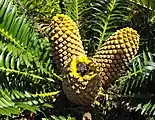 Extant Encephalartos, typical example of the Cycas. Monosulcites Pollen is pretty similar to the extant ones of this genus | |
|
|
|
A Pollen Grain, incertade sedis inside Cycadopsida, Corystospermaceae and Araucariaceae. Rare, with around a 0.7-1% on all samples.[56] |
 Extant Encephalartos, typical example of the Cycas. Chasmatosporites Pollen is pretty similar to the extant ones of this genus. Alternatively, it maybe come from Ginkos or Gnetales | |
|
|
|
A Pollen Grain, affinities with Ginkgoales inside Ginkgophyta. Very rare, with less than 1% on all samples.[56] |
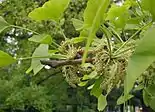 Extant Ginkgo, only surviving example of the Ginkgoaceae. Ginkgoites Pollen is pretty similar to the extant ones of this genus | |
|
Rugaletes[56] |
|
|
|
A Pollen Grain, incertade sedis inside Coniferophyta. Around a 7.5% on all the samples.[56] |
|
|
Quadraeculina[56] |
|
|
|
A Pollen Grain, affinities with Podocarpaceae and Pinaceae inside Coniferophyta. Around a 1–3.9% on all the samples.[56] |
|
|
|
|
A Pollen Grain, affinities with Abietoideae, Taxodiaceae, Araucariaceae, Cupressaceae and Sciadopityaceae inside Coniferophyta. Around 1-1.5% on all the samples.[56] Pollen From arbustive to arboreal plants, resembling the pollen of the modern genus Tsuga. The differences observed between Cerebropollenites and Tsuga are no greater than the differences observed between the pollen of the two Sections of Tsuga, Hesperopeuce and Micropeuce. |
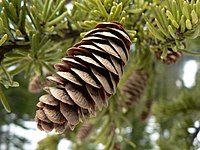 Extant Tsuga Cone, example of the Abietoideae. Cerebropollenites is similar to the pollen found on this genus | |
|
Pinuspollenites[56] |
|
|
|
A Pollen Grain, affinities with Pinaceae inside Coniferophyta. Around a 1–4.5% on the samples.[56] |
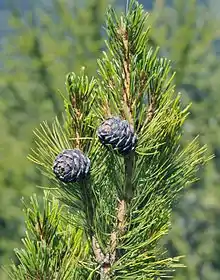 Extant Pinus cembra Cone, example of the Pinidae. Pinuspollenites is similar to the pollen found on this genus |
|
Cedripites[56] |
|
|
|
A Pollen Grain, affinities with Pinaceae inside Coniferophyta. Rare, with around a 1.5% on all samples.[56] |
|
|
|
|
A Pollen Grain, affinities with Cheirolepidiaceae inside Coniferophyta. Moderately abundant, with around a 1.5-9% on all samples.[56] |
||
|
Spheripollenites[56] |
|
|
|
A Pollen Grain, affinities with Cheirolepidiaceae inside Coniferophyta. Scarce, around a 1.5–3.9% on all the samples.[56] |
|
|
Parvisaccites[65] |
|
|
|
A Pollen Grain, affinities with Podocarpaceae and Cupressaceae inside Coniferophyta. |
.jpg.webp) Extant Podocarpus Cone, example of the Podocarpaceae. Parvisaccites is similar to the pollen found on this genus |
|
|
|
A Pollen Grain, affinities with Taxodiaceae and Cupressaceae inside Coniferophyta. The most abundant pollen recovered locally, with near a 30% on some samples.[56] |
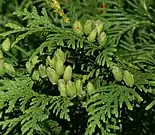 Extant Thuja Cone, example of the Cupressaceae. Perinopollenites is similar to the pollen found on this genus | |
|
Araucariacites[56] |
|
|
|
A Pollen Grain, afinnities with Araucariaceae inside Coniferophyta. Rare, with around a 1.5% on all samples.[56] |
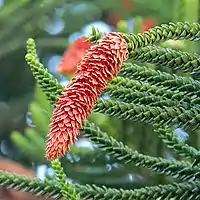 Extant Araucaria Cone, example of the Araucariaceae. Araucariacites is similar to the pollen found on this genus |
Megaflora
| Genus | Species | Location | Material | Notes | Images |
|---|---|---|---|---|---|
|
Selaginellites?[66] |
Selaginellites? sp. |
|
|
A small herbaceous epiphytic lycopsid, Incertade sedis inside Lycopsida. External exotic roots are preserved within detritus-filled cavities between the petiole bases of Osmundastrum pulchellum, with wall thickenings similar to the vasculature evident in ancient and modern herbaceous lycopsids.[67] |
_(8516527488).jpg.webp) Extant Selaginella, a Lycopsid that grows its roots on floor ferns |
|
|
A small (50 cm tall) Royal Fern, member of Osmundaceae inside Filicopsida. The most known fossil of the location, thanks to its exceptional fossilized Rhizome, that has preserved Nuclei and Chromosomes, a fine subcellular detail has rarely been documented in fossils.[70] Its Rooted in DNA content was used to extrapolate relative genome, finding relationships with extant Osmundastrum cinnamomeum, and confirmed a monophyletic Osmunda.[71] |
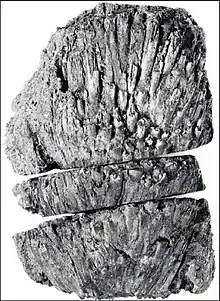 Osmundastrum pulchellum rhizome | ||
|
Ptilophyllum sp. |
|
|
A Bennetite, afinnities with Williamsoniaceae inside Bennettitales. This single impression of a bennettitalean leaf fragment found in a fine ash layer constituted the only foliar remains identified within the volcaniclastic deposit. |
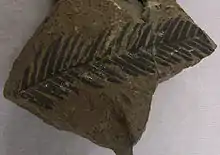 Example of Ptilophyllum leaf | |
Fossil Wood
| Genus | Species | Location | Material | Notes | Images |
|---|---|---|---|---|---|
|
Protophyllocladoxylon[73] |
Protophyllocladoxylon spp. |
|
|
A Conifer, affinities with Cupressaceae inside Coniferophyta. The main diagnostic wood recovered locally, identified based on the possession of uniseriate rays with smooth walls, pointed oblique oopores, absence of axial parenchyma, and tracheid radial walls. It resembles the extant Thuja plicata, but hosts a mean rings more similar to Juniperus thurifera. A few fossil wood specimens clearly represent portions of large trunks, with at least one fragment derived from a trunk of 1.68 m in diameter (with stimated c.5.3 m). Although, most specimens represent lateral branches or even roots of small size (10 cm long and 5 cm wide).[74] Its growth rings are distinct in all wood samples.[75] |
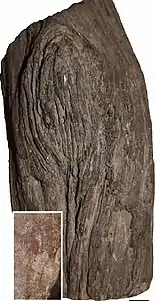 Permineralized Protophyllocladoxylon wood with a branch trace recovered from the volcaniclastic sediments at Korsaröd |
|
Tiloxylon[76] |
Tiloxylon lindleyanum |
|
|
A Conifer, affinities with Pinaceae (Probably Abietoideae) inside Coniferophyta. Referred originally to the genus Cedroxylon, using it as referente to stablish an Eocene age for the Volcanic deposits, as similar wood from Eocene age was recovered from Jutland.[76] This genus has been found to not be suitable to Mesozoic woods, and material similar to the one recovered on the volcanic deposits has been assigned to Tiloxylon (=Protocedroxylon), also known in the Toarcian of Greenland.[77] |
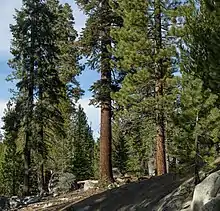 |
Bivalves
| Genus | Species | Location | Material | Notes | Images |
|---|---|---|---|---|---|
|
Trigonia primaeva |
|
Isolated Shells |
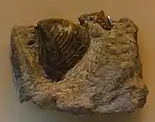
A marine/brackish Clam, member of Trigoniinae inside Trigoniidae. Correlated with the molluscs of the Hasle Formation of Bornholm and the Rya Formation |
| |
|
Antiquilima succincta |
|
Isolated Shells |
A marine/brackish clam, member of the family Limidae inside Limida. |
||
|
|
Isolated Shells |
A saltwater pointed nut Clam, type member of the family Nuculanidae inside Nuculida. |
| |
|
|
Isolated Shells |
A marine/brackish scallop, member of the family Pectinoidae inside Pectinida. |
| |
|
|
Isolated Shells |
A marine/brackish scallop, member of the family Plicatulidae inside Pectinida. Harpax spinosa is a species limited to the Margaritatus subzone (Latest Pliensbachian) |
||
|
|
Isolated Shells |
A marine/brackish scallop, type member of the family Oxytomidae inside Pectinida. |
| |
|
|
Isolated Shells |
A saltwater Mussel, type member of the family Mytilidae inside Mytilida. |
||
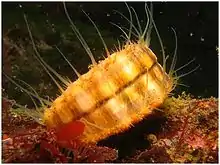
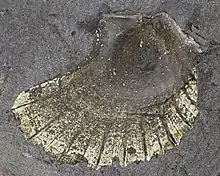
Arachnida
| Genus | Species | Location | Material | Notes | Images |
|---|---|---|---|---|---|
|
Oribatida Indeterminate |
|
|
A Mite, Incertade sedis inside Oribatida. On the petiole of Osmundastrum puchellum excavations up to 715 μm in diameter are evident, filled with pellets that resemble the coprolites of Oribatid mites found also on Paleozoic and Mesozoic Woods.[61] |
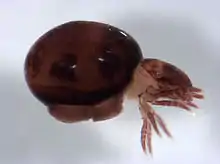 example of Oribatida mite | |
See also
- List of fossiliferous stratigraphic units in Sweden
- Kristianstad Basin
- Toarcian formations
- Mizur Formation, North Caucasus
- Sachrang Formation, Austria
- Saubach Formation, Austria
- Posidonia Shale, Lagerstätte in Germany
- Ciechocinek Formation, Germany and Poland
- Calcare di Sogno, Italy
- Marne di Monte Serrone, Italy
- Lava Formation, Lithuania
- Krempachy Marl Formation, Poland and Slovakia
- Rya Formation, Sweden
References
- Lidmar-Bergström, Olsson, & Olvmo (1997)-p98
- Augustsson (2001)-p23
- Tralau (1973)-p128
- Lidmar-Bergström, Olsson, & Olvmo (1997)-p99
- Sivhed (1984)-p26
- Vajda, Linderson & McLoughlin (2016)-p127
- Tappe, Smart, Stracke, Romer, Prelević & van den Bogaard (2016)-p30
- Vajda, Linderson & McLoughlin (2016)-p128
- Vajda, Linderson & McLoughlin (2016)-p141
- Augustsson (1999)-p14
- Vajda, McLoughlin & Bomfleur (2014)-p26
- Augustsson (2001)-p24
- Kjellen (1902)-p208
- Kjellen (1902)-p209
- Eichstädt (1883)-p412
- Ringberg (1984)-p59
- Eichstädt (1883)-p413
- Norling, Ahlberg, Erlström & Sivhed (1993)-p50
- Augustsson (2001)-p25
- Augustsson (2001)-p27
- Augustsson (2001)-p28
- Norling, Ahlberg, Erlström & Sivhed (1993)-p52
- Augustsson (1999)-p15
- Augustsson (1999)-p5
- Augustsson (1999)-p6
- Bomfleur, McLoughlin & Vajda (2014)-p1376
- Bomfleur, Grimm & McLoughlin (2014)-p4
- Bomfleur, McLoughlin & Vajda (2014)-p1377
- Vajda, Linderson & McLoughlin (2016)-p139
- Vajda, McLoughlin & Bomfleur (2014)-p27
- Bergelin (2009)-p169
- Bergelin (2009)-p170
- Bergelin, Obst, Söderlund, Larsson & Johansson (2011)-p791
- Tappe (2004)-p316
- Bölau & Kockel-Brosius (1965)-p19
- Bölau & Kockel-Brosius (1965)-p20
- Troedsson (1954)-p605
- Troedsson (1954)-p606
- Troedsson (1954)-p607
- Troedsson (1948)-p67
- Troedsson (1954)-p610
- Tralau (1973)-p127
- Klingspor (1976)-p207
- Bergelin (2006)-p21
- Bergelin (2009)-p168
- Bomfleur, McLoughlin & Vajda (2014), Suplementary Material-p2
- Vajda, Linderson & McLoughlin (2016)-p134
- Tappe, Smart, Stracke, Romer, Prelević & van den Bogaard (2016)-p34
- Bylund & Halvorsen (1993)-p140
- Ahlberg, Sivhed & Erlström (2003)-p529
- Ahlberg, Sivhed & Erlström (2003)-p534
- Stumpf, Ansorge & Grimmberger (2016)-p137
- Stumpf, Ansorge & Grimmberger (2016)-p138
- McLoughlin & Bomfleur (2016)-p93
- Bölau & Kockel-Brosius (1965)-p55
- Vajda, Linderson & McLoughlin (2016)-p133
- Vajda, Linderson & McLoughlin (2016)-p132
- Tralau (1973)-p130
- Tralau (1973)-p131
- Tralau (1973)-p132
- McLoughlin & Bomfleur (2016)-p91
- Tralau (1973)-p133
- Tralau (1973)-p134
- Tralau (1973)-p135
- Tralau (1973)-p136
- McLoughlin & Bomfleur (2016)-p88
- McLoughlin & Bomfleur (2016)-p89
- Bomfleur, Grimm & McLoughlin (2014)-p5
- Bomfleur, Grimm & McLoughlin (2015)-p6
- Bomfleur, Grimm & McLoughlin (2015)-p8
- Bomfleur, McLoughlin & Vajda (2014)-p1378
- McLoughlin & Bomfleur (2016)-p87
- Vajda, Linderson & McLoughlin (2016)-p138
- Vajda, Linderson & McLoughlin (2016)-p136
- Vajda, Linderson & McLoughlin (2016)-p137
- Tralau (1973)-p121
- Philippe & Bamford (2008)-p193
- Lundgren, B. (1882)-p136
- Troedsson, G.(1954)-p607
- Lundgren, B. (1882)-p137
- Troedsson, G.(1954)-p608
Bibliography
- Vajda, V.; Linderson, H.; McLoughlin, S. (2016). "Disrupted vegetation as a response to Jurassic volcanism in southern Sweden". Geological Society, London, Special Publications. 434 (1): 127–147. Bibcode:2016GSLSP.434..127V. doi:10.1144/SP434.17. S2CID 53626549. Retrieved 30 July 2021.
- Stumpf, Sebastian; Ansorge, Jörg; Grimmberger, Gunther (2016). "Grätensandsteine und andere Geschiebe des oberen Lias (Toarcium) aus Norddeutschland [Upper Liassic sandstones with fish remains (so-called Grätensandsteine) and other Toarcian glacial erratics from northern Germany]" (PDF). Geschiebekunde aktuell. 32 (4): 121–141. Retrieved 30 July 2021.
- McLoughlin, S.; Bomfleur, B. (2016). "Biotic interactions in an exceptionally well preserved osmundaceous fern rhizome from the Early Jurassic of Sweden". Palaeogeography, Palaeoclimatology, Palaeoecology. 464 (1): 86–96. Bibcode:2016PPP...464...86M. doi:10.1016/j.palaeo.2016.01.044. Retrieved 30 July 2021.
- Tappe, S.; Smart, K. A.; Stracke, A.; Romer, R. L.; Prelević, D.; Van den Bogaard, P., P. (2016). "Melt evolution beneath a rifted craton edge: 40Ar/39Ar geochronology and Sr–Nd–Hf–Pb isotope systematics of primitive alkaline basalts and lamprophyres from the SW Baltic Shield. ". Geochimica et Cosmochimica Acta. 173 (1): 1–36. Bibcode:2016GeCoA.173....1T. doi:10.1016/j.gca.2015.10.006. Retrieved 30 July 2021.
- Bomfleur., B.; Grimm, G. W.; McLoughlin., S. (2015). "Osmunda pulchella sp. nov. from the Jurassic of Sweden—reconciling molecular and fossil evidence in the phylogeny of modern royal ferns (Osmundaceae)". BMC Evolutionary Biology. 15 (1): 126. doi:10.1186/s12862-015-0400-7. PMC 4487210. PMID 26123220. Retrieved 30 July 2021.
- Vajda, V.; McLoughlin, S.; Bomfleur, B. (2014). "Fossilfyndet i Korsaröd". Geologiskt Forum-Geological Society of Sweden. 82 (1): 24–29. Retrieved 30 July 2021.
- Bomfleur, B.; Grimm, G. W.; McLoughlin, S. (2014). "A fossil Osmunda from the Jurassic of Sweden—reconciling molecular and fossil evidence in the phylogeny of Osmundaceae". bioRxiv: 005777. doi:10.1101/005777. S2CID 88109470. Retrieved 30 July 2021.
- Bomfleur, B.; McLoughlinVajda, V. (2014). Fossilized nuclei and chromosomes reveal 180 million years of genomic stasis in royal ferns. Science, 343(6177), 1376-1377, S.; Vajda, V. (2014). "Fossilized nuclei and chromosomes reveal 180 million years of genomic stasis in royal ferns". Science. 343 (6177): 1376–1377. Bibcode:2014Sci...343.1376B. doi:10.1126/science.1249884. PMID 24653037. S2CID 38248823. Retrieved 30 July 2021.CS1 maint: multiple names: authors list (link)
- Bergelin, I.; Obst, K.; Söderlund, U.; Larsson, K.; Johansson, L. (2011). "Mesozoic rift magmatism in the North Sea region: 40 Ar/39 Ar geochronology of Scanian basalts and geochemical constraints. ". International Journal of Earth Sciences. 100 (4): 787–804. Bibcode:2011IJEaS.100..787B. doi:10.1007/s00531-010-0516-3. S2CID 128811834.
- Bergelin, I. (2009). "Jurassic volcanism in Skåne, southern Sweden, and its relation to coeval regional and global events". GFF. 131 (1): 165–175. doi:10.1080/11035890902851278. S2CID 128825994.
- Philippe, Marc; Bamford, Marion K. (2008). "A key to morphogenera used for Mesozoic conifer-like woods". Review of Palaeobotany and Palynology. 148 (2–4): 184–207. doi:10.1016/j.revpalbo.2007.09.004. Retrieved 30 November 2021.
- Bergelin, I. (2006). "40Ar/39Ar Geochronology of Basalts in Scania, S Sweden: Evidence for Two Pulses at 191-178 Ma and 110 Ma, and Their Relation to the Break-up of Pangea". Geologiska Institutionen, Lunds Univ. 1 (1): 2–25. Retrieved 30 July 2021.
- Tappe, S. (2004). "Mesozoic mafic alkaline magmatism of southern Scandinavia". Contributions to Mineralogy and Petrology. 148 (3): 312–334. Bibcode:2004CoMP..148..312T. doi:10.1007/s00410-004-0606-y. S2CID 140536796.
- Ahlberg., A.; Sivhed, U.; Erlström, M. (2003). "The Jurassic of Skåne, southern Sweden". GEUS Bulletin. 1 (1): 527–541. doi:10.34194/geusb.v1.4682.
- Augustsson, C. (2001). "Lapilli tuff as evidence of Early Jurassic Strombolian-type volcanism in Scania, southern Sweden". GFF. 123 (1): 23–28. doi:10.1080/11035890101231023. S2CID 140544085.
- Augustsson, C. (1999). "Lapillituff som bevis för underjurassisk vulkanism av strombolikaraktär i Skane". Examensarbete, Geologiska Institutionen, Lunds Universitet. 109 (1–16): 1–12. Retrieved 16 November 2021.
- Lidmar-Bergströml, K.; Olsson, S.; Olvmo, M. (1997). "Palaeosurfaces and associated saprolites in southern Sweden". Geological Society, London, Special. 120 (1): 95–124. Bibcode:1997GSLSP.120...95L. doi:10.1144/GSL.SP.1997.120.01.07. S2CID 129229906.
- Norling, E.; Ahlberg, A.; Erlström, M.; Sivhed, U. (1993). "Guide to the Upper Triassic and Jurassic geology of Sweden". Sveriges Geologiska Undersökning. 82: 71.
- Bylund, G.; Halvorsen, E. (1993). "Palaeomagnetic study of Mesozoic basalts from Scania, southernmost Sweden". Geophysical Journal International. 114 (1): 138–144. Bibcode:1993GeoJI.114..138B. doi:10.1111/j.1365-246X.1993.tb01473.x.
- Ringberg, B. (1984). "Cyclic lamination in proximal varves reflecting the length of summers during late Weichsel in southernmost Sweden". Climatic Changes on a Yearly to Millennial Basis. 1: 57–62. doi:10.1007/978-94-015-7692-5_5. ISBN 978-90-481-8399-9.
- Sivhed., U. (1984). "Litho-and biostratigraphy of the Upper Triassic-Middle Jurassic in Scania, southern Sweden" (PDF). Sveriges geologiska undersökning. 78 (4): 1–30. Retrieved 30 July 2021.
- Klingspor, I. (1976). "Radiometric age-determination of basalts, dolerites and related syenite in Skåne, southern Sweden". GFF. 98 (1): 195–216.
- Tralau, H. (1973). "En palynologisk åldersbestämning av v ulkanisk aktivitet i Skåne". Fauna och Flora. 68 (1): 121–176.
- Bölau, E.; Kockel-Brosius, M. (1965). "Der tertiäre Vulkanismus in Zentralschonen, Südschweden: Mikropaläontologische Untersuchungen an Bohrproben aus Schonen" (PDF). Gleerup (1): 1–55. Retrieved 30 July 2021.
- Troedsson, Gustaf (1954). "Om lias-sandsteuen vid Brandsberga och Kolleberga". Geologiska Foereningan i Stockholm. Foerhandlingar,. 76 (4): 605–612. doi:10.1080/11035895409453582. Retrieved 13 December 2021.CS1 maint: extra punctuation (link)
- Troedsson, G. (1948). "On rhythmic sedimentation in the Rhaetic-Liassic beds of Sweden" (PDF). In International Geological Congress.‘Report of the Eighteenth Session, Great Britain. 1 (1): 64–72. Retrieved 13 December 2021.
- Kjellen, R. (1902). "Bidrag till Sveriges endogena geografi". Geologiska Föreningen i Stockholm Förhandlingar. 24 (4): 193–220. doi:10.1080/11035890209449951.
- Eichstädtat, F. (1883). "Om basalttuffen vid Djupadal i Skåne". Geologiska Föreningen i Stockholm Förhandlingar. 6 (10): 408–415. doi:10.1080/11035898309444082.
- Lundgren, B. (1882). "Undersökningar öfver Molluskfaunan i Sveriges äldre mesozoiska bildningar". Geologiska Föreningen i Stockholm Förhandlingar. 6 (3): 136–137. Retrieved 13 December 2021.
| Ph |
| ||||||||||||||||||||||
|---|---|---|---|---|---|---|---|---|---|---|---|---|---|---|---|---|---|---|---|---|---|---|---|
 Mesozoic • Cretaceous • Jurassic • Triassic Mesozoic • Cretaceous • Jurassic • Triassic | |||||||||||||||||||||||