Rajasinha I of Sitawaka
Rajasinghe I (Sinhala:පළමුවන රාජසිංහ) [1] was a king of the Kingdom of Sitawaka. He is known for his extreme bravery and patriotism against the Portuguese invasion of Sri Lanka. Born as Tikiri Bandara to King Mayadunne of the Kingdom of Sitawaka, the name "Rajasinha" was given to him after the fierce battle against Portuguese forces at the Battle of Mulleriyawa. Rajasinha means the King of Lions (or the Lion King).
| Rajasinha I | |
|---|---|
| King of Sitawaka | |
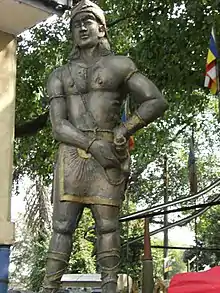 | |
| Reign | 1581–1593 |
| Coronation | 1581 |
| Predecessor | Mayadunne |
| Successor | Vimaladharmasuriya I |
| Born | 1544 Sri Lanka |
| Died | 1593 (aged 48/49) Pethangoda Bamboo Grove |
| Burial | |
| Spouse | Queen Consort Nilupulmala Kirawelle |
| Issue | Prince Rajasuriya Prince Jayasuriya |
| Father | Mayadunne |
| Mother | Queen Consort Leelawathi |
| Religion | Hinduism prev. Theravada Buddhism |
Ascent to throne
Generally, it has been recorded that he reigned from 1581 to 1592. However, according to De Queros, Mayadunne handed over the kingdom to Rajasinha in 1578. In 1581, Mayadunne died leaving Rajasinha to ascend the throne.[2] There are conflicting information in various sources regarding his role in his father Mayadunne's death. In the 4th chapter of Mahawamsa written by Thibbotuwawe Buddharakhitha thero during the reign of Kirti Sri Rajasinha of Kandy states that Rajsinha killed Mayadunne. Minor Rajawaliya also recorded that due to his patricidal act which was considered as an irreversible "anantharya" karma by Buddhist monks, conflicts arose between him and the Buddhist monks and as a result he followed an anti-Buddhist line. However, critics believe that the non-recording of a patricidal event in important sources such as Rajawaliya and Alakeshwara war renders the fact that he killed his father suspicious and conflicting. Rebairo, too, does not record a patricidal event. Dutch envoy Spillburjon who visited Sengkadagala kingdom reported that the rumor of patricide was spreading only in the Kandyan kingdom. Queros is known for his antipathy towards Sitawaka Rajasinha. In this background, if he committed patricide, Queros would have reported it without fail. In his lengthy account, Queros reported that Mayadunne died of natural causes after having lived 85 years. According to him, Rajasinha returned to Seethawaka from the famous siege of the Colombo fort on hearing the passing away of his father.[3]
Expeditions
While his main battle was against the Portuguese forces in defense of the sovereignty of the Sinhala monarch, he had to battle with numerous internal forces—some regional and individual, supported directly and indirectly by forces from Portugal.
One such adventure with cunningness happend when Veediya Bandara was at crushing a rebellion, and knowing Veediya Bandara's absence, Mayadunne of Sitawaka prepared to attack Kingdom of Kotte with the ruler of Kingdom of Kandy as his ally. When the words reached Veediya Bandara in Uva Province, he made haste and descended upon the army of Kandy before it joined forces with Mayadunne.[citation needed] Afterwards, his army invaded and captured Kingdom of Sitawaka again as Mayadunne fled without a fight.[citation needed]
This, however, was it was a trick secretly deployed forces above Sitawaka fort attacked Veediya Bandara' men and took them by complete surprise. Unprepared and outnumbered, they endured a heavy defeat for the misjudgment of their leader. Veediya Bandara himself, retreated with several of his guards only to be betrayed by them as there was a hefty price announced by Prince Tikiri on his head. while Velayudha Arachchi fighting alone with Prince Tikiri's Army to make enough time to fall back his Commander and friends of commanders.
It is said that they were 50 betrayal men's of the Kingdom of Kotte fighting with Veediya Bandaraand his men to win hefty price and Maggona Arachchi fought till his death to protect his Chief ( Veediya Bandara), when Prince Tikiri Bandara Rajasinha, son of Mayadunne arrived there with a massive force.
Rather than facing certain death, Veediya Bandara ordered Vijeyakoon Mudali, Hiti Imbule Bodiraja Perumal, and Varusapperuma Arachchi to flee to Kotte and wait for his Orders but they instantly refused and Veediya Bandara was angry, he reordered to fall back and carry the body of his loyal commander-general of personal bodyguard, Maggona Arachchi (he was the childhood friend to Veediya Bandara) and then decided to surrender to prince Tikiri who in time, distinguished himself as a warrior king.
in the captivity of Prince Tikiri, Veediya Bandara fell in love with Princess Tikiri the sister of Prince Tikiri and daughter of King Mayadunne of Sitawaka . And managed to escape with the help of princess and finally they married.
One another such adventure of Tikiri Bandara was the battle against his brother-in law "Veediya Bandara". Mayadunne initiated the campaign to destroy Veediye Bandara primarily due to (1) the ill treatment meted out to Mayadunne's daughter Tikiri Kumari (Princess Tikiri) who was the wife of Veediya Bandara and (2) non-rendering of the support to Mayadunne to wage war against the Kandyan ruler. Combined Sitawaka and Portuguese troops attacked Veediye Bandara's fort at Pelenda chasing him down to Devundara and capturing Tikiri Kumari. Sitwaka troops were led by twelve-year-old Tikiri Bandara. Veediye Bandara re grouped with the troops of the Kandyan leader and reached Salpiti Korale to attack Sitawaka troops. He was defeated by Tikiri Bandara again. He fled to Kanda uda rata and returned to Alut Nuwara with troops of the kandyan king. After a fierce battle at Alutnuwara, Veediye Bandara was decisively defeated by Tikiri Bandara. According to the "Alakeshwara War", this battle was so fierce and legendary, following which Tikiri Bandara was called "Rajasinha". Rajawaliya states that the title Rajasinha that implies "Lion who is the king of kings" was given to him following this famous battle.
While Rajasinha waged his war against Portuguese, King Karaliyadde Bandara, utilized Portuguese soldiers to protect his Kandyan kingdom. Infuriated by this relationship with Portuguese invaders, with the support of Weerasundera Mudali of Peradeniya, Rajasinha led his troops up to the entry point at Balana in 1583 and chased Karalyadde Bandara.[4]
The battle with the Portuguese in Mulleriyawa was the bloodiest fought to date. While the Portuguese held guns and more advanced weapons, the Sinhalese army simply equipped with swords and their ancient fighting method called Angam Pora, defeated the entire Portuguese army. This was the greatest defeat a European army ever had in an Asian land. It still remains that way. According to Queros, though he solicited support of Malabar coast or Kerala troops, non-availability of a naval fleet caused by the Portuguese raids of port-towns affected his endeavors to cleanse the country from invaders despite his remarkable sieges of Colombo Fort in 1581 and 1587.[5][6]
Battle of Mulleriyawa
It is widely accepted that a Portuguese army led by Captain-Major Afonso Pereira de Lacerda was defeated by Sitawakan forces at Mulleriyawa in the year of 1562. But Portuguese sources provide a different picture.
Pereira de Lacerda was suffering from chronic malaria which almost reduced him to a state of delirium. So Goa sent a veteran commander named Jorge de Menezes (nicknamed Baroche for his exploits at the city of Broach which lies in the bay of Cambaya) to take over. He took over the office in year 1559 and claimed that he intend to finish the enemy that brought him to the island. De Menezes marched out triggering the events that eventually led to the battle of Mulleriyawa.[7]
De Menezes held the office of captain-major of Portuguese Ceylon from 1559 to 1560 which places the battle sometime after May 1559 and at the same time questions the above date (1562).
Movements to the Battle
The Portuguese advanced along the southern bank of the Kelani River through Maedanda and Weragoda towards Mulleriyawa.[8] Their objective was to capture Mapitigama stockade which was located on the northern bank.[9] It was strategically located (current day Udumapitigama) controlling the river and land route to Sitawaka. Therefore, by capturing it the Portuguese expected to use it as a launching pad for the coming invasion.[10]
King Mayadunne received the news of this invasion force and sent an army under the command of his son Tikiri Bandara towards Hewagama. On arrival, he summoned Military caste of Aturigiri Korale, Hewagam Korale, Koratota, and Hokandara areasto further bolster his numbers. Surprisingly previously fierced enemies of Kingdom of Sitawaka , The Maggona Arachchi junior, sons of late General Maggona Arachchi joined with Sithawaka forces to completely destroy Armies of Portugal and their Sri Lankan supporters, Its believed that after the fall of Kingdom of Kotte with the Veediya Bandara's son, Don Juan Dharmapala Maggona fighters were desperate about country and the nation. [11]
Meanwhile, a Portuguese detachment under Jorge de Menezes and Jorge de Melo successfully surprised the retreating Sitawakan border guards in a sneak attack at dawn. They captured a smaller stockade on the southern bank, killing the garrison of 300 men. Encouraged by this early success, de Menezes prepared his forces to capture the grand stockade of Mapitigama. At this moment, he received reports of Sitawakan forces in a meadow (Hewagama)[12] and ordered a night march.
Tikiri Bandara was aware of the movements of de Menezes and de Melo, and sent a force under Wickramasinghe Mudali to check their advance. These armies met at the village of Mulleriyawa[11] one hour before dawn.[12]
First Battle of Mulleriyawa
The battle was short and the Sitawakans were defeated. They retreated towards Hewagama leaving 200 dead, pursued by the Portuguese.[13] Wickramasinghe Mudali was himself wounded.[14] Jorge de Menezes wanted to annihilate the Sitawakans and pressed the pursuit.[13]
Retreating Sitawakan forces took refuge in a narrow pass which had been fortified earlier. Against the better judgment of veteran soldiers, de Menezes ordered to attack the fortified pass. But now reorganized and well entrenched, Wickramasinghe Mudali managed to repulse repeated waves of attacks.[15]
These futile efforts exhausted the Portuguese and consumed their ammunition reserves. When the captains approached de Menezes regarding low gunpowder reserves, it led to the famous reply “...If there is no powder they might load their muskets with sand, and if they did not shoot, they might finish the fight with the sword, because such brave Portuguese had no need of arms as long as they had nails and teeth.”[16]
De Menezes renewed the attack, but his men withdrew against his orders to hold back.[16] Exhausted and low on ammunition they were forced to rest at the village of Mulleriyawa.[14]
Second Battle of Mulleriyawa
Once he received the news, Tikiri Bandara divided his forces into three groups. The first group consisted of militia men from Athurugiriya, Hewagama, Koratota, Hokandara, and 1000 Sitawakan swordsmen with targes. He sent them in a flanking maneuver to cut off enemy's retreat and to attack in the rear.[17]
Then he reinforced Wickramasinghe Mudali's remaining forces with elephants and elite targe bearers and deployed them in left and right wings.[17] Their exact role is not known but probably their orders were to secure flanks and to stand by as reserves.[18]
Finally, Tikiri Bandara deployed the remaining targe bearers, war elephants, and cavalry in the center and assumed the command himself.[17]
Meanwhile, the Portuguese found their rear blocked by large trees[19] and the enemy close by, they drew up themselves (arranged in battle ranks) in an open area at Mulleriyawa.[17] (Rajavaliya specific about the fact that Sitawaka forces attacked an enemy army in formations, on the other hand according to Portuguese sources they were ambushed by a force of war elephants while withdrawing.)
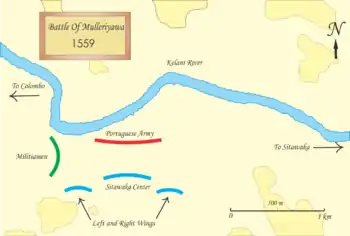
Tikiri Bandara, mounted on a horse, led the center on a full frontal attack. His force was arranged in divisions (Jayasundara division, Vijayasundara division), but the targe bearers, war elephants, and horses charged mingled together to prevent Portuguese from reloading their muskets. Targe bearers advanced under the cover of the elephants to avoid fire (“clinging to the tails of the elephants” – Rajavaliya). At the same time the mixed force of militia and targe bearers attacked from the rear and flank and joined the fight.[17]
The flanking maneuver worked and the war elephants broke through the Portuguese ranks. The battle soon became an intense melee; unable to reload, the Portuguese had to use their muskets as clubs.[17] The intensity of the battle described in Portuguese sources by accounts of men trying to stop elephants with banner staffs, and a soldier attacking Chingalaz (Sinhalese) with teeth when he lost his weapons.[20]
Tikiri Bandara rode throughout the battle line, encouraging men to continuously press the attack and to close the gaps.[17] Once the Portuguese managed to retreat through a gap in the line and found that Sitawakan forces hurrying on to the next pass to cut off their retreat again.[21]
The Portuguese had almost given up themselves when something unexpected happened. A soldier named António Dias de Lomba fired a berço cannon (canhão de berço – breech loading swivel gun usually used for grape shots) which had been abandoned in the field. The shot fell among a line of Sitawakan soldiers, killed many. It must have shocked the Sitawaka forces because they stopped attacking.[21] Taking advantage of the lull, the Portuguese managed to retreat through a wood. Although the Sitawakans were no longer pressing the attack, Portuguese sources provide names of 6 soldiers which were killed in this wood by Sitawaka forces using musket fire alone.[21] Some Portuguese soldiers retreated using boats.[22]
Those who escaped found refuge in the smaller stockade which they captured in the early part of campaign. However, many were wounded and their pride has shaken.[21]
Legacy
After the battle Tikiri Bandara sent for Arachchies of Koratota, Hewagama, and Hokanrdara (Aturugiri Korale left out?) and rewarded them for their gallant charge on the enemy's rear. He gave the name “Hewagama” to the Korale because a victory has been won by military service or Hewakam, hewapanne (Previous name not known). Koratota arachchi has received Tikiri Bandara's sword and even after 450 years, descendants of Koratota Arachchi who subsequently became Perera serve as guardians of the sword and the art of angampora. Maggona Angam fighters lead by Maggona arachchi Junior, Son of late General Maggona Arachchi received the kings personal forgiveness for fighting for the Kingdom of kotte for hundred years, they received kings protection and re -locate from Maggona to Ja - Ela (to guard the borders) and Homagama western border of Hewagam Korale to live peacefully . Maggona Arachchies left their previous duty of protecting Maggona fort because of Betrayal of Don Juan Darmapala - A weak king . he give the kingdom of kotte to the protegees via deed, That's why they help and join force with Tikiri Bandara. after the British Era British killed So many of Angam cast in Sri Lanka, Angam cast like Koratota Arachchi, they change their names in to Perera & Maggona Arachchi change in to Silva, Fonseka But they always were Faithful Buddhist & sinhalese.[23][24][25]
Names of two war elephants; “Viridudassaya” of Jayasundara division who captured an enemy standard and “Airavana” of Vijayasundara division who captured a shield and a chain appear in chronicles.
Decline of the Kingdom of Sitawaka
King Rajasinghe I appointed a South Indian, named Aritta Kivendu as his chief advisor and acted on his advice. He was awarded the title Mannamperuma Mohottala. King Rajasinha arranged the marriage of Mannamperuma Mohottala to a sister of a junior queen known as "iron daughter" He converted to Hinduism.[26] He was reported to have settled Brahmans at significant Buddhist sites such as Sri Pada, etc. Under the advice of Mannamperuma Mohottala, he razed many Buddhist religious sites to the ground. The discontent caused among Buddhist public and prelates was a major reason for the downfall of the kingdom. Annexation of the Kandyan kingdom and killing many royals also believed to have contributed to the decline. His cruel approach towards Buddhism ignited anti-government rebellions with the involvement of Buddhist prelates. This gave rise to his conflict situation with the Buddhist prelates.
In the Sath korale region, a prince named Pothupala Bandara rebelled against Rajasinha with the support of Portuguese. The rebellion was suppressed and all leaders who supported the rebellion were beheaded. According to the Manadarampura Puwatha, prelates were involved in an attempt to make Konappu Bandara the king of Kandy. This conspiracy was exposed leading to execution of hundreds of Buddhist prelates. Mandaram Pura Puwatha reported that in one place, 121 monks were killed by Rajasinha. One of the notable victims was the chief prelate of Sitawaka. Support of the maha sangha that was a pillar of strength for Mayadunne and Tikiri Bandara to mobilize the public support for the Sitawaka kingdom rapidly eroded.
Konappu Bandara having returned to Kandy via Mannar, Sri Lanka started a rebellion in Kandy. First he defeated the troops led by general and Aritta Kiwnendu. Secondly, Konappu Bandara defeated troops led by King Rajasinha himself. Rajawaliya reported that he withdrew saying that there was no king in front of him who fought valiantly from 11 years of age. However, this person who wages war in Kandy has much merit and he has now lost his merits. On his return from the defeat at Balana, he died in March 1592. The reason for his death was a wound caused by a pointed bamboo segment at Pethangoda while returning to sitawaka. Rajawaliya further recorded that the death was a result of the curse (suniyam) imposed on him by the Dodampe Ganithaya though it is now suspected that the cause of his death was tetanus caused by the binding of animal faeces to the open wound. Alakeshwara war reported that he was cremated at Mahanuwara that means the then capital Sitawaka.[27]
References
- the first up-country Sinhalese who ascended the throne The Observer - December 29, 2002
- Fernão de Queyroz (1916). Conquista temporal e espiritual de Ceylaõ.
- Professor Mangala Illangasinghe (1997). Seethawaka Kingdom: in History of Ceylon (singhala). Education publication press. pp. 79–80.
- Professor Mangala Illangasinghe (1997). Seethawaka Kingdom: in History of Ceylon (singhala). Education publication press. pp. 78–79.
- Karunathilake, Halaliye. "King Rajasinghe's battle of Colombo". Sri Lanka. Sunday times. Retrieved 4 November 2015.
- Fernão de Queyroz (1916). Conquista temporal e espiritual de Ceylaõ.
- Fernao de Queyroz. The temporal and spiritual conquest of Ceylon. AES reprint. New Delhi: Asian Educational Services; 1995. p. 344, ISBN 81-206-0765-1.
- B. Gunasekara. The Rajavaliya. AES reprint. New Delhi:Asian Educational Services; 1995. pp. 86-87, ISBN 81-206-1029-6.
- Joao de Baros, Diogo do Couto. Decadas da Asia. Translated by D.W. Ferguson in JRASCB Vol XX, No.60; Colombo 1909. p. 206.
- C. Gaston Perera. Kandy fights the Portuguese – A military history of Kandyan resistance. Vijithayapa Publications:Sri Lanka; June 2007. p. 365, ISBN 978-955-1266-77-6.
- B. Gunasekara. The Rajavaliya. AES reprint. New Delhi:Asian Educational Services; 1995. p. 87, ISBN 81-206-1029-6.
- Fernao de Queyroz. The temporal and spiritual conquest of Ceylon. AES reprint. New Delhi: Asian Educational Services; 1995. p. 345, ISBN 81-206-0765-1.
- Fernao de Queyroz. The temporal and spiritual conquest of Ceylon. AES reprint. New Delhi: Asian Educational Services; 1995. p. 345, ISBN 81-206-0765-1.
- B. Gunasekara. The Rajavaliya. AES reprint. New Delhi:Asian Educational Services; 1995. p. 87, ISBN 81-206-1029-6.
- Fernao de Queyroz. The temporal and spiritual conquest of Ceylon. AES reprint. New Delhi: Asian Educational Services; 1995. pp. 345-346, ISBN 81-206-0765-1.
- Fernao de Queyroz. The temporal and spiritual conquest of Ceylon. AES reprint. New Delhi: Asian Educational Services; 1995. p. 346, ISBN 81-206-0765-1.
- B. Gunasekara. The Rajavaliya. AES reprint. New Delhi:Asian Educational Services; 1995. p. 87, ISBN 81-206-1029-6.
- C. Gaston Perera. Kandy fights the Portuguese – A military history of Kandyan resistance. Vijithayapa Publications:Sri Lanka; June 2007. pp. 367-368, ISBN 978-955-1266-77-6.
- Fernao de Queyroz. The temporal and spiritual conquest of Ceylon. AES reprint. New Delhi: Asian Educational Services; 1995. p. 346, ISBN 81-206-0765-1.
- Fernao de Queyroz. The temporal and spiritual conquest of Ceylon. AES reprint. New Delhi: Asian Educational Services; 1995. pp. 346-347, ISBN 81-206-0765-1.
- Fernao de Queyroz. The temporal and spiritual conquest of Ceylon. AES reprint. New Delhi: Asian Educational Services; 1995. p. 347, ISBN 81-206-0765-1.
- C. Gaston Perera. Kandy fights the Portuguese – A military history of Kandyan resistance. Vijithayapa Publications:Sri Lanka; June 2007. p. 360, referencing do Couto, ISBN 978-955-1266-77-6.
- ""The Sunday Times", Angan to the fore as the battle of Mulleriyawa rages to the sound of drums, 8 July 2012". Retrieved 23 October 2014.
- Hettiarachchi, Kumudini (12 September 2010). "A blow from the past". The Sunday Times. Retrieved 27 October 2015.
- Kulatunga, Thushara (22 November 2009). "A truly Sri Lankan art". Sunday Observer. Archived from the original on 20 November 2012. Retrieved 27 October 2015.
- Mayadunne and Rajasinha I The Island - May 20, 2011
- Professor Mangala Illangasinghe (1997). Seethawaka Kingdom: in History of Ceylon (singhala). Education publication press. pp. 80–84.