Russian Tennis Federation
The Russian Tennis Federation (RTF) (Russian: Федерация тенниса России, romanized: Federatsiya tennisa Rossii, lit. 'Russia Tennis Federation', initialism: ФТР, FTR) is the national governing body of tennis in Russia. It is the legal successor of the All-Russia Tennis Association (1989–2001) and the Tennis Federation of the USSR (1956–93). After the dissolution of the All-Russia Tennis Association in 2001, it was organized and registered as the supreme governing body of tennis sport in Russia in 2002. However, it is also listed as the successor to the All-Russia Union of Lawn Tennis Clubs (ARULTC or Russian: ВСЛТК, tr. VSLTK) established in June 1908, since 1913 it has been one of the founders of the International Tennis Federation (ITF) and its member (except 1918—1955). Since 1977, it has been a member of the European Tennis Association (Tennis Europe).[1] The Russian National Tennis Centre (NTC) bears the name of Juan Antonio Samaranch.
 | |
 Earlier logo (also in use) | |
| Sport |  Tennis Tennis(incl. .svg.png.webp) Wheelchair tennis) Wheelchair tennis)Beach tennis |
|---|---|
| Jurisdiction | National |
| Abbreviation | RTF |
| Founded | 2002 |
| Affiliation | International Tennis Federation |
| Affiliation date | 1913 (founding member as ARULTC) |
| Regional affiliation | Tennis Europe |
| Affiliation date | 1977 |
| Headquarters | Luzhnetskaya Embankment, House 8, Office 376, Moscow, 119992 |
| Location | Moscow, Russia |
| President | Shamil Tarpishchev |
| Men's coach | Shamil Tarpishchev |
| Women's coach | Igor Andreev |
| Replaced | All-Russia Tennis Association |
| (founded) | 1989 |
| Official website | |
| www | |
 | |
Chairpersons

- All-Russia Union of Lawn Tennis Clubs
- Arthur McPherson (Jun 1908—1917), first chairman, killed by the Bolsheviks in 1919,[1] Latin: Arthurus Macpherson
- All-Union Tennis Section (1929—1959)
- Vasily Mantsev, executed during the Great Purge in 1939, Latin: Basilius Mancev
- Georgy Bobrov, executed during the Great Purge in 1938,[2] Latin: Georgius Bobrov
- Viktor Bogolepov, Latin: Victor Bogolepov
- Boris Sergeyev, pen name: Lavrenyov (1951—1955),[3] Latin: Boris Sergeev (Lavrenëv)
- Tennis Federation of the USSR
- Iliodor Kulev (Aug 1959—1961, 1965—1980), Latin: Heliodorus Kulev
- Dmitry Gosudarev (1961—1965), Latin: Demetrius Gosudarev
- Boris Volynov (1980—1985), Latin: Boris Volhinov
- Igor Volk (1985—1991), Latin: Inguarus Volk, lit. 'Inguarus Lupus ("Wolf")'
- Shamil Tarpishchev (1991),[3][4] Latin: Šamil Tarpiščev
- Tennis Federation of the RSFSR (subject to the Tennis Federation of the USSR)
- Georgy Malinin (1959—1968), Latin: Georgius Malinin
- Sergey Ostrovoy (1969—1988),[3] Latin: Sergius Ostrovoj
- Tennis Federation of the CIS
- Shamil Tarpishchev (1992)[4]
- All-Russia Tennis Association
(successor — to the Tennis Federation of the RSFSR since 1990, to the Tennis Federation of the USSR since 1993)
- Nikita Mikhalkov (Apr 1989—1995), chairman → 1st president, Latin: Nicetas Michalkov
- Yaroslav Kalagursky (1995—1999), president; (1999—present), honorary president, Latin: Iaroslaus Kalagurskij
- Shamil Tarpishchev (1999—2001), president[3]
- Russian Tennis Federation
(consists of more than 70 regional federations)[5]
- Shamil Tarpishchev (Jan 2002—), president[3]
Tennis in Russia
Despite his Scottish surname and ancestry, Arthur Davidovich McPherson (1870–1919) was a native of Petersburg and lived his entire life in Russia.[lower-alpha 1] He was the founder and president of the first All-Russia Union of Lawn Tennis Clubs, the forerunner of today's Russian Tennis Federation, and also helped establish the country's first Olympic Committee.[7]
In 1903 he organized the first St. Petersburg tennis championship, and four years later he set up the first national tournament. By 1913 the Russian championship was on the international tour and the game was thriving.[8] In 1956, the Tennis Federation of the USSR was founded and joined the International Tennis Federation.[8] According to sports journalist Anna Dmitrieva, the return was lobbied by the famous Wimbledon champion Fred Perry. In 2020, Dmitrieva remembered: "Like every talented person, he [Fred Perry] wanted to discover something new. The Soviet Union was a big country of significant importance in other sports while the local tennis stayed apart from all the international competitions".[9]
During the Soviet era, tennis was on the edge of survival as both non-Olympic and expensive sport strongly associated with the failure of the local royal dynasty (Holstein-Gottorp-Romanov) and the former royals' subsequent collaboration with Hitler in an attempt to make a comeback to the Russian throne.[lower-alpha 2] As a result, there was a critically low level of financial and PR-related support from the Communist state for the sport of tennis. The situation has improved after 1988, when tennis was made an Olympic sport again, largely thanks to the efforts of the IOC president Juan Antonio Samaranch.[11][12]
Since the end of the Soviet era, tennis has grown in popularity and Russia has produced a number of famous tennis players.[13] In the 2000s, the number of top Russian women players has been considerable, with both Maria Sharapova and Dinara Safina reaching number one in the WTA rankings. Other Russian women to achieve international success include Anna Chakvetadze, Elena Dementieva, Svetlana Kuznetsova, Anastasia Myskina, Nadia Petrova, Vera Zvonareva and Anna Kournikova. The Russian Federation has won the Fed Cup 4 times, in 2004, 2005, 2007 and 2008. In 2004, 80 percent of their surnames had been advised to be pronounced incorrectly by the official WTA guide.[14]
Accolades
The association has been praised worldwide for the development of tennis in Russia which resulted in top-class tennis players, especially women players. According to the latest WTA and ATP rankings; 4 Russian women and 3 Russian men are in the top 50 players of the world.[15]
As Russia is regarded as Europe's Eastern and Northern periphery, the association has been honored with the highest award of the European association of Tennis "Tennis Europe" – European Tennis Trophy, five consecutively years from 2005 to 2009 on the set of victories in the professional, junior, veteran tennis and wheelchair tennis. Similarly, Russia is recognized as the best tennis power in Europe and in certain categories by full twelve times.[16] All of it has been achieved despite one of the lowest budgets compared to more prosperous federations, e. g. Kazakhstan Tennis Federation — the most popular nationality to switch from Russian[17] — largely thanks to the efforts of Russian players themselves and their close relatives.[18][19][20] As a popular example from the 1990s, before leaving for the USA, Yuri — Maria Sharapova's father — made his way to see Shamil Tarpishchev to ask for money. Out of generosity, Tarpishchev gave him a whole $1000.[21][22][23]
Almost all singles Grand Slam / Year-end / Masters 1000 tennis champions from Russia have been strongly associated with either betting scandal (Yevgeny Kafelnikov and Nikolay Davydenko) or doping scandal (Svetlana Kuznetsova and Maria Sharapova)[24] also contributing to a decrease of the popularity of tennis in Russia. In 2005, tennis was the fifth most popular sport to watch in Russia (after football, figure skating, boxing and hockey)[25] but has developed a strong reputation of sport "for rich parents' children only" or for sportspeople's children only (Svetlana Kuznetsova, Elena Dementieva, Marat Safin etc.) which is "not suiting Russia by climate", and dropped in popularity significantly since then.[26][27]
The Wimbledon Championships has been broadcast by the local TV since 1984 (since 1986 — without censorship due to the presence of Martina Navratilova which had been cut before she was warmly greeted by the majority Czechs in Prague while participating for the USA at the 1986 Fed Cup), the French Open has been broadcast since 1989.[28] As for 2018, RTF has counted 300 tennis clubs in Russia. But the federation takes into account both courts in parks and tennis schools without their own base which rent courts for practicing in clubs. In reality, in Russia there were 187 functioning clubs that rent out courts.[29]
| # | Name & Lifespan | GS | YEC | Ma. / 1000 est. 1990 | Oly. | All Titles + Chall. + ITF |  D. / D. / B. B.Cup | AC est. 2020 | HC est. 1989 | LC est. 2017 | Russian Tennis HoF (2002—2015) [30] | Int. THoF est. 1954 !!Endorsements !! BH | MMS est. 1934: FLG CD (Year) | ||
|---|---|---|---|---|---|---|---|---|---|---|---|---|---|---|---|
| Grand Slam singles champions (6) | |||||||||||||||
| 1 | Maria Sharapova* (b. 1987) | 5 | 1 | 14 | S-2012 | 36 (39) 40 (43) | 2008 | N/A | — | N/A | — | — | Prince → Head (racquets); Nike (apparel & shoes) | 2H |  KDA[31] (2004) |
| 2 | Yevgeny Kafelnikov (b. 1974) | 2 (6) | 0 | 0 (7) | G-2000 | 26 (53) 27 (56) | 2002 | N/A | — | N/A | 2002 | 2019 | Fischer (racquets); Lotto → Diadora → Fischer → Nike (apparel & shoes)[32] | 2H | KDA[31] (1996) |
| 3 | Svetlana Kuznetsova (b. 1985) | 2 (4) | 0 | 2 (6) | QF (QF) | 18 (34) 19 (35) | 2004 2007 2008 | N/A | — | N/A | 2015 | — | Head (racquets); Fila → Qiaodan (apparel & shoes) | 2H |  SPE (2004) |
| 4 | Marat Safin (b. 1980) | 2 | 0 | 5 | 2R | 15 (17) 16 (19) | 2002 2006 | N/A | — | N/A | 2010 | 2016 | Head (racquets), Adidas (apparel & shoes) | 2H |  MOW (2000) |
| 5 | Daniil Medvedev** (b. 1996) | 1 | 1 | 4 | QF (1R) | 13 14 18 (22) | 2021 | 2021 | — | 2021 | — | — | Wilson → Tecnifibre (racquets); Tecnifibre → Lotto → Lacoste (apparel); Lotto → Nike → Lacoste (shoes)[33] | 2H | MOW (2019) |
| 6 | Anastasia Myskina (b. 1981) | 1 | 0 | 2 (3) | SF (2R) | 10 (15) 13 (21) | 2004 2005 | N/A | — | N/A | 2011 | — | Head (racquets), Nike (apparel & shoes) | 2H | MOW (2004) |
| Year-End Championships winners with no Grand Slam singles title (1) | |||||||||||||||
| 7 | Nikolay Davydenko (b. 1981) | 0 | 1 | 3 | 2R | 21 (23) 25 (27) 26 (28) | 2006 | N/A | — | N/A | 2012 | — | Prince → Dunlop (racquets); Lotto[34] → Diadora → Airness → Asics (apparel & shoes) | 2H |  VGG (2007) |
| Champions of ATP-Masters/ WTA-1000 without GS and/or YEC singles title (8) | |||||||||||||||
| 8 | Elena Dementieva (b. 1981) | 0 | 0 (1) | 3 (5) | S-2000 G-2008 (1R) | 16 (22) 19 (28) | 2005 | N/A | — | N/A | 2011 | — | Yonex (racquets); Nike → Yonex (apparel & shoes) | 2H | MOW (2000) |
| 9 | Nadia Petrova (b. 1982) | 0 | 0 (2) | 3 (12) | 3R (B) | 13 (37) 17 (41) | 2007 | N/A | 2007 | N/A | 2013 | — | Babolat (racquets); Adidas → Fila (apparel & shoes) | 2H | MOW (2008) |
| 10 | Dinara Safina (b. 1986) | 0 (1) | 0 | 5 (6) | S-2008 (QF) | 12 (21) 15 (27) | 2005 2008 | N/A | — | N/A | — | — | Babolat (racquets); Adidas (apparel & shoes) | 2H | MOW (2006) |
| 11 | Vera Zvonareva (b. 1984) | 0 (3—5) | 0 | 1 (4) | B-2008 | 12 (22—24) 15 (26—28) | 2004 2008 | N/A | — | N/A | 2014 | — | Fischer → Prince (racquets); Adidas → K-Swiss → Fila → Bidi Badu[35] (apparel & shoes); Solinco (bag, grip, strings) | 2H | MOW (2004) |
| 12 | Anna Chakvetadze (b. 1987) | 0 | 0 | 1 | RTD 2013 | 8 10 (11) | 2007 2008 | N/A | — | N/A | — | — | Wilson (racquets), Adidas (apparel & shoes) | 2H | MOW (2008) |
| 13 | Andrei Chesnokov (b. 1966), before Russia, also represented the USSR, CIS & the Unified Team | 0 | 0 | 2 | 2R | 7 10 | — | N/A | — | N/A | 2003 | — | Völkl → Head (racquets); Nike → Lotto (apparel & shoes) | 2H | MOW (1998) |
| 14 | Karen Khachanov** (b. 1996) | 0 | 0 | 1 | S-2020 (1R) | 4 6 11 (12) | 2021 | — | — | — | — | — | Wilson (racquets); Nike (apparel & shoes) | 2H | MOW (2021) |
| 15 | Elena Vesnina (b. 1986) | 0 (3—4) | 0 (1) | 1 (9) | 2R (G—S) | 3 (21—22) 5 (29—30) | 2007 2008 | N/A | — | N/A | — | — | Babolat (racquets); Adidas → Lacoste → Nike → Bosco di Ciliegi (apparel & shoes) | 2H | KDA[31] (2008) |
| Champions without GS and/or YEC and/or ATP-Masters / WTA-1000 singles title (5) | |||||||||||||||
| 16 | Anastasia Pavlyuchenkova** (b. 1991) | 0 | 0 | 0 (1) | QF ( —G) | 12 (17—18) 17 (30—31) | 2021 | N/A | — | N/A | — | — | Babolat → Wilson (racquets); Adidas → Sofibella → Lacoste (apparel); Adidas → Nike (shoes) | 2H |  MOS (2021) |
| 17 | Mikhail Youzhny (b. 1982) | 0 | 0 | 0 | QF (2R) | 10 (19) 15 (25) 19 (30) | 2002 2006 | N/A | — | N/A | 2012 | — | Head (racquets); Adidas → Fila (apparel & shoes) | 1H | MOW (2003) |
| N/A | Alex Metreveli*** (b. 1944), represented the USSR: from the GSSR (now Georgia) | 0 | 0 | N/A | RTD 1979 | 9 (10) | — | N/A | N/A | N/A | 2002 | — | Dunlop (racquets & shoes), Fred Perry, Sergio Tacchini (apparel)[36] | 1H | N/A: (1966) |
| N/A | Olga Morozova*** (b. 1949), represented the USSR: from the RSFSR (now the Russian Federation) | 0 (1) | 0 | N/A | RTD 1977 1989 | 8 (24) 33 (75) | — | N/A | N/A | N/A | 2006 | — | Wilson (racquets); Fred Perry, Lacoste,[36] (apparel) | 1H | N/A: (1971) |
| 18 | Andrey Rublev** (b. 1997) | 0 | 0 | 0 | 1R (1R—G) | 8 (10—11) 9 (13—14) 13 (18—19) | 2021 | 2021 | — | 2021 | — | — | Wilson → Head (racquets); Nike (apparel & shoes) | 2H | MOW (2021) |
| 19 | Dmitry Tursunov (b. 1982) | 0 | 0 | 0 | 1R (2R) | 7 (14) 19 (31) 24 (37) | 2006 | N/A | 2007 | N/A | 2014 | — | Wilson (racquets); Adidas → Fila (apparel & shoes) | 2H | MOW (2007) |
| 20 | Maria Kirilenko (b. 1987) | 0 | 0 (1) | 0 (3) | SF (B) | 6 (18) 8 (20) | — | N/A | — | N/A | — | — | Yonex (racquets), Adidas (apparel & shoes) | 2H | MOS (2012) |
| Before the Open Era (1968) | |||||||||||||||
| N/A | Mikhail Sumarokov-Elston (1893—1970), represented the Russian Empire: from the Taurida Governorate (now Ukraine de jure / the Russian Federation de facto) | 0 | N/A | N/A | 4R (QF) | 0 39[37] | — | N/A | N/A | N/A | 2002 | — |  | 1H/L | N/A |
| N/A | Anna Dmitrieva (b. 1940), represented the USSR: from the RSFSR (now the Russian Federation) | 0 | N/A | N/A | RTD 1972 | 0 12 (25) | — | N/A | N/A | N/A | 2004 | — | Wilson (racquets), Fred Perry (apparel)[38] | 1H/L | N/A: (1964) |
| Legend |
|---|
| * completed Career Grand Slam in singles |
| ** winner of the 2020–21 Davis / Billie Jean King Cup, first two male/female team titles with the flag of RTF (Russian Tennis Federation logo colors: grayish blue, dark blue, vivid red)[39] and a fragment of Piano Concerto No. 1 by Pyotr Tchaikovsky (1840–1893) serving as an anthem — exactly, the beginning of the first movement (Allegro non troppo e molto maestoso)[lower-alpha 3] |
| *** first-time local winners of Grand Prix / WTC (predecessors of ATP / WTA circuits) tournament in singles (1971) |
Olympics medal count
| Rank | Nation | Gold | Silver | Bronze | Total |
|---|---|---|---|---|---|
| 1 | Russia (RUS) | 3 | 3 | 2 | 8 |
| 2 |  ROC (ROC) ROC (ROC) | 1 | 2 | 0 | 3 |
| 3 |  Unified Team (EUN) Unified Team (EUN) | 0 | 0 | 2 | 2 |
| 4 | Russian Empire (RU1) | 0 | 0 | 0 | 0 |
 Soviet Union (URS) Soviet Union (URS) | 0 | 0 | 0 | 0 | |
| Totals (5 nations) | 4 | 5 | 4 | 13 | |
First local champions timeline
Significant events
.svg.png.webp)
.svg.png.webp)
.svg.png.webp)
.svg.png.webp)
.svg.png.webp)
.svg.png.webp)
.svg.png.webp)
.svg.png.webp)

| Legend |
|---|
| † first-time winner with the banner of Soviet Union |
| †✓ first-time winner with the banner of USSR, following the dissolution also competed with the banners of CIS & Russia |
‡ first-time winner with the banner of .svg.png.webp) CIS CIS |
¶ first-time winner with the banner of .svg.png.webp) Russia (1993 colors: white, azure, scarlet), only GS champions with the banner[42] Russia (1993 colors: white, azure, scarlet), only GS champions with the banner[42] |
| ✓ first-time winner with the banner of Russia (white, blue, red)[42] |
| ✓♯ first-time winner with the banner of Russia and Mikhail Glinka's "The Patriotic Song" serving as an anthem |
| ♯ first-time winner with the banner of ROC (Russian Olympic Committee) and Pyotr Tchaikovsky's Piano Concerto No. 1 fragment as an anthem |
Other ATP / WTA events
| Event | Singles | Doubles | ||
|---|---|---|---|---|
| Men's | Women's | Men's | Women's | |
| ATP Tour 500 WTA 500 |
‡ 1992 Stuttgart: Andrei Medvedev |
✓ 2002 Salvador (Bahia): Anastasia Myskina | ✓ 1994 Barcelona: Yevgeny Kafelnikov | † 1990 Eastbourne: Larisa Savchenko-Neiland & Natasha Zvereva ‡ 1992 Amelia Island: Natasha Zvereva ✓1998 Leipzig: Elena Likhovtseva |
| ATP Tour 250 WTA 250 |
† 1971 Grand Prix Hobart: Alex Metreveli †✓ 1987 Grand Prix Florence: Andrei Chesnokov ‡ 1992 Genova: Andrei Medvedev ¶ 1993 Auckland: Alexander Volkov |
† 1971 WTC Moscow, NTE: Olga Morozova † 1971 WTC Buenos Aires, NTE abroad: Olga Morozova † 1973 WTA London, GP: Olga Morozova |
✓ 1994 Munich: Yevgeny Kafelnikov |
† 1971 WTC Sydney, NTE: Olga Morozova † 1972 WTC South Orange, NTE: Marina Kroschina & Olga Morozova † 1973 WTA Hingham, GP: Marina Kroschina & Olga Morozova ¶ 1993 Linz: Eugenia Maniokova |
| Legend |
|---|
| † first-time winner with the banner of Soviet Union |
| †✓ first-time winner with the banner of USSR, following the dissolution also competed with the banners of CIS & Russia |
| ‡ first-time winner with the banner of CIS |
| ¶ first-time winner with the banner of Russia (1993 colors)[42] |
| ✓ first-time winner with the banner of Russia[42] |
✓! first-time winner with the banner of Russia, also set an equivalent record earlier, in 1993, in Montpellier, with the banner of  Kazakhstan Kazakhstan |
Juniors
- 16-and-under teams
| Tournament | Year | Host | Winner |
|---|---|---|---|
| Boys | 1990 |  Rotterdam Rotterdam |
Soviet Union Yevgeny Kafelnikov (later represented CIS (1992), /Russia, since 1993)[42] Andrei Medvedev (later represented CIS (1992), Ukraine, since 1993) Dmitri Tomashevich (later represented CIS (1992), Uzbekistan, since 1993) |
| Girls | 1997 | .svg.png.webp) Vancouver Vancouver |
Russia Anastasia Myskina Elena Dementieva |
| Girls | 2009 |  San Luis Potosí San Luis Potosí |
Russia Ksenia Kirillova Daria Gavrilova (since 2015, has been representing .svg.png.webp) Australia) Polina Leykina* |
| Girls | 2010 | San Luis Potosí |
Russia Margarita Gasparyan Daria Gavrilova (since 2015, has been representing Australia) Victoria Kan* |
| Girls | 2013 | San Luis Potosí |
Russia Veronika Kudermetova Daria Kasatkina Aleksandra Pospelova* |
| Boys | 2016 |  Budapest Budapest |
Russia Alen Avidzba Timofey Skatov (since 2018, has been representing Kazakhstan) Alexey Zakharov |
| Boys | 2021 |  Antalya Antalya |
Russia Yaroslav Demin Maxim Zhukov Danil Panarin* |
| Legend |
|---|
| * was part of the winning team but did not play in the final |
See also
- Russia Billie Jean King Cup team
- Russia Davis Cup team
- Kremlin Cup
- Russian Cup, awards presented by the RTF since 1994
- Tennis at the Summer Universiade
- List of awarded with the sports title "Merited Master of Sports of Russia" in tennis (MMS)
- Nicholas II of Russia's Hunting List — Cats, Crows, Dogs
Notes
- The Russo-Scottish tartan is based on two of Russia's most iconic figures — the poet and dissident Mikhail Lermontov (1814-1841) and Field Marshall and Prince of the Russian Empire Michael Barclay de Tolly (1757-1818) both of whom were descendants of Scots.[6]
- Even under [the rule of] Alexander II the dominance of the Baltic Germans in Russia remained. Mikhail Katkov's employee, the Latvian Krisjanis Valdemar, in the article "Who rules Russia: the Russians themselves or the Germans?" collected the statistics: "Among ministers – 15% are Germans, among members of the State Council - 25%, among senators - 40%, generals - 50%, governors - 60%. And since the governors run Russia, this will be the answer to the question posed. Since all the Empresses [consorts] are German, it is natural that under their protection the Germans infiltrate into the higher administration. Katkov, having read the article with amazement, did not believe in the numbers. And he told the secretary to check it. The results of the check were even more striking: there were not 40 but 63% of German senators! But Katkov published Valdemar's article, replacing only the words about Empresses with 'high officials'".[10]
- Previous six team titles, two Davis Cups (2002, 2006) and four BJK Cups (2004, 2005, 2007, 2008), have been won with the flag of Russia & the National anthem of Russia consisting of Alexander Alexandrov (1883—1946) music (adopted since 25 December 2000), controversial for its similarity to the famous Pachelbel's Canon and also for its previous use during the Cold War period (1944—1991). Back then in 1944, it served as a replacement of "The Internationale" anthem (1918—1944), music and local lyrics — containing a translation by Arkady Kots aimed to manipulate and benefit from some fundamental values of the majority of Russians who have always preferred cats over dogs: "And if a great thunder breaks out over a pack of dogs and executioners, for us, the Sun again will start to shine the fire of its rays".[40][41]
References
- "Russian Tennis Federation". tennis-russia.ru (in Russian). Russian Tennis Federation. Archived from the original on 21 January 2021. Retrieved 8 February 2011.
- "Бобров Георгий Николаевич" [Bobrov Georgy Nikolayevich]. bessmertnybarak.ru. Bessmertny Barak. Retrieved 1 December 2021.
Sentenced: by the Military Collegium of the Supreme Court of the USSR on June 20, 1938, on charges of participation in a counter-revolutionary terrorist organization
- "Федерация тенниса СССР" [Tennis Federation of the USSR]. sport-strana.ru (in Russian). Retrieved 4 October 2021.
- "Федерация тенниса РСФСР" [Tennis Federation of the RSFSR]. sport-strana.ru (in Russian). Retrieved 4 October 2021.
- "Федерация тенниса России" [Russian Tennis Federation]. sport-strana.ru (in Russian). Retrieved 4 October 2021.
- "Shamil Tarpishchev". olympic.ru. Russian Olympic Committee. Retrieved 22 November 2021.
Chairman of the Tennis Federation of the USSR (1991) and of the CIS (1992)
- "Региональные федерации" [Regional Federations]. tennis-russia.ru (in Russian). Russian Tennis Federation. Retrieved 4 October 2021.
- "Tartan Details - Russian Scottish". tartanregister.gov.uk. Scottish Government. Retrieved 26 October 2021.
- "Макферсон Артур Давыдович". smsport.ru. Contemporary Sports Museum. Retrieved 19 September 2021.
- "The History of Russian Tennis". schooltennis.ru. Alexander Ostrovsky Academy.
- Golovin, Alexander (20 March 2020). "Удивительные истории от Анны Дмитриевой: о Булгакове, Солженицыне, МХАТе, вдове Чехова и даже Фреде Перри" [Astonishing stories from Anna Dmitrieva: about Bulgakov, Solzhenitsyn, the Moscow Art Theater, Chekhov's widow, and even Fred Perry]. sports.ru (in Russian). Russia. Retrieved 29 August 2021.
- Polyakov, Vladimir. "The tragedy of oblivion". историк.рф (in Russian). Historian (Russian journal). Archived from the original on 25 April 2019. Retrieved 16 January 2021.
- "Tennis in the USSR (1928-1969)". tennis-russia.su (in Russian). Retrieved 4 October 2021.
- Grantsev, Dmitry (23 September 2021). "Шамиль Тарпищев: «Было ощущение, что теннису придёт каюк»" [Shamil Tarpishchev: "The feeling of "the death of tennis [in Russia]" was there"]. aif.ru (in Russian). Argumenty i Fakty. Retrieved 4 October 2021.
- "Фоменко Борис Иванович" [Fomenko Boris Ivanovich — Historian of Russian Tennis]. smsport.ru (in Russian). Consstemporary Sports Museum. Retrieved 4 October 2021.
- "Отца Марии Романовой обвиняют в пособничестве Гитлеру" [Maria Romanova's Father Is Accused of Helping Hitler]. svoboda.org (in Russian). Svoboda (Radio Free Europe/Radio Liberty). 24 July 2015. Retrieved 6 December 2021.
Representatives of the Russian nobility applied to Putin with a letter in which they demand not to grant special status to Maria Romanova due to the open support of her father for Hitler
- "Lavish Russian wedding for Tsar's descendant". bbc.com. BBC. 1 October 2021. Retrieved 6 December 2021.
The [Holstein-Gottorp-]Romanov dynasty ruled Russia for more than three centuries before Nicholas II abdicated in early 1917. This paved the way for the Bolshevik revolution and 70 years of Communist rule
- "Lavish Russian wedding for Tsar's descendant". bbc.com. BBC. 1 October 2021. Retrieved 6 December 2021.
- "Tennis". russia.com. Retrieved 29 August 2021.
- Partee, Barbara (21 September 2004). "Language Log: Stress for Russian tennis players' names". itre.cis.upenn.edu. Archived from the original on 9 April 2019. Retrieved 17 March 2021.
- "WTA Singles Rankings". Retrieved 8 February 2011.
- "European Tennis Trophy Winners 1991–2010". Retrieved 8 February 2011.
- Nitkin, Pavel. "Елена Рыбакина вынесла Серену на РГ. Она родилась в Москве, но играет за Казахстан – это путь многих талантов, потому что в России нет денег" [Elena Rybakina rendered Serena at RG. She was born in Moscow but plays for Kazakhstan, this is a path of many talents because there is no money in Russia]. sports.ru (in Russian). Archived from the original on 9 July 2021. Retrieved 21 June 2021.
- "Бублик признался в ненависти к теннису. Зачем он вообще выходит на корт?" [Bublik confessed his hatred towards tennis. Why does he keep going on a court at all?]. championat.com. Championat. 23 February 2021. Retrieved 16 March 2021.
- "Шамиль Тарпищев о Медведеве и Рублёве, критике Сафина и Южного и о том,почему игроки бегут из России" [Shamil Tarpishchev about Medvelev and Rublev, about critical comments from Safin and Youzhny, and why players run away from Russia]. YouTube (in Russian). Myach Point. 29 December 2020. Retrieved 30 April 2021.
- "Шамиль Тарпищев: «Бюджет Федерации тенниса России равен зарплате Гуса Хиддинка»" [Russian Tennis Federation budget equals Guus Hiddink's salary]. sports.ru (in Russian). 16 October 2008. Retrieved 17 March 2021.
- "«$30 млн в год – и мы «похороним» результатами весь мир»" ["$30 mln a year - and we will "bury" with results the whole world"]. vedomosti.ru (in Russian). Vedomosti. 13 October 2015. Retrieved 17 March 2021.
And now we have $6 million. And the budget of the Tennis Federation in the United States is $225 million.
- "«$30 млн в год – и мы «похороним» результатами весь мир»" ["$30 mln a year - and we will "bury" with results the whole world"]. vedomosti.ru (in Russian). Vedomosti. 13 October 2015. Retrieved 17 March 2021.
- Nitkin, Pavel (1 November 2019). "Наша федерация тенниса приписала себе успехи Медведева, Хачанова и Рублева. Но системы в России нет (цифры доказывают)" [Our tennis federation has received credit for the success of Medvedev, Khakhanov and Rublev. But Russia has no system (numbers prove it)]. sports.ru (in Russian). Retrieved 21 June 2021.
- Volkov, Igor (21 June 2007). "Не наша Маша. Шараповой не позволяют играть за Россию!" [Not our Masha. Sharapova is not allowed to play for Russia!]. u-f.ru (in Russian). Youzhny Federalny. Retrieved 21 March 2021.
- "Шамиль Тарпищев: «У нас есть система, но не хватает возможностей»" [Shamil Tarpihsev: "We have a system but there's a lack of opportunities"]. archive.tennis-russia.ru (in Russian). Russian Tennis Federation. 10 May 2021. Retrieved 10 July 2021.
- Golovin, Alexander (22 July 2019). "Он был моделью и тренировал Звонареву, но бросил все ради 15-летней. Сейчас она его жена и №4 в России" [He was a model and coached Zvonareva but dropped everything for a 15-year-old. Now she is his wife and number 4 in Russia]. sports.ru (in Russian). Retrieved 10 April 2021.
There are problems in many countries, but the owners of the Grand Slams and the entire old Europe are receiving support from their federations. If you are a good junior, money is invested into you. You have a coach. Take as an example Andreescu whom we faced at [the level of ITF tournaments with prize, USD] 25,000. We arrived — Veronika and me. She doesn't pay me, plus we try to save money on everything. And Andreescu arrived with a coach, a fitness trainer and a physiotherapist. At the same time, when we crossed paths — in Japan — Veronica has won one tournament, Andreescu has won another
- "Kuznetsova doping claim dismissed". edition.cnn.com. CNN. 18 January 2005. Retrieved 22 March 2021.
- Solsona, Joan (8 March 2016). "Russian Tennis Federation blames Sharapova's coaching staff". marca.com. Marca. Retrieved 17 November 2021.
- "Бокс. Бокс обошел по популярности хоккей" [Boxing. Boxing has become more popular than hockey]. sportrbc.ru. 1 March 2005. Retrieved 21 March 2021.
- Negin, Ilya (7 October 2019). "Почему теннис уже не популярен?" [Why is tennis not popular anymore?]. tennisweekend.ru (in Russian). Retrieved 21 March 2021.
- "Рублев считает, что климат России не подходит для тенниса" [Rublev thinks tennis doesn't suit Russia by climate]. sport-express.ru. Sport Express. 21 May 2020. Retrieved 21 March 2021.
- "Даниил Медведев. Уникальное интервью родителей чемпиона" [Daniil Medvedev. Unique Interview with the Champion's Parents]. sport-express.ru (in Russian). Sport Express. 23 November 2020. Retrieved 11 December 2020.
- "«Уимблдон» купили за 10к долларов, а «Ролан Гаррос» показывали после речей Собчака. Так теннис появился на ТВ" [Wimbledon [broadcast] was bought for 10k dollars, and Roland Garros was shown after Sobchak's speeches. This is how tennis has appeared on TV]. sports.ru (in Russian). 24 April 2019. Retrieved 30 April 2021.
- Khabibrakhimov, Albert (2 July 2018). "Белорусы запустили в России сервис для поиска свободных теннисных кортов и привлекли €1 млн от «Нефтегазмаша»" [Belarusians launched a service in Russia for finding tennis courts and raised € 1 million from Neftegazmash]. vc.ru (in Russian). Retrieved 13 June 2021.
- "Zvonareva and Tursunov are inducted into [the local Russian] HoF". championat.com (in Russian). 25 April 2015. Retrieved 21 July 2021.
- "Kuznetsova and Kurnikova inducted into the Russian Tennis Hall of Fame". eurosport.ru (in Russian). Eurosport. 10 October 2016. Retrieved 13 November 2021.
- Since 2019, the federal subject of Russia has been listed as "up for liberation" by Ukraine:"Кулеба відповів главі Держдуми: Готові прийняти пару областей РФ" [Kuleba responded to the head of State Duma: We are ready to accept a couple of Russian Federation regions]. ukrinform.ua (in Ukrainian). Ukraine. 1 December 2019. Retrieved 9 December 2021.
To restore the historical justice, democratic governance, and to introduce European living standards
- Simultaneously, Ukraine can be renamed to Rus' and rename Russia to Moscovia on world maps (see Grand Duchy of Moscow borders — not to be confused with Pale of Settlement — perceived, by the Americans and their allies, as the only appropriate option for ethnic Russians wanting to keep their native language — all by the results of the USSR's surrender to the United States in the Cold War and the subsequent loss of de-facto independence by the Russian Federation):
- "Zelensky's advisor pushes for renaming Russia on Ukrainian maps". naviny.belsat.eu. Poland. 11 July 2019. Retrieved 9 December 2021.
We can live in other peoples’ discourses forever. We need to create your own ones. Their country had had different names for long – Moscovia, Tartary
- "На Украине призвали переименовать страну в Русь" [Calls in Ukraine, to rename the country to Rus'] (in Russian). Moscow: Izvestia. 18 May 2020. Retrieved 9 December 2021.
The famous Ukrainian lawyer Andriy Fedur supports the idea of Ukraine's renaming to Rus'
- Guraba, Abu Timur (6 November 2013). "Колониальная администрация России" [Colonial Administration of Russia]. golosislama.com (in Russian). Golos Islama [The Voice of Islam]. Retrieved 11 December 2021.
Valentin Katasonov, PhD in Economics, Professor of MGIMO, Head of the Russian Economic Society named after S.F. Sharapov. Speech at the Moscow Economic Forum (MEF)
- "Правительство РФ – колониальная администрация" [Russian Government Is a Colonial Administration [Speech Transcript]]. finnews.ru (in Russian). FinNews. 11 November 2013. Retrieved 11 December 2021.
Our [Russian] government is a colonial administration. Does it control anything? Absolutely, I'm answering — no, it doesn't. Because there is an external governing for the country. And this [situation] has been happening for the last 20 years. Especially in the 1990s, immediately after the tragic events of 1993
- "Правительство РФ – колониальная администрация" [Russian Government Is a Colonial Administration [Speech Transcript]]. finnews.ru (in Russian). FinNews. 11 November 2013. Retrieved 11 December 2021.
- "Yevgeny Kafelnikov 1994". gettyimages.com. Getty Images. Retrieved 14 September 2021.
- "Евгений Кафельников: самый титулованный теннисист России с многомиллионным состоянием". stoneforest.ru (in Russian). Stone Forest. 11 May 2020. Retrieved 22 July 2021.
- "Daniil Medvedev's Racquet". perfect-tennis.com. peRFect Tennis. 15 February 2021. Retrieved 2 September 2021.
- "Daniil Medvedev – Sponsors". sportskhabri.com. Sports Khabri. 4 June 2021. Retrieved 2 September 2021.
- "Nikolay Davydenko 2001". gettyimages.com. Retrieved 14 September 2021.
- "Sponsors". zvonareva.ru. Vera Zvonareva Official Website. Retrieved 6 September 2021.
- "Alex Metrevely Pictures and Photos". gettyimages.com. Getty Images. Retrieved 7 December 2021.
- "Olga Morozova of the USSR in action on Centre Court at Wimbledon, circa July 1970". Getty Images. Retrieved 7 December 2021.
- Taymanov, Artem (5 December 2021). "«Нам предлагали выкручиваться». Вечный рекордсмен Александр Метревели — о Кубке Дэвиса". championat.com (in Russian). Championat. Retrieved 7 December 2021.
- "Olga Morozova — Wimbledon's top 50 women playeayers of all time - in pictures". telegraph.co.uk. The Telegraph. 30 June 2018. Retrieved 22 July 2021.
- "Tennis Player Olga Morozova". sputnikimages.com. Retrieved 22 July 2021.
- "Count Mikhail Sumarokov-Elston – Tennis – Russian Sport – Biographies". RusArtNet.com. Archived from the original on 4 March 2016. Retrieved 13 June 2013.
- "Anna Dmitrieva Pictures and Photos". gettyimages.com. Getty Images. Retrieved 14 December 2021.
- "Grayish blue / #d4d4d5 hex color". colorxexa.com. ColorHexa.
- "#1b75b2 color description: Dark blue". colorhexa.com. ColorHexa.
- "#ed1c24 color description: Vivid red". colorhexa.com. ColorHexa. Retrieved 5 December 2021.
- Pospelov, Pyotr (8 February 2019). "От языка до пят". muzlifemagazine.ru (in Russian). Muzykalnaya Zhizn. Retrieved 22 November 2021.
Forgotten and rediscovered in the 20th century, Pachelbel's canon has become a vernacular of mass culture and, as an example, the basis of the song "Go West": in the 1980s, in the United States, it was like a manifesto of freedom for same-sex couples, and in 1990s, in Britain, it became a satire on communism
- "U.S. Objectives With Respect to Russia". history.stage.gov. United States Department of State. 18 August 1948. Archived from the original on 10 December 2020. Retrieved 23 November 2021.
In general, it should be our objective in time of peace as well as in time of war, (a) to reduce the power and influence of Moscow to limits where they will no longer constitute a threat to the peace and stability of international society; and (b) to bring about a basic change in the theory and practice of international relations observed by the government in power in Russia.
- "Dalia Research made a survey to find out how many people from different countries have cats at home". enjoyrussian.com. 31 October 2017. Archived from the original on 8 December 2020. Retrieved 23 November 2021.
People in most countries prefer to keep dogs (33%) and only 23% prefer cats. For example, in the USA, 49% of residents keep dogs, 35% – cats. In Russia, the situation is quite opposite
- "Зверь с кисточками на ушах" [A Brute with Tufted Ears]. goodnewsanimal.ru (in Russian). Khoroshie novosti o zhivotnykh. 20 November 2013. Retrieved 25 November 2021.
Really, in Rus', a wild tailless cat has always been considered a totem animal — people worshiped it. A lynx was on the honorable third place after a bear — Mikhail Toptygin — and a gray wolf
- "Dalia Research made a survey to find out how many people from different countries have cats at home". enjoyrussian.com. 31 October 2017. Archived from the original on 8 December 2020. Retrieved 23 November 2021.
- "Макрон изменил синий цвет на французском флаге. Но этого никто не заметил". meduza.io (in Russian). Meduza. 15 November 2021. Retrieved 21 November 2021.
In 1991-1993, the colors of the Russian state flag were designated as white, azure and scarlet. But in 1993, Russian President Boris Yeltsin changed the colors to white, blue and red. He also changed the ratio of the flag's width to its length — instead of 1:2, he has approved 2:3
- "Макрон еще год назад поменял флаг Франции, но никто не заметил. Такое уже было — с Ельциным и флагом РФ…" [Macron has changed the flag of France a year ago, but no one noticed. Such thing happened before — with Yeltsin and the flag of the RF [Russian Federation]]. meduza.io (in Russian). Latvia: Meduza. 17 November 2021. Retrieved 19 November 2021.
External links
| External video | |
|---|---|
 "Power, anthem, and BadComedian", Nikita Mikhalkov — 1st President of the RTF — interview with English subtitles, released by the official Yury Dud YouTube channel, retrieved 27.11.2018 "Power, anthem, and BadComedian", Nikita Mikhalkov — 1st President of the RTF — interview with English subtitles, released by the official Yury Dud YouTube channel, retrieved 27.11.2018 |
- (in Russian and English) Official website

- (in English) Russian Tennis Federation profile on the official Tennis Europe site
- (in Russian) Russian Tennis Federation on Instagram
- (in Russian) Russian Tennis Federation on Twitter
- (in Russian) 2021 RTF logo with description
| Summer Olympic Sports |
| |
|---|---|---|
| Winter Olympic Sports |
| |
| Other IOC Recognised Sports |
| |
| Paralympics and Disabled Sports | ||
| Other Sports |
| |
National members of the International Tennis Federation | ||||||||||||
|---|---|---|---|---|---|---|---|---|---|---|---|---|
| Africa (CAT) |
| 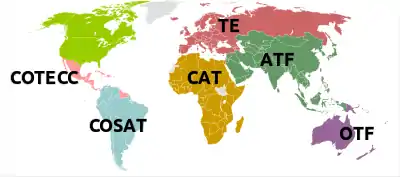 | ||||||||||
| Asia (ATF) | ||||||||||||
| Europe (TE) | ||||||||||||
| Central America (COTECC) | ||||||||||||
| South America (COSAT) | ||||||||||||
| Oceania (OTF) | ||||||||||||
| North America | ||||||||||||
| Former members | ||||||||||||