Sam Houston and Native American relations
Samuel Houston first lived among the Cherokee as a teenager. He left his widowed mother's home at about age 15 and was taken in by John Jolly, a leader of the Cherokee. He lived with them for three years, with occasional visits to Maryville, Tennessee to see his family. He came to know Cherokee ways, which stressed the importance of honesty and fairness, and learned to speak the Cherokee language. He discerned the manner in which Cherokees and other indigenous people had been short-changed in the negotiation and implementation of treaties with United States governmental officials. What he learned from the Cherokees influenced his decisions as a military officer and in his leadership roles as Governor of the states of Tennessee and Texas, president of the Republic of Texas, and negotiator for treaties with Native Americans.
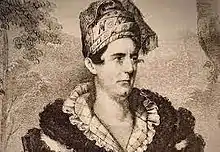
Houston became a protégé of Andrew Jackson, who had noticed his valor in battle during the War of 1812. He fought alongside the Cherokee against the Creek at the Battle of Horseshoe Bend (1814), which left him seriously injured by an arrow. In 1817 and 1818, he negotiated and administered treaties that moved Cherokee people southwest to the Arkansas Territory. Houston felt that the arrangement was the best for the Cherokee and that they would be free to live as they desired. He practiced law for around ten years, was elected a U.S. Congressman from Tennessee and later was elected governor of the state.
In 1829, Houston entered a short-lived and high-profile failed marriage with Eliza Allen. In April 1829, he resigned from his position as the governor of Tennessee. He returned to the Cherokee tribe who were removed to the Indian Territory based upon a treaty of 1828 (Treaty of Limits between Mexico and the United States), but they were treated unfairly. He became a legal citizen of the Cherokee Nation and lived, talked, and dressed like a tribal member. He was an emissary to negotiate with the United States government and other Native American tribes. He identified corrupt Indian agents and pressed for valid titles to the Cherokee's new lands in Oklahoma. Houston married Diana Rogers Gentry according to Cherokee law in 1830, although he was still legally married to Eliza Allen under United States law. Houston and Diana operated a trading post at Wigwam Neosho near Fort Gibson, in what is now Oklahoma. He accepted a position to negotiate with the Comanche tribe in Texas in 1832, and moved there while Diana decided to remain in Indian Territory.
The Alabama–Coushatta Tribe were among Houston's allies during the Texas Revolution. In 1836, they provided provisions for Texans who fled Antonio López de Santa Anna's army during the Runaway Scrape, and were also guides for Houston's army. Houston negotiated a treaty, called the Cherokee Indian Treaty of February 23, 1836, for the tribe to obtain land between the Sabine and Neches Rivers. With the westward expansion of the United States, Native American tribes were pushed west. As president of the Republic of Texas, Houston developed a policy for Native American tribes with the goal of providing trading opportunities, safety, and peace. Throughout the last years of his presidency, Houston made numerous efforts for the Republic to find common ground with the various tribes, asserting their right to own land, and thus gained their respect and friendship. In 1854, during his term as a United States Senator from Texas, Houston was instrumental in the state setting aside 1,280 acres for the Alabama–Coushatta Indian Reservation. Houston became governor of Texas at the same time that the country was moving towards civil war. While those around him wanted to separate from the Union, Houston believed it would end badly for the South. Texas seceded from the Union and all the state government officials but Houston took an oath of loyalty to the Confederacy. As a result, he was removed from office and was replaced by Edward Clark, his lieutenant governor. He was able, though, to get the Confederate States War Department to discharge all draftees from the Alabama-Coushatta tribe, which had distanced itself completely from the conflict.
Sam Houston's life with the Cherokees
Early life
Sam Houston was born in Virginia.[1][2] His father Samuel Davidson Houston, an American Revolutionary War veteran, died in 1806, when Houston was eleven. Two years later, his mother Elizabeth Blair Paxton (1757–1831) moved the family of nine children to the wilderness of Blount County, Tennessee.[1] They settled ten miles from Maryville on a 619-acre tract along Baker's Creek.[lower-alpha 1] His father had purchased the property before his death. The Houstons cleared the land, built a cabin, and opened a store.[4] Houston enjoyed reading the books in a large collection his father left, especially the Greek classics, and learning about faraway lands and other periods of history from them.[5]
The farm was near the Tennessee border with the Cherokee Nation, whose members often traded at the Houstons' store. The Cherokee were one of the Five Civilized Tribes.[6] Bored by his chores, Houston would retreat for hours into the woods, where he sometimes ran into Cherokee people, whom he found peaceful and friendly.[7]
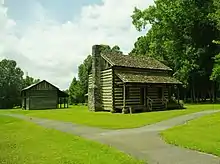
Houston attended Porter Academy,[8] Blount County, Tennessee's first school,[9][lower-alpha 2] of which his two older brothers, James and John, were trustees.[6] He hated taking orders from his brothers, at the farm and the store.[11] Although he disliked school, preferring to read the classics from his father's library, Houston wanted to study Latin at the academy, but the headmaster refused him permission to do so.[12][13]
Houston preferred the "free and unsophisticated spiritual expression of the Native Americans" over the stern church sermons on damnation and hell.[6] In 1809, he crossed the Tennessee River to live with the Cherokees on Hiwassee Island along the banks of the Hiwassee River about 90 miles (southwest) from the family home.[1][7][14]
John and James found him at John Jolly's home, reading a book.[15] When his brothers asked him to return to the family, Houston told them that he was tired of their tyranny and preferred to be among the Cherokee people.[16]
Houston lived among the Cherokee for three years,[1] wearing their clothing, speaking the Cherokee language,[17] dancing in their dances, and playing their ball games.[18] He hunted wild game with the Cherokee boys and wandered along woodland streams with the girls. These experiences helped shape his character and gave him skills that aided him while serving in the military and in leadership roles.[12][13] The tribe was led by John Jolly (also known as Ahuludegi or Oolooteka), who emphasized the importance of fairness and honesty.[15] The Indian agent of the Cherokee in southeastern Tennessee, Return J. Meigs, stated that Jolly's house was "one of the largest...finest homes in the South."[19][20][18] Houston considered Jolly his "Indian Father", and regarded the Cherokees as his family. Jolly adopted him and gave him the Cherokee name Colonneh, or "the Raven,"[18] who in Cherokee lore fights an evil spirit to save the Corn Spirit, thereby ensuring a bountiful harvest.[15]
Houston visited his family in Maryville occasionally[18][21][16] when his clothing needed mending[12] or he needed money. While he was away from home, he kept up a correspondence with his cousins, inquiring after his younger brother William's welfare, and showing affectionate concern for his sisters.[6] He purchased gifts for tribal members on credit, and acquired a reputation for drinking too much liquor, as well as debt that he needed to pay off. Consequently he took a job clerking at a store in Kingston, thirty miles west of Maryville.[13]
Houston returned to Maryville in 1812, and at age 19 opened a school in a one-room schoolhouse a few mile north, where he charged a tuition of eight dollars per term, payable in cash, cotton cloth, and corn. His venture was successful, and he later recalled that he "experienced a higher feeling of dignity and self-satisfaction than from any other office or honor which I have held."[22] Finding himself again facing debts, in March, 1813, he enlisted in the U.S. Army, which was recruiting soldiers nearby and was appointed as a sergeant the same day.[23] Houston fought in the Creek War where he led the charge against the Creek. He rose through the ranks and he developed what would be a life-long relationship with Andrew Jackson.[24][25] He fought alongside the Cherokee during the War of 1812 at the Battle of Horseshoe Bend in 1814.[21] He was badly hurt when an arrow was shot into his upper thigh, and was not expected to live through the night, but he recovered enough to return home as a first lieutenant under Andrew Jackson in May 1817.[18][26]
Resettlement to Arkansas Territory (1818)
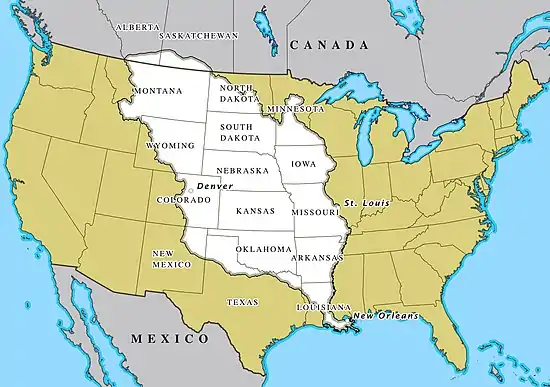
As whites settled in the ever-expanding western frontier, political pressure mounted to remove Native Americans from the Southern United States to land west of the Mississippi River, as proposed in 1803 (year of the Louisiana Purchase) by Thomas Jefferson. A delegation of Cherokee people visited the western lands in 1809. By 1816, Andrew Jackson wanted all Cherokee to move west and he thought that Sam Houston could help make this happen.[27] In 1817, after a treaty was negotiated with the Cherokee, Jackson appointed Houston as a sub-agent to administer the treaty because he could speak the Cherokee language and knew many of the people that were to be moved. Houston believed that the removal of Cherokee from East Tennessee was inevitable,[28][29] and he felt that the Cherokee were moving to a place where they could live in peace. He was known among the Cherokee as the Great Chief of the whites.[30]
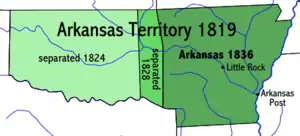
In February 1818, Houston was strongly reprimanded by Secretary of War John C. Calhoun after he wore Native American dress to a meeting between Calhoun and Cherokee leaders, beginning an enmity that lasted until Calhoun's death in 1850.[31] Houston believed that the clothing he had worn showed respect for the Native American delegation, but Calhoun felt that it was unbecoming of an officer in the United States Army. Houston was also charged, and later cleared, of involvement in an illegal slavery ring.[32] Angry over the incident with Calhoun and an investigation into his activities, Houston resigned from the army in 1818.[33]
Houston continued to act as a government liaison with the Cherokee.[18][33] The treaty he negotiated in 1818 stipulated that tribal members should get the same amount of land that they had in Tennessee. They were to have free navigation of the waterways, all head rights for their land, and receive money to make necessary improvements.[34] Governor Joseph McMinn and Calhoun decided that it was important to ensure the success of the treaties and they bribed Tahlonteeskee, who received $1,000 (equivalent to $16,907 in 2020) while other delegates received $500 in bribes. It is unknown whether Houston was aware of the arrangement. Unlike the later Trail of Tears, there was no forced removal of the Cherokee. Their removal was well-organized, with much of the travel on river boats.[35] Once they arrived, though, they learned that they had been given land that had been Osage and Quapaw hunting grounds.[36]
Arrival
After receiving his law license and practicing law in Tennessee beginning in 1819, Houston was elected a U.S. Congressman in 1823, chosen for the position by Andrew Jackson. On October 1827, he took the oath as the governor of Tennessee.[37] In January 1829, Houston married Eliza Allen, the daughter of wealthy plantation owner John Allen of Gallatin, Tennessee; their marriage quickly fell apart,[38] and in April 1829, Houston resigned as governor. Shortly after leaving office, he traveled west to rejoin the Cherokee,[39] and reunited with John Jolly's group of Cherokee in mid-1829.[40]
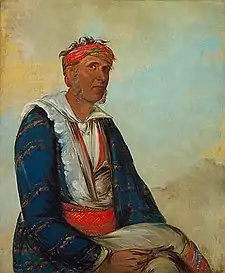
After a calamitous journey, Houston disembarked from the steamboat into a clearing that was lit by torches carried by slaves of John Jolly. The chief had been notified that Houston was on board and he came to meet him and take him two miles back to his home.[41]
The old chief threw his arms around him and embraced him with great affection. He said,[42]
My son, eleven winters have passed since we met. My heart has wandered often where you were; and I heard you were a great chief among your people. Since we parted at the Falls, as you went up the river, I have heard that a dark cloud had fallen on the white path you were walking, and when it fell in your way you turned your thoughts to the wigwam. I am glad of it—it was done by the Great Spirit… We are in trouble and the Great Spirit has sent you to give us council, and take trouble away from us. I will tell our sorrows to the great father, General Jackson. My wigwam is yours—my home is yours—my people are yours—rest with us.
Seeking refuge from white society, Houston went to the lodge of John Jolly[18] to live among the people who gave him the happiest time of his life.[43] In a letter dated May 11, 1829, to Andrew Jackson, he described himself as a man in "the darkest, direst hour of human misery" after his failed marriage.[44] For his excessive drinking, he was nicknamed "Big Drunk".[18]
Cherokee leaders
Jolly had a large plantation worked by up to twelve enslaved people, and owned more than 500 head of cattle. Jolly was a generous host to whoever visited his large, fine house.[45][lower-alpha 3] The wealthier members of the Cherokee Nation lived like southern planters; their labor was supplied by enslaved black people; they purchased fine goods from Baltimore, Philadelphia, or New Orleans, and they copied the fine mansions of the planters when they built their own homes. They did not approve, though, of the way that whites lived, and enjoyed their own cultural traditions. For instance, Houston and Jolly followed an ancient tradition among friends where they fed one another from a common spoon.[45]
The leaders that Houston knew, such as Jolly, John Drew, Captain John Rogers, and Walter Webber were successful men who operated mercantile businesses or plantations, where cotton or corn crops were grown and harvested by African American enslaved people. Many of the leaders were partially of European descent, their fathers or fore-fathers being white traders who intermarried with the Cherokee people. They aimed to live like successful white people, but there were also full-blooded Cherokee people who preferred to live according to Cherokee traditions.[19]
Treaty of 1828
More than ten years earlier, Houston had helped negotiate the treaty that brought the Cherokee to Arkansas, believing that they would not be subject to pressure from white Southerners to leave the area. He thought they would thus escape the continual encroachments by whites on their lands, but he had soon become very aware that the Cherokee were being taken advantage of by their own agents in the Arkansas country.[46]
The treaty of 1828 (Treaty of Washington, May 6, 1828) required the Cherokee to move further west into Indian Territory, now Oklahoma. Although part of the arrangement was that the Indian agents were to give the Cherokee $50,000 (equivalent to $1,178,333 in 2020) in gold coin[47][48] for abandoning their lands in Arkansas, they were given instead worthless certificates or paper money of little value. These agents also reduced the rations that the Cherokee were to have received.[49] The Cherokee suspected that the United States government would move other Cherokee groups from the East onto their land, without increasing the amount of land they received, and they wanted good titles to their new lands.[50]
Life among the Cherokee
On October 31, 1829, Houston was granted citizenship to live among the Cherokee with all the rights and responsibilities of native members of the tribe.[lower-alpha 4] A committee, appointed by Jolly, assessed the contributions that he had made to the Cherokee, his integrity, as well as his proposals for the future, and they accepted him into the Cherokee Nation. The National Committee and Council approved him as well. Being a citizen of the Cherokee Nation gave him more cachet as a tribal emissary.[18][52][lower-alpha 5] He was uniquely qualified to help them because he knew how the United States government operated, he spoke the Cherokee language and could interpret it, and he understood the needs of the Cherokee. He was also a Council leader.[54] Houston wanted to assimilate into the nation as best he could, so he avoided white people, donned the clothing and turbans of the natives, wore a goatee and grew out his hair, which he braided and let fall down his back. He reportedly would not speak English, used an interpreter when he had to talk to white men, and carried no weapons but a bow and arrow, which he had learned to use as a boy.[55] In 1829, Houston participated in a seven-day Green Corn Dance celebration that involved cleansing the wrongs committed in the past year by purging all traces of illness and foreign substances from the body, dancing, and games, as well as having governmental and religious functions.[56]
Houston had learned the ways of the Cherokee and how they perceived the world by living with them. He shared their appreciation for the land and its forests, and how they related to the natural world, unlike those white men who did not respect the Cherokee's connection with their homelands and hunting grounds. White men had deceived them, introduced devastating diseases, taught them their vices, and changed their way of life. Houston endeavored to work in their best interests and protect them.[57]
Into 1831, Houston was often depressed and drunk. He physically attacked John Jolly once when he was drunk and violent. He campaigned for a seat on the Cherokee tribal council, but was defeated, likely because of his drinking and bad behavior. He had a shift in attitude after the death of his mother in September 1831 in Maryville, deciding that he needed to stop drinking and change his life path.[49]
Marriage to Diana Rogers Gentry (1830–1832)
Houston married Diana Rogers Gentry under Cherokee law[18] in the summer of 1830.[58] Although separated from Eliza Allen, Houston was still legally married to her, but the Cherokee were not concerned about that.[49] Diana was the daughter of Chief John "Hellfire" Rogers (1740–1833), a Scots-Irish trader, and Jennie Due (1764–1806), a sister of Chief John Jolly.[58] John Rogers had served as a captain in the British army during the American Revolutionary War and fought under Andrew Jackson at the Battle of Horseshoe Bend in the War of 1812,[59] alongside his sons and Houston. He was the official interpreter for the Cherokee and the likely successor of John Jolly.[60]
Diana was the name given to her at birth, but among the Cherokee she may have been known as Tiana. She was a tall, beautiful mixed-race woman, mostly Scottish and English, and less than a quarter Cherokee.[61] According to family lore, Diana attended a Moravian missionary school, perhaps Brainerd Mission.[62][lower-alpha 6] Diana was previously married to David Gentry, a wealthy and powerful white man, in Tennessee. In 1817, the Gentrys moved to the Dardanelle area in Arkansas, where he was a successful blacksmith. They may have had two children, Joanna and Gabriel, neither of whom had issue. It is also said that they had no children. David died during a battle with the Osage people.[64]
Houston called Diana "Hina".[65][lower-alpha 7] They settled near Fort Gibson on the Neosho River and operated a trading post at Wigwam Neosho.[18][67][lower-alpha 8] After declining to accompany Houston to Texas in 1832, Diana remained in Indian Territory with titles to their property, which included their residence and their land. The marriage ended without animus,[58][69] and she later remarried. Diana died in 1838 of pneumonia.[58] Will Rogers was her nephew, three generations removed.[70]
Resettlement to Indian Territory (1830–1850)
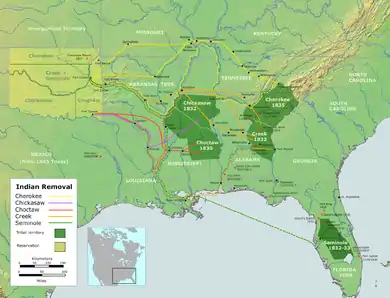
Because of Houston's experience in government and his connections with President Jackson, most of the local Native American tribes asked Houston to mediate disputes, knowing that he was close to Jackson, and considering an appeal to him a more direct way to communicate their needs to the Jackson administration.[71] In December 1829, Houston, serving as an ambassador appointed by John Jolly (Chief Oolooteka), and accompanied by a delegation of representatives of other Cherokee groups, went to Washington, D.C. to request assistance.[49][72] He met with Jackson who subsequently removed corrupt Indian agents from their positions. He also ordered surveys of Cherokee lands so that good titles could be issued.[49]
In anticipation of the removal of the remaining Cherokee east of the Mississippi River, Houston made an unsuccessful bid to supply rations to the Native Americans during their journey.[73]
On June 22, 1830, Houston wrote in an article that Native Americans "might indeed look to this, as a land of happiness and contentment. But until suitable Agents are sent to them, then can only regard this as the land of promises; where fraud will supplant faith, and injustice triumph over humanity". He expressed concern for the Cherokee from the East being able find to "peace or happiness" in the Indian Territory until the people that were already there had honest and competent agents. It was signed TAH-LOHN-TUS-KY.[74]
Houston gladly accepted a mission offered by Andrew Jackson to negotiate with the Comanche so that they would not attack those Native Americans that the United States government was moving westward. He crossed the border into Texas on December 2, 1832.[69] He met with the Comanche in San Antonio and they agreed to meet in May 1833 with governmental officials at Fort Gibson.[75]
In 1845, John L. O'Sullivan supported President James K Polk's expansion policy. He said that it was the United States's "manifest destiny to overspread and to possess the whole continent," thus coining the term manifest destiny.[76]
Texas Revolution (1835–1836)
Before the Texas Revolution, the Alabama–Coushatta Tribe were among Houston's allies. Earlier, they had crossed the Sabine River into what was then part of New Spain in 1780 and fought against the Spanish during the Mexican War of Independence. They were pivotal in the surrender near San Antonio on April 1, 1813 (Battle of Alazan Creek).[77][lower-alpha 9] In 1836, they provided provisions for people who passed through their villages in the Runaway Scrape, while fleeing Antonio López de Santa Anna's army. They were also guides for Houston's army. Houston negotiated a treaty for the tribes between the Sabine and Neches Rivers[77][78] called the Cherokee Indian Treaty of February 23, 1836.[79]
Republic of Texas (1836–1838; 1841–1844)
First term, 1836–1838
One of the tasks facing the new Republic of Texas was the need to establish a policy for Native American tribes. President Houston planned to provide frontier protection, engage in trade relationships, and promote peace.[78] On December 5, 1836, a law was enacted that gave Houston the power to protect Native Americans by establishing trading posts and blockhouses.[80] Laws had also been enacted to establish a large army and a chain of forts, but President Houston, having sympathy for the native peoples, would not execute these laws, on the common sense grounds that there were no funds to pay for them.[81] He was able to provide riflemen and militia to protect the frontier. The law allowed for treaties, use of agents, and ability to distribute goods among Native American tribes.[82]
Relations between whites and native peoples became increasingly problematic as Native Americans were pushed west and their land was usurped by whites.[82] Throughout the last years of his presidency, Houston made numerous efforts for the Republic to find common ground with the various tribes, asserting their right to land ownership. Many tribes thus came to respect him as their friend.[83][84][85][86][87] In 1836–1837, Houston enlisted the aid of the peaceful Texas Delaware tribe to guard the Texas border against more hostile tribes, When Mirabeau B. Lamar became president in 1838, his policies helped fuel the Texas–Indian wars.[88] With John Forbes[89] and John Cameron,[90] Houston negotiated a treaty in East Texas with the Cherokee people (Treaty of Bowles Village with the Republic of Texas), in February 1836. Houston, Forbes and Cameron were commissioners for the provisional government.[18] The United States Congress would not ratify the treaty, and negotiations there failed.[91] In early 1837, the Republic's government moved to a new capital, the city of Houston, named for Sam Houston as its first president.[92]
In 1838, Houston frequently clashed with the United States Congress over issues such as a treaty with the Cherokee, and establishment of a land-office act[93] and was forced to put down the Córdova Rebellion, a plot to allow Mexico to reclaim Texas with aid from the Kickapoo Indians.[18]
By keeping troops out of the Indian country, Houston had avoided serious troubles with the native tribes, and nothing came of the threats made by the Cherokee after the Texas Senate refused to ratify the treaty granting them permanent title to their lands.[94][95][96] By the end of Houston's first term in December 1838, however, the native peoples of Texas had become restive from continuing white encroachment on their lands. In accordance with the Republic's constitution, Houston did not stand for re-election in the 1838 election. He was succeeded by Mirabeau B. Lamar, who, along with Burnet, led a faction of Texas politicians opposed to Houston.[97] Lamar sought to exterminate hostile tribes, and wanted other tribes removed to reservations. In the case of the Alabamas and Coushattas, he sought to provide good titles to their lands, but they misunderstood the purpose of the surveyors who arrived on their land. Thinking that their land was going to go to white settlers, they moved out of the area. Before the situation could be rectified, whites began settling on the land.[78] The Lamar administration removed many of Houston's appointees and established a new capital at Austin. Lamar raised volunteer troops and rangers to pacify the hostile tribes and launched a war against the Cherokee, this led to the Cherokee being driven from Texas by military force in 1839,[80][98] and campaigns against the Comanche continued until the end of 1840.[99]
Although Lamar's policy of punitive expeditions against the native peoples achieved its goal, Houston's policy of friendship and conciliation, even as they continued their raids on white settlements,[98] had better results for the native peoples and was less costly in lives lost and funds expended by the Republic. Houston's defense of his Native American friends was the object of much newspaper commentary and was debated bitterly in the Texas Congress.[80]
The Republic of Texas constitution barred presidents from seeking a second consecutive term,[100] so Lamar left office in 1841. Houston was again elected president.[101][102]
Second term, 1841–1844
When Sam Houston left the presidency of Texas the first time, the Anglo population seemed to support Lamar's strong anti-Indian policies. After the Great Raid of 1840 and hundreds of lesser raids, with all of the captives either killed by the native peoples or recovered, and with the Republic bankrupt,[103] Texans turned away from continuation of war and toward more diplomatic initiatives by electing Houston to his second presidency. [18]
Houston's Indian policy was to disband most of the regular Army troops, and to muster four new companies of rangers to patrol the frontier. Houston ordered the Texas Rangers to protect the lands of the Native Americans from encroachment by settlers and illegal traders. He wanted to end the cycle of rage and revenge that had spiraled out of control under Lamar. Under Houston's policies, the Texas Rangers were authorized to punish severely any infractions by the native peoples, but they were never to initiate such conflict. When depredations occurred to either side, the troops were ordered to find and punish the actual perpetrators, rather than retaliating against innocent people simply because they were Native Americans.[18]
Houston set out to negotiate with the Native tribes. The Caddo were the first to respond, and in August 1842, a treaty was made. Houston then expanded it to include all tribes except the Comanche, who still wanted permanent war. In March 1843, Houston reached agreement with the Delaware, Wichitas, and other tribes. At that point, Buffalo Hump (Potsʉnakwahipʉ), a war chief of the Penateka band of the Comanche who trusted Houston, began to talk. In August 1843, a temporary treaty accord led to a ceasefire between the Comanches and their allies, and the Texans, and on September 29, 1843, his administration negotiated the Treaty of Bird's Fort with the Delaware, Chickasaw, Waco, Tawakani, Keechi, Caddo, Anadahkah, Ionie, Biloxi, and Cherokee.[104] In October 1843, the Comanche agreed to meet with Houston to try to negotiate a treaty similar to the one just concluded at Fort Bird. (That this included Buffalo Hump, after the events at the Council House, showed the faith the Comanche had in Houston.) In early 1844, Amorous Man, Buffalo Hump, and Old Owl (Mopechucope), concluded a treaty at Tehuacana Creek in which they agreed to surrender all white captives, and to cease raiding Texan settlements in exchange for the cessation of military action against them, the establishment of more trading posts, and formal recognition of the boundaries they chose for the Comanchería.[105]
Comanche allies, including the Waco, Tawakoni, Kiowa, Kiowa Apache, and Wichita, also agreed to join in the treaty. The Texas Senate, before ratifying the treaty in its final form, removed the boundary that would have confined white settlers to the region east of the Edwards Plateau, causing Buffalo Hump to reject this altered version of the agreement, and a resumption of hostilities began.[106][107]
U.S. Senator (1846–1859)

In February 1846, the Texas legislature elected Houston as one two inaugural U.S. senators from the state. Houston chose to align with the Democratic Party.[108] In January, 1853, he was reelected to the US Senate,[109] and In November 1857, the Texas legislature chose John Hemphill to succeed him when his term was set to expire in March 1859.[110] He remained a firm advocate of the rights of the Indians during the thirteen years he served,[111] even though his cause was unpopular, and antagonized Texas citizens.[112]
Houston was the only southern Democratic member of the US Senate who voted against the Kansas-Nebraska bill introduced by Stephen A. Douglas of Illinois in 1854 to organize the Kansas and Nebraska Territories and effectively repeal the Missouri Compromise, allowing the residents to decide the slavery question for themselves. During a night session of the Congressional debates held before its passage, Houston had stood and made a closing address to the full galleries, asking a question not raised by anyone else. He wanted to know what provision would be made for the forty thousand Indians inhabiting the area in question, and pleaded their case, allowing that there was "little hope that any appeal I can make for the Indians will do any good." This was not the last time he detained the Senate to ask justice for "a race of people whom I am not ashamed to say have called me brother."[113]
Also in 1854, Houston was instrumental in the state of Texas setting aside 1,280 acres for the Alabama-Coushatta Indian Reservation, in what is now Polk County, Texas. Since that time, the reservation has increased in size to 4,500 acres under the trusteeship of the state.[114][115]
On January 29 and 31, 1855, Senator Houston made a speech in the US Senate in defense of the Comanche and the other tribes of Texas. An excerpt:
I well remember in 1835, 1836, 1837 and 1838, in Texas, we had peace. The Comanches would come down to the very seaboard in amity and friendship, would repose confidently in our dwellings, would receive some trifling presents and would return home exulting, unless they were maltreated, or their chiefs received indignities. If they did receive such, they were sure to revisit that section of the country as soon as they went home and fall upon the innocent. For the years I have mentioned, in Texas, we had perfect peace, and, mark you, it did not cost the government over $10,000.00 a year. We had no standing army. A new administration came in and the Congress immediately appropriated $1,500,000.00 for the creation of two regular regiments. Those regiments were raised. What was the consequence? The policy had changed in the inauguration of the president. He announced the extermination of the Indians. He marshalled his forces. He made incursions on a friendly tribe who lived in sight of our settlements where the arts of peace were cultivated and pursued by them—by agriculture and other arts, and by exchange and traffic of such productions of the soil as were convenient. They lived by traffic with Nacogdoches. The declaration was made, and it was announced by the cabinet that they would kill off 'Houston's pet Indians'.[116]
In early 1855, the situation along the entire Texas border had worsened greatly. Native American war parties from north of the Red River crossed it into the frontier regions of Texas and sometimes struck armed white settlements far southward. They destroyed an entire German settlement near San Antonio in 1855, and Native raiders on horseback followed the Indian trail used by the Comanche war chief Buffalo Hump to the Gulf of Mexico.[117]
These disastrous strikes against the white settlers caused a political uproar, with the whites demanding that the Texas state government again muster rangers to fight the raiders. Houston lost his Senate seat because he opposed harsh reprisals against the Native peoples. Jefferson Davis, United States Secretary of War at the time, was determined to address the raiding, and hostile policies against them resumed.[117][118]
Houston's final years (1860-1863)
During Houston's final term as Governor of Texas, the Texas Secession Convention passed the Texas Ordinance of Secession on February 1, 1861, and Texas effectively became part of the Confederate States of America on March 1.[119] Houston, like all other office holders in the state, was expected to take an oath of loyalty to the Confederacy. He refused and was removed from office by the Secession Convention on March 16; he was succeeded by Lieutenant Governor Edward Clark.[18][120][121][122] In his final years, his friends among the Alabama-Coushatta tribe would visit his home. During this period, Houston managed to get the Confederate War Department to discharge all draftees from the Alabama-Coushatta tribe, which had distanced itself completely from the conflict.[120]
Legacy
The Cherokee Removal Memorial Park, overlooking Hiwassee Island, was established to honor the relationship between Sam Houston and Native Americans who lived in Tennessee, Arkansas, and Oklahoma. It is located near Dayton, Tennessee and the confluence of the Tennessee and Hiwassee Rivers.[123]
Samuel Houston Mayes, named after his parent's friend, was the Principal Chief of the Cherokee Nation in Indian Territory (1895–1899).[124]
Notes
- Haley states that they had a 419-acre farm.[3]
- The school is named for state representative James P.H. Porter who introduced a bill to allow for creation of schools. It was passed into law in 1806.[9] Rev. Mark Moore taught at the academy that opened in 1808.[10]
- While many Native American tribes ranged over land to hunt and gather food, Cherokees were among the first agrarians.[45]
- He was a citizen of the United States, Cherokee, Mexico, the Republic of Texas, and the Confederate States of America.[51]
- Trading was not as easy as he expected, with native Cherokee questioning why he should have the right to trade, and some whites questioned it, too. He eventually became a U.S. citizen again under the Texas Admission Act.[53]
- Diana's father was very interested in education for children. Her brother and sister were educated and it is very likely that Diana was, too. Diana signed legal documents with her mark (X), which was common among literate Cherokee who did not want to share their name on a white man's document.[63]
- Her name was spelled a number of ways: Talhina, Titania, Tania, and more.[66]
- A historical marker was placed at the site on Highway 69 near Porter, Oklahoma by the Oklahoma Historical Society in 1995, which was visited by Washington Irving who wrote the book A Tour on the Prairies.[67][68]
- The Alabama–Coushatta tribes were separate but very similar tribes who intermarried. They were part of the Creek Confederacy and spoke the Muskogean languages. They have a shared history and lived in Alabama and before settling in southeast Texas in the Big Thicket.[78]
References
- Ramage 1894, pp. 310–311.
- Williams 2018, p. PT207.
- Haley 2004, p. 7.
- Woodward 2003, p. 13.
- Woodward 2003, p. 10.
- Haley 2004, p. 8.
- Woodward 2003, p. 15.
- Haley 2002, p. 7.
- "Porter name predates the public schools". The Daily Times. Maryville, Tennessee. May 9, 2018. Retrieved August 15, 2021.
- Stewart, Matthew (September 20, 2014). "'Evolving' Porter Academy Museum opens to public". The Daily News. Maryville, Tennessee. Retrieved August 15, 2021.
- Haley 2004, pp. 6–8.
- Crane 1884, p. 19.
- Haley 2004, pp. 9–10.
- "History on Hiwasse Island" (PDF). The Center for Historic Preservation, Middle Tennessee State University. Retrieved July 26, 2021.
- Woodward 2003, p. 16.
- Haley 2004, p. 10.
- Williams 1994, pp. 25–26.
- Kreneck 2020.
- Gregory 1996, p. 12.
- Williams 1994, pp. 21–24.
- Gregory 1996, p. 9.
- Woodward 2003, p. 18.
- Haley 2002, p. 10–11.
- Ramage 1894, p. 312.
- Woodward 2003, pp. 20–25.
- Woodward 2003, pp. 23–26.
- Gregory 1996, pp. 17–18.
- Haley 2002, pp. 19–20.
- Woodward 2003, p. 26.
- Gregory 1996, pp. 8–9, 18.
- Haley 2002, pp. 24–25.
- Woodward 2003, pp. 27–28.
- Haley 2002, pp. 26–29.
- Gregory 1996, p. 18.
- Gregory 1996, p. 19.
- Gregory 1996, p. 20.
- Woodward 2003, pp. 28, 31.
- Haley 2002, pp. 49–57.
- Haley 2002, pp. 60–61.
- Haley 2002, pp. 64–65.
- Gregory 1996, p. 8.
- Gregory 1996, pp. 9–10.
- Gregory 1996, pp. 8–9.
- Gregory 1996, p. 3.
- Gregory 1996, pp. 11–12.
- Gregory 1996, pp. 15–18.
- Chipman, Torgot & Campbell 2013, p. 91.
- Williams 2018, p. PT81.
- Woodward 2003, p. 37.
- Woodward 2003, pp. 34, 37.
- Woodward 2003, p. 5.
- Gregory 1996, pp. 22–24.
- Gregory 1996, pp. 25–28.
- Gregory 1996, p. 28.
- Gregory 1996, pp. 29–30.
- Gregory 1996, p. 39.
- Crane 1884, p. 40.
- Haley 2002, p. 70.
- Conley 2007, p. 191.
- Gregory 1996, pp. 36–37.
- Gregory 1996, pp. 33–34.
- Gregory 1996, p. 38.
- Gregory 1996, pp. 38–39.
- Gregory 1996, pp. 37–38.
- Gregory 1996, p. 35.
- Gregory 1996, p. 34.
- "Wigwam Neosho Historical Marker". www.hmdb.org. Retrieved July 18, 2021.
- "OHS Historical Marker Program". www.okhistory.org. Retrieved August 12, 2021.
- Woodward 2003, p. 41.
- James 1929, pp. 150–152.
- Haley 2002, pp. 68–69.
- Haley 2002, pp. 71–72.
- Haley 2002, pp. 73–74.
- Woodward 2003, p. 36.
- Woodward 2003, p. 43.
- Woodward 2003, p. 75.
- "History". Alabama-Coushatta Tribe of Texas' Website. Retrieved August 12, 2021.
- "Alabama-Coushatta Indians". Texas State Historical Association. Retrieved July 22, 2021.
- McClendon 1948, p. 32.
- Friend 2010, p. 81–82.
- Spaw 1990, p. 21.
- Dickerson, W. E. S. "American Indian Relations". Texas State Historical Association. Retrieved July 23, 2021.
- Haley 2004, pp. 300–400.
- Crane 1884, pp. 334–348.
- Seale 1992, pp. 144–146.
- "Minutes of Council at the Falls of the Brazos, October 7, 1844". Texas State Library Archives Commission. Retrieved July 22, 2021.
- "Sam Houston House". National Register Digital Assets. National Park Service. Retrieved July 22, 2021.
- "Delaware Indians". Handbook of Texas Online. Texas State Historical Association. Retrieved July 22, 2021.
- "Forbes, John". Handbook of Texas online. Texas State Historical Association. Retrieved July 23, 2021.
- "Cameron, John". Handbook of Texas Online. Texas State Historical Associaton. Retrieved July 23, 2021.
- Woodward 2003, p. 63.
- Haley 2002, p. 186.
- Haley 2002, pp. 201–202.
- Hale 1987, p. 22.
- Everett 1995, p. 75.
- McClendon 1948, p. 40.
- Haley 2002, pp. 205–206.
- Prucha 1995, p. 355.
- Haley 2002, pp. 213–215.
- Nance, Joseph M. "Republic of Texas". Texas State Historical Association. Retrieved September 15, 2021.
- Woodward 2003, p. 68.
- Haley 2002, pp. 221–234.
- Spaw 1990, p. 26.
- "Republic of Texas". Handbook of Texas Online. Texas State Historical Association. Retrieved July 22, 2021.
- Texas State Library 2017.
- McCoy & Fountain 2017, p. 70.
- Gelo & Wickham 2018, p. 6.
- Haley 2002, pp. 294–295.
- Wisehart 1962, p. 702.
- Flanagan 2010, pp. 136–137.
- Rozelle 2017, p. PT148.
- Campbell 2013, pp. 83, 101.
- James 1929, pp. 383–384.
- Tiller 1996, p. 565.
- Reservation, Alabama Indians on the Alabama-Coushatta Indian. "A Guide to the Alabama Indians Land Grants, 1854–1855". legacy.lib.utexas.edu. Retrieved July 22, 2021.
- Starr 1922, p. 222.
- Fehrenbach 2003, p. 421.
- Cooper 2010, p. 277.
- "Secession". Texas State Library and Archives. Retrieved August 12, 2021.
- Haley 2002, pp. 400–401.
- "1861 Secession Convention". Texas State Library and Archives Commission. Retrieved March 4, 2012.
- "Giants of Texas History: Sam Houston". Texas State Library and Archives Commission. Retrieved August 12, 2021.
- Montgomery, Robin, Walker County Historical Commission (August 18, 2016). "Statue to honor Sam Houston's contributions to Cherokees". Retrieved July 27, 2021.
- "Mayes, Samuel Houston". The Encyclopedia of Oklahoma History and Culture. Retrieved August 15, 2021.
Bibliography
- Campbell, Randolph B. (2013). This Corner of Canaan: Essays on Texas in Honor of Randolph B. Campbell. University of North Texas Press. ISBN 978-1-57441-503-2.
- Chipman, Donald E.; Torgot, Andrew J.; Campbell, Randolph B. (2013). This Corner of Canaan: Essays on Texas in Honor of Randolph B. Campbell. University of North Texas Press. p. 91. ISBN 978-1-57441-503-2.
- Conley, Robert J. (2007). A Cherokee Encyclopedia. University of New Mexico Press. p. 191. ISBN 978-0-8263-3951-5.
- Cooper, William J. (December 22, 2010). Jefferson Davis, American. Knopf Doubleday Publishing Group. p. 277. ISBN 978-0-307-77264-0.</ref>
- Crane, William Carey (1884). Life and select literary remains of Sam Houston of Texas. Philadelphia: J. B. Lippincott & Co. LCCN 11016609. OCLC 1048334540.
- Everett, Dianna (1995). The Texas Cherokees: A People Between Two Fires, 1819-1840. University of Oklahoma Press. ISBN 978-0-8061-2720-0.
- Fehrenbach, T. R. (2003). Comanches: The History of a People. Anchor Books. ISBN 978-1-4000-3049-1.
- Flanagan, Sue (2010). Sam Houston's Texas. University of Texas Press. ISBN 978-0-292-78921-0.
- Friend, Llerena (2010). Sam Houston, the Great Designer. University of Texas Press. ISBN 978-0-292-78911-1.
- Gelo, Daniel J.; Wickham, Christopher J. (2018). Comanches and Germans on the Texas Frontier: The Ethnology of Heinrich Berghaus. Texas A&M University Press. ISBN 978-1-62349-594-7.
- Gregory, Jack Dwain (1996). Sam Houston with the Cherokees, 1829–1833. Norman, Oklahoma: University of Oklahoma Press. ISBN 978-0-8061-2809-2.
- Hale, Duane K. (1987). Peacemakers on the Frontier: A History of the Delaware Tribe of Western Oklahoma. Delaware Tribe of Western Oklahoma Press.
- Haley, James L. (2002). Sam Houston. Norman, Oklahoma: University of Oklahoma Press. ISBN 978-0-8061-3405-5.
- Haley, James L. (2004). Sam Houston. Norman, Oklahoma: University of Oklahoma Press. ISBN 978-0-8061-3644-8.
- James, Marquis (1929). The Raven: A Biography Of Sam Houston. Bobbs-Merrill.
- Kreneck, Thomas H. (2020). "Houston, Samuel". Handbook of Texas Online. Texas State Historical Association. Retrieved August 12, 2021.
- McClendon, R. Earl (1948). "The First Treaty of the Republic of Texas". The Southwestern Historical Quarterly. 52 (1): 32–48. ISSN 0038-478X. JSTOR 30237525.
- McCoy, Robert R.; Fountain, Steven M. (2017). History of American Indians: Exploring Diverse Roots. ABC-CLIO. ISBN 978-0-313-38683-1.
- Prucha, Francis Paul (1995). The Great Father: The United States Government and the American Indians. U of Nebraska Press. ISBN 978-0-8032-8734-1.
- Ramage, B. J. (1894). "Sam Houston and Texan Independence". The Sewanee Review. 2 (3): 309–321. ISSN 0037-3052. JSTOR 27527811.
- Rozelle, Ron (2017). Exiled: The Last Days of Sam Houston. Texas A&M University Press. ISBN 978-1-62349-587-9.
- Seale, William (1992) [1970]. Sam Houston's Wife: A Biography of Margaret Lea Houston. Norman, Oklahoma: University of Oklahoma Press. p. 17. ISBN 978-0-8061-2436-0.
- Spaw, Patsy McDonald (1990). "Senates of Republic First Congress, 1836–1837". The Texas Senate: Republic to Civil War, 1836-1861. Texas A&M University Press. ISBN 978-0-89096-442-2.
- Starr, Emmet (1922). History of the Cherokee Indians and Their Legends and Folk Lore. Warden Company. p. 222.
- Texas State Library (2017). "Native American Relations in Texas | Treaty Negotiations". www.tsl.texas.gov. Texas State Library and Archives Commission. Retrieved August 23, 2021.
- Tiller, Veronica E. Velarde (1996). American Indian Reservations and Trust Areas. Economic Development Administration, U.S. Department of Commerce.
- Williams, John H. (1994) [1993]. Sam Houston: Life and Times of Liberator of Texas an Authentic American Hero. Simon & Schuster. ISBN 978-0-671-88071-2.
- Williams, John H. (2018). Sam Houston. New Word City. ISBN 978-1-64019-148-8.
- Wisehart, Marion Karl (1962). Sam Houston, American Giant. R.B. Luce.
- Woodward, Walter M. (2003). Sam Houston : for Texas and the Union. New York: PowerPlus Books. ISBN 978-1-61106-484-1. OCLC 1036846415.
| Federally recognized tribes | |
|---|---|
| State-recognized tribes | |
| Indigenous languages | |
| List of Native American peoples of Texas |
|
| Related topics | |
† extinct language / ≠ extinct tribe / >< early, obsolete name of indigenous tribe(s) / ° people absorbed into other tribe(s) | |