Serbia–Slovakia relations
Serbian-Slovak relations are foreign relations between Serbia and Slovakia. Both countries established direct diplomatic relations in 1993. Serbia has an embassy in Bratislava. Slovakia has an embassy in Belgrade. Slovakia is among the few NATO and EU members which have not recognized the independence of Kosovo.[a] Also Serbia is an EU candidate and Slovakia is an EU member.
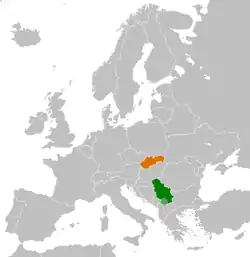 | |
 Serbia |
 Slovakia |
|---|---|
History
Serbian-Slovak relations i.e. cooperation was especially good in the 18th and the 19th century, in the fields of culture, art, commerce, education, science, politics and military.[1]
During the course of two centuries, more than 2500 Serbs were educated in various universities and higher institutions of learning in Slovakia, mostly in Bratislava, Košice and Kežmarok.[1]
Noted Slovaks were active in the cultural and political life of Serbia, such as Pavel Jozef Šafárik, Ján Kollár and Ľudovít Štúr. Under the influence and drawing on the works of Serbian linguist Vuk Stefanović Karadžić, Pavel Jozef Šafárik and Jan Kolar decided to start collecting Slovak folk poems. During the 19th century, Serbs and Slovaks supported each other and were active in spreading the ideas based on Slavophilia.[1]
Serbian author and historian Risto Kovijanić researched Serbian-Slovak relations for over 50 years and published a number of works on the topic.[1]
Both nations were oppressed by foreign occupiers and Slovaks and Serbs recognised in each other friends and allies in the struggle for independence of their countries and autonomy of their language and Slavic culture.[1]
Historian and an expert on Serb-Slovak relations Nebojša Kuzmanović concludes that Serbs had the best relations with Slovaks out of any ethnic group throughout their history.[1]
In February 2021 President of Serbia Aleksandar Vučić and Minister of Foreign Affairs Nikola Selaković held a meeting with Slovak Minister of Foreign and European Affairs Ivan Korčok.[2]
Gallery
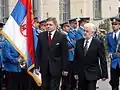 Prime ministers Robert Fico with Mirko Cvetković
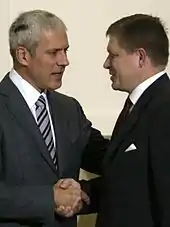 Robert Fico meeting with Serbian President Boris Tadić.
See also
Notes
| a. | ^ Kosovo is the subject of a territorial dispute between the Republic of Kosovo and the Republic of Serbia. The Republic of Kosovo unilaterally declared independence on 17 February 2008. Serbia continues to claim it as part of its own sovereign territory. The two governments began to normalise relations in 2013, as part of the 2013 Brussels Agreement. Kosovo is currently recognised as an independent state by 97 out of the 193 United Nations member states. In total, 112 UN member states have recognised Kosovo at some point, of which 15 later withdrew their recognition. |
References
- Kuzmanović, Nebojša (2004). "Susretanje kultura, pledoaje za izučavanje srpsko - slovačkih književnih veza". Sunčanik. Bačka Palanka.
- Serbia, RTS, Radio televizija Srbije, Radio Television of. "Вучић са словачким шефом дипломатије: Политички дијалог и економска сарадња две земље стално напредују". www.rts.rs. Retrieved 2021-02-08.
External links
- Serbian Ministry of Foreign affairs about the relation with Slovakia
- Serbian embassy in Bratislava (in Serbian and Slovak only)
- Slovak embassy in Belgrade
| Africa |  | |
|---|---|---|
| Americas | ||
| Asia | ||
| Europe |
| |
| Oceania | ||
| Former |
| |
| Multilateral relations | ||
| Disputes | ||
| Diplomacy | ||
| Africa |  | |
|---|---|---|
| Americas | ||
| Asia | ||
| Europe | ||
| Diplomatic missions | ||