Baku Governorate
The Baku Governorate (Russian: Бакинская губерния, Pre-Reform Russian: Бакинская губернія) was one of the guberniyas of the Caucasus Viceroyalty of the Russian Empire, with its centre in Baku. Area (1897): 34,4000 sq. versts, population (1897): 789,659.[1] The only foreign border of the governorate was Persia to the south. Within the empire, it bordered the Elisabethpol Governorate (the Tiflis and Erivan Governorates before 1868) and the Dagestan Oblast.
Baku Governorate
Бакинская губерния | |
|---|---|
 Coat of arms | |
 | |
| Country | Russia |
| Political status | Governorate |
| Region | Caucasus Viceroyalty |
| Established | 1846 as Shamakhi Governorate; renamed to Baku Governorate in 1859 |
| Abolished | 1917 |
| Area | |
| • City | 39,149 km2 (15,116 sq mi) |
| Population (1916) | |
| • City | 1,281,575 |
| • Density | 33/km2 (85/sq mi) |
| • Urban | 19.80% |
| • Rural | 80.20% |
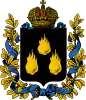
The governorate was originally established in 1846 as the Shamakhi Governorate, replacing what had been several military precincts. After the 1859 Shamakhi earthquake, the capital of the governorate was transferred from Shamakhi to Baku. On July 12, 1859, the governorate's name was changed accordingly. The coat of arms of the governorate was instituted on July 5, 1878,. Initially, the Baku Governorate included Karabakh, Zangezur, and the former Shaki Khanate. These areas were separated in 1868 to create the Elisabethpol Governorate.
The governorate was preserved until the establishment of the Azerbaijan Democratic Republic, when it was split into the Baku Governorate and the Lankaran General-Governorate.
Administrative division
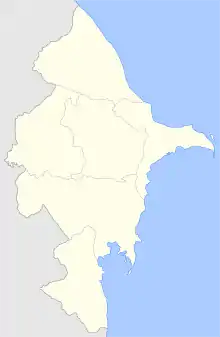
After the establishment of the Elisabethpol Governorate in 1868, the Baku Governorate had six uyezds:
Demographics
Russian Imperial Census of 1897
According to the 1897 census, 789,659 people populated the governorate, of which, 55% were male. Azerbaijanis (then known as Caucasian Tatars, mostly Shiite) constituted the majority of the population with significant minorities of Russians, Armenians, Lezgins, Tats, Talysh, and Jews.[1]
Ethnic groups in the Erivan Governorate by Uyezd[2]
| Uyezd | Azerbaijani Tatars |
Tats | Russians | Armenians | Lezgins | Talysh people | Other Dagestani | Germans | Persian | Jews | Avars |
|---|---|---|---|---|---|---|---|---|---|---|---|
| TOTAL | 58,7% | 10,8% | 8,9% | 6,3% | 5,8% | 4,2% | 1,4% | ... | ... | ... | ... |
| Baku | 34,7% | 18,9% | 24,0% | 12,3% | ... | ... | ... | 1,8% | 2,6% | 1,1% | ... |
| Geokchay | 79,0% | 3,4% | 2,1% | 11,0% | 1,7% | ... | ... | ... | ... | ... | 1,5% |
| Javad | 93,3% | ... | 4,5% | ... | ... | ... | ... | ... | ... | ... | ... |
| Kuba | 38,3% | 25,3% | 1,4% | ... | 24,4% | ... | 6,3% | ... | ... | 2,2% | ... |
| Lankaran | 64,7% | ... | 7,2% | 0,37% | ... | 26,7% | ... | ... | ... | ... | ... |
| Shamakhi | 73,7% | 3,7% | 9,3% | 11,7% | ... | ... | ... | ... | ... | 0.9% | ... |
Ethnic groups at the start of the 20th century
The ethnic group composition of the governorate changed considerably in the latter part of the 19th century. By the beginning of the 20th century, there were 214,700 inhabitants, amongst them, Russians, Ukrainians and Belarusians - 76,3 thousand -> (35.5%), Azerbaijanis ("Caucasian Tatars" back then) - 46 thousand -> (21.4%), Armenians - 42 thousand -> (19.4%), Persians\Iranians - 25 thousand -> (11.7%), Jews - 9,7 thousand -> (4.5%), Georgians - 4 thousand -> (1, 9%), Germans - 3.3 thousand -> (1.5%), the Kazan Tatars - 2.3 thousand -> (1.1%).[3] Muslims generally lived in the historical centre of Baku (Old Baku), surrounded by the khan's castle in the west of the city. Armenians mostly lived in the industrial zone in the north of the city. During the construction of the new city centre, various ethnic groups started to move to different districts.[4]
Caucasian Calendar of 1917
The 1917 Caucasian Calendar which produced statistics of 1916 indicates 1,281,575 residents in the Baku Governorate, including 701,603 men and 579,972 women, 1,012,206 of whom were the permanent population, and 269,369 were temporary residents.[5]
| Uyezd (district) | Russians | Other Europeans | Georgians | Armenians | North Caucasians | Kurds | Other Asian Nationalities | Gypsies | Jews | TOTAL | ||||
|---|---|---|---|---|---|---|---|---|---|---|---|---|---|---|
| Orthodox | Sectarian | Muslim | Yezidi | Christian | Shia Muslim | Sunni Muslim | ||||||||
| Baku[lower-alpha 1] | 95,259 | 9,695 | 7,522 | 9,004 | 77,198 | 11,386 | 501 | 191 | 4,773 | 168,644 | 30,023 | 239 | 7,662 | 422,097 |
| 22.6% | 2.3% | 1.8% | 2.1% | 18.3% | 2.7% | 0.1% | 0.0% | 1.1% | 40.0% | 7.1% | 0.1% | 1.8% | 100.0% | |
| Geokchay | 975 | 2,321 | 3 | 0 | 17,207 | 153 | 0 | 0 | 0 | 48,681 | 63,943 | 0 | 815 | 134,098 |
| 0.7% | 1.7% | 0.0% | 0.0% | 12.8% | 0.1% | 0.0% | 0.0% | 0.0% | 36.3% | 47.7% | 0.0% | 0.6% | 100.0% | |
| Javad | 23,863 | 2,265 | 24 | 0 | 984 | 0 | 0 | 0 | 0 | 127,440 | 7,688 | 0 | 41 | 162,305 |
| 14.7% | 1.4% | 0.0% | 0.0% | 0.6% | 0.0% | 0.0% | 0.0% | 0.0% | 78.5% | 4.7% | 0.0% | 0.0% | 100.0% | |
| Kuba | 5,086 | 297 | 0 | 0 | 1,512 | 49,105 | 0 | 0 | 22 | 20,457 | 106,690 | 0 | 15,035 | 198,204 |
| 2.6% | 0.1% | 0.0% | 0.0% | 0.8% | 24.8% | 0.0% | 0.0% | 0.0% | 10.3% | 53.8% | 0.0% | 7.6% | 100.0% | |
| Lankaran | 7,813 | 10,267 | 56 | 0 | 836 | 0 | 0 | 0 | 0 | 176,962 | 7,168 | 0 | 217 | 203,319 |
| 3.8% | 5.0% | 0.0% | 0.0% | 0.4% | 0.0% | 0.0% | 0.0% | 0.0% | 87.0% | 3.5% | 0.0% | 0.1% | 100.0% | |
| Shemakhi | 2,669 | 16,724 | 6 | 0 | 22,350 | 517 | 0 | 0 | 139 | 40,532 | 77,174 | 0 | 1,441 | 161,552 |
| 1.7% | 10.4% | 0.0% | 0.0% | 13.8% | 0.3% | 0.0% | 0.0% | 0.1% | 25.1% | 47.8% | 0.0% | 0.9% | 100.0% | |
| TOTAL | 135,665 | 41,569 | 7,611 | 9,004 | 120,087 | 61,161 | 501 | 191 | 4,934 | 582,716 | 292,686 | 239 | 25,211 | 1,281,575 |
| 10.6% | 3.2% | 0.6% | 0.7% | 9.4% | 4.8% | 0.0% | 0.0% | 0.4% | 45.5% | 22.8% | 0.0% | 2.0% | 100.0% | |
Known governors
- Konstantin Tarkhanov-Mouravov, 1859–1863
- Mikhail Kolyubakin, 1863–1872
- Dmitry Staroselsky, 1872–1875
- Valery Pozen, 1875–1882
- Justin von Huebsch Grostal, 1882–1888
- Vladimir Rogge, 1888–1899
- Dmitry Odintsov, 1899–1904
- Mikhail Nakashidze, 1904–1905
- Andrei Fadeyev, 1905
- Vladimir Alyshevsky, 1905–1915
- Leo Potulov, 1916–1917[6]
References
- 405,829 residents were concentrated in the Baku city urban area, leaving 16,268 in the rural portion of the uyezd.
- ЭСБЕ/Баку (in Russian). Brockhaus and Efron Encyclopedic Dictionary. Retrieved 5 June 2016.
- Демоскоп Weekly - Первая всеобщая перепись населения Российской Империи 1897 г. Распределение населения по родному языку и уездам. Российской Империи кроме губерний Европейской России
- Современный Азербайджан. // Новый Восток. 1926. № 4. С. 174
- Йорг Баберовски. (2004). Под ред. И. Герасимова (ed.). "Цивилизаторская миссия и национализм в Закавказье: 1828-1914 гг". Новая имперская история постсоветского пространства. Казань: New Imperial History: 322. ISBN 9785852470249.
- Кавказский календарь .... на 1917 год (in Russian). pp. 349–352.
- Baku Lands Archived 2011-04-26 at the Wayback Machine
External links
- Chisholm, Hugh, ed. (1911). . Encyclopædia Britannica. 3 (11th ed.). Cambridge University Press. p. 230.