Squatting in Ireland
Squatting in the Republic of Ireland is the occupation of unused land or derelict buildings without the permission of the owner. In the 1960s, the Dublin Housing Action Committee highlighted the housing crisis by squatting buildings. From the 1990s onwards there have been occasional political squats such as Grangegorman.
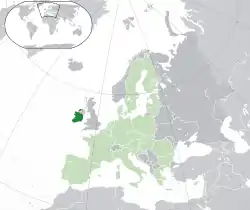
The legality of squatting in Ireland
Dublin Housing Action Committee's campaigning in the late 1960s resulted in some successes but also the Prohibition of Forcible Entry and Occupation Act of 1971, which criminalized squatting.[1] Squatters can gain title to land and property by adverse possession as governed by the 1957 Statute of Limitations Act.[2] An occupant is entitled to apply to the Property Registration Authority for legal possession provided they are in continuous and uninterrupted occupation of the property without the permission of the owner for 12 years.[3] If the land is owned by the state the period is 30 years.[2] In 2004, a squatter who had occupied a building for 16 years was unable to gain title because the owner had been paying for insurance on the house, while in 2008 radio presenter Pat Kenny failed to gain title to land owned by his neighbour.[2][4]
History
Squatting in Ireland was mentioned in letters in 1846, but by 1870 the issue was said to be in the past.[5][6] Irish Travellers wanted houses in the Republic of Ireland in the 1970s and used squatting as a tactic to gain them.[7] The Dublin Housing Action Committee (DHAC) was active between 1968 and 1971. It would occupy buildings to protest the housing crisis and support those who were imprisoned. Dennis Dennehy had previously squatted in Birmingham and London. He was arrested and imprisoned in 1969 after occupying 20 Mountjoy Square the previous year.[8] When he decided to go on hunger strike, it galvanised protests over housing. There were nightly marches to Mountjoy Prison and blockades of O'Connell Bridge. The Dublin Trades Council supported him and President De Valera was heckled.[9] Later in 1969, three men were imprisoned after the eviction of the Carlton Hotel on Harcourt Street and five activists barricaded themselves inside a room at the Four Courts.[9]
Many young people emigrated from Ireland in the 1980s and squatted in London.[10] In Dublin, there was a political squat on Arran Quay in 1995.[2] Housing activists occupied Disco Disco on Parnell Square in July 2003 and were evicted within 24 hours.[11] From 2003 to 2004 the Magpie Squat was a residential space which housed activists on Upper Leeson Street. It had a library and a vegetable garden.[11]
2010s
In the 2010s, with the construction of ghost estates across the country there was a rise in occupations in rural areas. A man in Tullamore, County Offaly defeated a claim for possession in court when the judge saw the improvements he had made to his squat, on an empty estate.[12] Activists from Occupy Cork squatted a National Asset Management Agency (NAMA) building in Cork at Christmas 2011, with the intention of using it as a community resource centre.[13]
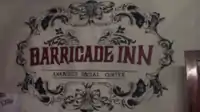
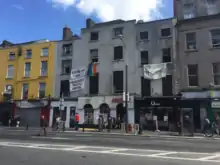
Dublin hosted the 2014 International Squatter Convergence, which had previously been held in cities such as Brighton, Dijon, Berlin and Leeds. Events were hosted by Seomra Spraoi, a self-managed social centre.[14] The Grangegorman squat in 2015 was a complex of buildings which successfully resisted eviction.[15] The news of the successful resistance spread across social media[16] and international news.[17] The squat was publicly supported by the Lord Mayor Christy Burke[18] and by Irish Times journalist Una Mullally,[19] before being evicted the following year, with the site later developed into student accomdation for those attending Dublin IT.[2] A building which once housed Neary's Hotel on Parnell Street in Dublin's north inner city, was occupied in 2015 and renamed The Barricade Inn by the squatters.[20][21] The Inn, operated by Anarchists aligned with the Workers Solidarity Movement, housed over two dozen residents who also operated a cafe and music venue from the building. Following a court order, The Barricade Inn and its residents were evicted by court order in February 2016.[11]
Illegal evictions also occur, such as a 2015 case in which three men were convicted of false imprisonment.[22]
Apollo House and the "Home Sweet Home" campaign
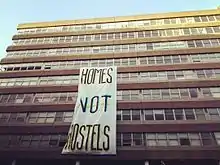
In December 2016 Apollo House, a 9-storey office block in Dublin City Centre, was taken over by squatters who attempted to convert it into a homeless shelter. The building, which had previously been used as office space for various companies, had fallen under the control of National Asset Management Agency by 2016 in the wake of the Post-2008 Irish economic downturn. A large group of activists working under the banner of "Home Sweet Home" occupied the building and subsequently housed over 200 homeless in the building during the Christmas period. The occupation drew considerable national attention in Ireland and drew the support of many high profile Irish artists such as Glen Hansard, Christy Dignam, Jim Sheridan,[23] Kodaline, Hozier,[24] Damien Dempsey, John Connors and Saoirse Ronan[25] as well as political parties such as Sinn Féin. In January 2017 a court ordered the residents to leave the premises, which they did voluntarily on 12 January without incident.[26] In the years immediately following, Apollo House was bought and demolished by a property developer.[27]
2020s
On 12 September 2021 a group began squatting a building that had laid vacant for 10 years in the Stoneybatter neighbourhood of Dublin.[28] The group began operating "That Social Centre"; offering free services such as a Cafe and a Bike repair shop. Five weeks later, on the morning of 27 October, a large group of private security guards, in view of some despatched Gardaí, attempted to evict the squatters from the premises. A fracas ensued that was captured on video and then posted to social media. Although the security guards were able to enter the squat and destroy the interior, a counter-demonstration quickly mounted what almost devolved into a riot, at which point the Gardaí moved to break up the two groups and sent the security guards away.[29] By that evening, the squatters re-entered the building and a large crowd gathered to support them.[28][29][30] The incident prompted much discussion within Irish media, with many newspapers suggesting the incident was a symptom of a deepening housing crisis in Ireland and Dublin in particular.[30][31]
See also
References
- Murray, Thomas (18 August 2016). Contesting Economic and Social Rights in Ireland: Constitution, State and Society, 1848–2016. Cambridge University Press. p. 307. ISBN 978-1-107-15535-0.
- Donnellan, Grace (21 April 2019). "Precarious Living: Squatters' rights in Ireland". University Observer. Retrieved 20 March 2021.
- Independent Woman (19 September 2007). "Squatters' rights to be reviewed – Property, Unsorted". Independent.ie. Archived from the original on 19 February 2012. Retrieved 20 February 2012.
- Finn, Christina (20 November 2014). "Galway man denied squatters' rights after living in house for 16 years". The Journal. Retrieved 20 March 2021.
- Foster, Thomas Campbell (1846). Letters on the Condition of the People of Ireland. Chapman and Hall. p. 706.
- a Close Observer of Long Local Experience, and One who Has Had Opportunities of World-wide Comparisons, Etc (1870). The Irish Land Question, Impartially Considered. p. 88.CS1 maint: multiple names: authors list (link)
- Gmelch, Sharon Bohn; Gmelch, George (2014). Irish Travellers: The Unsettled Life. Indiana University Press. p. 133. ISBN 978-0-253-01461-0.
- McEneaney, Sinead (14 May 2019). "Political commemoration and housing protest in Ireland: A lesson from the 1960s". History Workshop. Retrieved 20 March 2021.
- Murray, Thomas (18 August 2016). Contesting Economic and Social Rights in Ireland: Constitution, State and Society, 1848–2016. Cambridge University Press. pp. 294, 305, 306. ISBN 978-1-107-15535-0.
- Lalor, Francesca (25 April 2019). "The Squat Generation: Documentary On Newstalk". Newstalk. Archived from the original on 2 September 2019. Retrieved 14 June 2020.
- McDermott, Fiachradh. "The short history of squatting in Dublin: Rejecting consumerism and being 'a bit punk'". The Journal. Archived from the original on 30 April 2018. Retrieved 3 October 2020.
- Claire O'Brien (15 October 2011). "Squatter told he can stay in NAMA ghost estate home – National News". Independent.ie. Archived from the original on 19 February 2012. Retrieved 20 February 2012.
- O'Connell, Brian (7 January 2012). "Occupy Nama: the protesters' latest strategy". The Irish Times. Archived from the original on 4 October 2020. Retrieved 4 October 2020.
- Creed, Barry (26 September 2014). "Squatters from around the world gather in Dublin". The Irish Times. Archived from the original on 11 August 2015. Retrieved 3 October 2020.
- Dan Griffin. "Squatter Supporters hurt in Grangegorman stand off". Irish Times. Archived from the original on 6 July 2015. Retrieved 6 January 2015.
- Aoife Barry. "Grangegorman squatters welcome "victory" as they resist eviction". The Journal. Archived from the original on 25 March 2015. Retrieved 6 January 2015.
- "Residents resist eviction, clash with police in Dublin suburb". Al Jazeera. Archived from the original on 26 March 2015. Retrieved 6 January 2015.
- "Lord Mayor Praises Squatters Work". Irish Independent. Archived from the original on 2 June 2015. Retrieved 6 January 2015.
- Una Mullally. "The Grangegorman Squat". Irish Times. Archived from the original on 24 March 2015. Retrieved 6 January 2015.
- Sylvia Thompson (29 October 2015). "Squatters bring life to old buildings". Irish Times. Archived from the original on 30 October 2015. Retrieved 6 November 2015.
- Sheils, Conor (1 November 2015). "Ireland's most famous squatters are facing eviction". The Journal. Archived from the original on 30 April 2018. Retrieved 3 October 2020.
- "Three men sentenced over forced eviction for landlord". Irish Times. Archived from the original on 5 July 2015. Retrieved 6 February 2015.
- "'Homeless crisis has worsened since Apollo House demonstration' - campaigners". Irish Independent. 17 December 2017.
- Quinlan, Ronald (26 November 2018). "Marlet set to pay over €77m an acre for Apollo House site". Sunday Independent. Retrieved 6 November 2020.
- Cullen, Paul (18 December 2016). "Apollo House protesters to meet owners over occupation". Irish Times. Retrieved 3 November 2021.
- Holland, Kitty (12 January 2017). "Homeless and activists leave Apollo House amid emotional scenes". Irish Times. Retrieved 3 November 2021.
- Kelly, Olivia (7 May 2020). "Hawkins House, one of Dublin's ugliest buildings, finally set to be demolished". Irish Times. Retrieved 3 November 2021.
- Young, Pariesa (29 October 2021). "'They broke in using brute force': Irish activists protest attempted eviction from vacant building". France 24. Retrieved 3 November 2021.
- O'Brien, Mark (27 October 2021). "Protesters gather after alleged eviction in city centre". Dublin Live. Retrieved 3 November 2021.
- "the property had been used as a squat by a group of activists". Newstalk. 28 October 2021. Retrieved 3 November 2021.
- Pollak, Sorcha (3 November 2021). "Is Dublin city losing its cultural soul?". Irish Times. Retrieved 3 November 2021.
External links

| By country |
|
|---|---|
| Movements |
|
| In culture |
|
| Related topics | |
| |


