Straight line mechanism
In the late seventeenth century, before the development of the planer and the milling machine, it was extremely difficult to machine straight, flat surfaces. For this reason, good prismatic pairs without backlash were not easy to make. During that era, much thought was given to the problem of attaining a straight-line motion as a part of the coupler curve of a linkage having only revolute connection. Probably the best-known result of this search is the straight line mechanism development by Watt for guiding the piston of early steam engines. Although it does not generate an exact straight line, a good approximation is achieved over a considerable distance of travel. Exact linkages were later discovered, but not in time to be put to as much use.
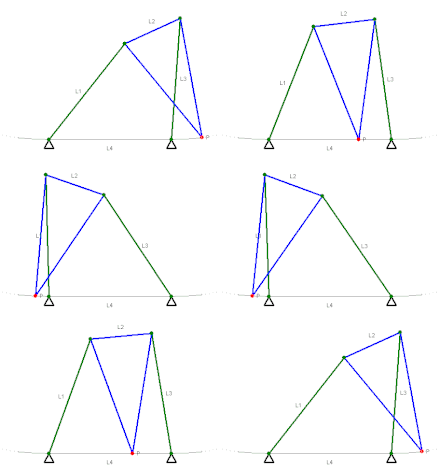
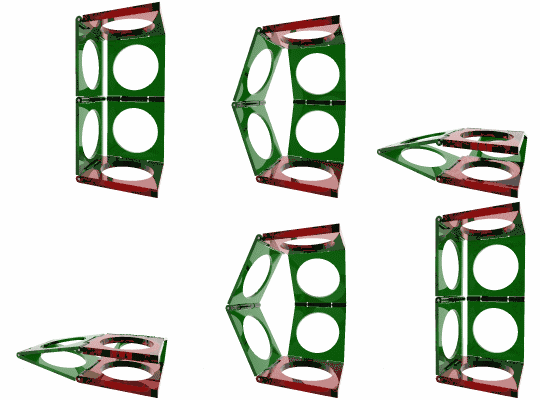
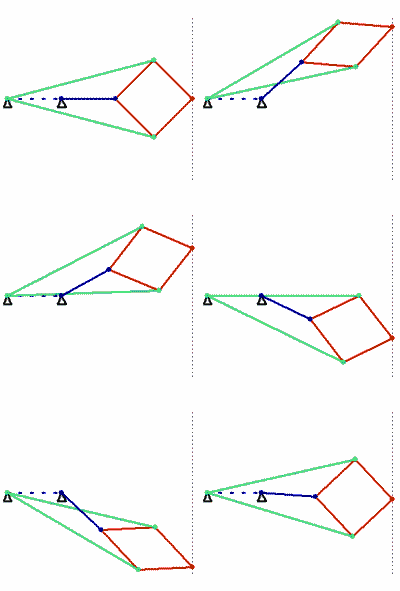
bars of identical colour are of equal length
List of linkages
Nearly straight line linkages
- Watt's linkage (1784)
- Parallel motion (1784), also by James Watt
- Chebyshev linkage
- Chebyshev's Lambda Mechanism (1878) (Can trade off straightness and near constant velocity)
- the Roberts mechanism
- Hoeckens linkage (1926) (this requires a sliding joint within it)
Perfect straight line linkages
Eventually, several linkages were discovered that produced perfect linear output:
- Sarrus linkage (1853)
- Peaucellier–Lipkin linkage (1864)
- Hart's first inversor/Hart's W-frame (1874)
- Hart's second inversor/Hart's A-frame (1875)
- Quadruplanar inversor (1875)
The earlier Scott Russell linkage (1803) translates linear motion through a right angle, but is not a straight line mechanism in itself.
Rolling mechanisms
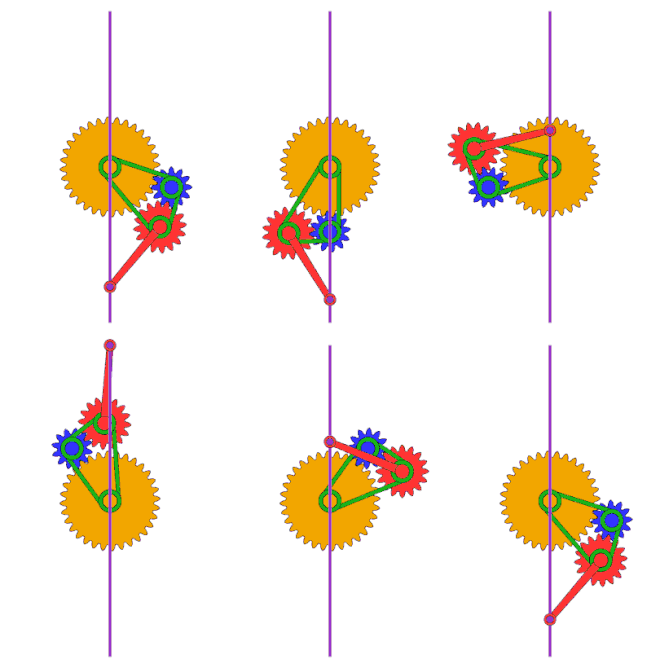
These mechanisms produce a straight line as a rolling curve, not as a coupler curve – i.e. they use gears or belts, instead of just bars connected by rotary joints.
- Tusi couple (1247), a 2:1 ratio hypocycloid (when used as a mechanical device, as in Murray's Hypocycloidal Engine, this is a spur gear rolling inside a ring gear of twice the diameter)
- Cardan straight line mechanism,[1] working by the same principle but only using spur gears, with an idler gear to reverse the motion
See also
- Four-bar linkage
- Level luffing crane (these usually use a version of Chebyshev linkage)
- Rigid chain actuator
Sources
- https://web.archive.org/web/20180418124753/http://kmoddl.library.cornell.edu/model.php?m=139 Reuleaux Collection, Cornell university
- Theory of Machines and Mechanisms, Joseph Edward Shigley
External links
- Cornell university (archived) - Straight-line mechanism models
- Alfred Kempe (1877). How to Draw a Straight Line (PDF). Macmillan – via University of California at Irvine.
- Daina Taimina. "How to Draw a Straight Line - a tutorial". Cornell University.
- Simulations using the Molecular Workbench software
- bham.ac.uk - Hart's A-frame (draggable animation) 6-bar linkage