Tarun Tapasi
Tarun Tapasi (Nepali: तरुण तपसी, romanized: Taruṇa Tapasī, lit. 'The Young Ascetic') is an epic by Kabishiromani Lekhnath Paudyal. It was published on 1953 by Sajha Prakashan. The epic is divided into 19 cantos. The poet called his epic as a navya-kavya, a new epic instead of maha-kavya. The epic is written in Shikharini chhanda.
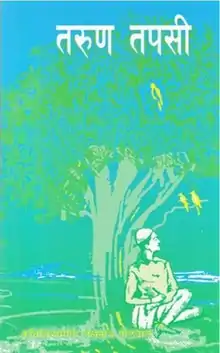 Cover page | |
| Author | Lekhnath Paudyal |
|---|---|
| Original title | तरुण तपसी |
| Country | Nepal |
| Language | Nepali |
| Genre | Poetry (navya-kavya) |
| Published | 1953 |
| Publisher | Sajha Prakashan |
Publication date | 1953 |
| Media type | Print (Paperback) |
| Pages | 128 |
| ISBN | 9789993327554 |
| Preceded by | Laalitya Vol. 1 |
| Followed by | Mero Rama (poem) |
Synopsis
The epic is a lengthy-narrative poem. The epic begins with a poet who takes a rest under a tree in a chautari in evening time. The poet has recently lost his wife and is grief-stricken. The poets decides to write something but it becomes dark. Then a sage appears before him who represents the soul of the tree. The sage delivers a homily to the poet as the tree who has been rooted in a single place and has seen various seasons change. The sage talks to him about his hardships and the hardships of other people who he have seen and observed for many years in a lifetime. The years of observations and learning through those observation have enlighten the sadhu.[1]
Cantos
There are 34 verses in the first canto, which have been introduced in the subject by starting the poem. As the poet wanders, he reaches an unhabituated place. The sun was also setting in the western sky during the long rainy season. The holy river was flowing a little farther and many rocks were visible on the bank. The poet, who had reached such a secluded and beautiful place, was also distressed by the loss of his wife. His inner desire to do penance was also awakening. As he lifted his pen to write something about austerities, the sun went down and the world became black. A sage then appears before him. The poet presents various question to the sadhu which then becomes the subject of the poem.
The second canto has 27 verses. The sadhu is narrating his life story in this canto.
There are 36 verses in the third canto. It contains the story of the sage growing up like playing with animals, his kite being caught in the branch of the tree and observing a bird nesting over time as the day darkens in an anecdotal manner.
There are 26 verses in the fourth canto, which include the description of the winter spent by the ascetic and the experience of the arrival of spring. Here is the experience of him entering adolescence after childhood.
There are 27 verses in the fifth canto. Here, topics like birds gathering and consulting, hunters killing birds, construction of the chautara are presented in an interesting way.
There are 31 verses in the sixth canto, where the lament of the bird is presented in touching manner.
There are 26 verses in the seventh canto, in which the message is given to turn from violence to compassion.
Similarly, there are 30 verses in the eighth canto , 29 verses in the ninth canto, 34 verses in the tenth canto, 36 verses in the eleventh canto, 28 verses in the twelfth canto, 32 verses in the thirteenth canto, 29 verses in the fourteenth canto, 38 verses in the fifteenth canto, 32 verses in the sixteenth canto, 24 verses in the seventeenth canto, 26 verses in the eighteenth canto and 36 verses in the nineteenth canto. All these verses contain the experience of the ascetic.[2]
Symbolism
The poem is full of allegory and symbolism. The poet in the epic represents the poet himself. Before writing this epic, poet had lost his first wife and was grief-struck. A divine revelation caused him to write the poem. The poem criticizes the world ideologically and philosophically through the Divine ascetic's neutral commentary on the pleasures and sorrows of the worldly human community, ostentation, conservatism, oppression, exploitation, religion and rituals, etc. The theme of this epic is the touching address of the benevolent tree of nature, which devotes its entire life to philanthropy, in the guise of young ascetic, to the self-absorbed mankind. The poem also discusses how the anomalies, inconsistencies, chaos and greed of the human who are considered to be divine creation but have arisen due to various shortcomings are making the society miserable.[3][4] As in Paudyal's famous poem Pinjada Ko Suga, he uses a bird as a metaphor for the opressed human in this poem too.[5]
Reception
Playwright and litterateur Balkrishna Sama wrote the foreword of the book in a later edition on March 22, 1965.[6] He considered this epic as a milestone in the Nepali literature.
The poem was highly appreciated by Nepalese reader and the status of the poet was highly uplifted by the poem in Nepali society. On January 4, 1955 during the occasion of seventeeth anniversary of the poet, the Nepalese poetic society presented their compliments to the poet by placing him on a ratha (chariot). The chariot was pulled from Thamel to an ancient round tree in Tundikhel by thousands of admirers of the poet. King Tribhuvan also presented his compliments. The then prime minister Matrika Prasad Koirala, Mahakabi Laxmi Prasad Devkota, playwright Balkrishna Sama, poet Siddhicharan Shrestha, the them home minister Tanka Prasad Acharya, American priest Fr. Moran were some of the intellectuals who pulled the chariot. The wheels of the chariot was engraved with Satyam Shivam Sundaram. A team of four different Scouts unit, eight women cavalry, and a military musical troupe accompanied the procession.[7]
See Also
References
- "Himalayan Voices". publishing.cdlib.org. Retrieved 2021-11-14.
- "तरुण तपसीमा लेखनाथ पौड्याल". News of Nepal. Retrieved 2021-11-14.
- "तरुण तपसीमा लेखनाथ पौड्याल". News of Nepal. Retrieved 2021-11-14.
- "कविशिरोमणि सम्झेर". कविशिरोमणि सम्झेर. Retrieved 2021-11-14.
- Kafle, Hem Raj. "Alternative Readings on Paudyal's "The Parrot in the Cage"". Cite journal requires
|journal=(help) - Paudyal, Lekhnath (1953). तरुण तपसी [Tarun Tapasi] (in Nepali). Nepal: Sajha Prakashan. pp. 5–10. ISBN 9789993327554.
- @therecord. ""My poems and plays are usually meant for social repair"- Lekhnath Poudel - The Record". www.recordnepal.com. Retrieved 2021-11-14.
External Links
| Poems |
|  |
|---|---|---|
| Epics |
| |
| Poetry anthology |
| |
| ||