Tokyu 2000 series
The Tokyu 2000 series (東急2000系, Tōkyū 2000-kei), reclassified Tokyu 9020 series (東急9020系, Tōkyū 9020-kei) from 2019,[1] is a Japanese commuter electric multiple unit (EMU) train type operated by Tokyu Corporation on Tokyu Den-en-toshi Line and Tokyo Metro Hanzomon Line inter-running services in the Tokyo area since 1992, as well as the Tokyu Oimachi Line since 2018. Three 10-car sets were built[2] by Tokyu Car Corporation between 1992 and 1993.
| Tokyu 2000/9020 series | |
|---|---|
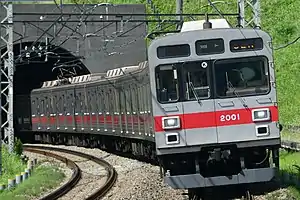 A 2000 series set on the Den-en-toshi Line, July 2019 | |
| In service | 1992–Present |
| Manufacturer | Tokyu Car Corporation |
| Constructed | September 1992–1993 |
| Entered service | March 1992 |
| Refurbished | 2018–2019 |
| Number built | 30 vehicles (3 sets) |
| Number in service | 20 vehicles (3 sets; as of 18 February 2019) |
| Formation | 10 cars per set, 5 cars (Oimachi Line) |
| Fleet numbers | 2101, 9022–9023 (as of 18 February 2019) |
| Operator(s) | Tokyu Corporation |
| Depot(s) | Nagatsuta |
| Line(s) served | |
| Specifications | |
| Car body construction | Stainless steel |
| Car length | 20,000 mm (65 ft 7+3⁄8 in) |
| Width | 2,800 mm (9 ft 2+1⁄4 in) |
| Doors | 4 pairs per side |
| Maximum speed | service: 110 km/h (70 mph), design: 120 km/h (75 mph) |
| Traction system | (Before Refurbishment) GTO-VVVF (After Refurbishment) SiC-VVVF |
| Acceleration | 3.3 km/(h⋅s) (2.1 mph/s) |
| Deceleration | 3.5 km/(h⋅s) (2.2 mph/s) (service) 4.5 km/(h⋅s) (2.8 mph/s) (emergency) |
| Electric system(s) | 1,500 V DC Overhead wire |
| Current collection method | Pantograph |
| Safety system(s) | CS-ATC |
| Track gauge | 1,067 mm (3 ft 6 in) |
Operations
The 2000 series sets are used on the Tokyu Oimachi Line and Tokyu Den-en-toshi Line and Tokyo Metro Hanzomon Line inter-running services; they are not capable of running through onto the Tobu Skytree Line, and have circular "K" stickers on the centre front cab window to indicate this.[2]
Design
Based on the earlier Tokyu 9000 series EMU design, two sets were introduced in 1992, followed by a third in 1993.[2] The first two sets were delivered with roller blind destination indicators, whereas the third set was delivered from new with 3-colour LED destination indicators.[2] All three sets have since been modified with full-colour LED destination indicators.[2]
Formations
Den-en-toshi Line 10-car sets
The 10-car sets consist of six motored (M) cars and four unpowered trailer (T) cars, formed as shown below, with car 1 at the Shibuya end.[3][4]
| Car No. | 1 | 2 | 3 | 4 | 5 | 6 | 7 | 8 | 9 | 10 |
|---|---|---|---|---|---|---|---|---|---|---|
| Designation | Tc2 | M2 | M1 | T2 | M2 | M1 | T1 | M2 | M1 | Tc1 |
| Numbering | 2000 | 2250 | 2200 | 2700 | 2350 | 2300 | 2800 | 2450 | 2400 | 2100 |
| Weight (t) | 27.8 | 33.1 | 34.7 | 26.2 | 33.1 | 34.7 | 27.2 | 33.1 | 34.7 | 27.8 |
| Capacity (total) | 130 | 144 | 144 | 144 | 144 | 144 | 144 | 144 | 144 | 130 |
The M1 cars are each fitted with one lozenge type pantograph.[4]
Interior
Seating is longitudinal bench seating throughout.[2] Cars 3 and 9 have wheelchair spaces.[3]
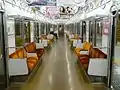 Interior view
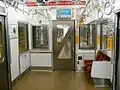 Interior view of car 3, showing the wheelchair space
History
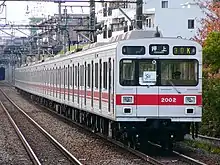
The first two sets entered service on the Den-en-toshi Line in September 1992.
Set 2103 entered service on the Oimachi Line in 2018 as a five-car formation.[1]
By February 2019, 2000 series sets 2102 and 2103 were reclassified "9020 series" and respectively numbered 9022 and 9023.[1]
References
- Hirose, Atsushi (18 February 2019). "東急2000系改め,9020系が登場" [Tokyu 2000 series reclassified as 9020 series]. Japan Railfan Magazine Online (in Japanese). Retrieved 4 December 2021.
- 私鉄車両年鑑2012 [Japan Private Railways Annual 2012]. Tokyo, Japan: Ikaros Publications Ltd. February 2012. p. 143. ISBN 978-4-86320-549-9.
- 私鉄車両編成表 2012 [Private Railway Rolling Stock Formations - 2012]. Japan: JRR. July 2012. p. 68. ISBN 978-4-330-29911-2.
- Watanabe, Mineo (May 1992). "東急2000系" [Tokyu 2000 series]. Japan Railfan Magazine. Vol. 32 no. 373. Japan: Koyusha Co., Ltd. pp. 29–33.
 |
Wikimedia Commons has media related to Tokyu 2000 series. |
Tokyu Corporation trainsets | ||
|---|---|---|
| In service |  | |
| Withdrawn |
| |