Traditionalist conservatism in the United States
In the United States, traditionalist conservatism is a political and social ideology and a type of conservatism based on Aristotle's philosophy and Edmund Burke's writings.[1]
| This article is part of a series on |
| Conservatism in the United States |
|---|
 Conservatism portal Conservatism portal United States portal United States portal |
Traditional conservatives value the preservation of their ancestors' institutions and societal order above hyper-individualism.[1] Traditionalist conservatives believe in a transcendent moral order manifested through certain natural principles to which they believe society should obediently conform.[1] Traditionalist conservatives also place a premium on the rule of law when it comes to protecting individual liberty.[1]
Fiscal conservatives and social conservatives (particularly the Christian right), according to some observers, have overshadowed or superseded classic conservatism.[2]
History
18th century
The Federalists had no ties to European-style nobility, royalty, or organized churches when it came to "classical conservatism." According to historian John P. Diggins:
Thanks to the framers, American conservatism began on a genuinely lofty plane. James Madison, Alexander Hamilton, John Marshall, John Jay, James Wilson, and, above all, John Adams aspired to create a republic in which the values so precious to conservatives might flourish: harmony, stability, virtue, reverence, veneration, loyalty, self-discipline, and moderation. This was classical conservatism in its most authentic expression.[3]
Something akin to Burkean traditionalism was transported to the American colonies through the policies and principles of the Federalist Party and its leadership as embodied by John Adams and Alexander Hamilton. The Federalists strongly opposed the excesses and instability of the French Revolution, defended traditional Christian morality, and supported a new "natural aristocracy" based on "property, education, family status, and [a] sense of ethical responsibility."[4]
In Revolutionary America, John Adams was one of the first champions of a traditional social order. Adams challenged radicals like Thomas Paine, who sought a unicameral legislature (Adams deemed it too democratic) in his Defence of the Constitution (1787). His translation of Discourses on Davila (1790), which included his own comments, was a study of "human motivation in politics". Adams felt that human nature would always lead to harmful tendencies that would necessitate government intervention.[5]
Alexander Hamilton, Secretary of the Treasury and co-author of The Federalist Papers (1787–1788) which was and still is a major interpretation of the new 1789 Constitution, led the Federalist Party. Both Jeffersonian classical liberalism and the radical ideologies that emerged from the French Revolution were criticised by Hamilton. He opposed free-market economics and advocated for a strong central government.[6]
19th century
The Whig Party had an approach that mirrored Burkean conservatism in the post-Revolutionary era, although rarely did Whigs cite Burke. Against the Jacksonian era's dominant democratic ethos, Whig leaders led the struggle for tradition and custom. In many ways, their conceptions of the Union mirrored Benjamin Disraeli's "One Nation Conservatism," which stood for hierarchy and organic society.
Daniel Webster of Boston was the most notable Whig statesman, along with Henry Clay. His most famous speech, the "Second Reply to Hayne" (1829), chastised Southerners like John C. Calhoun for arguing that states had the authority to invalidate federal laws they deemed unconstitutional.[7] Webster rarely addressed Burke, but he did follow similar lines of thinking from time to time.[8]
Rufus Choate, who adored Burke, was Webster's political and intellectual heir.[9] Choate was a component of the newly developed legal culture in New England, which was centered on Harvard Law School. Lawyers, he argued, were the guardians and preservers of the Constitution, and that it was the responsibility of the educated to manage political institutions. "The Position and Functions of the American Bar, as an Element of Conservatism in the State" (1845) was Choate's most renowned speech.[10]
George Ticknor and Edward Everett were the "Guardians of Civilization" in the Northern antebellum period, according to Emory University professor Patrick Allitt.
George Ticknor, a Harvard professor with a Dartmouth education, was the area's leading proponent of humane education. Ticknor, a scion of an old Federalist family and the creator of the Boston Public Library educated his students in Romance languages and the works of Dante and Cervantes at home while advocating America abroad to his numerous international friends, including Lord Byron and Talleyrand.[11]
Like Ticknor, Edward Everett was educated at the same German university (Goettigen) and advocated for the U.S. to follow same virtues as the ancient Greeks and eventually went into politics as a Whig. A firm Unionist (like his friend Daniel Webster), Everett deplored the Jacksonian Democracy that swept the nation. A famed orator in his own right, he supported Lincoln against Southern secession.[12]
Orestes Brownson, an American Catholic writer and political theorist (as well as a former political and religious radical), is best known for his 1865 book The American Republic, which examines how America satisfies Catholic tradition and Western Civilization. Brownson was a staunch Unionist who was critical of both Northern abolitionists and Southern secessionists.[13]
20th century
On both sides of the Atlantic in the 20th century, traditionalist conservatism was concentrated on two publications: The Bookman and its successor, The American Review. The eccentric Seward Collins owned and edited these publications, which featured the writings of the British Distributists, New Humanists, Southern Agrarians, T. S. Eliot, Christopher Dawson, and others. Collins eventually shifted his support to fascism and, as a result, many of his traditionalist supporters abandoned him. Despite the journal's demise due to Collins' increasingly radical political ideas, The American Review left a lasting impression on orthodox conservatism.[14]
Another intellectual branch of early-20th-century traditionalist conservatism was known as the New Humanism. Led by Harvard University professor Irving Babbitt and Princeton University professor Paul Elmer More, the New Humanism was a literary and social criticism movement that opposed both romanticism and naturalism. Beginning in the late 19th century, the New Humanism defended artistic standards and "first principles" (Babbitt's phrase). Reaching an apogee in 1930, Babbitt and More published a variety of books including Babbitt's Literature and the American College (1908), Rousseau and Romanticism (1919) and Democracy and Leadership (1924) and More's Shelburne Essays (1904–1921).[15]
The Southern Agrarians were another group of traditionalist conservatives. They were originally known as "the Fugitives," a group of Vanderbilt University poets and writers that included John Crowe Ransom, Allen Tate, Donald Davidson and Robert Penn Warren. In 1930 some of the Fugitives joined other traditionalist Southern writers to publish I'll Take My Stand, which applied standards sympathetic to local particularism and the agrarian way of life to politics and economics. Warren and traditionalist scholar Cleanth Brooks later formulated a form of criticism known as the New Criticism. The "twelve southerners" who contributed to the book condemned northern industrialism and commercialism, echoing prior distributist views. A few years after the release of I'll Take My Stand, some of the Southern Agrarians teamed up with Hilaire Belloc and Herbert Agar to publish Who Owns America: A New Declaration of Independence, a new collection of writings.
New conservatives
Following WWII, the initial stirrings of a "traditionalist movement" emerged, with University of Chicago professor Richard M. Weaver among those who helped to create it (and hence the greater Conservative Movement in America). Weaver's book Ideas Have Consequences (1948) traced the progressive decline of Western cultural ideals since the Middle Ages.[16] Another professor, Peter Viereck repeated Weaver's writings in 1949 with his book Conservatism Revisited, which looked at Prince Klemens Metternich's conservative philosophy.
Following Weaver and Viereck, a flowering of conservative research began with the publication of Eric Voegelin's The New Science of Politics in 1953, Robert A. Nisbet's The Quest for Community in 1953, and Clinton Rossiter's Conservatism in America in 1955. The Conservative Mind: From Burke to Eliot, authored by Russell Kirk in 1953, was the book that defined the traditionalist school, providing a detailed account of the intellectual heritage of Anglo-American traditionalist conservatism.[17]
When these thinkers appeared on the academic scene they became known for rebuking the progressive worldview inherent in an America comfortable with New Deal economics, a burgeoning military–industrial complex and a consumerist and commercialized citizenry. These conservative scholars and writers garnered the attention of the popular press of the time and before long they were collectively referred to as "the New Conservatives". Among this group were not only Weaver, Viereck, Voegelin, Nisbet, Rossiter and Kirk, but other lesser known thinkers such as John Blum, Daniel Boorstin, McGeorge Bundy, Thomas Cook, Raymond English, John Hallowell, Anthony Harrigan, August Heckscher, Milton Hindus, Klemens von Klemperer, Erik von Kuehnelt-Leddihn, Richard Leopold, S. A. Lukacs, Malcolm Moos, Eliseo Vivas, Geoffrey Wagner, Chad Walsh and Francis Wilson,[18] as well as Arthur Bestor, Mel Bradford, C. P. Ives, Stanley Jaki, John Lukacs, Forrest McDonald, Thomas Molnar, Gerhard Neimeyer, James V. Schall, S.J., Peter J. Stanlis, Stephen J. Tonsor and Frederick Wilhelmsen.[19]
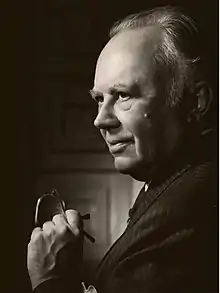
Russell Kirk, an independent scholar, writer, critic, and man of letters, was the undisputed leader of the New Conservatives. Kirk was a prominent person in the conservative movement, and he was friends with William F. Buckley, Jr., a National Review columnist, editor, and syndicated columnist, as well as a historian and horror fiction writer. The Conservative Mind: From Burke to Santayana (later republished as The Conservative Mind: From Burke to Eliot) is his most well-known work. Kirk's ideas and legacy are intertwined with the history of traditionalist conservatism, with his impact felt at think tanks like the Heritage Foundation, the Intercollegiate Studies Institute, and most especially the Russell Kirk Center for Cultural Renewal.
Kirk's PhD dissertation, The Conservative Mind was prepared while he was a student at the St. Andrews University in Scotland. Kirk, who had previously written a biography of American conservative John Randolph of Roanoke, had sketched forth six "canons of conservative thought" in the book, which included:
- Belief that a divine intent rules society as well as conscience... Political problems, at bottom, are religious and moral problems.
- Affection for the proliferating variety and mystery of traditional life, as distinguished from the narrowing uniformity and egalitarian and utilitarian aims of most radical systems.
- Conviction that civilized society requires orders and classes...
- Persuasion that property and freedom are inseparably connected, and that economic leveling is not economic progress...
- Faith in prescription and distrust of "sophisters and calculators." Man must put a control upon his will and his appetite.... Tradition and sound prejudice provide checks upon man's anarchic impulse.
- Recognition that change and reform are not identical...[20]
Goldwater movement and its aftermath
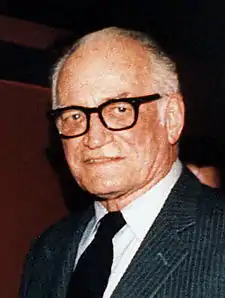
Senator Barry Goldwater rose to national prominence after L. Brent Bozell Jr. (William F. Buckley, Jr.'s Catholic traditionalist brother-in-law) ghostwrote The Conscience of a Conservative for him. The book promoted a conservative ideology similar to that of Buckley's National Review, and it drove Goldwater to run against Vice President Richard Nixon for the 1960 Republican presidential nomination, but he lost.[21]
In 1964, Goldwater returned to confront the Republican Party's Eastern Establishment, which had controlled it since the 1930s. In a campaign marred by attacks from liberal Republican primary opponents (Rockefeller, Romney, Scranton, and others), the press, the Democrats and President Lyndon B. Johnson, Goldwater found new allies allies among conservatives, particularly traditionalists. Goldwater's cause was championed by Russell Kirk as the maturation of the New Right in American politics. In his syndicated writings, Kirk supported Goldwater and campaigned for him in the primaries.[22] Following Goldwater's defeat, the New Right regrouped and found a new figurehead in the late 1970s: Ronald Reagan.
Fundamental differences developed between libertarians and traditional conservatives. Libertarians wanted the free market to be unregulated as possible while traditional conservatives believed that big business, if unconstrained, could impoverish national life and threaten freedom.[23] Libertarians also believed that a strong state would threaten freedom while traditional conservatives regarded a strong state, one which is properly constructed to ensure that not too much power accumulated in any one branch, was necessary to ensure freedom.[23]
Leading 20th and 21st century traditionalist figures
Traditionalist conservative Russell Kirk inspired former Tennessee Republican Senator Fred Thompson, former Michigan Republican Senator Spencer Abraham and former Illinois Democratic Senator Paul Simon.[24] Thompson gave an interview about Kirk's influence on the Russell Kirk Center's blog.[25] Former Illinois Republican Congressman Henry Hyde[24] and Michigan Republican Congressmen Thaddeus McCotter and Dave Camp, both of whom visited the Russell Kirk Center in 2009, are among the U.S. Congressmen impacted by Kirk. In 2010, then-Congressman Mike Pence acknowledged Kirk as a major influence.[26] Former Michigan Republican Governor John Engler is a personal friend of the Kirks[24] and a trustee of the Wilbur Foundation,[27] which supports the Russell Kirk Center for Cultural Renewal in Mecosta, Michigan. Engler gave a speech about Kirk at the Heritage Foundation, which may be found on the Russell Kirk Center's blog.[28]
Other influences
Traditionalist conservative influences on those who emerged in the 1940s and 1950s as "the New Conservatives" included Bernard Iddings Bell, Gordon Keith Chalmers, Grenville Clark, Peter Drucker, Will Herberg and Ross J. S. Hoffman.[29]
Organizations
Journals, periodicals and reviews
- Modern Age: A Quarterly Review
- Touchstone Magazine
- The University Bookman
- The Political Science Reviewer
- The Chesterton Review
- Image: A Journal of the Arts and Religion
References
- Deutsch & Fishman 2010, p. 2.
- Dreher, Rod (September 24, 2012). "The Rout Of Traditionalist Conservatism". The American Conservative. Retrieved January 7, 2020.
- John P. Diggins (1994). Up from Communism. Columbia UP. p. 390. ISBN 9780231084895.
- Viereck, p. 89
- Patrick Allitt, The Conservatives: Ideas and Personalities Throughout American History (Yale University Press, 2009) p. 12
- Frohnen, pp. 369–70.
- Frohnen, pp. 906–08.
- Craig R. Smith (2005). Daniel Webster and the Oratory of Civil Religion. University of Missouri Press. p. 45. ISBN 9780826264299.
- Rufus Choate (2002). The Political Writings of Rufus Choate. Regnery Gateway. p. 6. ISBN 9780895261540.
- Muller, Jerry Z., ed. Conservatism: An Anthology of Social and Political Thought from David Hume to the Present (Princeton University, 1997) pp. 152–66.
- Allitt, Patrick. (2009) The Conservatives: Ideas and Personalities Throughout American History. New Haven: Yale University Press, pp. 62–63.
- Allitt, Patrick. (2009) The Conservatives: Ideas and Personalities Throughout American History. New Haven: Yale University Press, pp. 63–64.
- Allitt, Patrick. (2009) The Conservatives: Ideas and Personalities Throughout American History. New Haven: Yale University Press, pp. 83–86.
- Frohnen, Bruce, Jeremy Beer, and Jeffrey O. Nelson (2006) American Conservatism: An Encyclopedia. Wilmington, DE: ISI Books, pp. 76–77.
- Frohnen, Bruce, Jeremy Beer, and Jeffrey O. Nelson (2006) American Conservatism: An Encyclopedia. Wilmington, DE: ISI Books, pp. 621–22.
- Nash, George H. (1976, 2006)The Conservative Intellectual Movement in America since 1945. Wilmington, DE: ISI Books, pp. 30–36.
- Dunn, Charles W. (2003)The Conservative Tradition in America, Lanham, MD: Rowman & Littlefield, p. 10.
- Viereck, Peter (1956, 2006) Conservative Thinkers from John Adams to Winston Churchill. New Brunswick, NJ: Transaction Publishing, p. 107.
- Nash, George H. (1976, 2006) The Conservative Intellectual Movement in America since 1945. Wilmington, DE: ISI Books, pp. 50–55, 68–73.
- Kirk, Russell (1953)The Conservative Mind: From Burke to Eliot. Washington, D.C.:Regnery, pp. 7–8.
- Allitt, Patrick. (2009) The Conservatives: Ideas and Personalities Throughout American History. New Haven, CT: Yale University Press, p. 188.
- Kirk, Russell. (1995) The Sword of Imagination: Memoirs of a Half-Century of Literary Conflict. Grand Rapids, MI: William B. Eerdmans Publishing Co., pp. 285–288.
- Bogus 2011, p. 16.
- Person, James E. Jr. Russell Kirk: A Critical Biography of a Conservative Mind. Lanham, MD: Madison Books, p. 217.
- "Senator Fred Thompson « Russell Kirk, man of letters".
- "Permanent Things". Archived November 9, 2017, at the Wayback Machine.
- the grant foundation grants org at wilburfoundation.org
- "Michigan Governor John Engler speaks at the Heritage Foundation « Russell Kirk, man of letters".
- Viereck, Peter (1956, 2006) Conservative Thinkers from John Adams to Winston Churchill. New Brunswick, NJ: Transaction Publishers, p. 107.
Bibliography
- Aberbach, Joel D.; Peele, Gillian (2011). "Conservative Tensions and the Republican Future". Crisis of Conservatism?: The Republican Party, the Conservative Movement, and American Politics After Bush. Oxford University Press. ISBN 0-199-83136-X.
- Bogus, Carl T. (2011). Buckley: William F. Buckley Jr. and the Rise of American Conservatism. Bloomsbury Publishing. ISBN 1-596-91580-3.
- Deutsch, Kenneth L.; Fishman, Ethan (2010). The Dilemmas of American Conservatism. University Press of Kentucky. ISBN 0-813-13962-7.
| Schools |  | ||||
|---|---|---|---|---|---|
| Principles | |||||
| History | |||||
| People |
| ||||
| Parties |
| ||||
| Movements | |||||
| Historical factions | |||||
| See also | |||||
| |||||