Turkey–Ukraine relations
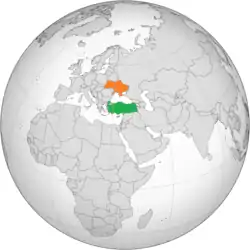
Turkey and Ukraine have a long chronology of historical, geographic, and cultural contact. Diplomatic relations between both countries were established in early 1990s when Turkey became one of the first states in the world to announce officially about recognition of sovereign Ukraine. Turkey has an embassy in Kyiv and a consulate general in Odessa. Ukraine has an embassy in Ankara and a consulate general in Istanbul. Turkey is a full member of NATO and Ukraine is a candidate. Also both countries are BLACKSEAFOR and BSEC members.
 | |
 Turkey |
 Ukraine |
|---|---|
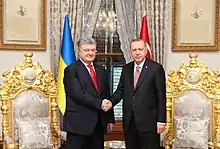
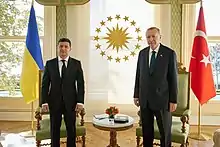
In late January 2010 Ukrainian President Viktor Yanukovych and Turkish Prime Minister Recep Tayyip Erdoğan agreed to form a free trade zone between the two countries during 2011.[1] But bilateral free trade talks were put on hold in 2013.[2]
Following the end of 2015, Turkey and Ukraine experienced closer relations as a result of both countries increasingly strained relationship with Russia.[2] On 20 August 2016 Turkish President Recep Tayyip Erdoğan told his Ukrainian counterpart Petro Poroshenko that Turkey would not recognize the 2014 Russian annexation of Crimea; calling it "Crimea's occupation".[3] On 9 January 2017 Turkey's Foreign Minister Mevlüt Çavuşoğlu stated "We support the territorial integrity of Ukraine and Georgia. We do not recognize the annexation of the lands of Ukraine".[4]
History
On February 3, 2020, Recep Tayyip Erdoğan visited Ukraine and met with President Zelensky. They signed an agreement on military-financial cooperation. It provided for the Turkish side to allocate about $ 36 million for the needs of the Armed Forces of Ukraine for the purchase of Turkish military and dual-use goods.[5]
Abduction of Turkish dissidents
There has been a rise in number of Turkish dissidents fleeing to Ukraine, following the violent crackdown launched by Turkish leader Erdoğan following the failed 2016 coup. In 2018, the Turkish regime pressured then-President of Ukraine, Petro Poroshenko, to handle dissidents. Subsequently, Ukraine imprisoned and deported two Turkish journalists, and a blogger, revoking their visas.[6][7]
According to Radio Free Europe in February 2020, the Ukrainian government was found complicit in letting the Turkish intelligence abduct Turkish dissidents, mostly those who linked with the Gülen movement; Kyiv had already deported a number of Gulenists back to Turkey in 2021.[8][9] Turkey, despite being a NATO member (which Ukraine has shown aspiration to join), has become increasingly aggressive against other NATO and European Union members, while Ukraine has stood silent toward Turkey's aggressiveness.[10]
Embassies
The Embassy of Turkey is located in Kyiv, Ukraine. The Embassy of Ukraine is located in Ankara, Turkey.
Diplomacy
References
- Ukraine and Turkey start forming free trade zone, UNIAN (January 25, 2010)
- Ukraine, Turkey may forge anti-Russian alliance in Black Sea, UNIAN (16 March 2016)
- Erdogan Tells Poroshenko Turkey Won't Recognize Crimea As Russian, Radio Free Europe (20 August 2016)
- Turkey does not review the position on Ukraine and Georgia in favor of, Ukrayinska Pravda (9 January 2017)
- "Візит турецького президента до Києва - перший крок до зони вільної торгівлі". Deutsche Welle.
- "Turks Living in Fear as Erdogan's Wrath Stretches to Ukraine".
- https://www.indopremier.com/ipotnews/newsDetail.php?jdl=CORRECTED___Ukraine_arrested_Turkish_blogger_for_Ankara__police&news_id=1385850&group_news=ALLNEWS&taging_subtype=UKRAINE&name=&search=y_general&q=UKRAINE,%20&halaman=1
- "In Kyiv, Erdogan Said All the Right Things -- Unless You're a Turkish Dissident in Ukraine".
- "Ukraine deports suspected Gulen supporters to Turkey - Al-Monitor: The Pulse of the Middle East".
- Abroad, Turkey (30 July 2021). "Why the West should take Turkey's international abductions more seriously". Ahval.
External links
- Turkish embassy in Kyiv
- Ukrainian embassy in Ankara
- Turkish Ministry of Foreign Affairs about relations with Ukraine
| |||||||||||||||||||||||||||||||||||||||||||||||||||||||||||||||
| |||||||||||||||||||||||||||||||||||||||||||||||||||||||||||||||
| |||||||||||||||||||||||||||||||||||||||||||||||||||||||||||||||
| Africa |  | |
|---|---|---|
| Americas | ||
| Asia | ||
| Europe | ||
| Multilateral relations | ||
| Disputes | ||
| Diplomatic missions | ||