Urdu movement
The Urdu movement was a socio-political movement aimed at making Urdu the universal language and symbol of the cultural and political identity of the Muslim communities of the Indian subcontinent during the British Raj. The movement began with the fall of the Mughal Empire in the mid-19th century, fuelled by the Aligarh movement of Sir Syed Ahmed Khan. It strongly influenced the All India Muslim League and the Pakistan movement.
History
Most of the grammar and basic vocabulary of Hindustani descends directly from the medieval Indo-Aryan language of central India, known as Śauraseni.[1] After the tenth century, several Śauraseni dialects were elevated to literary languages, including Braj Bhasha, Awadhi and the Khari Boli of Delhi.
During the reigns of the Turko-Afghan Delhi Sultanate and the Mughal Empire in India, where Persian was adopted as the official language and Delhi was established as the capital, the imperial court and concomitant immigration infused the Indo-Aryan dialect of Hindi spoken in Delhi (the earliest form is known as Old Hindi) with large numbers of Persian, Arabic, and Chagatai words from the court; this occurred as a result of cultural contact between Hindus and Muslims in Hindustan and became the fruit of a composite Ganga-Jamuni tehzeeb.[2][3][4][5][6][7] The introduced words were primarily nouns and were employed for cultural, legal and political concepts. These Persian and Arabic loanwords form 25% of Urdu's vocabulary.[8][9] As a form of Hindustani and a member of the Western Hindi category of Indo-Aryan languages,[7] 75% of Urdu words have their etymological roots in Sanskrit and Prakrit,[8][10][11] and approximately 99% of Urdu verbs have their roots in Sanskrit and Prakrit.[9][12]
The new court language developed simultaneously in Delhi and Lucknow, the latter of which is in an Awadhi-speaking area; and thus, modern Hindustani has a noticeable Awadhi influence even though it is primarily based on Delhi dialect. In these cities, the language continued to be called "Hindi" as well as "Urdu".[13][6] While Urdu retained the grammar and core vocabulary of the local Hindi dialect, it adopted the Nastaleeq writing system from Persian.[6][14]
The term Hindustani is derived from Hindustan, the Persian-origin name for the northwestern Indian subcontinent. The works of the 13th century scholar Amir Khusro are typical of the Hindustani language of the time:
सेज वो सूनी देख के रोवुँ मैं दिन रैन ।
पिया पिया मैं करत हूँ पहरों, पल भर सुख ना चैन ॥
.سیج وو سونی دیکھ کے رووں میں دن رہیں
.پیا پیا میں کرت ہوں پہروں، پل بھر سکھ نہ چین
sej vo sūnī dekh ke rovũ ma͠i din rain,
piyā piyā ma͠i karat hū̃ pahrõ, pal bhar sukh nā cain.
Seeing the empty bed I cry day and night
Calling for my beloved all day, not a moment of happiness or peace.
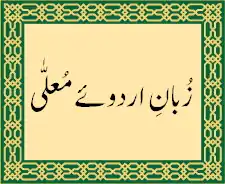
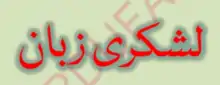
The language went by several names over the years: Hindavi ("of Hindus or Indians"), Dahlavi ("of Delhi"), Hindustani ("of Hindustan") and Hindi ("Indian").[15] The Mughal Emperor Shah Jahan built a new walled city in Delhi in 1639 that came to be known as Shahjahanabad. The market close to the royal fort (the Red Fort) was called Urdu Bazar ("Army/camp Market", from the Turkic word ordu, "army"), and it may be from this that the phrase Zaban-e-Urdu ("the language of the army/camp") derives. This was shortened to Urdu around the year 1800. The Mughal term Ordu with the local equivalent Lashkari[16] or "camp language" (cognate with the English word, "horde"), was used to describe the common language of the Mughal army. The language spread from the interaction of Persian-speaking Muslim soldiers to the local people who spoke varieties of Hindi. Soon, the Persian script in the cursive Nasta'liq form was adopted, with additional letters to accommodate the Indian phonetic system. Large number of Persian words were adopted in Hindustani, as were even grammatical elements such as the enclitic ezāfe.[8][17]
The official language of the Ghurids, Delhi Sultanate, the Mughal Empire, and their successor states, as well as their language of poetry and literature, was Persian, while the official language of religion was Arabic. Most of the sultans and the nobility of the sultanate period were Turkic peoples from Central Asia who spoke Chagatai as their mother tongue. The Mughals were also Chagatai, but later adopted Persian. The basis in general for the introduction of Persian language into the Indian subcontinent was set, from its earliest days, by various Persianized Central Asian Turkic and Afghan dynasties.[18] Muzaffar Alam asserts that Persian became the lingua franca of the empire under Akbar for various political and social factors due to its non-sectarian and fluid nature.[19] However, the armies, merchants, preachers, Sufis, and later the court, also incorporated the local people and elements of the medieval Hindu literary language, Braj Bhasha. This new contact language soon incorporated other dialects, such as Haryanvi, Panjabi, and in the 17th century the dialect of the new capital at Delhi. By 1800, Delhi dialect had become the dominant base of the language.[20]
When Wali Mohammed Wali arrived in Delhi, he established Hindustani with a light smattering of Persian words, a register called Rekhta, for poetry; previously the language of poetry had been Persian. When the Delhi Sultanate expanded south to the Deccan Plateau, they carried their literary language with them, and it was influenced there by more southerly languages, producing the Dakhini dialect. During this time Hindustani was the language of both Hindus and Muslims. The non-communal nature of the language lasted until the British Raj in India, when in 1837 Hindustani in the Persian script (i.e. Urdu) replaced Persian as the official language and was made co-official along with English. This triggered a Hindu backlash in northwestern India, which argued that the language should be written in the native Devanagari script. This literary standard, called simply Hindi, replaced Urdu as the official register of Bihar in 1881, establishing a sectarian divide of "Urdu" for Muslims and "Hindi" for Hindus, a divide that was formalized with the independence of India and Pakistan after the withdrawal of the British.[21]
Hindi-Urdu controversy
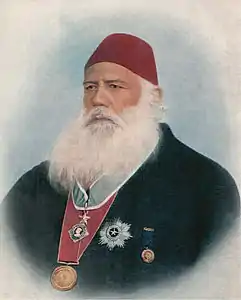
The Hindi-Urdu controversy arose in 1867 when the British government prepared to accept the demand of the Hindu communities of the United Provinces (now Uttar Pradesh) and Bihar to change the Perso-Arabic script of the official language to Devanagari and adopt Hindi as the second official language on demand of Hindu activists. Muslim politician Sir Syed Ahmed Khan became the most vocal opponent of this change.[22] He viewed Urdu as the lingua franca of Muslims. Having been developed by the ruling Mughal Empire, what became known as Urdu was used as a secondary language to Persian, the official language of the Mughal court.[22] Since the decline of the Mughal dynasty, Sir Syed promoted the use of Urdu through his own writings. Under Sir Syed, the Scientific Society of Aligarh translated Western works only into Urdu.[22] Sir Syed considered Urdu to be "a common legacy of Hindus and Muslims".[23] The schools established by Sir Syed imparted education in the Urdu-medium. The demand for Hindi, led largely by Hindus was to Sir Syed an erosion of the centuries-old Muslim cultural domination of India.[24][25] Testifying before the British-appointed education commission, Sir Syed controversially exclaimed that "Urdu was the language of gentry and of people of high social standing, whereas Hindi was to be the vulgar."[22] His remarks provoked a hostile response from Hindu leaders and advocates of Hindi. ".[26] The Hindus unified across the region to demand the recognition of Hindi. The success of the Hindi movement led Sir Syed to further advocate Urdu as the symbol of Muslim heritage and as the language of the Muslim intellectual and political class.[22] His educational and political work grew increasingly centred on and exclusively for Muslim interests. He also sought to persuade the British to give it extensive official use and patronage.
Urdu in Muslim politics
Sir Syed's call for the adoption of Urdu as the language of Indian Muslims won extensive support from the Aligarh Movement and Muslim religious activists of the Deobandi and Wahabbi schools. Muslim religious and political leaders Mohsin-ul-Mulk and Maulvi Abdul Haq developed organisations such as the Urdu Defence Association and the Anjuman Taraqqi-i-Urdu, committed to the perpetuation of Urdu.[22] Sir Syed's protege Shibli Nomani led efforts that resulted in the adoption of Urdu as the official language of the Hyderabad State and as the medium of instruction in the Osmania University. This political campaign was criticised for making the use of Urdu a political issue that served as a wedge between Muslims and Hindus, who saw Sir Syed's advocacy as an effort to re-establish Muslim hegemony.[22][27] To Muslims in northern and western India, Urdu became an integral part of political identity and communal separatism. The division over the use of Hindi or Urdu would further fuel communal conflict between Muslims and Hindus in India.[22] The All India Muslim League and the Jamaat-e-Islami projected Urdu as essential for the political and cultural survival of Islamic society in India. Muslim politicians like Muhammad Ali Jinnah, Sir Muhammad Iqbal, Liaquat Ali Khan emphasised Urdu as the symbol of Muslim heritage and political identity. The political cause of Urdu became a core issue at the heart of the Two-Nation Theory, which advocated that Muslims and Hindus were irreconcilably separate nations. Advocates of the Pakistan movement sought to make Urdu a key argument in drawing distinctions with India's Hindu-majority population. Muslim religious leaders such as Maulana Mohammad Ali, Maulana Shaukat Ali and Maulana Maududi emphasised the knowledge of Urdu as essential for ordinary and religious Muslims.
Urdu in Pakistan and India

In Pakistan, Urdu has been so far, the National language and the Lingua franca, while English holds the status as one of the official languages of the state. However, this policy caused considerable political turmoil in East Bengal, which was home to Bengali-speaking population who constituted the majority of the population of Pakistan. Jinnah, most West Pakistani politicians emphasised that only Urdu would be recognised officially. This intensified the cultural and political gulf between West Pakistan and East Pakistan. The East Pakistan Awami Muslim League (the predecessor of the Awami League), established by A. K. Fazlul Huq, Huseyn Shaheed Suhrawardy and Sheikh Mujibur Rahman in 1949 would lead the demand for the recognition of Bengali. Intensifying protests and strikes led by political groups, unions and students groups would lead to the imposition of martial law. The killing of protesting students by police in 1952 triggered a massive wave of protests in the province, which would come to be known as the Bengali Language Movement. Although politicians like Khwaja Nazimudin supported the cause of Urdu, a vast majority of Bengali nationalists saw the government policy as a symbol of racial discrimination. This wedge in Pakistani society would ultimately lead to the Bangladesh Liberation War and the establishment of Bangladesh in 1971.
Independent India adopted Urdu as one of its 22 scheduled languages although its counterpart, Hindi, enjoys the status of official language. Urdu is also officially recognised by the states of Jammu and Kashmir, Uttar Pradesh, Telangana, Bihar and Delhi. Urdu is widely used by Indian Muslims across the country and there are a large number of Urdu-medium schools, colleges and universities, including madrassahs, the Jamia Millia Islamia and the Aligarh Muslim University. Urdu is also a part of popular culture, media and publications. Numerous Urdu language films have been produced, which include Umrao Jaan, Shatranj Ke Khiladi and Pakeezah.
Despite being given the status of a scheduled language, there have been concerns that the Urdu language has largely been on a decline in India. This decline has been attributed to reasons such as lack of promotional policies by central language regulation boards, the promulgation and preference of Urdu's counterpart Hindi as the Indian union's official language since 1950, the higher number of Hindi-speakers in India leading to the suppression of Urdu, the partition of India and Urdu's national language status in Pakistan overshadowing the language's prospects in India, as well as the lack of many schools in India teaching Urdu as a medium of instruction.[28]
See also
References
- Alfred C. Woolner (1999). Introduction to Prakrit. Motilal Banarsidass. p. 5. ISBN 978-81-208-0189-9.
- "Women of the Indian Sub-Continent: Makings of a Culture - Rekhta Foundation". Google Arts & Culture. Retrieved 25 February 2020.
The "Ganga-Jamuni tehzeeb" is one such instance of the composite culture that marks various regions of the country. Prevalent in the North, particularly in the central plains, it is born of the union between the Hindu and Muslim cultures. Most of the temples were lined along the Ganges and the Khanqah (Sufi school of thought) were situated along the Yamuna river (also called Jamuna). Thus, it came to be known as the Ganga-Jamuni tehzeeb, with the word "tehzeeb" meaning culture. More than communal harmony, its most beautiful by-product was "Hindustani" which later gave us the Hindi and Urdu languages.
- Farooqi, M. (2012). Urdu Literary Culture: Vernacular Modernity in the Writing of Muhammad Hasan Askari. Springer. ISBN 978-1-137-02692-7.
Historically speaking, Urdu grew out of interaction between Hindus and Muslims.
- Kesavan, B. S. (1997). History Of Printing And Publishing In India. National Book Trust, India. p. 31. ISBN 978-81-237-2120-0.
It might be useful to recall here that Old Hindi or Hindavi, which was a naturally Persian- mixed language in the largest measure, has played this role before, as we have seen, for five or six centuries.
- Strnad, Jaroslav (2013). Morphology and Syntax of Old Hindī: Edition and Analysis of One Hundred Kabīr vānī Poems from Rājasthān. Brill Academic Publishers. ISBN 978-90-04-25489-3.
Quite different group of nouns occurring with the ending -a in the dir. plural consists of words of Arabic or Persian origin borrowed by the Old Hindi with their Persian plural endings.
- Taj, Afroz (1997). "About Hindi-Urdu". The University of North Carolina at Chapel Hill. Archived from the original on 19 April 2010. Retrieved 30 June 2019.
- First Encyclopaedia of Islam: 1913-1936. Brill Academic Publishers. 1993. p. 1024. ISBN 9789004097964.
Whilst the Muhammadan rulers of India spoke Persian, which enjoyed the prestige of being their court language, the common language of the country continued to be Hindi, derived through Prakrit from Sanskrit. On this dialect of the common people was grafted the Persian language, which brought a new language, Urdu, into existence. Sir George Grierson, in the Linguistic Survey of India, assigns no distinct place to Urdu, but treats it as an offshoot of Western Hindi.
- Ahmad, Aijaz (2002). Lineages of the Present: Ideology and Politics in Contemporary South Asia. Verso. p. 113. ISBN 9781859843581.
On this there are far more reliable statistics than those on population. Farhang-e-Asafiya is by general agreement the most reliable Urdu dictionary. It twas compiled in the late nineteenth century by an Indian scholar little exposed to British or Orientalist scholarship. The lexicographer in question, Syed Ahmed Dehlavi, had no desire to sunder Urdu's relationship with Persian, as is evident even from the title of his dictionary. He estimates that roughly 75 per cent of the total stock of 55,000 Urdu words that he compiled in his dictionary are derived from Sanskrit and Prakrit, and that the entire stock of the base words of the language, without exception, are derived from these sources. What distinguishes Urdu from a great many other Indian languauges ... is that is draws almost a quarter of its vocabulary from language communities to the west of India, such as Persian, Turkish, and Tajik. Most of the little it takes from Arabic has not come directly but through Persian.
- India Perspectives, Volume 8. PTI for the Ministry of External Affairs. 1995. p. 23.
All verbs in Urdu are of Sanskrit origin. According to lexicographers, only about 25 percent words in Urdu diction have Persian or Arabic origin.
- Dalmia, Vasudha (31 July 2017). Hindu Pasts: Women, Religion, Histories. SUNY Press. p. 310. ISBN 9781438468075.
On the issue of vocabulary, Ahmad goes on to cite Syed Ahmad Dehlavi as he set about to compile the Farhang-e-Asafiya, an Urdu dictionary, in the late nineteenth century. Syed Ahmad 'had no desire to sunder Urdu's relationship with Farsi, as is evident from the title of his dictionary. He estimates that roughly 75 per cent of the total stock of 55.000 Urdu words that he compiled in his dictionary are derived from Sanskrit and Prakrit, and that the entire stock of the base words of the language, without exception, are from these sources' (2000: 112-13). As Ahmad points out, Syed Ahmad, as a member of Delhi's aristocratic elite, had a clear bias towards Persian and Arabic. His estimate of the percentage of Prakitic words in urdu should therefore be considered more conservative than not. The actual proportion of Prakitic words in everyday language would clearly be much higher.
- Taj, Afroz (1997). "About Hindi-Urdu". University of North Carolina at Chapel Hill. Archived from the original on 7 November 2017. Retrieved 27 March 2018.
- "Urdu's origin: it's not a "camp language"". dawn.com. 17 December 2011. Archived from the original on 24 September 2015. Retrieved 5 July 2015.
Urdu nouns and adjective can have a variety of origins, such as Arabic, Persian, Turkish, Pushtu and even Portuguese, but ninety-nine per cent of Urdu verbs have their roots in Sanskrit/Prakrit. So it is an Indo-Aryan language which is a branch of Indo-Iranian family, which in turn is a branch of Indo-European family of languages. According to Dr Gian Chand Jain, Indo-Aryan languages had three phases of evolution beginning around 1,500 BC and passing through the stages of Vedic Sanskrit, classical Sanskrit and Pali. They developed into Prakrit and Apbhransh, which served as the basis for the formation of later local dialects.
- Rahman, Tariq (2001). From Hindi to Urdu: A Social and Political History (PDF). Oxford University Press. pp. 1–22. ISBN 978-0-19-906313-0. Archived from the original (PDF) on 10 October 2014. Retrieved 7 October 2014.
- Delacy, Richard; Ahmed, Shahara (2005). Hindi, Urdu & Bengali. Lonely Planet. pp. 11–12.
Hindi and Urdu are generally considered to be one spoken language with two different literary traditions. That means that Hindi and Urdu speakers who shop in the same markets (and watch the same Bollywood films) have no problems understanding each other -- they'd both say yeh kitne kaa hay for 'How much is it?' -- but the written form for Hindi will be यह कितने का है? and the Urdu one will be یہ کتنے کا ہے؟ Hindi is written from left to right in the Devanagari script, and is the official language of India, along with English. Urdu, on the other hand, is written from right to left in the Nastaliq script (a modified form of the Arabic script) and is the national language of Pakistan. It's also one of the official languages of the Indian states of Bihar and Jammu & Kashmir. Considered as one, these tongues constitute the second most spoken language in the world, sometimes called Hindustani. In their daily lives, Hindi and Urdu speakers communicate in their 'different' languages without major problems. ... Both Hindi and Urdu developed from Classical Sanskrit, which appeared in the Indus Valley (modern Pakistan and northwest India) at about the start of the Common Era. The first old Hindi (or Apabhransha) poetry was written in the year 769 AD, and by the European Middle Ages it became known as 'Hindvi'. Muslim Turks invaded the Punjab in 1027 and took control of Delhi in 1193. They paved the way for the Islamic Mughal Empire, which ruled northern India from the 16th century until it was defeated by the British Raj in the mid-19th century. It was at this time that the language of this book began to take form, a mixture of Hindvi grammar with Arabic, Persian and Turkish vocabulary. The Muslim speakers of Hindvi began to write in the Arabic script, creating Urdu, while the Hindu population incorporated the new words but continued to write in Devanagari script.
- Mody, Sujata Sudhakar (2008). Literature, Language, and Nation Formation: The Story of a Modern Hindi Journal 1900-1920. University of California, Berkeley. p. 7.
...Hindustani, Rekhta, and Urdu as later names of the old Hindi (a.k.a. Hindavi).
- Aijazuddin Ahmad (2009). Geography of the South Asian Subcontinent: A Critical Approach. Concept Publishing Company, 2009. p. 120. ISBN 978-8180695681.
- Bhatia, Tej K.; Ritchie, William C. (2006). The Handbook of Bilingualism. John Wiley and Sons. p. 789. ISBN 9780631227359.
- Sigfried J. de Laet. History of Humanity: From the seventh to the sixteenth century UNESCO, 1994. ISBN 9231028138 p 734
- Alam, Muzaffar. "The Pursuit of Persian: Language in Mughal Politics." In Modern Asian Studies, vol. 32, no. 2. (May, 1998), pp. 317–349.
- H. Dua, 2006, "Urdu", in the Encyclopedia of Language and Linguistics, 2nd edition.
- Parthasarathy, R.; Kumar, Swargesh (2012). Bihar Tourism: Retrospect and Prospect. Concept Publishing Company. p. 120. ISBN 978-8-180-69799-9.
- R. Upadhyay. "Urdu Controversy – is dividing the nation further". South Asia Analysis Group. Archived from the original (PHP) on 11 March 2007. Retrieved 15 October 2006.
- Muslim Politics and Leadership in the South Asian Sub-continent, Yusuf Abbasi, 1981, page 65-66
- R. Upadhyay. "Indian Muslims – under siege?". South Asia Analysis Group. Archived from the original (PHP) on 2 October 2006. Retrieved 19 October 2006.
- R. C. Majumdar (1969). Struggle for Freedom. Bharatiya Vidya Bhavan. p. 127. ASIN: B000HXEOUM.
- Muslim Politics and Leadership in the South Asian Sub-continent, Yusuf Abbasi, 1981, page 90
- Yusuf Abbasi (1981). Muslim Politics and Leadership in the South Asian Sub-continent. Institute of Islamic History, Culture, and Civilization, Islamic University (Islamabad). p. 90.
- Shahabuddin, Syed (13 May 2011). "Urdu in India: victim of Hindu nationalism & Muslim separatism – i". The Milli Gazette. Retrieved 9 March 2012.
.jpg.webp)