Vietnamese martial arts
Traditional Vietnamese martial arts (Võ thuật Cổ Truyền Việt Nam) often referred to as Võ thuật, can be loosely divided into those of the Sino-Vietnamese descended from the Han, and the Chams or indigenous Vietnamese.
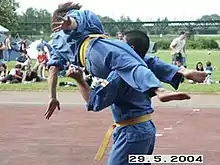
Flying scissors to the neck. The opponent is forced to the ground with a twist of the body.
| Part of a series on |
| Vietnamese martial arts |
|---|
 |
| Part of a series on the |
| Culture of Vietnam |
|---|
 |
| History |
| People |
| Languages |
| Cuisine |
| Festivals |
| Literature |
| Sport |
|
Modern schools
Modern styles, or Phái (schools), include:
- Võ thuật Bình Định/Bình Định Gia – umbrella title for all the traditional styles of Bình Định.
- Nhất Nam
- Vovinam – Founded by Nguyễn Lộc. Also called Vovinam Việt Võ Đạo (Việt = Vietnamese, Võ = martial, Đạo = way)
- Võ Việt Nam (Cuton) or Võ Đạo of Phạm Văn Tan.[1]
- Overseas
- Cuong Nhu of Ngô Đồng (d. Florida 2000), known also by the Japanese title O Sensei.
- Qwan Ki Do, founded in France.[2]
- Tam Qui Khi-Kong, now popular in Russia.
Terminology
- võ sư – master
- võ phục – tunic
- võ kinh – martial arts scripture
- Bắc Việt võ – Northern Vietnam style
- quyền – fist, such as Hùng kê quyền, Hồng Gia quyền, Lão mai quyền
- võ thuật Bình Định – martial arts of Bình Định
- Đấu vật – ring wrestling (can also mean western wrestling)
- Hand techniques (đòn tay)
- Elbow techniques (chỏ)
- Kicking techniques (đá)
- Knee techniques (gối)
- Forms (Quyền, Song Luyện, Đa Luyện)
- Attack techniques (chiến lược)
- Traditional wrestling (Vật cổ truyền)
- Leg Attack take-downs (đòn chân tấn công)
- Staff (côn)
- Sword (kiếm)
- Halberd (dao dài, "long knife")
- Rope dart/chain whip (nhuyễn tiên, different from Chinese rope dart)
See also
References
- Gabrielle Habersetzer, Roland Habersetzer (2004). Encyclopédie des Arts Martiaux d'Extrême-Orient: Technique, historique, biographique et culturelle.
A la veille de l'indépendance du Vietnam (1955) différents groupements. sous le couvert d'associations sportives. virent le jour. avec notamment le mouvement Vovinam de Nguyen-Loc. le Tinh-Vô-Hoi (arts martiaux sino-vietnamiens) avec entre autres Chau Quan Ky. le Vo-Vietnam (Cuton) ou encore le Vu-Dao (Pham Van Tan*). Ces groupements connurent une structuration plus forte dans le cadre du Sud Vietnam dans les années 1960. avec. notamment. la création du Tong-Hoi-Vo-Hoc-Viet-Nam ..
CS1 maint: uses authors parameter (link) - Tătaru, Irene Teodora (2021). "Basic Arm Techniques in Qwan Ki Do". Bulletin of the Transilvania University of Brasov Series IX, Sciences of Human Kinetics. 14 (1): 101.
| Regional origin | |
|---|---|
| Unarmed techniques | |
| Weapons | |
| Training | |
| Grappling | |
| Striking | |
| Internal | |
| Full contact / combat sports | |
| Self-defense / combatives | |
| Eclectic / hybrids | |
| Martial arts at the Summer Olympics | |
| Martial arts at the World Games | |
| Martial arts at the Pan American | |
| Martial arts at the Asian | |
| Martial arts at the African | |
| |


| History |
|   | |||||||||||||||
|---|---|---|---|---|---|---|---|---|---|---|---|---|---|---|---|---|---|
| Geography |
| ||||||||||||||||
| Politics |
| ||||||||||||||||
| Economy | |||||||||||||||||
| Society |
| ||||||||||||||||
This article is issued from Wikipedia. The text is licensed under Creative Commons - Attribution - Sharealike. Additional terms may apply for the media files.