William Finnemann
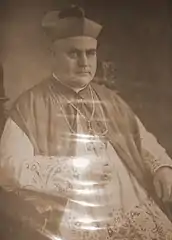
William (Wilhelm) Finnemann (December 18, 1882 – October 26, 1942) was a priest of the Society of the Divine Word, auxiliary bishop of Manila and apostolic vicar of Calapan, the Philippines. H was martyred by the Japanese through being thrown into the sea near Verde Island off the coast of Batangas City, Batangas.
William Finnemann, SVD | |
|---|---|
| Apostolic Vicar of Calapan | |
 | |
| Church | Roman Catholic Church |
| Diocese | Calapan |
| See | Calapan |
| Term ended | 26 October 1942 |
| Successor | Henry Ederle, SDV |
| Other post(s) |
|
| Orders | |
| Ordination | 29 June 1911 |
| Consecration | 21 May 1929 as Auxiliary Bishop of Manila |
| Rank | Apostolic Vicar |
| Personal details | |
| Birth name | Wilhelm Finnemann |
| Born | 18 December 1882 Soest, North Rhine-Westphalia German Empire |
| Died | 26 October 1942 (aged 59) Near Verde Island, Batangas, Philippines |
| Nationality | German |
| Sainthood | |
| Feast day | 26 October |
| Venerated in | Catholic Church |
| Title as Saint | Servant of God |
| Attributes | Episcopal attire Pectoral cross Biretta |
| Patronage | Persecuted Christians |
Life
Born in Büninghausen, Soest, North Rhine-Westphalia in the German Empire, Finnemann was the second oldest of fourteen children. He learned shoemaking from his uncle to help with the family expenses. The pastor of the Hultrop, Dr. Bernhard Köper, invited him to study in a Latin school, where he proved a good student.[1]
Young Finnemann wrote to various missionary religious orders asking to be admitted. Arnold Janssen, founder of the Society of the Divine Word, accepted. With his parents' permission and a letter of recommendation from Köper, Finnemann entered the seminary in April 1900. Köper had also generously offered to cover the cost. Finnemann was ordained as priest on October 1, 1911.[2]
He was assigned to Abra, a province in the northern Philippines. For five years, he set about establishing parishes, building schools and handling pastoral care. He became a naturalized Filipino. With the outbreak of World War I, he was taken into protective custody by the Americans and brought to the USA, winding up at the Society's St. Mary's Mission Seminary in Techny, Illinois where he remained for some years.[3] He later returned and in 1926 established Espiritu Santo Parish in Manila.
Bishop
In 1929 he was appointed Auxiliary Bishop of Manila, and served as chairman of the first National Eucharistic Congress. In 1936, he was named prefect apostolic of Mindoro, [4] and returned home to Hultrop for a brief visit.[1]
During the Japanese occupation of World War II, Bishop Finnemann publicly denounced the arbitrary acts of Japanese soldiers against the civilian population and vigorously resisted the occupation of church property. He refused to allow women and girls to be abused by Japanese soldiers. Finnemann was frequently arrested and subjected to beatings. He resisted plans to escape saying that a shepherd cannot abandon his flock.[1]
On October 26, 1942, he was taken aboard a military boat on the pretext of being transferred to Manila for a court martial. The bishop was aware he was unlikely to survive. Once out in the deep waters between Calapan and Batangas, he was bound and thrown overboard because he refused to turn over to the Japanese army a convent of the Holy Spirit Sisters for use for as a brothel.[5]
Cause of beatification and canonization
Finnemann is currently in consideration for sainthood in the Roman Catholic Church with protocol number 2290 assigned by the Congregation for the Causes of Saints. On December 7, 1999, he was declared Servant of God.[6]
References
- "W. Finnemann - Hultrops größter Sohn", Festschrift der St.- Sebastian-Bruderschaft, Soester Anzeiger, 20 July 1985
- "The fight of Bishop William Finneman, SVD", The Manila Times, August 5, 2012
- The Official Catholic Directory. United States, P.J. Kenedy, 1921. p. 61
- "Society of the Divine Word Recounts Bishop Finnemann's Death", UCA News, February 21, 1999
- Eilers, Franz-Josef. "Telling the Story of Jesus in Asia", World Mission Magazine, Manila July 2006
- "3 Bishops meet on Finnemann beatification", SVD, Philippine Central Province
External links
| Saints |  | |
|---|---|---|
| Blesseds | ||
| Venerables | ||
| Servants of God |
| |
| ||



Authority control  | |
|---|---|
| General | |
| National libraries | |
| Other | |