Wotsits
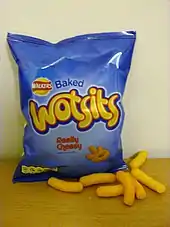
Wotsits is a British brand of cheesy flavoured corn puffs sold first by Golden Wonder and now by Walkers Crisps. The most common form is the "Really Cheesy" flavour of corn puffs.[1] Other shapes and flavours have also been sold, including limited-edition varieties. The brand name in the singular ("Wotsit") refers to an individual corn puff. It is an allusion to the slang term "whatsit", a placeholder name, to which it is phonetically identical in British speech.
 | |
| Product type | Cheese puffs |
|---|---|
| Owner | Walkers |
| Country | United Kingdom |
| Markets | United Kingdom |
| Previous owners | Golden Wonder |
In December 2002, Golden Wonder changed hands and sold the Wotsits product range to Walkers in January 2003.[2] Prior to this, Walkers had sold a similar American product, Cheetos, which was considered a rival to Wotsits in the UK market. Walkers relaunched Cheetos in the UK in June 2015 and both brands are now sold together.
Advertising
The brand was the first to introduce inserts into its packs in 1994, with the insertion of "Pogs". It also inserted merlin football stickers and other inserts aimed at 11-year-old boys. The brand was advertised with the strapline "you only get a whoosh with a Wotsit" between 1994 and 2002 following a campaign designed by JWT of a play on words. Wotsits packaging used to come with a joke or trivia section on the back.
Wotsits were one of the sponsors of SMTV Live (alongside other Walkers snacks such as Monster Munch and Squares) from 4 January 2003 until the show's discontinuation on 27 December 2003.
In 2003, the advertising agency Abbott Mead Vickers made a public apology when the Parliamentary Select Committee on Health brought to light a private brief that it had made to Frito-Lay (Walkers' owners) where it proposed encouraging children (4 to 9 years old) to believe that "Wotsits are for me—I'm going to buy them when I get the chance and pester Mum for them when she next goes shopping".[3]
See also
- Whatchamacallit
- Cheetos
- NikNaks
- Nik Naks (British snack), or Crunchy Wotsits
References
- "Walkers Wotsits Crisps | Walkers Snacks". walkers-snacks.co.uk. Retrieved 29 October 2019.
- archive.theargus.co.uk; article dated 28 May 2002, retrieved 27 October 2006.
- publications.parliament.uk, retrieved 27 October 2006. (Note: These contain the referenced information, but are not necessarily the sources used by the original author.)
External links
- "PRELIMINARY ANALYSIS OF FOOD INDUSTRY ADVERTISING DOCUMENTS", Written evidence, UK Parliament Select Committee on Health
| Brands and subsidiaries |
|  | ||||||||||
|---|---|---|---|---|---|---|---|---|---|---|---|---|
| Other holdings | ||||||||||||
| People |
| |||||||||||
| Related articles | ||||||||||||

