Xenocranium
Xenocranium is a monotypic genus of extinct epicotheriid mammal whose fossils were recovered from Oligocene of the American State of Wyoming.[1] The single species is Xenocranium pileorivale.
| Xenocranium Temporal range: | |
|---|---|
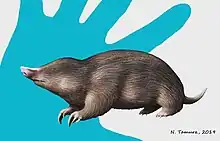 | |
| Xenocranium pileorivale size relative to a human hand | |
Scientific classification  | |
| Kingdom: | Animalia |
| Phylum: | Chordata |
| Class: | Mammalia |
| Order: | †Palaeanodonta |
| Family: | †Epoicotheriidae |
| Genus: | †Xenocranium Colbert, 1942 |
| Species: | †X. pileorivale |
| Binomial name | |
| †Xenocranium pileorivale Colbert, 1942 | |
Etymology
The name Xenocranium comes from the words xenos and cranios, meaning "strange" and "skull" respectively. The specific epithet is derived from pileus meaning "hat" and rivale meaning "brook", in reference to the nearby township of Hat Creek.[1]
Description
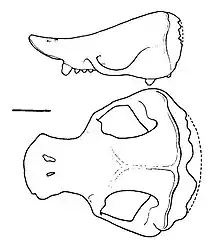
The anatomy of Xenocranium possesses many traits indicative of a subterranean lifestyle, including small eyes, an upturned snout, muscular arms with large attachment points for the triceps, teres major, and carpal and digital flexor muscles.[2] The dental formula is 0.1.41.1.5.[3]
Palaeoecology

The holotype of Xenocranium was recovered from the Brule Formation, 160 feet below the top of the Oligocene outcrop in the area,[1] which correlates with the Chadronian age to the Orellan age under the NALMA classification. Further remains have been found in the White River Formation of Nebraska.[3] The animals from these formations constitute the White River Fauna, which included predators like Archaeotherium and Hyaenodon, and a large diversity of herbivorous mammals, such as the ancestral horse Mesohippus, the cursorial rhinoceros Hyracodon, and the very common "oreodont" Merycoidodon.[4]
References
- Edentate from the Oligocene of Wyoming: Notulae Naturae of The Acad. of Natural Sciences of Phila., No. 109. Academy of Natural Sciences. ISBN 978-1-60483-109-2.
- Rose, Kenneth D.; Emry, Robert J. (1983). "Extraordinary fossorial adaptations in the oligocene palaeanodonts Epoicotherium and Xenocranium (Mammalia)". Journal of Morphology. 175 (1): 33–56. doi:10.1002/jmor.1051750105. ISSN 1097-4687.
- Postilla. Peabody Museum of Natural History. 1894.
- Scott, William Berryman (1913). A History of Land Mammals in the Western Hemisphere. MacMillan.