Zubayr ibn al-Awwam
Zubayr ibn al-Awwam (Arabic: الزبير بن العوام بن خويلد; 594–656) was an Arab Muslim commander in the service of the Islamic prophet Muhammad and the caliphs Abu Bakr (r. 632–634) and Umar (r. 634–644) who played a leading role in the Ridda wars against rebel tribes in Arabia in 632–633 and later participated in early Muslim conquests of Sasanian Iraq in 633–634, Byzantine Syria in 634–638, and African Exarchate in 639–643.

Born in Mecca, Zubayr belonged to the Banu Hashim and Banu Asad ibn Abd al-Uzza tribes. He was a cousin and companion of the Islamic prophet Muhammad and became one of the first converts to Islam.[3][5][6][17] His Kunya were Abu Abdullah (Arabic: ابو عبدالله).[2] He was also one of the ten companions whom Muhammad promised paradise.[5][6][17][3] He also shared common ancestry with Muhammad through Qusai ibn Kilab, 4th generation of Quraish chieftain in Mecca.[4][5][6][18] Zubayr was bestowed a honorary title of "Hawari Rasulullah" or "loyal bodyguard of the prophet" by the Muhammad himself for distinguished service during the Battle of Khandaq.[2][3][4][5][6] Zubayr participated in all military expeditions which led by Muhammad himself.[19][14][20]: 76 [Notes 3]
After the death of Muhammad, Zubayr became one of the most important political figure of Rashidun Caliphate due to his role within caliphate Majlis-ash-Shura.[20][2][3][4][5][6] Following the demise of Umar, Zubayr became the chief counselor involved in the ascension of Uthman ibn Affan as the third caliph.[3]
Zubayr had an illustrious military career within the caliphate as he involved in the campaigns against rebels and apostate across Arabia, particularly in the Battle of Zhu Qissa and the Battle of Yamama.[4][5][6] Later he served in the Battle of Yarmuk against Byzantine Empire.[20][2][3][4][5][6] Aside of the Muslim conquest of the Levant, Zubayr are largely involved in the Muslim conquest of Egypt, Sudan and Tripolitania.[20][2][3][4][5][6][18][22][23] And later Battle of Nahavand in the location of modern day Hamadan Province.[24] Zubayr was slain in the aftermath of the Battle of the Camel when the first civil war within caliphate occured during the reign of Ali.[17][4][5][6]
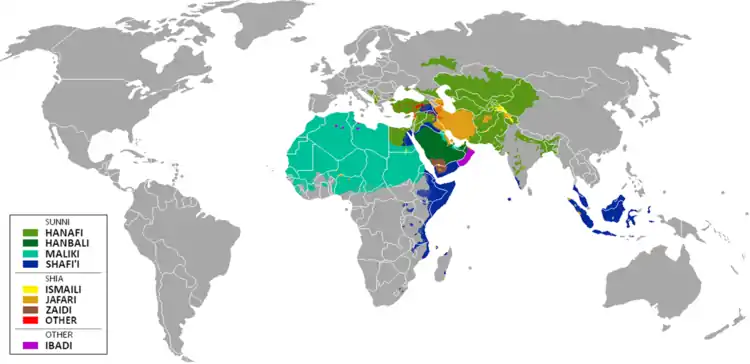
As one of principal companion of Muhammad, Muhaddith scholars narrated many hadiths with attributed chain of narrators from Zubayr.[25][26][27][28][29] Aside from military general and Shura council member, he also served as Mufti and one of few Sahaba who were allowed by the Caliphate institution to pass Fatwa verdict. Zubayr is also known for his chiefly important position in Islamic law, as he were among the very few dozens of Companions of the Prophet that were allowed to judge and pass fatwa verdict during the time of Rashidun caliphate.[30] His jurisprudence has influenced the Islamic scholarly communities across the ages, such as Madhhab schools of Sunni and the scholars of Ahl al-Hadith and Modern day Salafi.
Zubayr status as early Muslim hero and model of religious piety prompted many ethnic community across the world to claim themselves as his descendants. This claims found particularly in modern day Hejaz and Egypt, along with other areas such as Sudan and Egypt such as Beja Ababda community, Ja'alin tribe and Kawahla tribes even have documented traditional genealogy proof within their community which passed down through generations of how their people ancestry has ancestral link with Zubayr.[18][22][23] The Zubairi community which dwells in India and Pakistan until today also claim Zubayr as their ancestor as significant Zubayr descendant clans were allegedly migrated from their homeland and entered the Indian subcontinent through Umayyad campaigns in India in 7th AD century.[31][32][33]
Biography
Zubayr was born in Mecca in 594.[20]: 75 His father was Al-Awwam ibn Khuwaylid of the Asad clan of the Quraysh tribe, making Al-Zubayr a nephew of Khadijah. His mother was Muhammad's aunt, Safiyyah bint ‘Abd al-Muttalib, hence Zubayr was Muhammad's first cousin.[20]: 75 He had two brothers, Sa'ib and Abd Al-Kaaba; a maternal brother, Safi ibn Al-Harith, who was from the Umayya clan;[34]: 29 and several paternal siblings, including Hind bint Al-Awwam, a wife of Zayd ibn Haritha.[20]: 32
While he was still a boy, Zubayr fought an adult man and beat him up so fiercely that the man's hand was broken. Safiyyah, who was pregnant at the time, had to carry the man home. When the passers-by asked what had happened, she told them:
"He fought Al-Zubayr. Did you find Al-Zubayr soft like cheese or dates or full of brass?"
Hearing Safiyyah words, the passengers became impressed with how the young Zubayr can beat full grown man severely.[20]: 765
Al-Awwam died while Zubayr was still young. His mother used to beat him severely. When it was said to her, "You have killed him! You have wrenched his heart. Will you destroy the boy?" she replied, "I beat him so that he will be intelligent and will be bold in the battle."[20]: 76
Conversion to Islam
Zubayr was one of the first five men to accept Islam under the influence of Abu Bakr,[35]: 115 and is said to have been the fourth or fifth adult male convert.[20]: 76
Zubayr was one of the first fifteen emigrants to Abyssinia in 615,[35]: 146 until he returned there in 616.[35]: 147 During his stay Abyssinia, a rebellion against the Najashi, king of Aksumite, broke out. Najashi met the rebels on the banks of the Nile. The Muslims, greatly worried about losing their benefactor and decided to send Zubayr to search any news coming from Najashi. By using an inflated waterskin, he swam down the Nile river until he reached the point where the battle rages. He watched until the Najashi had defeated the rebels and then swam back to the Muslims. He ran up waving his clothes and reported the good news regarding the battle development, which caused the Muslims waiting to be rejoiced.[35]: 153 However, another version recorded az-Zubayr were crossing the Red sea, as this version states the Muslims were already within coast Arabian Peninsula.[Notes 4]
Zubayr was among those who returned to Mecca in 619 as they heard that the Meccans had converted to Islam. However, as they got near to Mecca, they learned that the report was false so that they entered the town under the protection of a citizen or by stealth."[35]: 167–168 During the period he stayed with early converts of Islam in Mecca, Zubayr given a shared responsibility as Hafiz who memorized and preserving every verses of Quran recited by Muhammad, along with Abu Bakkar, Abdur Rahman ibn Auf, Talhah and Sa'd ibn Abi Waqqas .[36]
Zubayr joined the general emigration to Medina in 622. At first he lodged with Al-Mundhir ibn Muhammad. It is disputed who became Zubayr's sworn brother as several names comes from various traditions, that whether Abdullah ibn Mas'ud, Talha ibn Ubaydullah, Ka'b ibn Malik, or Salama ibn Salama that were became Zubayr sworn brother.[20]: 76–77 [35]: 234 As a shrewd merchant, al-Zubayr diverted his trading business route from Mecca to Medina at the moment of this general migrations happened.[37]
Life in Medina with Muhammad
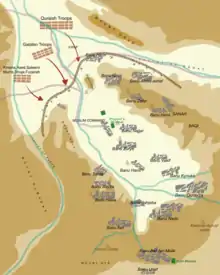
At the Battle of Badr he was sent as a scout and he captured a Meccan spy.[35]: 295 He fought in the battle and meet Quraish champion named Ubayda ibn Sa'id of the Umayya clan, who nicknamed Abu Dhatu'l Karish[Notes 5] Zubair found Ubayda were clad in armor that fully covered his entire body, leaving only his eyes are visible. Zubayr then pierced his spear through eyes of Ubayda and instantly killing him. Then Zubair stepped on his dead body and pulling his spear from Ubayda head with great force, until his spear are bended.[38] Another notable person which killed by Zubayr during this battle was Nawfal ibn Khuwaylid.[3] However, Ibn Ishaq recorded that it is Ali who killed Nawfal[39] al-Basalamah noted in battle of Badr, majority of Muslims ranks were centralized between three persons as their pivot of movements, which is Hamza ibn Abdul-Muttalib, Ali, and az-Zubayr.[40]
At the Battle of Uhud he volunteered to take up Muhammad's sword "with its right," which was to "smite the enemy with it until it bends," and was "much mortified" when Muhammad rejected his offer.[35]: 373 He was standing so close to the fleeing Meccan women that he could see Hind bint Utbah's anklets.[35]: 379 But it was at that point that the battle turned; Al-Zubayr was one of the handfuls of men who stood beside Muhammad when the Muslims in their turn fled and who accompanied him to the glen. "He was firm with him in the Battle of Uhud and he gave him allegiance to the death."[20]: 78 [35]: 381 During this battle, Zubayr killed a standard bearer of Banu Abd al-Dar tribe, named Kilab ibn Abi Talha.[41] Ibn Athir also recorded another az-Zubayr act of killing during battle of Uhud,[3] which identified by another traditional narration as Quraishite champion from Abd al-Dar tribe namely Talhah ibn Abi Talhah, whose nicknamed "kabsh al-Katibah" or "Ram of the Battalion".[42] Al-Zubayr killing Talhah by ambushing him and pulling him down from his camel, and slamming him to the ground.[42] According to Mubarakpuri, Muhammad praised az-Zubayr as the "Hawari" for the first time due to his achievement killing Ibn Abi Talhah.[21]
Mubarakpuri recorded Ibn Hisham narration, not long after the battle of Uhud, Muhammad had sent az-Zubayr and Abu Bakar to chase the victorious Quraish forces in Hamra al-Asad.[43] where they captured Quraish soldier from Banu Jumah, Abu Izzah al-Jumahi.[44] Muhammad then ordered az-Zubayr to execute Abu Izzah, as the latter break his promise with Muhammad to not involve in the war against them anymore, during the battle of Badr.[44]
Battle of the Trench
During the Battle of the Trench. Ibn Hisham recorded az-Zubayr engaged in duel against Nawfal ibn Abdullah ibn Mughirah al Makhzumi and slaying him by cleaving his body onto 2 parts with powerful strike with his sword.[4][Notes 6] However, other chroniclers such as Ibn Hajar Al-Asqalani recorded the men which killed by Zubayr was named Uthman ibn Mughirah al Makhzumi.[45] regardless the version, it is said by Dhahabi in his Siyar A’lamin Nubala that the vertical blow of Zubayr are so powerful so it was not only split Ibn Mughirah body perfectly along with his shield, but it is also cleaved the horse saddle which Ibn Mughirah sat.[3] The spectators from Muslim defenders cheered and praised the sharpness of the sword which az-Zubayr used, only to be replied by az-Zubayr that it is not his sword which need to be complimented, but it is the strength of his arm which held the sword.[6]
Waqidi reported that the full motion of Zubayr feat in this battle started when several enemy horsemens consisted of Ikrima ibn Abi Jahl, Hubayra ibn Abi Wahb, Dhiraar ibn al-Khattab, and Ibn Mughira al Makhzumi managed to cross the trench, then Zubayr and Umar ibn al Khattab chasing those horsemens and fight them.[46] Then as Umar facing Dhiraar, Zubayr facing the three other horsemens, where, as Ibn Hisham version, Zubayr managed to kill Ibn Mughira with his powerful strike that splitting Ibn Mughira body.[46] Then as the Muslims praising Zubayr, he continued to face Hubayra ibn Abi Wahb, who also struck by Zubayr.[46] Zubayr strike against Hubayra were similarly powerful that the Crupper of Hubayra horse were cut and the armor behind the horse were cut, which immediately seized by Zubayr as spoils.[46] the brutal deaths of Ibn Mughira and Hubayra at the hand of Zubayr caused Ikrima to retreat and escape from the trench.[46]
Aside from his amazing duels, Zubayr also played reconaissance role as he rode a roan horse when he volunteered to spying on Qurayza tribe regarding their activity to Muhammad. The latter then praised Zubair as he accomplished his mission, "Every Prophet has a disciple(Hawari), and my disciple is Al-Zubayr."[20]: 79 Witnesses narration from the hadith said that az-Zubayr rode to spy the Qurayza tribe activity at least thrice.[Notes 7]
After the Battle of the trench, Muhammad immediately instructed the Muslim army to march without ceasing or resting to the settlement of Banu Qurayza, a Jewish tribe who betray the Muslims in the previous battle. Banu Qurayza were besieged for several days before the Muslim pushed for break as az Zubair and other Muslim soldiers clutches battering ram wood log to ram the Jewish fortress gate, before they surrendered and executed.[40]
Pledge of Ridwan
In March 628 CE (6 AH), Muhammad set for Mecca to perform the ritual pilgrimage of Umrah.[47][3] The Quraysh denied the Muslims entry into the city and posted themselves outside Mecca, determined to offer resistance even though the Muslims did not have any intention or preparation for battle, which caused Muhammad sent Uthman ibn Affan as his envoy to meet with the leaders of Quraysh and negotiate their entry into the city.[3][47] The Quraysh caused Uthman to stay longer in Mecca than they originally planned which causing caused them to believe that Uthman had been killed.[3] In response, Muhammad gathered his nearly 1,400 Sahaba and called them to pledge to fight until death and avenge the death of Uthman.[3] After the pledge, verses were revealed in the Qur'an commemorating and appreciating the pledge and those who made it:
Certainly Allah was well pleased with the believers when they swore allegiance to you under the tree, and He knew what was in their hearts, so He sent down tranquillity on them and rewarded them with a near victory.
Due to this verse, the pledge is also known as the Pledge of Acceptance as it was believed in Islam to be a cause for God's blessing towards those who take pledge, including az-Zubayr.[47][3] while at the same day, the ratification of treaty of Hudaybiyyah also occured.
Siege of Khaybar fortresses
|
"Khaybar, know that I am Zubayr, |
| Zubayr ibn Awwam poetry before fighting Yassir in siege of Khaybar |
In 628 Al-Zubayr joined the expedition to Khaybar and bringing horse, which according to one of Waqidi source, It is the Arabian horse, as during that time, Waqidi claim there is only purebred horses in Arabia.[48] During this siege of the first fortress, Zubayr answered the challenge from Jewish champion named Yassir to single combat. His mother Safiya asked Muhammad, "Will he kill my son?" and Muhammad reassured her, "No, your son will kill him, Allah willing." Al-Zubayr advanced reciting poem before they fight, and Al-Zubayr killed Yasir. Afterward, the Muslims commented on how sharp his sword must have been; Al-Zubayr replied that it had not been sharp but he had used it with great force.[35]: 513–514 Later during the battle Zubayr once challenged in duel by another opposing force champion, who Zubayr also defeat and killed.[49] After the Muslims had conquered Khaybar fortresses, the Jewish treasurer, Kinana, was brought to Muhammad, but he refused to reveal where their money was hidden. However, later Muhammad ibn Maslama decapitated Kinana, in retaliation for his brother Mahmud,[35]: 515 [50]: 330–331 who had been killed in the battle a few days earlier.[35]: 511 [50]: 322–324 Al-Zubayr was later made one of the eighteen chiefs who each supervised the division of a block of booty-shares.[35]: 522
Later, as the Muslim forces return to Medina from Khaybar, they passed one more hostile Jewish settlement fortress in Wadi al-Qura. During this battle Zubayr facing at least two enemy who challenged for duels, which Zubayr accept both and ended defeated and killed both of them.[51]
Conquest of Mecca until death of Muhammad
In December 629, on the eve of the Conquest of Mecca, Muhammad sent Al-Zubayr and Ali to intercept a spy who was carrying a letter to the Quraysh. When they could not find the letter in her baggage, they realised she must have concealed it on her person, so they talked her into it. The spy then produced the letter, which she had hidden in her hair, and Al-Zubayr and Ali brought it back to Muhammad, confident that the Muslims would now take Mecca by surprise.[35]: 545 When Muhammad entered Mecca, Al-Zubayr held one of the three banners of the Emigrants[20]: 78 and commanded the left wing of the conquering army.[35]: 549
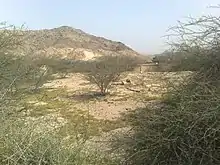
Later, During the Battle of Hunayn in 630 C.E.(8 A.H.) the Hawazin tribe forces under Malik ibn Awf ambushed the Muslims under the valley, which drove almost entire Muslim armies in rout except Muhammad and several mens.[52] The most progressive report came from Ibn Umar who gave testimony that there are still around 39 Muhajireen and around 60 Ansaris left behind with Muhammad,[53] with modern reasearchers have theorized az-Zubayr were among those who did not retreat in panic.[40] However, the Hawazin allied forces stunned and paused as they almost surrounded Muhammad and 100 of his followers, giving time for the previously fleeing Muslim armies for now regroup around Muhammad, az-Zubayr, and others whose they left in the frontline after routed by the enemy ambush.[Notes 8] After they consolidate themselves and rescued Khalid, who has been gravely injured during the first clash, the Muslims commence general Counterattack with Az-Zubayr on the front of the Rashidun cavalry.[Notes 9] The Hawazin forces immediately driven out of the valley by frontal attack by az-Zubayr after short engagement.[55][Notes 10] Nafi' ibn Jubayr reported that he see Abbas passing instruction from prophet Muhammad to Zubayr to plant the rallying flag. [56] After the battles in Awtas, the Muslims engaged in lengthy,Siege of Ta'if although it does not succeed to force an immediate surrender to the Hawazin.[40] Later, az-Zubayr participated in the last campaign with Muhammad, the Expedition of Tabuk.[40]
At certain point, Muhammad assigned Zubayr and Jahm ibn al-Suht as registrar and auditor of the zakat funds collected[57] Muhammad also employ Al-Zubayr as one of his scribe.[58] He once tasked by Muhammad to write a letter for Banu Mu'awiyah tribe of Tayy.[59] After the death of Muhammad, Ali ibn Zayd and several Tabi'un mentioned the each scars covered az-Zubayr body that he suffered.[14][20]: 76 It is said in all of the battles with Muhammad, az-Zubayr typically dressed in a distinctive yellow turban.[20]: 77 Except the Battle of Hunayn, where he reportedly wearing red turban.[3]
During Rashidun caliphate
Az-Zubayr played significant role the first phase of Ridda warsIn the third week of July 632,[60] as concentrations of rebels nearest Medina were located in two areas: Abraq, 72 miles to the north-east and Dhu Qissa, 24 miles to the east.[61] In the third week of July 632, the apostate army under Tulayha moved from Dhu Qissa to Dhu Hussa, from where they prepared to launch an attack on Medina.[62] Abu Bakr received intelligence of the rebel movements, and immediately prepared for the defense of Medina in the form of newly organised elite guard unit al-Ḥaras wa-l-shurṭa to guard Medina.[60] Az-Zubayr were appointed as one commander of these units.[9][62] Since all horses and trained camels were brought by Usama ibn Zayd to Balqa,[9] The Haras wa al-Shurta troops rode their untrained camels to the mountain passes of Medina at night, intercepting the Apostate coalition assault forces, until the enemy retreated to Dhu Qisha.[63] However, as the rebels retreated to the uphills on the outskirt, Abu Bakar and the Medinese army cannot catch up the battle in the outskirt of Medina, as they rode untrained camels, so they wait tomorrow to gather momentum for second strike and engaged them in the Battle of Zhu Qissa until the entire rebels routed.[64]
Then, after the rebels routed from the outskirt of Medina, the Caliph goes further to the north and crush another bedouin tribe rebels in Dumat al-Jandal city.[65]
Later, as Khalid ibn al-Walid engaged the biggest rebel faction led by Musaylimah, Ibn Hisham has recorded the second hand testimony from his father about the narration from the second son of Zubayr, Urwah ibn Zubayr, who testifies that his father, az-Zubayr ibn al-Awwam, has participaed in the Battle of Yamama while brought the ten-years old Abd Allah ibn al-Zubayr on his horse.[Notes 11]
Campaign in Levant
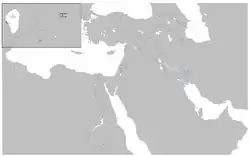
During the decisive Battle of Yarmouk in 636,[69] Ibn Kathir recorded in his bidayah wa nihayah the report from Urwah ibn Zubayr that his father,[4] Zubayr charging alone against the row of Byzantine soldiers, cleaving through their ranks until he emerged on the other side of Byzantine army.[4] al-Zubayr then returned to the Muslim ranks and repeat his act in charging alone again for the second time, only for him to survive and came back alive though suffered heavy injury on his shoulder.[3] Abdullah ibn Zubayr, who at that time are still children and brought on his father's chest,[3][6] giving his testimony as he witnessed,[Notes 12] that his father were doing salah prayer[Notes 13] on top of his camel while fighting the enemy at the same time.[70]
At some point, groups of Byzantine army breaking to camps of Muslims and looking for drinks, which immediately attacked by the hostile Muslim womens who defended the camp, consisted of unnamed wife of al-Zubayr, Hind bint Utbah, Umm Hakim[Notes 14], and others. These womens striking the Byzantines while taunting them as the "Uncircumcised ones"[71] Meanwhile, az-Zubayr lost his brother, Abd al Rahman al-Zubayr who has fallen in this battle.[4]
According to al-Waqidi, az Zubayr, fought side by side with Khalid ibn al-Walid and Hashim ibn Utba (also known as Hashim al-Marqal) so fiercely until at some point the three of them reached the tent of Vahan, commander of Armenians division of Byzantines, causing chaotic rout to the Armenian rank.[72] After the Byzantines defeated in Yarmuk, al-Zubayr were reportedly laughed and saying:
May the curse of God falls before them! they want only enmity. Will they get anything if the Byzantines overcomes us?[73]
Then, as the spoils of war started to be acoounted before divided according to the sharia ruling, Khalid intended to gave spoils of war for those who used pure blood Arabian horse bigger than those with hybrid blood..[74] Then az-Zubayr testified the ruling from Muhammad that the horsemens should be given five times of normal spoils with the details that four parts of the spoils for his (effort of bringing) horse whil one part for his service as normal soldier, which rebuked by Miqdad ibn Aswad who testified that Muhammad gave both of them only two times of normal spoils, as both Miqdad and az-Zubayr were the only horsemen during the battle of Badr. However, az-Zubayr wish were defended by Jabir ibn Abd Allah who testified Muhammad indeed once give az-Zubayr five parts of spoils of war during the battle of Khaybar for his service as cavalry man.[74] Thus caliph Umar in the end gave az-Zubayr special privilege of five parts of spoils for this, although he instructed this privilege ruling only apply to az-Zubayr, as caliph Umar want to reconciliate the matter to defaulting his policy of spoils of war without transgressing the ruling from hadith regarding spoils of war for cavalry.[74] After the matter settled in Yarmuk, az-Zubayr continued to encompany the Muslim army in Levant and capturing the coastal city of Ayla(now Aqaba),[75] town of al-Zuk al-Tahtani(30 km northeast of Safed), and Sukoun al-Ra.[15]
Campaign in Persia
In, caliph Umar sent az-Zubayr, Tulayha, Amr ibn Ma'adi Yakrib, Hudhayfah ibn al-Yaman and others under the command of Al-Nu'man ibn Muqrin to go to Nahavand, northern part of Zagros Mountains to face the gigantic army of Sasanian Empire in the battle of Nahavand.[24] It was said the reinforcement sent to aid the army in Nahavand were only numbered 4,000.[76] Az Zubayr managed to score a huge victory in this historical battle, whcih was coined as "Fatih al-Futuh" or "victory of victories", since this was the last considered by historians as the final huge army the Sassanid brought to face the caliphate,[24] as the number of Sassanid forces were 150,000 soldiers,[77] [78] which more than half are killed in this battle. During the campaign in Africa in the future, az-Zubayr testified that he reminded the battle of Nahavand.[Notes 15]
Campaign in Africa


After conquest of Jerusalem caliph Umar stayed for while in Jerusalem,[80] Amr ibn al-As, who at that time were in Egypt besieging Byzantine fortress, sent message to Umar asking reinforcement of exactly 8,000 soldiers. However, since at the moment were the caliphate suffered manpower strain, The Caliph sent a reply with an accompanying army which exactly numbered 4,000 soldiers, That are led by four commanders[Notes 16][Notes 17]
| I have sent you a reinforcements [sic] of 8.000 warriors. It consist of 4,000 mens [sic], each of 1,000 was led by four figures wherein each of these men strength are equal to 1,000 mens [sic] |
| 'Umar appraisal for az-Zubayr, Miqdad ibn al-Aswad, Ubadah ibn al-Samit, and Maslamah ibn Mukhallad.[Notes 18] |
There are difference opinion regarding the number of soldiers which brought by Al-Zubayr bin Al-Awwam as some said 12,000, and some narrations say that the force was with az Zubayr were 8,000.[76] As for military historian Khalid Mahmud opinion, he supports the view that the force with Az-Zubayr was indeed numbered 4,000 fighters, for the following reasons, the first of which is that this number is close to the number of fighters in the previous aid in the battles of Yarmouk, battle of al-Qadisiyyah and later to battle of Nahavand, and the second is that for the abrupt request for aid from Egypt during that moment, the supply which can be provided from Medina only sufficient for small number of forces as the supply for each conquests which done by Umar were constrained to every directions.[76]
Those 4 commanders were consisted two veteran Muhajireen, Zubayr Ibn al-Awwam and Miqdad ibn al-Aswad; and two Ansari commander named Maslama ibn Mukhallad al-Ansari; and Ubadah ibn al-Samit.[6] However, Baladhuri, Ibn al-Athir and Ibn Sa'd recorded that the four commander were consisted purely Qurayshite consisting Zubayr, Busr ibn Abi Artat, Umayr ibn Wahb, and Kharija ibn Hudhafa.[84][85][86][Notes 19] Az-Zubayr march to Ain Shams to assist 'Amr besieging the Byzantine fortress in Heliopolis, which has been besieged before by 'Amr unsuccessfully for months, until they capture it.[88][89] Later, During the Siege of Babylon Fortress, early chronoclers and mid medieval chronicler, Qatadah, reported az-Zubayr reported as personally leading his soldiers climbed the wall of the fortress through the side where a market called al-Hammam located,[3] then instructed his troops to shout Takbeer the moment he reached the top of the wall.[Notes 20] Zubayr was recorded to immediately descending the wall and opened the gates with his hand, which caused the entire Muslim army enter, prompting the terrified Muqawqis to surrender[Notes 21] while in Tabari version, It is the Byzantine garrisons who opened the gate, as they immediately surrender after witnessed az-Zubayr managed to climb the fortress wall.[91] Ibn Abd al-Hakam noted through his long narrations, that az-Zubayr skipped the siege of Alexandria, as the siege were done by 'Ubadah ibn al-Samit.[92]
Later in 639, 'Amr delegate Khalid ibn al-Walid to lead al-Zubayr and 10,000 Muslim army under his command to invade Bahnasa(Oxyrhynchus), where they faced against mustered Sudanese christian auxiliaries of Byzantine-Beja coalition in the "Battle of Darishkur".[93][Notes 22] Benjamin Hendrickx reported that the African christians has mustered around 20,000 symmachoi(black sudanese auxiliary units of Byzantine), 1,300 war elephants with Howdah housing archers,[96] and anti cavalry units named al-Quwwad that armed with iron staffs,[95] all of them commanded by a Patrician named Batlus.[94][94][95] al-Maqrizi and Waqidi stated in this conflict,az-Zubayr alongside with Miqdad, Dhiraar ibn al-Azwar, and Uqba ibn Amir each led 500 Rashidun cavalry to fight against the Elephant corps of Batlus, by using spears soaked in Santonin plants and Sulphur which then ignite their spears with flames to drive the elephants flee in terror.[8] [Notes 23] It was narrated by Rafi' ibn Malik that the final phase of this battle occured when az-Zubayr and several other commanders leading a night raid with 1.000 Rashidun cavalry, which routed the enemy encampments and seizing many spoils including numerous sheeps.[13][97] After the victory in Darishkur, the Byzantine Sudanese forces flee to Bahnasa town and locked the gates, which then followed by the Muslims besiege the town, as the enemy were reinforced by an arrival of 50,000 according to the report of al-Maqqari.[94][95] The siege dragged for months before the Muslim army managed to breach the gate and storming the city and forcing surrender to the inhabitant.[Notes 24] [Notes 25]
Sudan history researchers said the old chronicles from traditional History of Bahnasa conquest were attested by many older sources.[94][Notes 26], though MacMichaels doubt it,[Notes 27] Nevertheless, al Dukhayli mentioned there are several old poetries regarding the battle of Dariskhkur that allegedly came recited by al-Zubayr during the conquest of Bahnasa.[100] Waqidi also reported the conquest of Bahnasa in his record of the conquests,[101] while Rīṭī reported the existences of al-Zubayr descendants after the conquest of Bahnasa,[102] while MacMichaels admitted there are Arab settlers such asBanu Fazara who claimed to be descended from Banu Tamim were settled in Sudan after this conquest of Bahnasa.[94]
After the conquest of Egyptian and Sudanese, al-Zubayr followed 'Amr to the west. The Muslim army under Amr continued their campaign toward Tripolitania(Now Libya).[16] It is recorded during the lengthy siege of Tripoli, seven or eight Muslim soldiers from Madhlij tribe of Kinanah accidentally spotted an unguarded side of Tripoli, then those impietuous warriors managed to slip into the city unnoticed.[103] As the city caught off guard, these soldiers exploit this situation as they reaching the city centre and began slaying enemies.[103] The confused Byzantine Tripoli garrison thrown in extreme panic and disorder by the unexpected violence triggered by the eight intrepid enemy soldiers, thinking the Muslim armies have entered the city and flee with their ships anchored on the harbor.[103] These Madhlij warriors used this opportunity to open the town gate and informing 'Amr, who in turn immediately leading the Muslim army to enter the city unopposed and caused the defenseless Tripoli surrendered.[103][Notes 28] After they subdued Tripoli, Libda, and Sirte in 22 AH(643 AD), 'Amr sent al-Zubayr to besiege Sabratha in advance,[16] before 'Amr followed his suit and together with Zubayr subduing Sabratha.[106] However, further conquests in Africa came to halt after caliph Umar instructed them to restrain from any advance and consolidate the pacified region first.[107]
Reign of caliph Uthman
Later, as caliph Umar dying in 644, he selected Al-Zubayr and five other men to elect the next Caliph. Up after this, Zubayr officially served as a member of Majlis-ash-Shura, which responsible for elections of Caliph and functioned as governmental advisory council regarding the law.[108] When Abdullah ibn Masud passed away, az-Zubayr petitioned caliph Uthman to give Abdullah's pension to his heirs, which granted by the caliph.[109]
First civil war
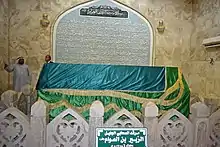
Uthman was assassinated in 656. Al-Zubayr had reason to hope that he would be elected as the next Caliph, although he knew that his old ally Talha was also a strong contender.[110] But Ali was elected,[2]: 166, 176 to the debate of Muhammad's widow Aisha.[111]: 52 Thereupon Al-Zubayr met with Aisha and Talha in Mecca, claiming he had only given allegiance to Ali at swordpoint.[2][112]
Al-Zubayr, Talha and Aisha called for Uthman's death to be avenged, and while Ali agreed, he said that he was not able to do this at the time.[111]: 18 The allies then collected an army and marched to Basra. In Basrah, however, they defeated the Governor and took over the city,[111]: 69–70, 76 [113] putting to death everyone who had been implicated in the assassination of Uthman.[111]: 73 When they were challenged over why they now cared about Uthman when they had shown him so much hostility during his lifetime, they claimed: "We wanted Uthman to meet our demands. We didn’t want him to be killed."[111]: 69
Ali certainly behaved like a man who suspected hostility towards himself, for he soon entered Basra with a professional army of twenty thousand.[111]: 121 For several days, there were negotiations, as both sides asserted they wanted only to see justice done.[111]: 122, 129, 130, 132, 152 But on 7 December 656 hostilities erupted. Aisha's warriors killed Ali's messenger-boy, and Ali responded, "Battle is now justified, so fight them!"[111]: 126–127
The battle started, but according to some traditions at some point Al-Zubayr lost the desire to fight. He said that Ali had talked him out of it during the negotiations on the grounds that they were cousins, but his son accused him of fearing Ali's army. Whatever the case, Al-Zubayr left the battlefield while Aisha continued to direct her troops from her camel. A man named Amr ibn Jurmuz decided to track Al-Zubayr's movements and followed him to a nearby field. It was time for prayer so, after each had asked the other what he was doing there, they agreed to pray. While Al-Zubayr was prostrating, Amr ibn Jurmuz stabbed him in the neck and killed him.[111]: 111–112, 116, 126, 158–159
Scholarship legacy
| Part of a series on |
| Sunni Islam |
|---|
 |
 Islam portal Islam portal |
Az Zubayr where generally viewed as important figure in the eyes of Islamic scholars, who collectively classified Zubayr as being among the highest-ranked Companions of the Prophet, due to his inclusion as ten Muslims to whom Muhammad guaranteed Paradise while they were still alive,[114][115]. This veneration of az Zubayr piety and high importance was highlighted by both classicals and contemporary scholars, such as Ibn Taymiyyah [116] are highlighted and approved by the 18th Hanbalite scholar and founder of Wahhabism, Muhammad ibn Abd al-Wahhab, whose opinion regarding az-Zubayr being agreed by Muhammad ibn al-Uthaymeen, another Hanbalite scholar and grand mufti of the Saudi Arabia .[117]
Aside from his inclusion of the hadith about ten companion who guaranteed paradise, scholars also exalted Zubayr for these six particular events:
- Migration from Mecca to Medina, were particularly special to the Muslim scholars who ranked those Companions who performed such as many Quranic revelation andHadith are viewed by scholars of Islam as appraisal those perform this event for their perseverence and willingness to leave worldly possessions in favor of mass migration due to the instruction of Muhammad.[3] It is further noted that az-Zubair done this for two times, as the first from Mecca to Abyssinia, were further skyrocketing az-Zubair scholarly status.[3]
- Battle of Badr attendance, which inaugurated a honorific title of "Al-Badri" in addition to Zubayr ibn-al-Awwam name.[1] Furthermore, group of scholars of Islam, included Ibn Taymiyyah has issued fatwa based on Hadith Qudse from Hatib ibn Abi Balta'ah and the revelation of verse of Al-Mumtahanah, that every Companions who attended of Badr, including az-Zubayr has been elevated to the saints status by Allah Himself.[118] Additionaly, according to scholars and clerics of Islam, the various hadiths, both authentics and inauthentics, that Gabriel,[3] Michael, Raphael[119] [Notes 29] the blower of Armageddon trumpet,[122] and thousands of archangels from third level of sky came to the battle of Badr by taking the shape of Zubayr body,[123][124] are deemed as his other personal virtue and venerable status according to Islamic belief.[125][29]
- Battle of Uhud attendance, which inaugurated a honorific title of "Al-Uhudi" in addition to Zubayr ibn-al-Awwam name.[1] Mubarakpuri believed az-Zubayr got his title of "al-Hawari" for the first time were in this battle.[21]
- Battle of Hamra al-Asad participation, as exegesis scholars believed that the "wounded pious warriors" depicted in Sura Al Imran, Ayah 172|Quran 3:172 (Translated by Shakir) were intended to be az-Zubayr and Abu Bakar, two of Sahaba who lead the vanguard of this battle, after they receiving injuries from the battle of Uhud.[126][127]
- Battle of the Trench personal achievement, which inaugurated a special title of "Hawari Rasulullah" bestowed by the Muhammad himself for his distinguished service during that battle.[2][3][4]
- Pledge of the Tree attendance.[3] Rashid Rida further explained that for every one who pledge during this pledge were regarded universally by Islam teaching as special[128] which such exlanation in line with Ibn Hajar al-Asqalani explanation of the Hadith of Bukhari regarding special position of the pledge attendance as the revelation of Hadith Qudse regarding the God's will towards them.[129]
Ahmad ibn Hanbal even dismiss and scolds those who criticize az-Zubayr conduct of rebelling towards caliphate of Ali, as Ibn Hanbal opined the critics lack of knowledge of Companions of such az Zubayr, and the Battle of the Camels were purely misunderstanding regarding the justice for Uthman killer as az-Zubayr were already giving pledge to Ali as caliph [130] While Ahmad student and 9th AD Hanbalite scholar, Al-Mubarrad wrote Mahd Al-Maram fi Fadil Al-Zubayr bin Al-Awwam, a special biography book that focusing on the virtues of az-Zubayr.[131]
Al-Dhahabi also wrote special chapter of biography of Zubayr in his book Siyar a`lam al-nubala(سير أعلام النبلاء) ('The Lives of Noble Figures').[6] While Ibn Athir also listed a chapter of az Zubayr in his biography book, Usd al-ghabah fi marifat al-Saḥabah.[5]
Prayers & ethics
Fiqh scholars adapted az-Zubayr technical practice of prayer found in the hadith transmitted by Muslim ibn al-Hajjaj as part of prayer procedure for Muslims daily prayers, where az-Zubayr practicing the final phase of hands prayer movement(Tashahud) by clasping his right middle, ring, and pinky fingers while pointing the index finger and putting the thumb above the clasped middle finger.[Notes 30] this practice of az Zubayr pointing right index finger for the final phase of the prayer movement were became a basis principle by modern scholars such as Muhammad ibn Abd al-Wahhab in his book, Adab al-Mashy Ila as-Salaa ,[133] and Muhammad Nasiruddin al-Albani.[134]
Regarding conduct of ethics, Al-Nawawi has listed az-Zubayr ruling regarding ethics of sitting down during eat and drinks in his book, Riyadh as Shaliheen, by basing the ethic in az-Zubayr practice, which narrated by his son, Abdulah.[135] another manners and ethic ruling based on az-Zubayr covering such as prohibition for sleeping during Sübh,[136] And ethics of sitting down while drinking.[137]
Saudi Grand Mufti Abd al Aziz ibn Baz also ruled the practice of reciting Sura Ar-Ra'd, Ayah 13|Quran 13:13 (Translated by Shakir) whenever a Muslim hearing sound of thunder, as this were practiced according to hadith tradition narrated by Zubayr.[138]
Zubayr narration of hadith also used by the Saudi Grand Mufti as ruling for Tawaf or ritual of circling the Kaaba.[139]
Hadith & Legals
As one of principal companion of Muhammad who followed him from the beginning of Islam, Islamic scholars narrated many Hadith that attributed from az-Zubayr.[3] Bukhari, Muslim , Ibn Majah and Nasa'i narrated the same hadith transmitted by Zubayr, including those Hadith studies that believed by some scholars as the Asbab al-Nuzul (cause of revelation) Āyah of Qur'an.[25] Asbab al-Nuzul of the Sura of An Nisa verse 65.[Notes 31][25][142] However, there is very few Hadith narrated from Zubayr in comparation with another prophet companion, as he was reluctant for narrating too much ahadith about Muhammad even though he had been constantly in his company. As he explained to his son Abdullah, "I heard Allah’s Messenger say, ‘Anyone who tells a lie about me should take a seat in the Fire.'"[20]: 80
Zubayr were among few of Sahabah that allowed to pass important Fatwa verdict of laws,[143] Thus his personal view were also influenced later era scholars.[30] Furthermore scholarships of jurisprudence history highlighted the Zubair method of proto-textualism,[144] were precedently influenced the scholars of Ahl al-Hadith which characterized by their approach to uphold the exegesis of Quran text should be binded by Sunnah and Hadith as guideline, while largely rejecting Qiyas(analogy) method of Ahl al-Ra'y(scholars of Logic).[145] This az Zubayr strict view on exegete field of Qur'an interpretation were recorded well in his primary biographies that are preserved by contemporary Muslim scholars, such as the saying of az-Zubayr when he advised one of his children to never arguing the text of Qur'an with logic, since the interpretation of Qur'an, according to az-Zubayr, should be binded with tradition of Hadith and Sunnah understanding.[146] such anti-rationalistic, traditionalistic and hadith oriented view were arguably also shared by many influential scholars in history that even reached the rank of Mujtahid (scholars who allowed to open their own Madhhab due to their knowledge vastness) such as Shafiite Ibn Kathir, Hanbalite Ibn Taymiyyah,[147][148] Ibn Hazm, Bukhari independent Madhhab,[149] and also scholars from Jariri, and Zahiri Maddhab.[150]
Thus, Sunni Islam Madhhab scholars has accepted Hadits and Exegesis from az Zubayr as the source of Islam Jurisprudence:
Maliki
Malik ibn Anas, founder of Maliki Madhhab has accepted the traditions from az Zubayr in his book Muwatta Imam Malik per ruling of cases, such as regarding Gazelle meat.[151] Malik also included the daily practice of az Zubayr as his source of "living sunnah"(living tradition) for his guideline to pass verdicts for various matters, in accordance of his school of though method.[152]
Shafiite
Shafiite scholars such as Ibn Hajar also accepted az Zubayr tradition as their source of law as through their books, such as Bulugh al-Maram, regarding the instruction to work hard.[153] and Al-Shafi'i in his own book, al-Risalah, that containing the laws came from az Zubayr tradition from hadiths regarding disputation among neighbors.[154] Regarding property ownership, Al-Mawardi postulated in his book Al-Ahkam al-Sultania w'al-Wilayat al-Diniyya, That according to Shafiite ruling, an unclaimed land property could be freely given by Islamic government to particular individual whom they saw can cultivate and process the land plot so it can became productive land. Mawardi based this ruling on the case when Muhammad given Iqta''(taxable land) plot for Zubayr who later design the land for his own horse training.[27] 20th century Shafiite scholar, Wahbah al-Zuhayli, highlighted that az-Zubayr ownership were legal per ruling of Shafii.[155]
Hanbali
Hanbalite scholars, both classical and contemporary accepted the legality regarding slaves or Halal business which practiced by az-Zubayr as shown in the Ijma of Ibn Taymiyyah.[156] While his principal student, Ibn Qayyim al-Jawziyya also recorded the law of ruling of the allowance for men to wear silk in the case of emergency, such as to band the wounds during wartime, where according to one Hadith, az Zubayr and 'Abd al-Rahman ibn 'Awf were allowed by prophet Muhammad to strap their wounds with silks.[157] This Zubayr tradition regarding silk usage were used by a 15th century African scholar Abu Al-Abbas Al-Wancharisi, for fatwa on the area of Morocco, and Algeria.[158]
The ruling regarding divorce by Zubayr tradition were also mentioned by Hanbalite as recorded by 13th AD Hanbalite and founder of tactile Qur'an writing for peoples who has Visual impairment,Zain Al-Din Al-Amidi.[159]
Hanafite
Careful examination by modern Islamic Jurisprudence researcher, Ismail Poonawala, has found the influence of the hadith regarding act of az-Zubayr for executing Rajm (stoning) toward adulterer within Abu Hanifa rulings of Hanafi for such kind of punishment's validity and how to implement the punishment according to the prophet teaching due to self confession of the accused.[160] This stoning law of Hanafite found in az-Zubayr hadith arguably has historical and profound influence on the state level with authority binding strength and even ratified as state law codex from late medieval to modern era:
- At least 2 governmental body has implemented Hanafite code of law to maintain Hanafite population in India, the first was the Mughal Empire, particularly on the canonization of Fatawa 'Alamgiri as state law the rule by Mughal emperor, Aurangzeb.[161] the second, the British Raj colonial government in India in 18th century also implement Alamgiri Hanafite law effort that also contain the stoning punishment to control their local Indian Muslim subjects.[161] Meanwhile, the modern era non-state scholarly community of Hanafite in Jameah Mahmoodiyah in South Africa and Deobandi in India using the Hanafite codex of Fatawa Alamgiri which legalized az-Zubayr jurisprudence as their source to produce fatwa regarding law of crimes.[162]
- Ottoman Empire, through their Qanuni law, which not unlike Fatawa Alamgiri, Qanun were formed and canonized Hanafite Sharia as state law by one of their most famous emperor, Suleiman the Magnificent[163][164] Their Qanun Law indirectly influenced their allegedly vassal states, Sultanate of Aceh, who also has their version of stoning law codex of Qanun.[165] This codex was even became autonomical legal codex of modern day Aceh province, as the province recognized Sharia law based on Qanun, which are called Qanun Jinayat.[166] This Hanafite law of Rajm stoning in Aceh Qanun Jinayat has survived to 20th century as it still recognized by Indonesian republic government in 2014 and Selangor federal state of Malaysia in 1995 as autonomical law.[167] While the modern time, the traditionalist and orthodox Taliban faction also reportedly to used their own variant of Hanafite Qanun.[168] The sub branch of the Afghani Qanun which regulate the family matters, including punishment for adulterers were named Qanun-i Izdisaj, which also containing the traditional Hanafite-Qanunite stoning punishment for adulterer.[169]
Contemporary

In the modern era, Islamic official committee of Saudi Arabia Scholars also used the practice of az-Zubayr as one of their source of fatawa, such as an act of government to spying any endangering act from enemy of the state, such as criminal behavior, alleged terrorism, and other illegal conduct, were allowed in Islam jurisprudence.[170] The commitee based this ruling of espionage by legitimate government from the act of az-Zubayr for spying Banu Qurayza for their alleged betrayal during the Battle of the Trench on the instruction of Muhammad.[170]
In Egypt region, az Zubayr jurisprudence has widespread influence, as Grand Mufti of Egypt, Muhammad Sayyid Tantawy recorded that due to az-Zubayr and 'Amr ibn al-As long period of stay in Egypt, Muslims in Egypt and Faqīh scholars of the country refers much of their fatwa and rulings based on az Zubayr verdicts during his tenure in Africa.[171]
Aside from general Madhhab schools and Islamic scholars committees and centres, independent researchers also mentioned az Zubayr tradition, for particular case of assisting friendly foreign government, were addressed by researchers of Islamic Jurist based on when the ruler of Abyssinia named Najashi, who granted Muslim refugees asylum or Istijarah, suffered rebellion in his kingdom.[26] the migrant Muslims send the young Zubayr to the battlefield without any sort of demand from the government, so that he can help Najashi in case the Aksum monarch need assistance in the future.[26]
Rules of war
During the distribution of spoils of war after the battle of Yarmuk az-Zubayr demanded that he should be given fifth times of the spoils of war which he argue by the ruling he gotfrom Muhammad once give az-Zubayr five parts from the 4/5 of the whole spoils of war during the battle of Khaybar for his service as cavalry man, which also supported by Jabir ibn Abdillah al-Ansari as the latter testified he witnessed the spoils distribution in Khaybar.[74] Although his demand were challenged by Miqdad ibn Aswad, who favored the horsemens should be given two parts instead, based on his own experience, that after the battle of Badr, when both az-Zubayr and Miqdad the only horse riders in Muslim army were given two parts by Muhammad,[Notes 32] which az-Zubayr cannot deny.[74] However, caliph Umar ruled a reconciling verdict by giving az-Zubayr special privilege to be given five parts of the spoils parts which designed for the army, although he instructed this privilege ruling only apply to az-Zubayr.[172] Caliph Umar want to reconciliate between the hadith from Miqdad and hadith from Zubayr,[Notes 33] without transgressing the ruling from Zubayr own hadith which he got during Khaybar.[74] This ruling which found from az-Zubayr hadith which transmitted by Al-Daraqutni were observed and discussed by contemporary scholars of Islam particularly Salafist scholars for the ruling from Umar were naturally relevant with Al-Anfal verse 41 "And know that anything you obtain of war booty - then indeed, for Allah is one fifth of it and for the Messenger and for [his] near relatives;"[Quran 8:41 (Translated by Saheeh International)], as modern salafists borrowed the interpretation of the verse from Ibn Kathir and Al-Baghawi, that Zubayr privilege were valid as he still counted as blood relative of Muhammad through az-Zubayr mother, so aside from the three parts which usually given to cavalry, two more parts of spoils were given to Zubayr for his blood relation with the prophet.[173]
Regarding the conduct of using torture as method of interrogation, Ibn Taymiyyah, Hanbalite scholar who has been praised as Mujaddid,[174] has issued Fatwa that using torture on certain case for exceptionally dangerous criminal or enemy of the state were allowed, which based on the conduct of Zubayr ibn al-Awwam, when he tortured the Jewish chieftain Kenana ibn al-Rabi in the aftermath of the conquest of Khaybar fortresses, as Kenana was hiding the war spoils in Khaibar and refused to tell it.[175] Abd al-Aziz Bin Baz, late 19th AD Grand Mufti of Saudi also supported Ibn Taymiyyah fatwa and issued his own fatwa with similar ruling on the basis Zubayr conduct of interrogating Kenana.[176] Ibn Baz highlighted Zubayr conduct were acknowledged and permitted by Muhammad, as Kenana was one of Jewish conspirator in khaybar.[176] This ruling of torturing testified and accepted by Islamic researcher as particular affirmative proposition in certain case against war criminal, including how Ali ibn Abi Talib and Zubayr once threaten a polytheist informant spy who about to inform Mecca about Muslims secret military operation.[177]
Enterpreneurship
_001.jpg.webp)
For his illustrious business career during his life, al-Zubayr was known to be very wealthy as in his will al-Zubayr had left a house for all of his divorced daughters.[20]: 80 Bukhari narrated in his tradition about Zubair bought a land property in area outskirt of Medina named Ghaba at a price of 170.000, [178] or 17,000 gold pieces,[179] then al-Zubayr sell it later at many folds of the original price at 1,700,000.[179]
In the eyes of scholars and researchers, al-Zubair Entrepreneurship has become serious object of study by scholars of Islamic institutions regarding the conduct and ethics in business in accordance of Islamic Fiqh, such as Dr Erwandi Tarmizi.[28] Additionally, Modern researchers of Islamic banking,[180] and Islamic financing theorists,[181] has delved the business aspect of Zubayr during his lifetime as rolemodel.[180][181] One of the principles of az-Zubayr business were the ethics of Fundraising based business according to Sharia.[182] This type of fundraising business in particular were Zubayr practice of accepting safety deposits as a loan and investing the money,[183][184] without accepting interest as profit of the business, which regarded as usury in Islam teaching.[185]
It is argued that the fundraising business of Zubayr were practically a Banking with zero interests.[186] The practice of al-Zubayr to accept deposits from peoples while not charging any interest to his clients were causing Zubayr to suffered an inflated debt of 2,000,000 Dinar[Notes 34] during his death.[186][Notes 35] However, al-Zubayr invested the deposit moneys of the clients for his own lucrative businesses, so his inheritors managed to settle his debts, while still leaving many heritage for his family.[187] After his death, his son Abdullah ibn Zubayr sell the property for 1.600.000 dinar,[178] to settle his father's debts.[188] He left a third of his property in bequests and instructed his son Abdullah to sell the rest of his property to pay off his debts, invoking Allah if any could not be paid. Abdullah found that the debts amounted to 1,200,000,[20]: 81 . Although Abdullah went to some trouble to settle all the debts, Al-Zubayr's four widows eventually inherited 1,100,000 each, leaving at least 30,000,000[20]: 81–82 to 50,000,000 Dinars.[189] This practice were allowed according to classical scholar consensus, such as Ibn Taymiyyah in his Majmu Fatawa[190]
During Abbasid era, such Islamic banking system were apparent.[186] there were even one business center named Dar-uz Zubayr in Basra that accept any deposits. Zafarul Islam theorized in his Academic journal released by Aligarh Muslim University, that the deposit center were named after Zubayr ibn al-Awwam.[191]
Slave Manumission
Since az-Zubayr has owned at least thousand slaves and manumitted at least one slave each day, there are some ex-slaves or Mawla of az-Zubayr who gained prominence in the later days. The examples are Yarba ibn Rabban Mawla az-Zubayr, who has become scholar of hadith after being freed by az-Zubayr, reached advances age of one hundred thirty and narrated on the authority of Saleh bin Khawat, and others, whose transmission quoted by later scholars such as Ibn Sa'd.[192] Another slave who gain prominence are Abu Yahya Mawla az-Zubayr, who also become narrator of Hadiths which transmissions were recorded by Ahmad ibn Hanbal, founder of Hanbalite school of though.[193]
Other legacy
Descendants & socio-political developments
Descendants that hail from az-Zubayr lineage were known to achieved high position in Islamic scholarship and genealogical study, as there are such of his grandsons, Amir ibn Abdullah ibn Zubayr, son of Abdullah,[194] and Hisham ibn Urwah, son of Urwah,[47][195] both are known Tabi' al-Tabi'in(third Generation Muslims), and hadith teachers of Malik ibn Anas, founder of Maliki Madhhab.[194][196][195] Another his notable grandson were Abbad ibn Abd Allah az-Zubair, who narrated many hadith that attributed to many companions, including az-Zubair, Aisha, and caliph Umar.[197] One of another descendant of az-Zubayr, Al-Zubayr ibn Bakkar(788-870 CE / 172-256 AH), was a prominent Arab Muslim historian and genealogist[198] who tutored son of caliph al-Mutawakkil[199] Zubayr ibn Bakkar ancestry are well documented by Al-Tabarani as being a grandson of Abdullah ibn Mus'ab al-Zubayr, a great grandson of Abdullah ibn Zubayr ibn al-Awwam.[200] Al-Tabarani also regarded Zubayr ibn Bakkar as reliable narrator on his commentary on Fatima bint Asad hadith narration.[200] Furthermore, Ibn Hajar al-Asqalani also regarded him as the most reliable authority for Quraysh genealogical matters.[201] The Zubayrids in general have remarkable tradition as one of the most detailing recording even on trivial things on significant redundancy,[202] particularly the male line.[203] Thus, their tradition making them one of the most notable primary sources found in the records of influential chroniclers such as Tabari.[204] The Zubayrids appeared to inherit largely complete version of the genealogy of the Quraysh which they adapted with regard to their own family, while also quite possible to keep other clan's genealogy records.[205]
This tradition from Zubayrids of Quraishite genealogy record keeping were continued up to 1953, Mus'ab ibn 'Abdallah ibn Mus'ab al-Zubairi released his genealogy book record, Kitab Nasab Quraysh, which published in Cairo. the record can trace the lineage of the Quraysh descendants such as descendants of Caliph Umar[206]
Palestine & Hejaz
Historian Juan Cole mentioned the rock inscriptions which depicted al-Zubayr and his children and descendants in Hejaz.[207] This foundings lead Cole to theorized as archeological proofs regarding the strong influence of Zubayrids revolution during the rule of Umayyad, in Hejaz as their power seat.[207] While the literary proof were laid on the records of Tabari and other medieval chroniclers which reported the ability of arguably most influential Zubayr son, Abdullah Ibn al-Zubayr, to rally opposition to the Umayyads in the Hejaz through, in the words of Gerard Hawting, through his rare prestige as elite generation of Sahaba who directly meet Muhammad during his life.[208] just like his father, Zubayr, who were also Sahaba.
The Zubairi clan, descendant of az-Zubayr, had representation in the region of Palestine and Ayla(now Aqaba), Jordan, as it is reported by his grandson, Thabit ibn Abdullah ibn Al-Zubayr was residing in the city during the Umayyad reign.[75]
Mu'tazilite theologian and chronicler Al-Jahiz has once theorized that the Zubayrids possessed anti-dynastic views, and resented dynastic rule of Umayyad Caliphate, Abbasid Caliphate, and even the imamate of Alids faction in Shiite.[209] However, Majied Robinson recorded that the Zubayrids, particularly their genealogy scholars, have longwithstanding loyalty towards the Abbasd caliphate, as they have tendency to omit the names of their clansmen into anonymousity those who involved in rebellion towards the caliphate from their records.[210]
Iraq & Iran

On the wake of Muslim conquest of Iraq, al-Zubayr reportedly build some estates across the subdued lands such as in Basra and Kufa.[189] One of Al-Zubayr descendant, Hamza ibn Abdallah was recorded has owned a large garden of 20,000 irrigated palm trees in Rabad and Najaf.[211] Bernard Lewis reported the estate al-Zubayr possessed in Basra still survived up until Lewis's day.[189]
Az Zubayr city which located within Basra in Al-Zubair District were named in memory of Zubayr ibn al-Awwam after his death.[212] al-Zubair district were one of the oldest settlement in Basra which grew to become an important commercial centre.[212] This caused many arab settlers to stay near Zubayr ibn al-Awwam shrine,[213] which is the reason the city was named by his name[212] In this city, the remains of the mosque dedicated to the memory of al-Zubayr ibn al-Awwam still can be seen.[212] Furthermore, Cole theorized that Abdullah ibn Zubayr heritage as son of al-Zubayr were the reason people of Kufa in Iraq supported him during the second civil war.[214] Az-Zubayr were known as huge Sunni population pocket in Iraq for long time.[215] In the 18th AD century, az Zubair city gained some notice during the rise of the Wahhabi movement As it onceonce visited by Muhammad ibn Abdul Wahhab.[216]
Nevertheless, one of most notable development of the city of al-Zubair during modern era were during the entrenchment of the emerging third Saudi regime in 1806 in the city,[217] where the Saudis turn al-Zubayr city as one of their stronghold safehaven for many powerful Najdi clans of the House of Saud During their immigration after the decline of moment of Saudi second kingdom,[215] which they besiege for about twelve days, before subduing the city.[218] The city of Zubair became temporary citadel of Saudi kingdom before they reestablish themselves to Arabian Peninsula.[217] During the 20th century, oil field has been developed at Al-Zubayr since 1949.[219] The population reached 180,900 around 2004.[219], while In 2005, another source estimate population of az Zubayr city were around 300,000 peoples.[220] On the border of Iraq and Kuwait, There are Zubairi dialect, a notable Arabic dialect south-east of Basra area.[221]
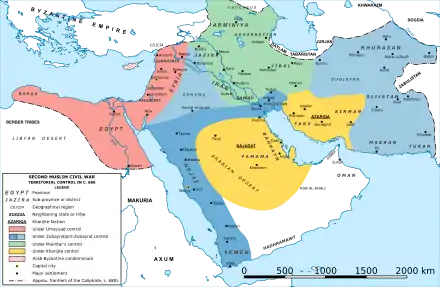
Meanwhile in Iran, during medieval era during the Umayyad era, The Zubayrids (a term which coined by most western scholars) under leadership of Abdullah ibn Zubayr has found legitimacy of their rule during that moment, as it was attested by the appearance of Zubayrid coins minted by their governor in Bishapur, Fars, which has Shahada inscription in it.[Notes 36] The Zubayrid caliphate were even finding nominal supports from one of the dangerous military element in middle east, the Kharijite horsemens who were feared for their zealotry and strength in battle.[223] The sympathy of the Kharijites towards them were attested when the Kharijites faction under Abu Bilal Mirdas,[224] a relatively tame Kharijite faction who according to Akbar Shah Khan Najibabadi living peacefully in the soils of Iran, has some extend of sympathy towards Zubayrid caliphate cause during the Second Fitna.[223] This faction only came into action after the decline of Abdullah ibn Zubayr power and the provocation of the Umayyad propagandists in Iran against Abdullah ibn Zubayr.[223] prominent leader of this faction were Abu Bilal Mirdas from Tamim tribe decimated the 2,000 Umayyad force from Basra under Aslam ibn Zur'a al-Kilabi, in the encounter at the village of Asak near Ramhurmuz, Despite being far fewer in numbers.[224][225]
Africa
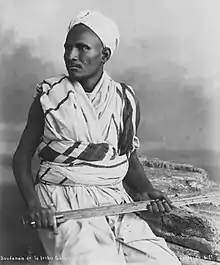
the African regions which subdued by Rashidun army under Amr ibn al-Aas and al-Zubayr also influenced by al-Zubayr legacy.[3][226][8] After Rashidun conquest of Bahnasa(Middle Egypt Oxyrhynchus), descendants of al-Zubayr from Banu(tribe) Muslih and Banu Ramadhan settled in Upper Egypt,[102] while al Qalqashandi recorded, Banu Zubayr of upper Egypt claiming themselves as descendants of Khalid ibn al-Walid al Makhzumi instead.[227] This coincided with al-Zubayr spread his of his estates and properties which he built in Alexandria and Fustat[189] In Egypt, The prestige of Zubayrid genealogy claims even affected the Egypt political development, as during parliamentary election in 1995, one of the candidates hired a local self taught historian to prove his genealogical connection to Zubayrid, in an attempt to support his candidacy.[228] Furthermore, the Seyf el-Nasr family, one of the oldest family residing in Mallawi, Minya Governorate of Egypt, are claimed as descendants of al-Zubayr.[229] In the different area, the tribe of Banu Muhammad ibn al-Warraq who inhabiting city of Girga, Sohag of upper Egypt, similarly claimed their relationship to az-Zubayr lineage.[230]
Meanwhile, in south of Egypt, starting from Aswan to further south into Sudan area that covering the coast of Red sea to the south, there are unanimous claims that came from multitude local traditions which attributed this genealogical origin due to az-Zubayr participation of the conquest of southern Egypt and al-Bahnasa.[231][232][233] In particular, Ababda tribes in eastern Egypt and Sudan claimed they were Arabic origin and Zubayr ibn al-Awwam were their eponym ancestor.[23][226][234] Despite western researchers classifying the Ababda as a subdivision of greater Beja community, the Ababda vehemently defending their claims that they are not originally Sudanese Beja origin and they are instead traced their Arabic heritage from al-Zubayr, and always speak Arabic as their main language.[228] In 1940, a local Ababda ethnologist named Hassan Hussayn Ahmad Khalifa al-Abadi released a book In the eastern desert and eastern Sudan:The Ababda and Other tribes, which self proclaimedly, an attempt to correct the mistake of western orientalist about their classification of Ababda as Bedja.[228] Khalifa stems from the complex tribal structures proofs as his evidences to proof Ababda genealogy to Arab, which al-Zubayr belong.[228] According to traditional sources, Ababda peoples claims their lineage came from common ancestor from Abbad ibn Abd Allah az-Zubair, grandson of Zubayr ibn al-Awwam.[23] Abad bore four children who would form the subdivisons of the Ababda tribe,[23] while according to modern day researchers from Egypt, The Zubayrid Ababda were supposedly descended from the line of Abdullah ibn al-Zubayr[235] The local genealogical traditions further explained, that for centuries, the Zubayrids settled in Aswan further moved to Ed Dueim and some area in Dongola and settled there.[236] With the exception of Ashbab, who stayed in Eastern Desert starting from the border of Qena and Al-Qaseer until the last border with Sudan,[237] Almost all of their tribe branches spread along the Nile river from the governate Ras Gharib and Halaib to the south, where they worked in petroleum, mining, fishing, and grazing industry.[235]
Aside from Ababda Zubayrid,[238] The Arabic Kawahla people inhabiting Eastern region of Sudan similarly claimed their ancestral right as descendant of Zubayr.[239] MacMichaels stated there two tradition claims of Arabic pedigree of Ababda.[240] The first were from Abdullah ibn al-Zubayr while the others they claimed through Khalid ibn al-Walid[241] The pedigree which allegedly from Abdullah were came from the Nisba (onomastics) manuscript possessed by Sheykh Abdullah Gadula Balilu, prominent lord of Kawahla.[242] According to the manuscript, their tribe were descendent from thirteen sons of Muhammad Kahil, grandson of Abdullah ibn Zubayr through a son named Musa.[242] while Muhammad Kahil, who bore four sons, were claimed by Kawahla traditional genealogist as their and Ababda peoples common ancestor.[243] Abdullah Gadula Manuscript were closed with appraisal toward the five notable sons of Zubayr ibn al-Awwam, Abdullah, Bakhit, Ubayd, Urwah, and Muhammad.[242] Majority of Kawahla were subject to Kababish tribe, until Mahdist War.[238]
Meanwhile, Ja'alin tribe community in Sudan also claimed as descendants of Zubayr,[244] this Zubayrid claimant tribe from Sultanate of Darfur has several notable figures in early modern history of Africa, such as:
- Rabih az-Zubayr, a warlord who led the resistance against French colonials until his demise and nicknamed "Napoleon of Africa" for his fierce resistance against the French.[245]
- Al-Zubayr Rahma Mansur, slave trader, Ottoman governor of Sudan, and pasha general of Khedivate of Egypt in the late 19th century. nemesis of General Charles Gordon. Al-Zubayr Rahma gained near-mythic status in the United Kingdom, where he was referred as "the richest and worst", a "Slaver King" "who [had] chained lions as part of his escort".[246][247]
Pakistan & India
Zubairi family, or also known as Zuberi clan is one of large tribal group whose lineage are completely traceable to their to the time of Muhammad,[32] as they claim themselves to be descendant of Zubayr ibn al-Awwam.[33] After almost 50 years of the conquest of Sindh by Muhammad ibn Qasim, Zubairis started migrating from Makkah and Madina towards Sindh.[32] Afterwards, the Zuberi clan recorded to dwell in Lahore, Panipat, Delhi and Sumbal. During the rule of Mughal Emperor Akbar, Zuberis also settled in Meerut and known as ruling Nawabs(governor) of Meerut.[32][33] Marehra also became centre of the family activities in 15th century AD. In Marehra “Kanboh Mohallah” was having largest concentration of Zuberis. Around 100 of the houses at Marehra were then owned by Zuberis.[32] many of Zuberi clan members settled near modern-day Dadu, Pakistan. By the end of 10 AD century, Zuberis started migrating from Sindh to Multan. During 14th century AD, part of the Zuberi clan migrated to Delhi led by Sufi Samauddin Zuberi.[32][33] After Indo-Pak partition period, most of the Zuberis migrated from India to Pakistan and got settled at Karachi, Lahore and Rawalpindi. Currently member of Zuberi Clan are settled all over the world at Karachi, Lahore, Islamabad, Saudi Arabia, Gulf States, United Kingdom and United States.[33] In 1936, the third family conference was held at Bareilly.[32] Later, in 1961 the Zuberi clan organized meeting in Karachi.[32]
Some of Muslim Kamboh community claim Arab ancestry claim descent from al-Zubayr ibn al-Awwam, as Husain Ahmad Zubairi said that the Kambo clan belonged to thc main tribe of the Quraish, particularly from al-Zubayr lineage.[31] Notable person from Zubairi Kambo were Ziauddin Ahmad Zuberi, 18th century philosopher and mathematician.[248]
Personal characteristic
Az-Zubayr is described as of medium height, lean, dark-complexioned, and hairy, though with a thin beard. His hair hung down to his shoulders, and he did not dye it after it turned white.[20]: 80 However, Dhahabi mentioned that al-Zubayr are described as burly and tall height, comparable to caliph Umar posture as it is said when he ride horse, al-Zubayr's feets touching and dragging the ground.[3] It is reported by second generations of Muslim scholars that entire body of az-Zubayr were covered with grisly battle scars.[14] Urwah ibn Zubayr said there are three distinctively deep scars over his shoulder,[249][3][131] two of these wounds there was an old scar he had received on the day of the battle of Badr and the other one received in the Battle of Yarmouk.[249] When Urwah was a child, he used to insert his fingers into those scars in play.[250] With the exception fo the Battle of Hunayn, where he wearing red turban called liwāʾ/ʿalam,[251][252] which signifying the willing to fight until death according to Arab tradition,[253] az-Zubayr usually wore yellow turban most of the time during battles, as prophet Muhammad spoke in hadith the army of angels dressing in yellow headgear and the clothing similar to Zubayr's attire.[Notes 37] According to Yasir Qadhi, Muhammad told the Muslims that the angels has descended to assist the Muslim army during Battle of Badr,[Notes 38] and wearing the same dress with az-Zubayr to honor him personally.[124] while alternatively, Basalamah translate this as indication of az-Zubayr physicall attractiveness, as according to his opinion, angels in Islamic belief frequently take forms of particularly attractive humans.[Notes 39]
| "...do not, argue humans with (the text of) Qur'an, instead, argue them with Sunnah.." [sic] |
| Zubayr ibn Awwam advice to his son regarding Qur'an interpretation debate.[Notes 40] |
As a man with extraordinary physical strength, Zubayr were said can split full grown man along with the victim's armor and saddle where he sat perfectly with his single strike of sword during the battle of the trench (Ghazwat al Khandaq).[4] Zubayr were recorded by Waqidi has done this feats twice during this battle against two Quraishite champions.[46]
Zubayr also reported as one of only two Muslim warriors in his time who can fought with two swords atop of their horse, while driving the horse with their legs. the other one being Khalid ibn al-Walid.[254] It is recorded that the sword belonged to az-Zubayr were adorned in silver material.[255] According to Bukhari, after the death of Abdullah ibn al-Zubayr, the silver sword of al-Zubayr were in possession of caliph Abd al-Malik ibn Marwan. the caliph returning the sword to al-Zubayr other son, Urwah.[256] in 20th AD, The sword allegedly belonged to al-Zubayr were now stored in the museum of Topkapi, Turkey.[257]
Az-Zubayr served along with Abu Bakar, Sa'd ibn Abi Waqqas and Sa'd ibn Mu'adh al-Ansari were served as Haras or personal bodyguard of Muhammad.[258]
Regarding his religious view, according to Libyan scholar Mustafa Bashir at-Tarabalisi, az-Zubayr were known for his textualism approach regarding the Islam jurisprudence.[144] This Textualism nature were characterized the later era of Ahl al-Hadith school of thought[145]
Stable
Az-Zubayr owned many horses.[259] The horses that being named by az-Zubayr were al-Ya'sūb, which he ride in the Battle of Badr.[260] Just as many Arab nobles of his era, al-Ya'sūb pedigree was preserved that even keep as their own distinct "horse-clan", which high quality lineage were carefully recorded and their breeding carefully maintained by the owner clan to keep their genealogical purity and quality, as in al-Ya'sūb case were the Asadi clan of az-Zubayr. al-Ya'sūb clan, the al-Asjadi horse clan were being owned and bred by al-Asadi tribe of az-Zubayr for generations.[261]
Another horse belonged to az-Zubayr that are named are Ghamra.[262][263]
At the time az-Zubayr married to Asma', Zubayr only posessed a horse and a camel as his property[249] However, after his death, Lewis mentioned al-Zubayr were possessed 1,000 horses which he left for his heirs.[264]
Wealth & estates
According to Daniel Pipes, al-Zubayr once owned 1,000 male and 1,000 female Ghilman or slave at one time, which he manumitted at least one each days[265] However, the primary source, Awza'i, only recorded 1,000 slaves without clarity of the genders of those slaves owned by al-Zubayr.[Notes 41] This report also supported by Bernard Lewis.[259]
Prophet Muhammad once gave him a large plot of land to build his house and a grant of some palm trees.[20]: 77 During his life, al-Zubayr possessed at least six land property:
- The first property were an Oasis situated in the lands formerly belonging to Banu Nadir.[267]
- The second property, a market fief belonged to Banu Qaynuqa which seized by Muslims and given to Zubayr after the conquest of Qaynuqa settlement by Muslims[268]
- The third property, according according to Asma, wife of Zubayr, were a property in Khaibar which contained date palms and other trees.[267]
- The fourth land property were also reported Zubayr received another large tract of land in Khaibar, where the size of the land, according to Abdullah ibn Umar, was a distance of Zubayr horse could sprinted until it stopped.[155]
- The fifth were given by Uthman ibn Affan during his reign as caliph had granted lands to Zubair[267]
- The sixth property acquired in 625 when al-Zubayr was given more palm trees from the land of the expelled Jewish Nadir tribe.[20]: 78
Aside from the properties in Hejaz, az-Zubayr also recorded has owned several houses in Egypt cities, namely Alexandria and Fustat, while in Iraq az-Zubayr also owned houses in Basra and Kufa,[259] Where az-Zubayr constructed markets.[269] Al-Masudi recorded that az-Zubayr estate were still present in 943-944 AD, where it still provide lodgings for merchants, commerce, and seafaring traders.[259]
Ya`qūb ibn Sufyān said that despite his vast wealth, az-Zubayr were known for his generosity as he never hoarding his income.[270]
Family
| Zubayr ibn Awwam lineage[Notes 42] | |||||||||||||||||||||||||||||||||||||||||||||||||||||||||||||||||||||||||||||||||||||||||||||||||||||||||||||||||||||||||||||||||||||||||||||||||||||||||||||||||||||||||||||||||||||||||||||||||||||||||||||||||||||||||||||||||||||||||||||||||||||||||||||||||||||||||||||||||||||||||||||||||||||||||||||||||||||||||||||||||||||||||||||||||||||||||||||||||||||||||||||||||||||||||||||||||||||||||||||||||||||||||||||||||||||||||||||||||||||||||||||||||||||||||||||||||||||||||||||||||||||||||||||||||||||||||||||||||||||||||||||||||||||||||||||||||||||||||||||||||||||||||||||||||||||||||||||||||||||||||||||||||||||||||||||||||||||||||||||||||||||||||||||||||||||||||||||||||||||||||||||||||||||||||||||||||||||||||||||||||||||||||||||||||||||||||||||||||||||||||||||||||||||||||||||||||||||||||||||||||||||||||||||||||||||||||||||||||||||||||||||||||||||||||||||||||||||||||||||||||||||||||||||||||||||||||||||||||||||||||||||||||||||||||||||||||||||||||||||||||||||||||||||||||||||||||||||||||||||||
|---|---|---|---|---|---|---|---|---|---|---|---|---|---|---|---|---|---|---|---|---|---|---|---|---|---|---|---|---|---|---|---|---|---|---|---|---|---|---|---|---|---|---|---|---|---|---|---|---|---|---|---|---|---|---|---|---|---|---|---|---|---|---|---|---|---|---|---|---|---|---|---|---|---|---|---|---|---|---|---|---|---|---|---|---|---|---|---|---|---|---|---|---|---|---|---|---|---|---|---|---|---|---|---|---|---|---|---|---|---|---|---|---|---|---|---|---|---|---|---|---|---|---|---|---|---|---|---|---|---|---|---|---|---|---|---|---|---|---|---|---|---|---|---|---|---|---|---|---|---|---|---|---|---|---|---|---|---|---|---|---|---|---|---|---|---|---|---|---|---|---|---|---|---|---|---|---|---|---|---|---|---|---|---|---|---|---|---|---|---|---|---|---|---|---|---|---|---|---|---|---|---|---|---|---|---|---|---|---|---|---|---|---|---|---|---|---|---|---|---|---|---|---|---|---|---|---|---|---|---|---|---|---|---|---|---|---|---|---|---|---|---|---|---|---|---|---|---|---|---|---|---|---|---|---|---|---|---|---|---|---|---|---|---|---|---|---|---|---|---|---|---|---|---|---|---|---|---|---|---|---|---|---|---|---|---|---|---|---|---|---|---|---|---|---|---|---|---|---|---|---|---|---|---|---|---|---|---|---|---|---|---|---|---|---|---|---|---|---|---|---|---|---|---|---|---|---|---|---|---|---|---|---|---|---|---|---|---|---|---|---|---|---|---|---|---|---|---|---|---|---|---|---|---|---|---|---|---|---|---|---|---|---|---|---|---|---|---|---|---|---|---|---|---|---|---|---|---|---|---|---|---|---|---|---|---|---|---|---|---|---|---|---|---|---|---|---|---|---|---|---|---|---|---|---|---|---|---|---|---|---|---|---|---|---|---|---|---|---|---|---|---|---|---|---|---|---|---|---|---|---|---|---|---|---|---|---|---|---|---|---|---|---|---|---|---|---|---|---|---|---|---|---|---|---|---|---|---|---|---|---|---|---|---|---|---|---|---|---|---|---|---|---|---|---|---|---|---|---|---|---|---|---|---|---|---|---|---|---|---|---|---|---|---|---|---|---|---|---|---|---|---|---|---|---|---|---|---|---|---|---|---|---|---|---|---|---|---|---|---|---|---|---|---|---|---|---|---|---|---|---|---|---|---|---|---|---|---|---|---|---|---|---|---|---|---|---|---|---|---|---|---|---|---|---|---|---|---|---|---|---|---|---|---|---|---|---|---|---|---|---|---|---|---|---|---|---|---|---|---|---|---|---|---|---|---|---|---|---|---|---|---|---|---|---|---|---|---|---|---|---|---|---|---|---|---|---|---|---|---|---|---|---|---|---|---|---|---|---|---|---|---|---|---|---|---|---|---|---|---|---|---|---|---|---|---|---|---|---|---|---|---|---|---|---|---|---|---|---|---|---|---|---|---|---|---|---|---|---|---|---|---|---|---|---|---|---|---|---|---|---|---|---|---|---|---|---|---|---|---|---|---|---|---|---|---|---|---|---|---|---|---|---|---|---|---|---|---|---|---|---|---|---|---|---|---|---|---|---|---|---|---|---|---|---|---|---|---|---|---|---|---|---|---|---|---|---|---|---|---|---|---|---|---|---|---|---|---|---|---|---|---|---|---|---|---|---|---|---|---|---|---|---|---|---|---|---|---|---|---|---|---|---|---|---|---|---|---|---|---|---|---|---|---|---|---|---|---|---|---|---|---|---|---|---|---|---|---|---|---|---|---|---|---|---|---|---|---|---|---|---|---|---|---|---|---|---|---|---|---|---|---|---|---|---|---|---|---|---|---|---|---|---|---|---|---|---|---|---|---|---|---|---|---|---|---|---|---|---|---|---|---|---|---|---|---|---|---|---|---|---|---|---|---|---|---|---|---|---|---|---|---|---|---|---|---|---|---|---|---|---|---|---|---|---|---|---|---|---|---|---|---|---|---|---|---|---|---|---|---|---|---|---|---|---|---|---|---|---|---|---|---|---|---|---|---|---|---|---|---|---|---|---|---|---|---|---|---|---|---|---|---|---|---|---|---|---|---|---|---|---|---|---|---|---|---|---|---|---|---|---|---|---|---|---|---|---|---|---|---|---|---|---|---|---|---|---|---|---|---|---|---|---|---|---|---|---|---|---|---|---|---|---|---|---|---|---|---|---|---|---|---|---|---|---|---|---|---|---|---|---|---|---|---|---|---|---|---|---|---|
| |||||||||||||||||||||||||||||||||||||||||||||||||||||||||||||||||||||||||||||||||||||||||||||||||||||||||||||||||||||||||||||||||||||||||||||||||||||||||||||||||||||||||||||||||||||||||||||||||||||||||||||||||||||||||||||||||||||||||||||||||||||||||||||||||||||||||||||||||||||||||||||||||||||||||||||||||||||||||||||||||||||||||||||||||||||||||||||||||||||||||||||||||||||||||||||||||||||||||||||||||||||||||||||||||||||||||||||||||||||||||||||||||||||||||||||||||||||||||||||||||||||||||||||||||||||||||||||||||||||||||||||||||||||||||||||||||||||||||||||||||||||||||||||||||||||||||||||||||||||||||||||||||||||||||||||||||||||||||||||||||||||||||||||||||||||||||||||||||||||||||||||||||||||||||||||||||||||||||||||||||||||||||||||||||||||||||||||||||||||||||||||||||||||||||||||||||||||||||||||||||||||||||||||||||||||||||||||||||||||||||||||||||||||||||||||||||||||||||||||||||||||||||||||||||||||||||||||||||||||||||||||||||||||||||||||||||||||||||||||||||||||||||||||||||||||||||||||||||||||||
| |||||||||||||||||||||||||||||||||||||||||||||||||||||||||||||||||||||||||||||||||||||||||||||||||||||||||||||||||||||||||||||||||||||||||||||||||||||||||||||||||||||||||||||||||||||||||||||||||||||||||||||||||||||||||||||||||||||||||||||||||||||||||||||||||||||||||||||||||||||||||||||||||||||||||||||||||||||||||||||||||||||||||||||||||||||||||||||||||||||||||||||||||||||||||||||||||||||||||||||||||||||||||||||||||||||||||||||||||||||||||||||||||||||||||||||||||||||||||||||||||||||||||||||||||||||||||||||||||||||||||||||||||||||||||||||||||||||||||||||||||||||||||||||||||||||||||||||||||||||||||||||||||||||||||||||||||||||||||||||||||||||||||||||||||||||||||||||||||||||||||||||||||||||||||||||||||||||||||||||||||||||||||||||||||||||||||||||||||||||||||||||||||||||||||||||||||||||||||||||||||||||||||||||||||||||||||||||||||||||||||||||||||||||||||||||||||||||||||||||||||||||||||||||||||||||||||||||||||||||||||||||||||||||||||||||||||||||||||||||||||||||||||||||||||||||||||||||||||||||||
Al-Zubayr have several siblings, both blood siblings and maternal siblings. According to Ibn Hajar in his Al-Isabah fi tamyiz al Sahabah, Abdullah ibn al-Awwam were killed in the Battle of Badr, while Abd al-Rahman ibn al-Awwam were killed during the battle of Yarmuk.[273] According to Ibn Athir in his Usd al-ghabah fi marifat al-Saḥabah, Al-Sa'ib ibn al-Awwam were killed during the battle of Yamama.[5]
Al-Zubayr married eight times and had twenty children.[20]: 75
- Asma bint Abi Bakr. They were married before the Hijra of 622 and divorced when Urwa was young, i.e., around 645.[34]: 179
- Umm Kulthum bint Uqba of the Umayya clan. They were married in 629, but "she disliked him," and they were divorced in a matter of months. After their daughter was born, Umm Kulthum married Abdur Rahman bin Awf.[34]: 163
- Zaynab
- Al-Halal bint Qays of the Asad tribe.
- Khadija the Younger
- Umm Khalid Ama bint Khalid of the Umayya clan. She was one of the emigrants who returned from Abyssinia in 628.[34]: 164 She had a Mawla whom she manumitted named Abu Muhammad al-Asadi; or more known as Musa ibn Uqbah. Musa are one of the earliest writter of early conquest of Islam history(Maghazi) and also a hadith transmitter.[274]
- Khalid
- Amr
- Habiba
- Sawda
- Hind
- Ar-Rabbab bint Unayf of the Kalb tribe.
- Mus'ab
- Hamza
- Ramla
- Atiqa bint Zayd of the Adi clan, a widow of Umar.[20]: 85
- Tumadir bint Al-Asbagh of the Kalb tribe, a widow of Abdur Rahman ibn Awf. Al-Zubayr divorced her only seven days after the wedding. She used to tell other women, "When one of you marries, she should not be deceived by seven days after what Al-Zubayr has done to me."[34]: 208–209 She did not, however, enlarge on the nature of the "deception".
- Umm Ja'far Zaynab bint Marthad of the Thaalaba tribe.
- Ubayda
- Ja'far
there were record from az-Zubayr's wives complained that he had "some harshness towards women".[34]: 163 [34]: 163 Atiqa only agreed to marry him on condition that he would never beat her.[275] However, contemporary writer Abdo Khal questioned the validity of this narration as he view the circulation of such story were not based from scholarly review of the text and instead based on unverified laymen interpretations in the modern times social media.[276]
Al-Zubayr tends to name his male children with the name of the Sahaba who died as Martyr in Islam,[3] such as Abd-Allah ibn Jahsh who died in the Battle of Uhud for Abd Allah ibn al-Zubayr, Urwah ibn Mas'ud, who died killed by peoples of Tha'if, for Urwah ibn Zubayr, Mus'ab ibn Umayr for Mus'ab ibn al-Zubayr, Khalid ibn Sa'id, who died in Battle of Marj as-Saffar for Khalid ibn al-Zubayr, And Amr ibn Sa'id ibn al-Aas, who killed during Battle of Yarmouk, for Amr ibn al-Zubayr.[277][3]
The two of most notable son of his was Abdullah ibn al-Zubayr, who claimed the caliphate during the reign of Yazid ibn Muawiyah,[278] along with Zubayr youngest son from Asma', Urwah ibn al-Zubayr, member of the most influental group of jurists known collectively as The Seven Fuqaha of Medina, prominent hadith scholar, and the first writer of Seerah or Maghazi.[279]
One of Zubayr's daughters, Ramlah bint al-Zubayr, married the Umayyad prince Khalid ibn Yazid,[280] despite the fact that Khalid was also the one who had killed Ramlah's brother Mus'ab ibn al-Zubayr in the Battle of Maskin (691).[281] Ibn Asakir recorded that Ramlah was famous for her extraordinary beauty.[280] Ramlah's beauty inspired Khalid to extoll her in his poems. However, this caused some trouble for Khalid, as various factions who disliked the Umayyad regime, such as the Shu'ubiyya movement, the Shia, and the Kharijites, spread exaggerated rumors regarding Khalid's poems for Ramlah. When these rumors reached the ears of the caliph Abd al-Malik ibn Marwan, he in turn berated and scolded and scolded this conduct of Khalid, which the Caliph regarded as vanity.[282]
See also
References
Notes
- The name were coined by Tabari[9]
- Coined Jund al Misr by Ibn Ashakir[11]
- According to Mubarakpuri in his Ar-Raheeq Al-Makhtum the title embedding of "Hawari Rasulillah" were occurred during the Battle of Uhud, after az-Zubayr killed Talhah ibn Abi Talhah al-Abd darri.[21]
- , the book reviewer, adding the sources of this material which did not found in original edition of Mahmud al-Misry book,Shahabatur Rasulullah.[3]
- Bukhari narrated as Abu Dhatu Kabsy, redaction from Basalamah Dhatu Kabsy are have two meaning, which can be"owner of muscles" or "owner of belly", which indicating Ubayda were either exceptionally muscular or have a huge belly. Either case, Basalamah theorized it means Ubayda possessed really huge posture[3]
- Dhahabi also supported this version, through firsthand witness of the battle who narrated this accident named Ibn Abi Zannad[3]
- In detailed narrations from Musnad Ahmad ibn Hanbal and Sahih al-Bukhari, Urwah ibn al-Zubayr, who was still a children at that time, reported he spotted his father rode his horse at least three times from the frontline of Khandaq to the Qurayzha settlement forts at the side of Medina city. This found in Sahih al-Bukhari, The Book of Virtues of the Companions, Hadith No. 3720, and the Musnad of Ahmad, the chain of transmission of the ten glad tidings of Paradise.[3]
- Muhammad ibn Ali Baghdadi, in his Tafsir al Khazen narrated a testimony from firsthand witness from Hawazin soldier who survived the battle and became Muslim later, that they swear they witnessed the entire valley were surrounded by angels disguised as humans riding horses and covered the valley with blackness of cloud, which are the reason they paused and did not press their advantage the moment that Muslim armies were routed.[54], while Basalamah also recorded the similar narration from Ibn Hisham[40]
- The narrations of az-Zubayr's advance accompanied by Muslim horsemens came from Akram without quoting sources.[12], while Basalamah narrated az-Zubayr charging alone without being accompanied by borrowing narrator's chains from Ibn Hisham[40]
- Basalamah noted that Malik ibn Awf, leader of the Hawazin lose heart the moment he faced az-Zubayr, as according to Basalamah, Malik has childhood trauma as he always lose duels against az-Zubayr in the past.[3]
- Bukhari reported that the day ten years old Abdullah bin Az-Zubayr brought by his father to the battlefield were during the Battle of Yarmouk against the Byzantine.[66][67][68] Dhahabi reasoned this happened during Yamama as Zubayr were exactly ten years old at that time, while Ibn Kathir argued the day Zubayr bring her son to the battlefield happened during Yarmouk.[3] However, Ibn Kathir still argued az-Zubayr were indeed fought in the Battle of Yamama and suffered permanent injury on his shoulder[6]
- Abdullah witnessed,[70]< technically supported Ibn Kathir explanation, through chains of narration of Yahya ibn Muhammad, from Musaddad, who report from Ataf bin Khalid who recorded the testimony from Abdullah and Urwah ibn Zubayr siblings.[6]
- Salat al-Khaufa prayer type which performed and allowed to be substitution of obligatory prayer of Muslims during war time which done with minimal movements while still being allowed to keep vigilant on battle and fight
- Wife of Ikrimah ibn Abi Jahl and relative of Khalid ibn al-Walid
- According to Mahmoud Sheet Khattab, az-Zubayr recalling his memory regarding Yarmuk and Nahavand when he climbed the wall of the fortress of Babylon with 6 of Muslim soldiers: "I commit myself… (to the battle of) Yarmouk, the decisive gates of the land of Levant, and the decisive battle of Nahawand.... the gates of Persia for the Muslim..."[79]
- John of Nikiû supported this traditions from Muslim chroniclers that the reinforcements numbered 4,000 although John did not mention the 4 commanders.[81]
- Hendrickx mentioned at least there are a thousand Black African Negro soldiers under Ubadah, amongs these reinforcements.[82]
- According to Basalamah commentary, the reason of Amr asking 8,000 soldiers for reinforcements are because he wants to are because 'Amr want those reinforcements merged with his 4,000 soldiers, so it can reach the quota of 12,000 soldiers. 'Amr based this number from a hadith that says "if Muslims were gathered in group of 12,000 soldiers for Jihad, they will be invincible (on the battlefield)", which responded by Umar by sending exactly 4,004 soldiers, where according to Umar those 4 men among them "equal to 1,000 each", thus fulfilling 'Amr requst of "8,000 reinforcements"[3] however, Tirmidhi has graded the hadith as weak in chain.[83]
- Regardless the version, Claude Cahen remarked, that this reinforcements army does not included any chieftains or tribes that rebelled during Ridda Wars, which means this army purely consisted of those who proven loyal from the beginning of Caliphate[87]
- Baladhuri said al-Zubayr climbed the Babylon fortress wall alone.[90] while other sources said he climbed it with a handful soldiers[3]
- The entire narrations found in Qatadah work, Futuh as-Sham wa Misr, page 209, 227[3]
- The compilation records about the conquest of Sudan and southern egypt were compilled in Futuhat Bahnasa by Waqidi and records of al-Maqrizi[94][95]
- The original version of collective narrations from Waqidi, Masudi, Sa'id ibn Jubayr, Abu Jaafar Al-Tabarani, Ibn Khalikan, Muhammad bin Ishaq and Ibn Hisham, differ about the Muslim commanders attended the Battle of Darishkur. The broadest mention even mentioned that Khalid ibn al-Walid, Khawlah bint al-Azwar(sister of Dhiraar), Al-Qa'qa' ibn Amr al-Tamimi and Abdurrahman ibn Abu Bakar(son of Abu Bakar) also attended this battle, and more details regarding the such as az-Zubayr and other commanders leading 500 Rashidun cavalry each. The details of the battle regarding the broadest and most independent narration also vividly describing the progress of the battle, the movements of each armies, including az-Zubayr troops, the duels, and in-battle poem recitations by az-Zubayr, Miqdad, Qa'qa ibn Amr, and others.[13]
- The first version narrated the siege of Bahnasa were led by Khalid ibn al-Walid, who also brought an ex Sassanid Marzban and his 2,000 Persian convert soldiers in this campaign. The Persian Marzban suggested to Khalid to form a suicide squad who will carry a wooden box filled with mixture of sulphur and oil and placing it at the gates, ignited it and blasting the gates(or melting the iron gate, according to the original translation), allowing the Muslim army to enter the city.[97][13]
- The second version were the Muslim army led by Qays ibn Harith without much details of how the Muslims managed to subdue the city. However, this source mention that Qays ibn Harith name were used temporarily to rename Oxyrhynchus for while to honor his deeds in this campaign, before being renamed to be al-Bahnasa.[98]
- Wallis Budge, author of The English Sudan, its History and Monuments, Quoted Burckhardt that the narrations of the Bedja troops arrival of 50,000 were attested by well authenticated train of chain narrators from the traditional accounts themselves.[99]
- MacMichaels, author of History of the Arabs in Sudan, doubted this major conflict happened as he argued the first contact between the Sudanese with Arab Muslims are unlikely came this early, before Abdullah ibn Sa'd contacted with the Sudanese in 641, after the capture of Aswan[94] However, Hendricxk mentioned that J. Jarry, and Vasilios Christides favored the Futuh of Bahnasa and argued it has strong factual standing.[95]
- The number of the Madhlij warriors fluctuated between seven or eight personnel, depending to the secondary sources.[103][104] [105]
- found in Mustadrak al Sahihayn.[120] The complete narration from Al-Hakim al-Nishapuri were:... Abu Abdullah Muhammad bin Yaqoub has reported from Ibrahim bin Abdullah Al-Saadi, who told us Muhammad bin Khalid bin Uthma, told us Musa bin Yaqoub, told me Abu Al-Huwairith, that Muhammad bin Jubayr bin Mut’im told him, that he heard Ali - may God be pleased with him - addresses the people, and he said: While I was leaving from the well of Badr, a strong wind came, the like of which I had never seen, then it left, then came a strong wind, the like of which I have never seen except for the one before it, then it went, then came a strong wind that I did not see before. I have never seen anything like it except for the one before it, and the first wind was Gabriel descended among a thousand angels with the Messenger of God - may God bless him and grant him peace - and the second wind was Michael who descended among a thousand angels to the right of the Messenger of God - may God bless him and his family and grant them peace - and Abu Bakr was On his right, and the third wind was Israfil. He descended with a thousand angels on the side of the Messenger of God - may God’s prayers and peace be upon him and his family - and I was on the right side. When God Almighty defeated his enemies, the Messenger of God - may God’s prayers and peace be upon him and his family - carried me on his horse, I blew up, and I fell On my heels, I prayed to God Almighty... Ibn al Mulqin, Hadith scholar from Cordoba of 13-14 AD century, evaluate this hadith tha he found weaknesses in Musa ibn Yaqoub and Abu al Huwairith chain, so he deemed there is weakness about this hadith.[121] However, recent scholarship from Ali Hasan al-Halabi has noted there is another hadith which supported the participation of Raphael in Badr[119]
- The author also noted this particular movements used by az-Zubayr also practiced by Abdullah ibn Umar in Sahih Muslim number 1339[132]
- There are contemporary Fatwa that the revelation of this verse were attributed to az-Zubayr were weak. based on the weakness of two narrators of this hadith. while according to this fatwa, the revelation of said verse were instead attributed to the tradition of Umar, the second Rashidun Caliph[141]
- The hadith were included in record of Ibn Manzur record of Miqdad ibn Aswad biography in his book, brief history of Damascus[172]
- The default rulings of caliphate were one parts for infantry, three parts for the soldiers who rode horses[172]
- 1 Dinar during Muhammad era were approximately 12 Dirhams[186]
- According to Ibn Sa'd, debt of al-Zubayr 1,200,000 Dinar.[187]
- Asid from a physical proof of Zubayrid influence of that area, the coin which has inscription of "There is no god but Allah and Muhammad is the messenger of God." were one of the first proof of Muhammad in documentary report, according to Harry and Thomas Munt.[222]
- Al-Hakim al-Nishapuri recorded in his Al-Mustadrak ala al-Sahihayn in a narration which deemed authentic by Bawazier in his Marwiyyat Ghazwatul Badr[125] Ibn Hajar al-Asqalani authorized it as authentic through Kitāb aṭ-Tabaqāt al-Kabīr written by Ibn Sa'd[29]
- Yassir Qadhi has quoted the hadith on his lecture Transcript about Zubayr ibn al-Awwam virtue session: "In the battle of Badr, the Prophet (peace be upon him) said on seeing a yellow turban tied around the head of az-Zubayr bin al-Awwām, “Verily, the angels [also] came down from heaven [to assist the believers] in the appearance of az-Zubayr”.[123]
- Haythami in his al Majma narrates from Tabarani that those angels were including Jibreel[3] Another chain narration source commentary also stated that thousands of angel army not only using using al-Zubayr dress, but also mimicking al-Zubayr's face
- az-Zubayr was saying:"....Laa tujadilinnasi bil Qur'an, wa laykin alaika bis Sunnah..." [sic] which according to Fahamsyah translate as "...do not, argue humans regarding (the text of)Qur'an, instead, argue them with Sunnah..". Fahamsyah gave commentary that according to az-Zubayr, the matter of Quran tafsir(exegesis) should not be relying solely on logic, since human knowledges were limited. Fahamsyah said that the contemporary orthodox scholarships of Islam, using this words of az-Zubayr to dismiss the opinions of Ahl al-Ra'y such as Muʿtazila rationalist school of though, which emerg during the Islamic Golden Age era.[146]
- Dhahabi recorded words of Awza'i in his Siyar a'lam Nubala[266]
- Genealogists and historians have disagreement who is the ancestor named Quraish, whether Qusay ibn Kilab[271] or Fihr ibn Malik[272]
Primary sources
- Recorded traditional oral narration of historical events during the early time of Islam of Urwah ibn Zubayr, an historian during Rashidun era.
- Earliests records of Maghazi (historical records regarding Islamic conquests) of Muhammad by Tabi'in historian Aban ibn Uthman
- Recorded narrations of Maghazi classifications by Ibn Shihab al-Zuhri
- Musnad Ahmad ibn Hanbal, which contains many scarces of historical account regarding military activity during the time of Muhammad and four righteous guided caliphate
- Sahih Bukhari Chapter 57: Book of Jihad, regarding ethics and basics of warfare according to Islamic tradition
- Sahih Muslim Chapter 19: Kitab Al-Jihad Wa'l-Siyar (The Book of Jihad And Expedition), regarding ethics and conduct during wartime
- Musnad Ahmad ibn Hanbal, a collection of hadith compiled by the Ahmad ibn Hanbal(d. 241 AH/855 AD) to whom the Hanbali fiqh(legislation) is attributed
- 'Jami at-Tirmidhi', also known as Sunan at-Tirmidhi, is one of "the six books" (Kutub al-Sittah – the six major hadith collections); authored by Al-Tirmidhi
- Sunan Abu Dawood, one of the Kutub al-Sittah (six major hadith collections), collected by Abu Dawud
- Masabih al-Sunnah contained narrations of the peoples who lived during the Rashidun conquests, including those directly involved in the conquest. Authored by Al-Baghawi
- Al-Sirah Al-Nabawiyyah (The Life of the Prophet), an edited recension by Ibn Isḥāq
- Tarikh al-Islam al-kabir, 'Great History of Islam' (50 vols., in Arabic); Ibn Hajar received it from adh-Dhahabi
- Siyar a`lam al-nubala, biographical manuscript of Companion of the prophet, authored by adh-Dhahabi
- History of the Prophets and Kings, more commonly known as Tarikh al-Tabari (تاريخ الطبري) or Tarikh-i Tabari or The History of al-Tabari (Persian: تاریخ طبری)
- Historical excerpts from Abu Bakr al-Zubaydi, scholar and historian from the Caliphate of Córdoba
- History of Damascus (Arabic: Tarikh Dimashq) is one of the most important books about the Islamic history of Syria, covering the life of important figures who resided in or visited Damascus. Authored by Ibn Ashakir
- Futuh al-Buldan, The Conquest of (the) countries, a work regarding early Islamic conquest 9th century historian Ahmad Ibn Yahya al-Baladhuri of Abbasid-era Baghdad
- Futūḥ mișr wa akhbārahā, Conquest of Egypt and some account of it, i.e. of the country) authored by Ibn Abd al-Hakam
- Kitab al-Tarikh wa al-Maghazi (Arabic: كتاب التاريخ والمغازي, "Book of History and Campaigns") by al-Waqidi
- Sahdba ma'a yl-Batlus(The book of the conquest of al-Bahnasa and what befell the Companions of the Prophet with the Patrician Batlus)
- Al-Mawāʻiẓ wa-al-Iʻtibār bi-Dhikr al-Khiṭaṭ wa-al-āthār; a historical excerpt authored by al-Maqrizi
- Genealogical Kawahla Nisba manuscript by Sheykh Abdullah Gadula Balilu al-Kawahla
Secondary sources
- al-Dihlawī 1991, p. 401.
- Jalal ad-Din Abdulrahman Al-Suyuti, Tarikh al-Khulafa. Translated by Jarrett, H. S. (1881). History of the Caliphs. Calcutta: The Asiatic Society.
- al-Misri (2015, p. Zubayr ibn Awwam chapter)
- Ibn Kathir 2009.
- ibn al-Athir 2012.
- adh-Dhahabī 2008.
- al-Mubarak 1997, p. 18.
- Norris 1986, p. 76-78.
- Rashid 1983.
- Sourdel 1965, p. 910.
- Ibn Ashakir 1995, p. 486.
- Akram 2007, p. 5.
- Waqidi, Muhammad ibn Umar (2008). فتوح الشام (نسخة منقحة) (Revised ed.). p. 48. Retrieved 15 November 2021.
- al-Asfahani 2016, p. 226.
- Al-Asqalani 2000, p. 349.
- al-Maghlouth 2015.
- Adamec 2017.
- Holt & Daly 2019.
- al-Asfahani 2016, p. 225.
- Muhammad ibn Saad. Kitab al-Tabaqat al-Kabir vol. 3. Translated by Bewley, A. (2013). The Companions of Badr. London: Ta-Ha Publishers.
- Mubarakpuri1 (2009)
- Ibrahim 2020, p. 217-231.
- Murray 1923, p. 423.
- Abd al Hadi, Ahmad (2001). من معارك الفتوح الإسلامية [From the battles of the Islamic conquests] (in Arabic). مركز الراية للنشر والإعلام،. p. 120. ISBN 9789775967466. Retrieved 6 December 2021.
- bin Musa 2006.
- Kausar & Imran 2016, p. 31.
- Mujahidin 2017, p. 8-9.
- Tarmizi 2017, p. 242.
- Abasoomar & Abasoomar 2016.
- Alwani, DeLorenzo & Al-Shikh-Ali (2003, p. 11)
- Umar 1998, p. 24.
- KHWANI 2005.
- Zuberi, Najmul Hasan. "Zuberis". Zuberis. Zuberi association. Retrieved 10 November 2021.
- Muhammad ibn Saad. Kitab al-Tabaqat al-Kabir vol. 8. Translated by Bewley, A. (1995). The Women of Madina. London: Ta-Ha Publishers.
- Muhammad ibn Ishaq. Sirat Rasul Allah. Translated by Guillaume, A. (1955). The Life of Muhammad. Oxford: Oxford University Press.
- Abdullah et al. 2016, p. 43. quoting al-Azami, 2005; Ahmad Don, 1991; al-Zarqani, t.th.
- Ibrahim 2011, p. 88.
- Zubaidi, Hashim & Sharif 2002, p. 706.
- Guillaume/Ishaq p. 337.
- Ibn Hisham & Basalamah (2019)
- Fazier 2013, p. 113.
- Sirjani 2020.
- al-Mubarakpuri (2008, p. 415-418)
- al-Mubarakpuri (2008, p. 416-418)
- al Asqalani, Ibn Hajjar (5 October 2011). "Fath al Bari". Retrieved 18 September 2021.
- Faizer 2013, p. 231
- Rizqullah Ahmad, Maftukhin & Basyaruddin (2017, p. 29)
- Fazier 2013, p. 339.
- Fazier 2013, p. 349.
- Muhammad ibn Umar al-Waqidi. Kitab al-Maghazi. Translated by Faizer, R., Ismail, A., and Tayob, A. K. (2011). The Life of Muhammad. Oxford & New York: Routledge.
- Fazier (2013, p. 349-350)
- Rizqullah Ahmad, Maftukhin & Basyaruddin (2017, p. 778, most scholars including Bukhari, Muslims, Tirmidhi, and Albani accept the primary report that only Muhammad and two of his uncle, Abu Sufyan ibn Harb and Abbas ibn Abd al-Muttalib has stood on their grounds.)
- Rizqullah Ahmad, Maftukhin & Basyaruddin (2017, p. 778, Narrated by Al-Hakim al-Nishapuri and Ahmad ibn Hanbal)
- al-Baghdadi (2014, p. 346)
- غزوة حنين معجزة إلهية لخالد بن الوليد في إختبار صعب للمسلمين - Battle of Hunayn; text: 10:27 at the same time when the cavalry group under the command of Zubair Ibn Al-Awwam had set off 10:31 and clashed with the forces of Malik Ibn Auf again. 10:34 Soon after, the Muslim forces succeeded in victory, 10:38 and Malik and the rest of the forces were expelled from the corridor, and the whole valley became under the Muslim's control. on YouTube
- Al-Qastallani 1905, p. Sahih al-Bukhari » Fighting for the Cause of Allah (Jihaad) - كتاب الجهاد والسير » Hadith 2976.
- Al Jaffri, Sawandi & Mohammad 2016, p. 172.
- Azami 2008, p. 97; Ibn Syabah, at Tanbih wa al Isyraf, p.245; Ibn Kathir al-Bidayah wan Nihayah, V/344; al Iraqi, al Ajalatus Saniyyah , p. 246; Ibn Sayyid an Nas. Uyunul Tsar, II/315.
- Azami 2008, p. 97; al-Watsa 'Iqus Siyasiyyah, document no. 193.
- Perlman 2015, p. 323.
- Griffel 2000.
- Ibn Jarir at-Tabari 2015, p. 46.
- Ibn Jarir at-Tabari 2015, p. 46; Khorasani Parizi 2011.
- al-Hanbali 2014, p. 86
- Fahmi, Hadi (2018). "Saad bin Abi Waqas". Mawdoo3. Mawdoo3. Retrieved 1 December 2021.
- Al-Kashmiri 1946, p. 4.
- Gibb 1960, p. 54–55.
- Bukhari 2007, p. 16.
- Futun Misr wa al Maghrib, p. 61; Qa’dat Fath al Sham wa Misr, p. 208-226
- Abu Bakr 1985, p. 249.
- Akram 2007, p. 279, quoting Waqidi: p 149. According to Balazuri (p. 141) these taunts against the Byzantines were uttered by Hind.
- Ibn Umar al-Waqidi, Muhammad (1997). "Futuh as-Sham". المكتبة الشاملة الحديثة (in Arabic). Dar al-Kutub al-Ilmiyya. Retrieved 7 December 2021.Ibn Umar, Muhammad (1865). Futūḥ al-šām 1 (in Arabic). al-Maṭbaʿah al-Kastīliyyah. p. 179. Retrieved 7 December 2021.
- Tabari 1992, p. 134.
- Ibn Umar al-Waqidi, Muhammad. "Futuh al-Sham (Revised Version) chapter:ذكر وقعة اليرموك". al-eman.com. al-eman. p. 21-49. Retrieved 7 December 2021.
- Athamina 2000, p. 42.
- Mahmud Abasy al-Jabir, Khalid (2013). الإستطلاع و دوره في التاريخ العربي الإسلامي لغاية 23 هـ / 645 م [Reconnaissance and its role in Arab-Islamic history until 23 AH / 645 CE]. Al Manhal. p. 257. ISBN 9796500081069. Retrieved 6 December 2021.
Subhi Abdul Hamid; Ma'araka al-Arba' al-hasimah; page 131
- Mahmud Abasy al-Jabir 2013, p. 245
- Kamal, Zuhayr (2009). اغتيال الخليفة عمر بن الخطاب: المحاضر الكاملة للتحقيق في الجريمة [Assassination of Caliph Omar Ibn Al-Khattab: Complete Records of the Investigation of the Crime] (in Arabic). الدار العربية للعلوم، ناشرون،. p. 146. ISBN 9789953878232. Retrieved 7 December 2021.
- Sheet Khattab, Mahmud (1996). Sufarāʼ al-Nabī, ṣallá Allāh ʻalayhi wa-sallam Volume 1. Muʼassasat al-Rayyān. Retrieved 7 December 2021.
- Ibn Jarir at-Tabari, Muhammad; Howard, I.K.A (1989). The Conquest of Iraq, Southwestern Persia, and Egypt (G. H. A. Juynboll translation ed.). State University of New York Press. p. 166. ISBN 978-0-88706-876-8. Retrieved 14 October 2021.
- Sijpesteijn 2006, p. 440, quoting John of Nikiou.
- Hendrickx 2012, p. 110-112.
- At-Tirmidhi, bu Isa. "Jami' al-Tirmidhi Book: 21, Hadith: 1548". Retrieved 25 November 2021.
- "Usd al-Ghabah fi Ma'rifat al-Sahabah 1 Thick Volume (أُسْدُ الغَابَة فِي مَعْرِفَةِ الصَّحَابة) by Imam 'Izz al-Din Abi al-Hassan Ibn al-Athir al-Jazari, Looh Press; Islamic & African Studies". www.loohpress.com. Retrieved 2020-08-08.
- Ibn Yahya al-Baladhuri, Ahmad (March 2011). The Origins of the Islamic State Being a Translation from the Arabic Accompanied With Annotations, Geographic and Historic Notes of the Kitab Futuh Al-buldan. Cosimo. ISBN 978-1-61640-534-2. Retrieved 21 September 2021.
- Ibn Sa'd, Muhammad. "al-Ṭabaqāt al-kabīr". MIT Libraries. MIT. Retrieved 14 October 2021.
- Shaban, M.A. (October 14, 1976). Islamic History: Volume 1, AD 600-750 (AH 132) A New Interpretation. Cambridge University Press. p. 34. ISBN 978-0-521-29131-6. Retrieved 14 October 2021.
- Abd al-Hamid Ali 1998, p. 121.
- Dhahabi, Sham ad Din. "The biography of 'Amr ibn al 'As radiya Llahu 'anhu; His deeds at the time of Abu Bakr, 'Umar and 'Uthman". Mahajjah. Mahajjah Institute. Retrieved 15 November 2021.
- Baladhuri 1996.
- Abu al Fadl (1967, p. 108-109)
- Ibn Abd al-Hakam (2014, p. 126, narrated through Abd al-Jabbar who report from Ibn Lahi’ah, who report from Yazid ibn Abi Habib)
- Blumell 2012, p. 295-300.
- Norris 1986, p. 81.
- Hendrickx 2012, p. 109-110.
- Wallis Budge 2013, p. 184; Maqrizi; translation by Na'um ben Suchair.
- Waqidi, Muhammad ibn Umar. "Futuh Sham, complete second version". modern comprehensive library. Retrieved 15 November 2021.
- Al Shinnawy, Mohammed (2019). "مدينة الشهداء خارج حساب محافظ المنيا" [The city of martyrs is outside the account of the governor of Minya]. Shada al-'Arab. Shada al-'Arab. Retrieved 15 November 2021.
- Norris 1986, p. 76-81.
- al-Dukhaylī 2011, p. 157.
- Waqidi 1865, p. 272.
- Rīṭī 1996, p. 82.
- Ibn Abd al Hakam 1996.
- Ibn Abd al Hakam & al-Hujairi 1996.
- Fall of Alexandria 641 – Early Muslim Expansion Documentary (Youtube). Canada: Kings and Generals. 2021. Event occurs at 16:20.
"All of sudden, they came upon Tripoli western boundary, where the city walls met the sea, and discovered that the section only thinly protected. In a display of bravery or foolishness, these eight intrepid opportunists used Tripoli vulnerable flank to infiltrate their way into the city"; "Before the defenders even realized what's happening, the Muslim group reached the city centre and began slaying enemies. Such unexpected violence triggered extreme panic within the city. In fact, a large number of the army within the city believed that a large had somehow got into the city. because of this, took refuge aboard ships anchored to the harbor."
- Adil Kamal 2005, p. 169
- Haykal 1944, chpt. 24
- Al-Mawardi 2017.
- Jasim Janabi, Khalid (1984). "تنظيمات الجيش العربي الإسلامي في العصر الأموي" [Organizations of the Islamic Arab Army in the Umayyad Era] (in Arabic). the University of California. Retrieved 7 December 2021.
- Al-Tabari, Tarikh al-Rusul wa’l-Muluk. Translated by Humphreys, R. S. (1990). Vol. 15, The Crisis of the Early Caliphate, pp. 238-239. Albany: State University of New York Press.
- Al-Tabari, Tarikh al-Rusul wa’l-Muluk. Translated by Brockett, A. (1997). Vol. 16, The Community Divided. Albany: State University of New York Press.
- "Sahih al-Bukhari 3129 – One-fifth of Booty to the Cause of Allah (Khumus) - كتاب فرض الخمس - Sunnah.com – Sayings and Teachings of Prophet Muhammad (صلى الله عليه و سلم)". sunnah.com. Retrieved 2021-02-04.
- Muir, W. (1924). The Caliphate: its Rise, Decline, and Fall from Original Sources, 2nd Ed., pp. 243-244. Edinburgh: John Grant.
- Abu Dawud 40:4632.
- Tirmidhi #3747
- al Bushi (2019, p. 682)
- al Uthaymeen (2019, p. 715)
- Ibn Taymiyyah, Muhammad (2018). "Salaf's position towards Sahabah: Meaning of Prophet's statement about people of Badr; Fatwa No: 359539". Islamweb. Retrieved 18 November 2021.
- Hakim, Saifuddin (2015). "Apakah Malaikat Israfil Bertugas Meniup Sangkakala pada Hari Kiamat? (1)". Muslim.or.id (in Indonesian). Muslim.or.id. Retrieved 14 December 2021.
[ يا آدم بر حجك ] " ما يُروى عن آدم -عليه السلام- أنه لَمّا حج قالت له الملائكة: «يا آدم بر حجك»: غير ثابت. " [من فوائد جلسة مع طلبة العلم /16/ذو الحجة/1432 ] __________________ " ... فهل يحسن بنا وقد أنضينا قرائحنا في تعلم هذه السنة المطهرة، وبذلنا في العمل بها جهد المستطيع، وركبنا المخاطرَ في الدعوة إليها؛ هل يحسن بنا بعد هذا كله أن نسكت لهؤلاء عن هذه الدعوى الباطلة، ونوليهم منّا ما تولّوا ونبلعهم ريقهم، وهل يحسن بنا أن لا يكون لنا في الدفاع عنها ما كان منّا في الدعوة إليها؟ إنّا إذن لمقصرون!..."
- al-Nishapuri, al-Hakim. "Kitabu Ma'rifat Shahabatu Radhiyallahu Anhum: Gabriel, Michael and Israfil descend in the Battle of Badr.". al Mustadrak ala Sahihayn. Islamweb: Islamweb. Retrieved 13 December 2021.
4488 - Narrated Abu Abdullah Muhammad ibn Ya'kub, through Ibrahim bin Abdullah Al Saadi , on the authority of Muhammad bin Khalid bin Athmah, on the authority of Musa bin Yaqub , who reported Abu Huwayrith , that Muhammad bin Jabir bin Mut'im, told him
- Abu Hafs Umar bin Ali bin Ahmad bin Muhammad bin Abdullah Al-Anshari Al-Wadi Asyi Al-Andalusi At-Tukuruwi Al-Mishri Asy-Syafi`i, Sirajuddin. "كتاب مختصر تلخيص الذهبي" [kitab mukhtasar talkhis aldhahabii]. Islamweb. Islamweb. Retrieved 14 December 2021.
- Hakim, Saifuddin (2015). "Apakah Malaikat Israfil Bertugas Meniup Sangkakala pada Hari Kiamat? (2)" [Does angel Raphael tasked to blow the trumpet of Armageddon in the day of judgment? (2)]. Muslim.or.id (in Indonesian). Muslim.or.id. Retrieved 14 December 2021.
Tafsir Al-Qurthubi, 7/20 (Maktabah Syamilah); At-Tadzkirah bi Ahwaalil Mauta wa Umuuril Akhirah, 1/488 (Maktabah Syamilah).; Fathul Baari 11/368 (Maktabah Syamilah); see Al-Imaan bimaa Ba’dal Maut, p. 112. ; Syarh Al-Ibanah: Al-Imaan bin Nafkhi Ash-Shuur, 5/33.; Syarh Al-‘Aqidah Al-Washithiyyah, 1/59-60 (Maktabah Asy-Syamilah). while in another book: وذلك أن الله سبحانه وتعالى يأمر اسرافيل وهو أحد الملائكة الموكلين بحمل العرش أن ينفخ في الصور (Syarh Al-‘Aqidah As-Safariyaniyyah, 1/467).
- Qadhi, Yasir (2016). "Lives Of The Sahaba 39 – Az-Zubayr Ibn Al-Awwam – PT 01". Muslim Central Audio. Muslim Central Audio. Retrieved 4 December 2021.
- Bin Al-Hassan & Al-Dimashqi (2012, p. 622, Al-Zubayr told us, he said: And Abu Al-Makarram Uqbah bin Makram Al-Dhabi told me, Musab bin Salam Al-Tamimi told me, on the authority of Saad bin Tarif, on the authority of Abu Jaafar Muhammad bin Ali, he said: On the day of Badr, Al-Zubayr bin Al-Awwam had a yellow turban)
- Rizqullah 2005, p. 410.
- Rizqullah Ahmad, Maftukhin & Basyaruddin (2017, p. 526, Bukhari and Muslim reported this narration which ended on Aisha as authentic.)
- al-'Asqalani 1500, p. 2, Sahih al-Bukhari 3849.
- Ridha, Rashid. "Bay'at ur Ridwan". Wikisource. Wikisource. Retrieved 18 November 2021.
- al-Asqalani, Ibn Hajar. "Fath Al-Bari Explanation of Sahih Al-Bukhari". Islamweb. Islamweb. Retrieved 18 November 2021.
- Marzuq Ath-Tharifi, Abdul Aziz. Akidah Salaf Vs Ilmu Kalam Jilid 1 Akidah Al-Khurasaniyyah #1 (in Indonesian) (346 ed.). Pustaka Al-Kautsar. Retrieved 25 November 2021.
- al-Hanbali 2014.
- Nur Baits (2021, p. 248 Hadith Riwayat Muslim 1336)
- Abd al-Wahhab (2019, p. 197)
- al-Albani (2004, p. 108)
- Nu'man (2020, p. 171, Muwatta Imam Malik, no.3424. Nawawi take this ruling from Muwatta despite being Shafiite scholar)
- Nu'man (2020, p. 282, Narrated by Urwah ibn az-Zubayr, that his father forbade his sons to sleep during morning prayer time;narrated by Hadith scholar Ibn Abi Shaybah)
- Ibn Abdul Aziz Asy-Syalhub 2019, p. 227
- Ibn Baz, Abd al Aziz. "ما يحسن بالمسلم قوله عند نزول المطر أو سماع الرعد؟" [What is good for a Muslim to say when it rains or when he hears thunder?; Fatwa number 13/85]. BinBaz.org (in Arabic). BinBaz.org. Retrieved 11 December 2021.
- Ibn Baz, Abd al Aziz. "ما الصواب فيما يحصل به التحلُّل في الحج؟ ; regarding Hajj pilgrimage". BinBaz.org (in Arabic). BinBaz.org. Retrieved 11 December 2021.
- Jurisprudence and Law – Islam Reorienting the Veil, University of North Carolina (2009)
- Al-Faqeeh, Abdullaah (2006). "Fatwa of Quranic verse (4:65)" (Printed). Islamweb center. committee comprises a group of licentiate graduates from the Islamic University, Al-Imaam Muhammad Bin Sa’oud Islamic University in Saudi Arabia. Retrieved 28 November 2021. Fatwa center
- Bukhari, Muhammad. "Sahih al-Bukhari » Distribution of Water - كتاب المساقاة » Hadith 2359". Sunnah.com. Sunnah.com. Retrieved 7 November 2021.Bukhari, Muhammad. "Sahih al-Bukhari » Distribution of Water - كتاب المساقاة » Hadith 2361". Sunnah.com. Sunnah.com. Retrieved 7 November 2021.Nasa'i, Abū `Abd ar-Raḥmān Aḥmad ibn Shu`ayb ibn Alī ibn Sīnān. "Sunan an-Nasa'i » The Book of the Etiquette of Judges - كتاب آداب القضاة » Hadith 5407". Retrieved 7 November 2021.Ibn Muslim, Abū al-Ḥusayn ‘Asākir ad-Dīn Muslim ibn al-Ḥajjāj. "Sahih Muslim » The Book of Virtues - كتاب الفضائل » Hadith 2357". Sunnah.com. Sunnah.com. Retrieved 7 November 2021.Ibn Majah, Abū ʻAbdillāh Muḥammad ibn Yazīd. "Sunan Ibn Majah » The Book of the Sunnah - كتاب المقدمة » Hadith 15". Sunnah.com. Sunnah.com. Retrieved 7 November 2021.
- bin Mat Saad, Hasbollah (2020). THE BASIC CONCEPTS OF SHARIAH. PENA HIJRAH RESOURCES. p. 205. ISBN THE BASIC CONCEPTS OF SHARIAH Check
|isbn=value: invalid character (help). Retrieved 14 December 2021. - Taufiq (2019, p. 18)
- Alwani, DeLorenzo & Al-Shikh-Ali (2003, p. 20)
- Zubair bin Awwam [Shirah Shahabat] – Ustadz Fadlan Fahamsyah, Lc, M.H.I on YouTubeFadlan Fahamsyah (Aug 13, 2018). Zubair bin Awwam [Shirah Shahabat] [Zubayr ibn Awwam – History of companion] (in Indonesian and Arabic). Event occurs at 47m48s.
....Laa tujadilinnasi bil Qur'an, wa laykin alaika bis Sunnah...
- Stowasser, Barbara Freyer (1996). Women in the Qur'an, Traditions, and Interpretation. Oxford University Press. p. 9. ISBN 978-0-19-976183-8.
- Spevack, Aaron (2014). The Archetypal Sunni Scholar: Law, Theology, and Mysticism in the Synthesis of al-Bajuri. SUNY Press. pp. 129–130. ISBN 978-1-4384-5371-2.
- Lucas 2006, p. 290–292, 303
- Stewart 2002, p. 99-158
- Ibn Anas (2007, p. 368)
- Wheeler (1996, p. 28-29)
- al-Asqalani & Yusuf (2007, p. 162)
- al Shafi'i (2018, p. 54)
- Al-Zuhayili (2021, p. 527)
- al Bushi (2019, p. 685,686)
- al Jawziyya (2010, p. 551)
- Al-Wancharisi, Abu Al-Abbas (2011). المعيار المعرب والجامع المغرب عن فتاوى إفريقيا والمغرب في فقه النوازل 1-8 ج3 [The expressive and comprehensive standard of Morocco on the fatwas of Africa and Morocco in the jurisprudence of calamities 1-8, part 3] (in Arabic). Dar Al Kotob Al Ilmiyah. p. 621. Retrieved 12 December 2021.
- Al-Amidi, Zain al Din (2011). الفتاوى الآمدية 1-2 ج2 [al-Amidi fatwa 1-2 part 2] (in Arabic). Dar Al Kotob Al Ilmiyah. p. 277. Retrieved 12 December 2021.
- Abū Ḥanīfah & Poonawala (2002, p. 450)
- Baillie & Elder (2009, p. 1-3 with footnotes)
- bin Hashim Limbada, Qasim; Ashraf, Muhammad (2004). "Insulting, stealing goods etc". IslamQa. Jameah Mahmoodiyah, South Africa: Darul Ifta. Retrieved 4 December 2021.
Fataawaa Aalamgeeriyyah, Vol. 5, Page 323, Fataawaa Rahimiyyah, Vol. 1, Page 83, Fataawaa Mahmoodiyah, Vol. 1, Page 17, Vol. 6, Page 18, Vol. 12, Page 25]
Hanafi Fiqh. "Results for "zubayr awwam"". IslamQa. Darul Ifta. Retrieved 4 December 2021. - Punar (2016, p. 20)
- an Naim Na (2009, p. 35-39, 76-79, 97)
- "Relasi Aceh Darussalam dan Kerajaan Utsmani, Sebuah Perspektif" [The Relationship between Aceh Darussalam and the Ottoman Empire, A Perspective]. Aceh institute. info@acehinstitute.org. 2015. Retrieved 22 November 2021.
- Cammack & Feener (2012, p. 42)
- Harahap (2018)
- Rahimi, Haroun (2021). "A Constitutional Reckoning with The Taliban's Brand of Islamist Politics A Constitutional Reckoning with The Taliban's Brand of Islamist Politics: The Hard Path Ahead". Qala-e-9 Borja, Kart-e-Parwan, Kabul, Afghanistan: 220–222. Retrieved 13 December 2021. Cite journal requires
|journal=(help)CS1 maint: location (link) - Mas'ud, Muhammad (2019). "1 SYARIAT DAN HUKUM ISLAM DI AFGANISTAN" [Law and Sharia in Afghanistan]. Afganistan (in Indonesian). Scribd: 1–17. Retrieved 13 December 2021.
Abdul Wahhab Khalaf, Ahkamul Ahwal al Syakhsiyyah fii Syari’ati al Islamiyah , Kuwait: Darul Qolam, 1990, hal. 60 Ahmad Mudzakar, Politik Syariat Islam (Dari Indonesia Hingga Nigeria ), Jakarta, Gema Insane pres, 2002, Ad-Dimasyqi, Muhammad bin Abdurrahman, Fiqih Empat Mazhab , Bandung: Hasyimi, 2013, Ali, Muhammad Daud, Kedudukan Hukum Islam Dalam Sistem Hukum Indonesia , dalam Pembangunan no 2 Tahun ke XII, Maret 1982 Amrullah Ahmad SF dkk, Dimensi Hukum Islam Dalam Sistem Hukum Nasional , Jakarta: Gema Insani Press, 1999 Ad-Dimasyqi, Muhammad bin Abdurrahman, Fiqih Empat Mazhab , Bandung: Hasyimi, 2013. Barkatullah, Abdul Halim dan Teguh Prasetyo, Hukum Islam – Menjawab Tantangan Zaman yang Terus Berkembang , Yogyakarta: Pustaka Pelajar, cet. 1, 2006 John F. Burns, “Taliban Rulers Decree Death by Stoning to Adulterers,”The Denver Post, November 3, 1996. Mahmood, Tahir, Family Law Reform in The Muslim World , N. M Tripathi PVT. LTD., Bombay, 1972 Mahmood, Tahir, Personal Law in Islamic Countries (History, Text, and Conparative Analysis) Academy of Law and Religion, New Delhi, 1987.; Mudzhar, H.M. Atho, Hukum Keluarga di Dunia Islam Modern, Ciputat Press, Jakarta, 2003
- Burhanuddin (2013)
- Tantawi (2008, p. 112)
- Hawramani, Ikram (1311). "Mukhtasar Tarikh al Dimashq: Miqdad bin Amr bin Thalabah bin Malik". hadithtransmitters.hawramani. hadithtransmitters.hawramani. Retrieved 7 December 2021.
- Ibn Kathir, Abu al Fida; ibn Masʻūd ibnMuḥammad al-Farrā' al-Baghawī, Ḥusayn. "واعلموا أنما غنمتم من شيء فأن لله خمسه وللرسول ولذي القربى واليتامى الآية 41 من سورة الأنفال". surahquran.com (in Arabic). surahquran.com. Retrieved 7 December 2021.; Sirah Nabawiyah #61 - Peristiwa Perang Khaybar 2 - Ustadz Dr. Firanda Andirja, M.A. on YouTube; bin Badawi al-Khalafi, Abdul Azhim. "Kitab Jihad (2)". Almanhaj (in Indonesian). Almanhaj. Retrieved 7 December 2021.
Setelah itu ghanimah (harta rampasan perang) dibagikan. Empat perlima bagian untuk orang-orang yang berperang, dengan perincian untuk pejalan kaki satu bagian dan untuk pasukan berkuda tiga bagian. Allah berfirman: وَاعْلَمُوا أَنَّمَا غَنِمْتُم مِّن شَيْءٍ فَأَنَّ لِلَّهِ خُمُسَهُ وَلِلرَّسُولِ “Ketahuilah, sesungguhnya apa saja yang dapat kamu peroleh sebagai rampasan perang, maka sesungguhnya seperlima untuk Allah dan untuk Rasul…” [Al-Anfaal: 41] Baca Juga Kitab Jihad (1) Dari Ibnu ‘Umar Radhiyallahu ‘anhuma, ia berkata: رَأَيْتُ الْمَغَانِمَ تُجَزَّأُ خَمْسَةَ أَجْزَاءٍ، ثُمَّ يُسْهَمُ عَلَيْهَا، فَمَا كَانَ لِرَسُوْلِ اللهِ j فَهُوَ لَهُ، يَتَخَيَّرُ. “Aku melihat harta rampasan dibagi lima bagian, kemudian diberikan kepada yang ikut berperang, adapun yang menjadi bagian Rasulullah Shallallahu ‘alaihi wa sallam, maka bagian itu adalah miliknya yang beliau pilih.” Dan dari beliau juga, bahwasanya Rasulullah Shallallahu ‘alaihi wa sallam membagi harta rampasan perang Khaibar, untuk penunggang kuda tiga bagian dan untuk kudanya dua bagian serta untuk pejalan kaki satu bagian. ; Shahih: [Shahiih al-Jaami’ish Shaghiir (no. 2303), Sunan Ibni Majah (II/952, no. 2853), ini adalah lafazh dalam riwayat beliau, dan yang meriwayatkan seperti ini tanpa menyebutkan ‘khaibar’, Shahiih al-Bukhari (VI/67, no. 2863), Shahiih Muslim (III/1383, no. 1762), Sunan Abi Dawud (VII/404, no. 2716)
- The Legal Thought of Jalāl Al-Din Al-Suyūṭī: Authority and Legacy, Page 133 Rebecca Skreslet Hernandez
- Abi Al-Abbas Ahmed Al-Harrani / Ibn Taymiyyah, Taqi Al-Din (2010). Abdel Qader Atta, Muhammad; Abdel Qader Atta, Mustafa (eds.). الفتاوى الكبرى - فتاوى شيخ الإسلام ابن تيمية 1-6 ج3 [The Great Fatwas - Fatwas of Sheikh Al-Islam Ibn Taymiyyah 1-6 Part 3] (in Arabic). Dar Al Kotob Al Ilmiyah. p. 521. Retrieved 12 December 2021.
- Ibn Baz, Abd al Aziz. "ما حكم تعذيب المُجْرِم المتهم؟" [What is the ruling on torturing the accused criminal?]. BinBaz.org (in Arabic). BinBaz.org. Retrieved 11 December 2021.
- Razmi, Mohsen; Enferadi Kolarkatteh, Morteza (2005). "A review of jurisprudential arguments for the permissibility of torture in islam". Revista Quaestio Iuris. 11 (3). doi:10.12957 (inactive 2021-12-14) Check
|doi=value (help). Retrieved 11 December 2021.CS1 maint: DOI inactive as of December 2021 (link) - Tarmizi 2017, p. 95.
- El-Ali 1959, p. 254.
- Al-Harbi 2017, p. 331-350.
- Hailu & Yatoo 2021.
- Lateh 2016, p. 46.
- Karaoğlu 2020, p. 4l.
- منان 2020.
- Zaroni 2007, p. 1.
- Al-Harbi 2015, p. 1.
- Ibn Sa'd 2013, p. 81.
- Asqalani 1976, p. 33.
- Lewis 1970, p. 221-222.
- al Bushi (2019, p. 685,686)
- Islam 1984, p. 783.
- ibn Sa‘d ibn Manī‘ al-Baṣrī al-Hāshimī, Muḥammad. الطبقات الكبرى - 5 [Major classes volume 5]. p. 412. Retrieved 7 December 2021.
- Ibn Hanbal, Ahmad. "Musnad Ahmad bin Hanbal vol 6". islamport.com (in Arabic). مؤسسة قرطبة - القاهرة. Retrieved 7 December 2021.
- Sayyid Ahmad (2012, p. 299)
- Farid (2006, p. 34)
- Ali, M. Amir. "Ayesha's Age". Ilaam.net. amirali@ilaam.net. Retrieved 17 November 2021.
- "'Aabad bin 'Abdullah bin al-Zubair عباد بن عبد الله بن الزبير بن العوام". Muslim Scholars Database. Arees Institute; webmaster@muslimscholars.info. 2011. Retrieved 18 November 2021.
- Crow 2005.
- Ibn Bakkār 2005, p. 14–18.
- Al-Shuaibi & Al-Shuaibi 2020, p. 227.
- Khalidi 2001, p. 188.
- Robinson 2014, p. 87
- Robinson 2014, p. 97
- Robinson 2014, p. 88
- Robinson 2014, p. 108
- Al-Zubayri 1953, p. 360. Umar ibn Ibrahim ibn Waqid al-Umari full nisba was Umar ibn Ibrahim ibn Waqid ibn Muhammad ibn Zayd ibn Abdallah ibn Umar ibn al-Khattab.
- Cole 2020.
- Hawting, G. R. (1986). The First Dynasty of Islam The Umayyad Caliphate AD 661-750. Carbondale : Southern Illinois University Press. p. 49. ISBN 9780415240734. OCLC 1083391651. Retrieved 8 December 2021.
- El-Attar 1996, p. 393-394
- Robinson 2014, p. 89-92
- El-Ali 1959, p. 259, quoting Bakri 1020-1; Yaqut al-Hamawi, vol IV, P.760.
- Khalaf & Mousa 2021, p. 36.
- Northedge & Petersen 2019, p. 54.
- Mehmet 2018.
- Alebrahim 2020, p. 521-534.
- Cook 1992, p. 191-202.
- N. Schofield, Richard (1991). Kuwait and Iraq Historical Claims and Territorial Disputes : a Report Compiled for the Middle East Programme of the Royal Institute of International Affairs. London : The Institute. p. 4. ISBN 9780905031354. Retrieved 8 December 2021.
- Alebrahim 2020.
- Britannica 2004.
- Dumper & Stanley 2007, p. 398.
- Alsiraih 2021.
- Munt & Henry Robert Munt 2014, p. 162
- Shah Khan Najibabadi, Akbar (2001). History of Islam (Vol 2). Darussalam. p. 158. ISBN 9789960892887. Retrieved 8 December 2021.
- Levi Della Vida 1993, pp. 123–124.
- Wellhausen 1901, p. 26.
- Hopkins & Saad 2004, p. 216, 219, 220, 227; Quoting Basri. 1995.
- al-Qalqashandī al-Fazari 2012, p. 410.
- Hopkins & Saad 2004, p. 216.
- Yehia 2015, p. 4-5(126-127) quoting Rezq, A.(1987) Ozma Al Tareekh mn Mallawi, Minia Governorate, p.9.(In Arabic).
- عثمان, عبد الله أحمد (2009). البلدان السوهاجية. الهيئة العامة لقصور الثقافة. p. 85. Retrieved 23 November 2021.
- Ramaḍān 1999, p. 238
- Tayyib 1993, p. 44
- مجلة الفيصل: العدد [Al-Faisal Magazine: Issue 369]. مركز الملك فيصل للبحوث والدراسات الإسلامية. 2007. Retrieved 23 November 2021.
- Abdel-Qadr et al. 2012, p. 399–418.
- Badawi 2021, p. 28.
- al-Hajj 2011.
- Ismail 2021, p. 28.
- MacMichael 1910, p. 224.
- MacMichael 1922, p. 27, 89, 90, 140, 148, 151, 215.
- Macmichaels 2011, p. 194.
- Macmichaels 2011, p. 194, while the claims of Khalid ibn Walid through his son, Sulaiman, also came in page 104.
- MacMichael 1922, p. 148.
- Macmichaels 2011, p. 149-151.
- Ibrahim 1988, p. 217-231.
- Ali, Wail (2017). ""رابح فضل الله".. نابليون أفريقيا الذي أرعب الفرنسيين" ["Rabih Fadlallah" .. Napoleon of Africa who terrified the French]. Al Jazeera Arabic (in Arabic). Al Jazeera. Retrieved 8 December 2021.
- Fuller, O. E. Brave Men and Women Their Struggles, Failures, And Triumphs, 1884
- Lang, Jeanie. "The Story of General Gordon" circa. 1900.
- Kamboj, Deepak (2019). "Kambojas in Muslim society; quoting: Empire and Information: Intelligence Gathering and Social Communication in India, 1780-1870 (Cambridge Studies in Indian History and Society) page 285. by C. A. Bayly; Rajnarayan Chandavarkar. Contributor, Gordon Johnson; Language, Ideology and Power: Language Learning among the Muslims of Pakistan and North India March 2008 Edition: Second revised edition Publisher: Oxford University Press, Karachi and Orient Blackswan, Delhi.ISBN: 81-250-3463-3 , page 126 Authors: Tariq Rahman". Kamboj Society. Kamboj Society. Retrieved 29 November 2021.
- Al-Kashmiri 1946, p. 4, Sahih al-Bukhari 3721; Sahih al-Bukhari 3975.
- Al-Kashmiri 1946, p. 4, Sahih al-Bukhari 3973; Sahih al-Bukhari 3721; Sahih al-Bukhari 3975.
- Hinds 1996, p. 97-142.
- Hinds 1996, p. 104-6.
- al-Misri (2019, p. Abu Dujana Simak chapter)
- Nasr 2020, p. 140.
- al-Asqalani 2000, p. 349.
- Bukhari 2007, p. Hadith no.3755.
- Haylamaz 2007, p. 6.
- "The Guards of the Prophet - I". islamweb.net. Doha - Qatar: Qatar Ministry of Awqaf and Islamic Affairs. 2013. Retrieved 5 December 2021.
- Lewis 1996, p. 59.
- Ibn Hisham, Abu Muhammad 'Abd al-Malik. "Sirat Ibn Hisham: The names of Muslim horses on the day of Badr". Islam web. Islam web. Retrieved 17 November 2021.
- Ibn al-Kalbi (2003, p. 35)
- Ibn Majah 2007.
- Ibn Hanbal 2012.
- Lewis 1970, p. 222, Ibn Sa'd recorded from narration chain that ends in Mas'udi.
- Pipes, Daniel (1981). Slave Soldiers and Islam The Genesis of a Military System; al Maqrizi; Mawaiz. Yale University Press. p. 141. ISBN 978-0-300-02447-0. Retrieved 15 October 2021.
- Dhahabi, Shamsuddin (1347). "كتاب تاريخ الإسلام ط التوفيقي 3" [The History of Islam conciliation book vol.3]. Mahajjah Institute. Al Tawfiqia Library. Retrieved 10 November 2021.
- Yığıtoğlu 2018, p. 54.
- Yığıtoğlu 2018, p. 243. quoting Lecker, M. (nd). İslam Öncesi ve İslam'ın İlk Döneminde Medine/Yesrib Pazarı Üzerine. 2(4), 157-172. (M. M. Söylemez, Trans.).
- Muhammad Mulham, Adnan (1998). المؤرخون العرب والفتنة الكبرى [Arab Historians and the Great Sedition] (in Arabic). Dar Al-Taliaa. p. 14. Retrieved 6 December 2021.
- Yusuf Patel, Hanif; Desai, Ebrahim. "Who was az-Zubair bin al-Awwām (may Allah be pleased with him)?". IslamQa. Darul Ifta. Retrieved 4 December 2021.
- Watt, W. Montgomery (1986). "Kuraysh". Encyclopedia of Islam. Volume V: Khe–Mahi (New ed.). Leiden and New York: Brill. pp. 434–435. ISBN 90-04-07819-3.
|volume=has extra text (help) - Hammer, Leonard; J. Breger, Marshall; Reiter, Yitzhak (2013). Sacred Space in Israel and Palestine Religion and Politics (Ebook). Taylor & Francis. ISBN 978-1-136-49033-0. Retrieved 26 November 2021.
- Asqalani 1400.
- Sukmana 2019, p. 114; Quoting Dhahabi in his Siyar A'lam Nubala.
- Ibn Hajar, Al-Isaba vol. 4 p. 687, cited in Abbott, N. (1942, 1985). Aishah – the Beloved of Mohammed, p. 88. London: Al-Saqi Books.
- Khal 2013
- "Tarikh al Islam, 'Ahd al Khulafa' al Rashidin, p. 505; al Tabaqat, 3/101". Mahajjah Institute. Mahajjah Institute. Retrieved 8 November 2021.
- Gibb 1960, p. 55.
- Khan et al. 2012.
- Ibn Ashakir 1995
- Ahmed 2010, p. 118.
- Kahlah 2011
Bibliography
- Abasoomar, Moulana Muhammad; Abasoomar, Moulana Haroon (2016). "Virtue of Sayyiduna Zubayr (radiyallahu 'anhu)". Hadith Answers. Darul Hadith. Retrieved 9 November 2021.
- Abd al-Hamid Ali, Abd al-Rahim Muhammad (1998). عمرو بن العاص القائد والسياسي [Amr ibn al-Aas, the leader and politician]. Jordan: Zahran Publishing House. p. 121. Retrieved 15 November 2021.
- Abd al-Wahhab, Muhammad ibn (2019). Syarah Adab Berjalan Menuju Shalat [Manners of Walking to the Prayer]. Darul Falah. p. 197. ISBN 9789793036892. Retrieved 22 November 2021.
- Abdel-Qadr, Mustafa; Wendrich, Willeke; Kosc, Zbigniew; Barnard, Hans (2012). The History of the Peoples of the Eastern Desert. Los Angeles: The Cotsen Institute of Archaeology Press. pp. 399–418. ISBN 978-1-931745-96-3.
- Abu Bakr, Muhammad ibn Ibrahim ibn al-Mundhir (1985). الأوسط في السنن والإجماع والقياس - ج 5 [mesial in Traditions, consensus, and analogy/al'awsat fi al sunan wa al Ijma wa al qias] (1 ed.). IslamKotob. Retrieved 12 November 2021.<
- Abu al Fadl, Muhammad (1967). تاريخ الطبري تاريخ الرسل والملوك، ويليه: الصلة – التكملة – المنتخب (ط. المعارف) [History of Tabari] (in Arabic) (Muhammad Abu al Fadl ed.). Dar al Ma'ruf. Retrieved 20 November 2021.
- Abū Ḥanīfah, Nuʻmān ibn Muḥammad; Poonawala, Ismail (2002). The Pillars of Islam: Muʻāmalāt: laws pertaining to human intercourse. Translated by Asaf Ali Asghar Fyzee. Oxford University Press. p. 450. ISBN 978-0-19-566784-4. Retrieved 22 November 2021.
- Adil Kamal, Ahmad (2005). اطلس الفتوحات الاسلامية. Dar Al Salam for printing, publishing, distribution and translation. ISBN 9773422577. Retrieved 16 November 2021.
- al-Albani, Muhammad Nasiruddin (2004). Fikih Syekh Albani (in Indonesian). Translated by Mahmud bin Ahmad Rasyid ·. Pustaka Azzam. Retrieved 21 November 2021.
- Al-Asqalani, Ibn Hajar (2000). فتح الباري بشرح صحيح البخاري - ج 7 [Fath Al-Bari with the explanation of Sahih Al-Bukhari – Part 7]. Dar al Fikri al Islamiya al Hadith. p. 349. Retrieved 15 November 2021.
- Abdullah, Murihah; Abdullah, Abdul Hafiz; Rosman, Arieff Salleh; Ilias, Mohd Faeez (2016). "Tanggungjawab Hufaz Menurut Al-Nawawi Dalam Al-Tibyan Fi Adabil Hamlatil Quran" [Hufaz's Responsiblities According to Al-Nawawi in Al-Tibyan Fi Adabil Hamlatil Quran]. International Journals of Humanities Technologies and Civilization (in Indonesian). 1 (12): 43. Retrieved 6 November 2021.
- Adamec, Ludwig W. (2017). Historical dictionary of Islam (Third ed.). Lanham, Maryland. ISBN 978-1-4422-7723-6. OCLC 953919036.
- Ahmed, Asad Q. (2010). The Religious Elite of the Early Islamic Ḥijāz: Five Prosopographical Case Studies. Oxford: University of Oxford Linacre College Unit for Prosopographical Research. ISBN 978-1-900934-13-8.
- Akram, A. I. (2007). Khalid Bin Al-Waleed, Sword of Allah: A Biographical Study of One of the Greatest Military Generals in History. Maktabah classic. p. 5. ISBN 978-0-9548665-2-5. Retrieved 9 November 2021.
- Alebrahim, Abdurrahman (2020). "The neglected sheikhdom at the frontier of empires and cultures: an introduction to al-Zubayr". Middle Eastern Studies. 56 (4): 521-534. doi:10.1080/00263206.2020.1735370. S2CID 216405414. Retrieved 8 November 2021.
- El-Ali, Saleh A. (1959). "Muslim Estates in Hidjaz in the First Century A. H." Journal of the Economic and Social History of the Orient. 2 (3): 254. doi:10.2307/3596188. JSTOR 3596188. Retrieved 11 November 2021.
- Alwani, Taha Jabir Fayyad; DeLorenzo, Yusuf Talal; Al-Shikh-Ali, A. S. (2003). Source Methodology in Islamic Jurisprudence Uṣūl Al Figh Al Islāmī. International Institute of Islamic Thought. ISBN 978-1-56564-404-5. Retrieved 20 November 2021.
- Alsiraih, Wasan (2021). "Speech Variation in the Dialect of Basra". Journal of the College of Arts. University of Basrah. 96 (2). Retrieved 15 November 2021.
- al-'Asqalani, Ibn Hajar (1500). "Explanation of Fath al-Bari". Islamweb. Retrieved 7 November 2021.
- al-Asfahani, Muhammad (2016). Biography of the Righteous Ancestors. Shamela. Shamela. Archived from the original on September 16, 2016. Retrieved 14 November 2021.
- al-Hanbali, Ibn al-Mubarrad (2014). Muhammad Al-Azhari Abu Al-Mundhir, Saleh bin (ed.). Mahd Al-Maram fi Fadil Al-Zubayr bin Al-Awwam [Pure Mercy in the Virtues of Al-Zubayr bin Al-Awwam]. p. 86. Retrieved 1 December 2021.
- Asqalani, Ibn Hajar (1400). "Al-Iṣābah fī Tamyīz al-Ṣahābah (الإصابة في تمييز الصحابة; The morning in the company of the companions)". Shamela. Shamela. Retrieved 13 November 2021.
- Asqalani, Ibn Hajar (1976). كتب أسلامية Volume 16, Issues 178-189. United Arab Republic: وزارة الاوقاف, المجلس الاعلى للشؤن الاسلامية. Ministry of Waqaf, Supreme Council for Islamic Affairs; al-Majlis-al-A'la-li-al-Shu'un-al-Islamiyya. Retrieved 13 November 2021.
- al-Asqalani, Ibn Hajar; Yusuf, Ahmad (2007). Terjemah Lengkap Bulughul Maram (in Indonesian). Translated by Mansyur Alkatiri, Khaeruddin Rendustera. Akbar Media. ISBN 9789799533739. Retrieved 20 November 2021.
- Athamina, Khalil (2000). فلسطين في خمسة قرون، من الفتح الإسلامي حتى الغزو الفرنجي (634-1099) (Arabic ed.). Indiana University. ISBN 9789953901343. Retrieved 15 November 2021.
- Azami, Muhammad Mustafa (2008). 65 Sekretaris Nabi(Sixty five Prophet's secretary) Original: Kuttabun Nabi Shalallahu 'Alaihi Wa sallam (Indonesia ed.). Gema Insani. ISBN 978-9790770805. Retrieved 11 November 2021.
- Badawi, Badawi M (2021). "Challenges and Prospects of Sustainable Development of Ecotourism and Handicrafts in Red Sea". International Journal of Eco-Cultural Tourism, Hospitality Planning and Development. 4 (1). doi:10.21608/ijecth.2021.187028 (inactive 2021-11-19). Retrieved 11 November 2021.CS1 maint: DOI inactive as of November 2021 (link)
- al-Baghdadi, Ali ibn Muhammad (2014). تفسير الخازن (لباب التأويل في معاني التنزيل) 1-4 ج2 [Tafsir al-Khazin]. Dar Al Kotob Al Ilmiyah. p. 346. Retrieved 21 November 2021.
- Baillie, Neil; Elder, Smith (2009). A digest of the Moohummudan law. London. p. 1-3 with footnotes. Retrieved 22 November 2021.
- Baladhuri, Ahmad bin Yahya bin Jabir (1996). "كتاب أنساب الأشراف" [book of Lineage of the Nobles]. Maktaba. Dar al Fikri. Retrieved 13 November 2021.
- Bin Al-Hassan, Abi Al-Qasim Ali; Al-Dimashqi, Ibn Asaker (2012). تاريخ مدينة دمشق 1-37 ج10 [History of the city of Damascus]. Dar Al Kotob Al Ilmiyah دار الكتب العلمية.
- bin Musa, Marwan Hadidi (2006). "Surat An-Nisa Ayat 65". tafsirweb. Indonesian religion ministry, Council of Senior Scholars (Saudi Arabia); Markaz Tafsir Riyadh. Retrieved 7 November 2021.
- Britannica, The Editors of Encyclopaedia (2004). "Al-Zubayr". Britannica. Iraq: Britannica.
- Blumell, Lincoln H. (2012). Epilogue. The Demise of Christian Oxyrhynchus. Brill. ISBN 9789004180987. Retrieved 15 November 2021.
- Bukhari, Muhammad ibn Ismail (2007). The Correct Traditions of Al'Bukhari 1-4 vol. 3 (Muhammad Mahdi Al-Sarif ed.). Dar Al Kotob Al Ilmiyah. Retrieved 12 November 2021.
- Burhanuddin, Anas (2013). "Bolehkah Memata-Matai Suami?" [Is it allowed to spying on husband?]. Almanhaj (in Indonesian). Indonesia; Java Island; Purwodadi: Lajnah Istiqomah Surakarta. Retrieved 22 November 2021.
- al Bushi, Abdullah bin Mubarak (2019). Ensiklopedi Ijma' Syaikhul Islam Ibnu Taimiyah. Darul Falah. ISBN 9786029208078. Retrieved 20 November 2021.
- Cammack, Mark E.; Feener, R. Michael (2012). "The Islamic Legal System in Indonesia" (PDF). Pacific Rim Law & Policy Journal. 21 (1).
- Cole, Juan (2020). "Hijazi Rock Inscriptions, Love of the Prophet, and Very Early Islam: Essays from Informed Comment". University of Michigan Library Department of History. hdl:2027.42/156109. Retrieved 8 November 2021.
- Cook, Michael (1992). "On the Origins of Wahhābism". Journal of the Royal Asiatic Society. Third Series. 2 (2): 191–202. doi:10.1017/S1356186300002376. JSTOR 25182507. Retrieved 10 November 2021.
- Crow, Karim Douglas (2005). Facing one Qiblah: legal and doctrinal aspects of Sunni and Shi'ah Muslims. Pustaka Nasional Pte Ltd. p. 194. ISBN 9789971775520.
- adh-Dhahabī, Shams ad-Dīn (2008). "Siyar A'lam Nubala". Wikipedia. Wikipedia. Retrieved 7 November 2021.
- al-Dihlawī, Muḥammad Yūsuf ibn Muḥammad Ilyās Kāndihlawī (1991). Ḥayātuṣ-ṣaḥābah The Lives of the Sahabah · Volume 1. Darul Ishaat. p. 401. Retrieved 5 November 2021.
- al-Dukhaylī, Ḥusayn ʻAlī ʻAbd al-Ḥusayn (2011). البنية الفنية لشعر الفتوحات الإسلامية في عصر صدر الإسلام [al-Bunyah al-fannīyah li-shiʻr al-futūḥāt al-Islāmīyah fī ʻaṣr ṣadr al-Islām/The artistic structure of the poetry of Islamic conquests in the era of early Islam]. Amman: Dār al-Ḥāmid lil-Nashr wa-al-tawzīʻ. p. 157. ISBN 9796500008936. OCLC 1184004713. Retrieved 12 November 2021.
- Dumper, Michael; Stanley, Bruce E. (2007). Cities of the Middle East and North Africa A Historical Encyclopedia. ABC-CLIO. p. 398. ISBN 978-1-57607-919-5. Retrieved 9 November 2021.
- El-Attar, Jamal F. (1996). "The Political Thought of Al-Jahiz With Special Reference to the Question of Khilafa (Imamate): A Chronological Approach". 2. hdl:1842/7390. Retrieved 28 November 2021. Cite journal requires
|journal=(help)
- Farid, Ahmad (2006). 60 Biografi Ulama Salaf. Pustaka al Kautsar. ISBN 9789795923695. Retrieved 17 November 2021.
- Fazier, Rizwi (2013). The Life of Muhammad Al-Waqidi's Kitab Al-Maghazi. Taylor & Francis. p. 349. ISBN 9781136921148. Retrieved 6 November 2021.
- Faizer, Rizwi (2013). The Life of Muhammad Al-Waqidi's Kitab Al-Maghazi. Taylor & Francis. p. 349. ISBN 9781136921148. Retrieved 6 November 2021.
- Gibb, H. A. R. (1960). "ʿAbd Allāh ibn al-Zubayr". In Gibb, H. A. R.; Kramers, J. H.; Lévi-Provençal, E.; Schacht, J.; Lewis, B. & Pellat, Ch. (eds.). The Encyclopaedia of Islam, New Edition, Volume I: A–B. Leiden: E. J. Brill. pp. 54–55. OCLC 495469456.
- Griffel, Frank (2000). Apostasie und Toleranz im Islam: die Entwicklung zu al-Ġazālīs Urteil gegen die Philosophie und die Reaktionen der Philosophen (in German). BRILL. p. 61. ISBN 978-90-04-11566-8.
- Hailu, Suadiq Mehammed; Yatoo, Nissar Ahmad (2021). "Islamic Finance in Ethiopia: Current Status, Prospects and Challenges". International Journal of Islamic Banking and Finance Research. 6 (1): 1–18. doi:10.46281/ijibfr.v6i1.1317. S2CID 240627919. Retrieved 6 November 2021.
- al-Hajj, Daf 'a Allah Ahmad (2011). "إمارة العبابدة.. عودة للتاريخ" [The Emirate of Ababda..a return to history]. Al-Ahram. Sudan Press. Retrieved 13 November 2021.
- Harahap, Cempaka Sari (2018). "Hukuman Bagi Pelaku Zina (Perbandingan Qanun No. 6 Tahun 2014 tentang Hukum Jinayat dan Enakmen Jenayah Syariah Negeri Selangor No. 9 Tahun 1995 Seksyen 25)" [Punishment for Adultery Perpetrators (Comparative Qanun No. 6 of 2014 concerning the Law of Jinayat and the Crime of Sharia Crimes in Selangor State No. 9 of 1995 Section 25)]. Hukum Fiqih(Fiqh Law). 4 (2). Retrieved 22 November 2021.
- Al-Harbi, A. T. (2017). "Determinants of Islamic banks' profitability: international evidence". International Journal of Islamic and Middle Eastern Finance and Management. 10 (3): 331-350. doi:10.1108/IMEFM-12-2015-0161. Retrieved 6 November 2021.
- Al-Harbi, Ahmad (2015). "Development of the Islamic Banking System". Journal of Islamic Banking and Finance. 3 (1). Retrieved 10 November 2021.
- Haykal, Muhammad Husayn (1944). Al Farooq, Umar.
- Haylamaz, Resit (2007). Khadija: The First Muslim and the Wife of the Prophet Muhammad (illustrated ed.). Tughra Books. ISBN 978-1-59784-121-4. Retrieved 9 November 2021.
- Hendrickx, Benjamin (2012). "The Border Troops of the Roman-Byzantine Southern Egyptian Limes: Problems and Remarks on the Role of the African and 'Black' African Military Units". Ekklesiastikos Pharos. 94. hdl:10520/EJC128657. Retrieved 13 November 2021.
- Hinds, Martin (1996). Studies in Early Islamic History. Darwin Press. ISBN 978-0-87850-109-0.
- Holt, P. M.; Daly, M. W. (2019). The History Of The Sudan: From The Coming Of Islam To The Present Day (reprint ed.). Routledge. ISBN 978-1-00-030217-2. Retrieved 8 November 2021.
- Hopkins, Nicholas S.; Saad, Reem (2004). Upper Egypt: Identity and Change. American Univ in Cairo Press. p. 216, 219, 220, 227; Quoting Basri, 1995. ISBN 9789774248641. Retrieved 8 November 2021.
- Ibn Abd al Hakam, Abu'l Qāsim ʿAbd ar-Raḥman bin ʿAbdullah; al-Hujairi, Muhammad (1996). tahmil kitab futuh misr wa'akhbaruha [تحميل كتاب فتوح مصر وأخبارها] (first ed.). Beirut: Dar al-Fikr. Retrieved 14 November 2021.
- Ibn Abd al-Hakam, Abu'l Qāsim ʿAbd ar-Raḥman bin ʿAbdullah (2014). فتوح مصر وأخبارها وفتح إفريقية والمغرب والأندلس (in Arabic). Dar al Kotob Ilmiyah. ISBN 9782745177575. Retrieved 20 November 2021.
- Ibn Ashakir, Abi Al-Qasim Ali bin Al-Hassan bin Heba Allah bin Abdullah Al-Shafi’i (1995). History of the city of Damascus. IslamKotob. Retrieved 14 November 2021.
- ibn al-Athir, Ali (2012). "Usd al-ghabah fi marifat al-Saḥabah (Arabic: أسد الغابة في معرفة الصحابة, lit. 'The Lions of the Forest and the knowledge about the Companions')". Waqfeya. Retrieved 13 November 2021.
- Ibn Bakkār, Al-Zubayr (2005), al-ʻĀnī, Sāmī Makkī (ed.), Al-Akhbār al-muwaffaqīyāt (2nd ed.), Dār ʻĀlam al-Kutub, pp. 14–18
- Ibn Abdul Aziz Asy-Syalhub, Fuad (2019). Ringkasan Kitab Adab (in Indonesian). Darul Falah. ISBN 9789793036847. Retrieved 25 November 2021.
- Ibn Hanbal, Aḥmad (2012). Musnad Ahmad ibn Hanbal. Riyadh: Darussalam Publishers. p. Hadith 6. Retrieved 7 November 2021.
- Ibn Hisham, Muhammad; Basalamah, Khalid Zeed Abdullah (2019). Sirah Nabawiyah-Ibnu Hisyam [History of the prophet, by Ibn Hisham with commentary book review from Khalid Basalamah] (in Indonesian). Translated by Ikhlas Hikmatiar (Video Book Review ed.). Khalid Basalamah official. Retrieved 18 November 2021.
- Ibn Jarir at-Tabari, Muhammad (2015). The History of Al-Tabari Vol. 10 The Conquest of Arabia: The Riddah Wars A.D. 632-633/A.H. 11 (Fred Donner Translation ed.). State University of New York Press. ISBN 978-1-4384-0140-9. Retrieved 14 October 2021.
- Ibn al-Kalbi, Hisham (2003). كتاب أنساب الخيل في الجاهلية والإسلام وأخبارها [The Book of Horse Genealogy in the Pre-Islamic Age and its News]. المكتبة الشاملة الحديثة. Retrieved 17 November 2021.
- Ibn Kathir, Abu al-Fiḍā ‘Imād Ad-Din Ismā‘īl ibn ‘Umar (2009). – via Wikisource.
- Ibn Majah, Abū ʻAbdillāh Muḥammad ibn Yazīd (2007). Sunan Ibn Majah » The Chapters on Charity - كتاب الصدقات » Hadith 2393. Darussalam Publishers. ISBN 9782987457046. Retrieved 7 November 2021.
- Ibn Anas, Malik (2007). Muwatta Imam Malik. Translated by Muphtah Aduli. Dar al-Kotob al-Ilmiyah. ISBN 9782745155719. Retrieved 20 November 2021.
- Ibn Sa'd, Muhammad (2013). Kitab At-Tabaqat Al-Kabir Volume III: The Companions of Badr (Aisha Bewley translation ed.). Ta-ha publisher. p. 81. ISBN 978-1-84200-133-2. Retrieved 10 November 2021.
- Ibrahim, Abdullah Ali (1988). "Breaking the Pen of Harold Macmichael: The Ja'aliyyin Identity Revisited". The International Journal of African Historical Studies. 21 (2): 217–231. doi:10.2307/219934. JSTOR 219934. Retrieved 8 November 2021.
- Ibrahim, Mahmood (2011). Merchant Capital and Islam. University of Texas Press. ISBN 978-0-292-74118-8. Retrieved 12 November 2021.
- Islam, Zafarul (1984). "Banking in the Abbasid Period a Special Study of the Tenth Century A. D." Proceedings of the Indian History Congress. 45: 783. JSTOR 44140275. Retrieved 10 November 2021.
- Ismail, Badawi M. (2021). "Challenges and Prospects of Sustainable Development of Ecotourism and Handicrafts in Red Sea". International Journal of Eco-Cultural Tourism, Hospitality Planning and Development. 4 (1): 28. doi:10.21608/ijecth.2021.187028 (inactive 2021-11-19). Retrieved 13 November 2021.CS1 maint: DOI inactive as of November 2021 (link)
- Al Jaffri, Ram; Sawandi, Saad Norfaiezah; Mohammad, Rahayu (2016). "Zakat Surplus Funds Management". International Journal of Economics and Financial Issues. 6 (7): 172. Retrieved 6 November 2021.
- al Jawziyya, Ibn Qayyim (2010). Zad Al-Ma'ad – Provisions Of The Afterlife Which Lie Within Prophetic Guidance زاد المعاد [انكليزي] ترجمة. Dar al Kotob Ilmiyah. ISBN 9782745162144. Retrieved 20 November 2021.
- Kahlah, 'Umar Ridha (2011). Flags of women in the Arab world and Islam ; Ramla bint Zubayr. Al-Risala Foundation. ISBN 9789933446147. Retrieved 24 November 2021.
- Karaoğlu, Ömer (2020). "An Overview of the Financial History of Muslims". Journal of Knowlede Economy and Knowledge Management. 15 (1). Retrieved 11 November 2021.
- Al-Kashmiri, Muhammad Anwar Shah bin Moazzam Shah (1946). Anwar al Baari. modern comprehensive library. Retrieved 7 November 2021.
- Kausar; Imran (2016). "Addressable Issues of Ijtihad of the Muslim World Today". The International Research Journal Department of Usooluddin. 4 (1): 172. Retrieved 6 November 2021.
- Khal, Abdo (2013). "Can sexual harassment be a duty?". Saudi Gazette. Saudi Gazette. Retrieved 27 November 2021.
This is a bogus story which is aimed at inviting husbands to harass their wives so as not to allow them to go out to work. I do not know if the tweeter meant only the husbands or was he asking all the men to harass women so that they do not go out to work? Whatever the tweeter’s intention was, he seems to be completely wrong.
- Khan, Ata ur Rehman; Khan, Janas; Dad, Karim; Rehman, Inayat ur; Al-Azhar, Zia ullah (2012). "Urwa Bin Zubair's "Al-Maghazi": Methodology and Critical". Asian Journal of Social Sciences & Humanities. 1 (4). Retrieved 9 November 2021.
- Khalaf, Maryam Khairallah; Mousa, Maher Yaqoub (2021). "نشأة مدينة الزبيرومراحلها المىرفىلىجية" [The emergence of the city of Al-Zubayr and its morphological stages]. Basrah & Arabian Gulf Studies Centre / University of Basrah (39): 36. Retrieved 8 November 2021.
- Khalidi, T. (2001). The Muslim Jesus: Sayings and Stories in Islamic Literature. Harvard University Press. p. 188. ISBN 0-674-00477-9.
- Khorasani Parizi, Ebrahim (2011). "Ansar's Role in the Suppression of Apostates in the Era of Caliphate of Abu Bakr; Tabari history.Vol.3, p.246, 247" (PDF). textroad publication. Department of History, Faculty of Literature and Humanities, Baft Branch, Islamic Azad University, Baft, Iran. Retrieved 9 October 2021.
- KHWANI, NAAT (2005). "Zuberi Clan History". Zuberi Association. Zuberi Association. Archived from the original on 2009-05-30. Retrieved 10 November 2021.
- Lateh, Bukhoree (2016). "Multiple Contracts According to the Fatwa of National Sharia Council". International Journal of Nusantara Islam. 4 (1): 41–48. doi:10.15575/ijni.v4i1.1184. Retrieved 6 November 2021.
- Lewis, Bernard (1970). "On the Revolutions in Early Islam". Studia Islamica. 32 (32): 215–231. doi:10.2307/1595221. JSTOR 1595221. Retrieved 11 November 2021.
- Levi Della Vida, G. (1993). "Mirdās b. Udayya". In Bosworth, C. E.; van Donzel, E.; Heinrichs, W. P. & Pellat, Ch. (eds.). The Encyclopaedia of Islam, New Edition, Volume VII: Mif–Naz. Leiden: E. J. Brill. pp. 123–124. ISBN 978-90-04-09419-2.
- Lewis, Bernard (1996). The Middle East: A Brief History of the Last 2,000 Years. 32. Simon and Schuster. ISBN 978-0-684-80712-6. Retrieved 16 November 2021.
- Lucas, Scott C. (2006). "The Legal Principles of Muhammad B. Ismāʿīl Al-Bukhārī and Their Relationship to Classical Salafi Islam". Islamic Law and Society. 13 (3): 290–292, 303. doi:10.1163/156851906778946341.
- MacMichael, H. A. (1910). "The Kababish. Some Remarks on the Ethnology of a Sudan Arab Tribe". The Journal of the Royal Anthropological Institute of Great Britain and Ireland. 40: 224. doi:10.2307/2843151. JSTOR 2843151. Retrieved 8 November 2021.
- Macmichaels, H. A. (2011). A History of the Arabs in the Sudan: And Some Account of the People who Preceded Them and of the Tribes Inhabiting Dárfūr (illustrated, reissue ed.). Cambridge University Press. p. 194, while the claims of Khalid ibn Walid through his son, Sulaiman, also came in page 104. ISBN 978-1-108-01026-9. Retrieved 11 November 2021.
- MacMichael, Harold Alfred (1922). A History of the Arabs in the Sudan and Some Account of the People who Preceded Them and of the Tribes Inhabiting Dárfūr, Volume 2. Cambridge University Press. p. 194. Retrieved September 8, 2015.
- al-Maghlouth, Sami ibn Abdullah (2015). أطلس الفتوحات الإسلامية [Atlas of Islamic Conquests] (Sami ibn Abdullah al Maghlouth ed.). al 'Abkan publishing. ISBN 978-9960548517. Retrieved 12 November 2021.
- Al-Mawardi, Abū al-Ḥasan ʿAlī Ibn Muḥammad (2017). Al Ahkam As Sultaniyyah – Al Mawardi. Repro Knowledgcast Limited. ISBN 9789388850278. Retrieved 24 October 2021.
- Mehmet, Ilhan (2018). "Abd Allah Ibn Al-Zubayr and His Career as Caliph". ANU Research Publications. Retrieved 8 November 2021.
- al-Misri, Mahmud (2015). Sahabat-Sahabat Rasulullah vol 1: Zubair bin Awwam [(Companion of the Prophet) vol 1: Zubair bin Awwam official Book review by Basalamah; quoting various supplementary sources such as Sahih Bukhari, Sahih Muslim, Siyar A'lam Nubala, Al-Tirmidhi, Prophetic biography of Ibn Hisham, etc.] (in Indonesian and Arabic). Pustaka Ibnu Katsir. p. Shaja'ah Zubayr ibn al-Awwam Radhiyallahu anh (bravery of Zubayr ibn al-Awwam; by Mahmud al-Misri. ISBN 9789791294386. Retrieved 6 November 2021.
- al-Misri, Mahmud (2019). Sahabat-Sahabat Rasulullah vol 3: Abu Dujana Simak [(Companion of the Prophet) vol 3: Abu Dujana Simak official Book review by Basalamah commentary, quoting various supplementary sources such as Sahih Bukhari, Sahih Muslim, Siyar A'lam Nubala, Baladhuri Futuh al-Buldan, etc.] (in Indonesian and Arabic). Pustaka Ibnu Katsir. ISBN 9789791294386. Retrieved 6 November 2021.
- al-Mubarak, Malik Abdulazeez (1997). Warfare in early Islam (PhD). University of Glasgow. p. 18. Retrieved 15 October 2021.
- al-Mubarakpuri, Safi ur Rahman (2008). ar Rahiq al Makhtum [the Sealed Nectar] (in Indonesian). Translated by Hanif Yahya (Abdul Majid Muluk ed.). Saudi Arabia: Darussalam. p. 416-418. Retrieved 21 November 2021.
- Mubarakpuri1, Safiur Rahman (2009). "Keberanian az-Zubeir Bin Awwâm Radhiyallahu Anhu" [the courage of az-Zubayr ibn Awwam, may god be pleased with him]. Almanhaj (in Indonesian). As Sunnah Magazine. Retrieved 22 November 2021.
- Mujahidin, Mujahidin (2017). "Konsep Iqtha' Pemberian Tanah Kepada Masyarakat Dalam Pemikiran Ekonomi Al-Mawardi (Studi Kitab Al-Ahkam Alsultaniyyah)" [Iqtha Concept of Giving Land to the Communityh in Economic Thinking of Al-Mawardi (Study of the Kitab Al-Ahkam Alsultaniyyah)]. Al Amwal Journal of Islamic Economic Law. 2 (1): 1–17. doi:10.24256/alw.v2i1.535. Retrieved 6 November 2021.
- Munt, Harry; Henry Robert Munt, Thomas (2014). The Holy City of Medina Sacred Space in Early Islamic Arabia (Hardcover). Cambridge University Press. p. 162. ISBN 9781107042131. Retrieved 10 December 2021.
- Murray, G. W. (1923). "The Ababda". The Journal of the Royal Anthropological Institute of Great Britain and Ireland. 53: 417–423. doi:10.2307/2843579. JSTOR 2843579. Retrieved 8 November 2021.
- an Naim Na, Abdullahi Ahmed (2009). Islam and the Secular State Negotiating the Future of Shari'a. Harvard University Press. ISBN 978-0-674-26144-0. Retrieved 22 November 2021.
- Nasr, Hassan (2020). تحرر: تحرر منهم لتصل إليك. al-'Abkan Publishing. p. 140. ISBN 978-6030327935. Retrieved 13 November 2021.
- Northedge, Alastair; Petersen, Andrew (2019). "The Archaeology of Early Islamic Basra: Challenges and Potential". Basra Its History, Culture and Heritage ed Paul Collins: 54. Retrieved 8 November 2021.
- Norris, H. T. (1986). "THE Futūḥ Al-Bahnasā: And its relation to pseudo-"Maġāzī" and "Futūḥ" literature, Arabic "Siyar" and Western Chanson de Geste in the Middle Ages". Quaderni di Studi Arabi. 4: 76-78. JSTOR 25802579. Retrieved 8 November 2021.
- Nu'man, Farid (2020). Fiqih Praktis Sehari-hari (in Indonesian). Gema Insani. ISBN 978-6022507819. Retrieved 20 November 2021.
- Nur Baits, Ammi (2021). Tafsir Shalat. Muamalah Publishing. p. 248 Hadith Riwayat Muslim 1336. Retrieved 20 November 2021.
- Perlman, Yaara (2015). "The Bodyguard of the Caliphs During the Umayyad and the Early Abbasid Periods". Al-Qanṭara. 36 (2): 315–340. doi:10.3989/alqantara.2015.009. ISSN 1988-2955.
- Punar, Bunyamin (2016). "Kanun and Sharia: Ottoman Land Law in Şeyhülıslam Fatwas From Kanunname of Budın to the Kananname-İ Cedıd". A Thesis Submitted to the Graduate School of Social Sciences of İstanbul Şehi̇r University. Retrieved 22 November 2021.
- al-Qalqashandī al-Fazari, Shihāb al-Dīn Abū 'l-Abbās Aḥmad ibn ‘Alī ibn Aḥmad ‘Abd Allāh (2012). Ṣubḥ al-Aʿshá fī Ṣināʿat al-Inshāʾ ('The Dawn of the Blind' /'Daybreak for the Night-Blind). p. 410. ISBN 9782745110213. Retrieved 12 November 2021.
- Al-Qastallani, Shihāb al-Dīn Abu'l-‘Abbās Aḥmad ibn Muḥammad ibn Abī Bakr (1905). Irshād al-Sarī fī Sharḥ al-Bukhārī. Riyadh: al-Maktaba. p. Sahih al-Bukhari » Fighting for the Cause of Allah (Jihaad) - كتاب الجهاد والسير » Hadith 2976. Retrieved 9 November 2021.
- Ramaḍān, ʻAbd al-ʻAẓīm Muḥammad Ibrāhīm (1999). الحدود المصرية السودانية عبر التاريخ : اعمال ندوة لجنة التاريخ والآثار بالمجلس الأعلى للثقافة بالاشتراك مع معهد البحوث والدراسات الأفريقية بجامعة القاهرة | 20 ــ 21 ديسمبر 1997 [The Egyptian-Sudanese Borders through History: The proceedings of the symposium of the History and Antiquities Committee of the Supreme Council of Culture in partnership with the Institute of African Research and Studies at Cairo University “December 20-21, 1997”] (in Arabic). ISBN 9789770164921. Retrieved 23 November 2021.
- Rashid, Aressa Mussa (1983). "The role of the Shurta in early Islam". Literatures, Languages, and Cultures PhD Thesis Collection. Retrieved 17 October 2021.
- Rīṭī, Mamdūḥ ʻAbd al-Raḥmān ʻAbd al-Raḥīm (1996). دور القبائل العربية في صعيد مصر منذ الفتح الاسلامي حتى قيام الدولة الفاطمية واثرها في النواحي السياسية والاقتصادية والاجتماعية والثقافية، 21-358 هـ [The Role of the Arab Tribes in Upper Egypt from the Islamic Conquest until the Establishment of the Fatimid State and its Impact on the Political, Economic, Social and Cultural Aspects, 21-358 A.H.] (Digitized in 2007 The University of Michigan ed.). The University of Michigan; Madboul Library. p. 82. Retrieved 12 November 2021.
- Rizqullah, Ahmad Mahdi (2005). A Biography of the Prophet of Islam In the Light of the Original Sources, an Analytical Study · Volume 1. Darussalam Publishers. p. 410. ISBN 9789960969022. Retrieved 9 November 2021.
- Rizqullah Ahmad, Mahdi; Maftukhin, Anis; Basyaruddin, Yessi H. M. (2017). Biografi Rasulullah Sebuah Studi Analitis Berdasarkan Sumber-sumber yang Otentik. Qisthi Press. ISBN 9789793715568. Retrieved 17 November 2021.
- Robinson, Majied (2014). "Prosopographical approaches to the nasab tradition : a study of marriage and concubinage in the tribe of Muḥammad, 500-750 CE". Thesis Submitted for PhD the University of Edinburgh. The University of Edinburgh. Retrieved 28 November 2021.
- Sayyid Ahmad, Mu’tasim (2012). The Hidden truth menyingkap fakta-fakta kebenaran yang hilang. Nur alhuda. ISBN 9786021841136. Retrieved 16 November 2021.
- Sirjani, Raghib (2020). "كتاب السيرة النبوية - راغب السرجاني" [Biography of the Prophet]. al maktabat al shaamilat al haditha. al-Maktaba. Retrieved 13 November 2021.
- al Shafi'i, Muhammad ibn Idris (2018). Ar-Risalah (in Indonesian). Pustaka al Kautsar. p. 54. ISBN 9789795925842. Retrieved 20 November 2021.
- Al-Shuaibi, Thamer Abdullah Dawood Salman; Al–Shuaibi, Thamer Abdullah Dawood Salman (2020). "Fatima bint Asad's Hadiths mentioned in the Sunnah books-Collection and authentication". Psychology and Education. 57 (3). Retrieved 11 November 2021.
- Siddiqi, Shamim Ahmad (2018). "Agricultural and Urban Land Rent, Sharecropping, and Land Reforms: A Suggested Islamic Economic Agenda". Journal of Islamic Business and Management. 7 (1). SSRN 3180511. Retrieved 5 November 2021.
- Sijpesteijn, Petra (2006). "The Arab Conquest of Egypt and the Beginning of Muslim Rule; Résumé: [Introduction.] – The State of evidence. - The conquest of Egypt. - Muslim rule in Egypt. - Arabization and islamization. - Conclusion. No: 2007-0516": 440. Retrieved 12 November 2021. Cite journal requires
|journal=(help) - Stewart, Devin (2002). "Muḥammad b. Dāwūd al-Ẓāhirī's Manual of Jurisprudence: Al-Wuṣūl ilā maʿrifat al-uṣūl". Studies in Islamic Legal Theory. 15: 99–158. doi:10.1163/9789047400851_009. ISBN 9789047400851. Retrieved 24 November 2021.
- Sourdel, D. (1965). "Filasṭīn — I. Palestine under Islamic Rule". In Lewis, B.; Pellat, Ch. & Schacht, J. (eds.). The Encyclopaedia of Islam, New Edition, Volume II: C–G. Leiden: E. J. Brill. pp. 910–913. OCLC 495469475.
- Sukmana, Jaya (2019). "Kontekstualisasi Makna Hadits Tentang Larangan Isbal" [Contextualization of the Meaning of the Hadith About the Prohibition of Isbal]. Jurnal Asy-Syukriyyah (in Indonesian). 20 (1): 110–121. doi:10.36769/asy.v20i1.47. S2CID 213907120. Retrieved 6 November 2021.
- Tabari, Muhammad ibn Jarir (1992). The History of Al-Tabari Vol. 12 The Battle of Al-Qadisiyyah and the Conquest of Syria and Palestine A.D. 635-637/A.H. 14-15 (Yohanna Friedmann ed.). State University of New York Press. p. 134. ISBN 978-0-7914-0734-9. Retrieved 12 November 2021.
- Tantawi, Muhammad Sayyid (2008). Konsep Ijtihad dalam Hukum Syarak. Kuala Lumpur, Malaysia: Institut Terjemahan Negara Malaysia Berhad. p. 112. ISBN 9789830682372. Retrieved 16 November 2021.
- Tarmizi, Erwandi (2017). Haram Wealth in Contemporary Muamalah (English ed.). Indonesia: PT Erwandi Tarmizi Konsultan. ISBN 9786021974209. Retrieved 24 October 2021.
- Tayyib, Muhammad Sulayman (1993). موسوعة القبائل العربية: بحوث ميدانية و تاريخية [Encyclopedia of Arab tribes: field and historical research] (in Arabic). Retrieved 23 November 2021.
- Taufiq, Muhammad (2019). Filsafat Hukum Islam dari teori dan implementasi. Duta Media Publishing. ISBN 9786237161479. Retrieved 16 November 2021.
- Umar, Muhammad (1998). Muslim Society in Northern India During the Eighteenth Century. ISBN 9788121508308.
- al Uthaymeen, Muhammad (2019). Syarah Aqidah Wasithiyah. Darul Falah. Retrieved 20 November 2021.
- Wallis Budge, E.A (2013). The Egyptian Sudan Its History and Monuments. Cosimo, Incorporated. ISBN 978-1-61640-455-0. Retrieved 15 November 2021.
- Waqidi, Muhammad ibn Umar (1865). فتوح الشام [فتوح الشام] (2010 Digitized ed.). the Bavarian State Library. p. 272. Retrieved 12 November 2021.
- Wellhausen, Julius (1901). Die religios-politischen Oppositionspartein im alten Islam (in German). OCLC 453206240.
- Wheeler, Brannon (1996). Applying the Canon in Islam: The Authorization and Maintenance of Interpretive Reasoning in Hanafi Scholarship. SUNY Press. ISBN 0-7914-2974-1. Retrieved 20 November 2021.
- Yehia, Enas Fares (2015). "Mallawi, Did It Deserve to be the Capital of El Farouqia?!". Journal of Faculty of Tourism and Hotels, Fayoum University. 9 (2/2). Retrieved 10 November 2021.
- Yığıtoğlu, Mustafa (2018). "Afro Eurasian Studies". Afro Eurasian Study. 7 (2). Retrieved 6 November 2021.
- Zaroni, Akhmad Nur (2007). "Gharar Transactions (Tinjauan terhadap Proses dan Obyek Transaksi Jual Beli)" [Jual Beli Gharar (Overview of the Process and Object of the Sale and Purchase Transaction)]. Mahazib Jurnal Pemikiran Islam. 4 (1): 1. Retrieved 11 November 2021.
- Zubaidi, Ahmad ibn Ahmad; Hashim, Muhammad Salam; Sharif, Muhammad Mahdi (2002). مختصر صحيح البخاري المسمى التجريد الصريح لاحكام الجامع الصحيح Concise volume of Al Bukhari correct tradition. دار الكتب العلمية،. p. 706. ISBN 9782745135131. Retrieved 23 October 2021.
- Al-Zubayri, Abu 'Abdallah Mus'ab ibn 'Abdallah ibn Mus'ab (1953). Kitab Nasab Quraysh (in Arabic). Cairo: Dar al-Ma'arif.
- Al-Zuhayili, Wahbah (2021). Fiqih Islam wa Adilatuhu Jilid 6 Jaminan (al-Kafaalah); Pengalihan Utang (al-Hawaalah); Gadai (ar-Rahn); Paksaan (al-Ikraah); Kepemilikan (al-Milkiyah) (in Indonesian). Gema Insani. p. 527. ISBN 9786022508892. Retrieved 21 November 2021.
- منان, عتاب (2020). "مقارنة الأداء المالي للمصارف الإسلامية والتقليدية في الأسواق الناشئة (بالغة الانجليزية" [Comparing the financial performance of Islamic and conventional banks in emerging markets (in English)]. مجلة الاسکندرية للبحوث المحاسبية (مجلة الاسکندرية للبحوث المحاسبية) (in Arabic). 4 (2). doi:10.21608/aljalexu.2020.106078. S2CID 225896422.
External links
- "ولد الزبير بن العوام" [al-Zubayr ibn al-Awwam Siring]. Egypt Family Tree website. حقوق الطبع محفوظة لموقع مصر @2011 (All rights reserved to Egypt website @2011).
- Zuberi Clan History – 2009 archive
- Talha and Zubair – 2011 archive
Islam topics | |||||||||||||
|---|---|---|---|---|---|---|---|---|---|---|---|---|---|
| |||||||||||||
| |||||||||||||
| |||||||||||||
| |||||||||||||
| |||||||||||||

Authority control  | |
|---|---|
| General | |
| National libraries | |
| Other | |