1994 German federal election
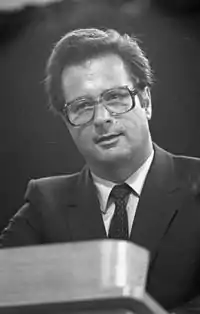
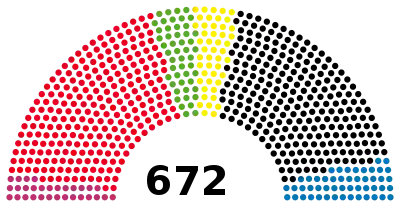
Federal elections were held in Germany on 16 October 1994 to elect the members of the 13th Bundestag. The CDU/CSU alliance led by Helmut Kohl remained the largest faction in parliament, with Kohl remaining Chancellor. This elected Bundestag was largest in history until 2017, numbering 672 members.
 | ||||||||||||||||||||||||||||||||||||||||||||||||||||||||||||||||||||
All 672 seats in the Bundestag 337 seats needed for a majority | ||||||||||||||||||||||||||||||||||||||||||||||||||||||||||||||||||||
|---|---|---|---|---|---|---|---|---|---|---|---|---|---|---|---|---|---|---|---|---|---|---|---|---|---|---|---|---|---|---|---|---|---|---|---|---|---|---|---|---|---|---|---|---|---|---|---|---|---|---|---|---|---|---|---|---|---|---|---|---|---|---|---|---|---|---|---|---|
| Registered | 60,452,009  0.0% 0.0% | |||||||||||||||||||||||||||||||||||||||||||||||||||||||||||||||||||
| Turnout | 47,737,999 (79.0%) 1.2pp | |||||||||||||||||||||||||||||||||||||||||||||||||||||||||||||||||||
| ||||||||||||||||||||||||||||||||||||||||||||||||||||||||||||||||||||
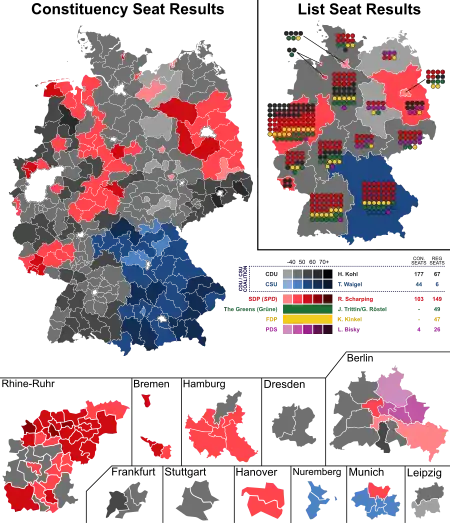 The left side shows constituency winners of the election by their party colours. The right side shows party list winners of the election for the additional members by their party colours. | ||||||||||||||||||||||||||||||||||||||||||||||||||||||||||||||||||||
| ||||||||||||||||||||||||||||||||||||||||||||||||||||||||||||||||||||
_cropped.jpg.webp)
.jpg.webp)

 |
|---|
|
Issues and campaign
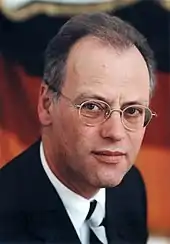
The SPD let its members elect a candidate for Chancellor against Helmut Kohl. Rudolf Scharping, Minister-President of Rhineland-Palatinate, beat Gerhard Schröder and Heidemarie Wieczorek-Zeul in the SPD's internal election. Tension between Scharping and other SPD leaders such as Oskar Lafontaine and Gerhard Schröder hampered his campaign. For the first time in their existence, Alliance 90/The Greens seemed to be willing to join a government in case a centre-left SPD–Greens coalition had a workable majority in the Bundestag.
The election also saw a "red socks" campaign used by the centre-right, including the CDU/CSU and the Free Democratic Party (FDP), to scare off a possible red–red–green coalition (SPD–PDS–Greens). Analysts have stated that such a strategy likely paid off, as it was seen as one of the decisive elements for the narrow victory of Kohl for the CDU/CSU–FDP. The campaign was criticized as an obvious attempt to discredit the whole political left; the PDS reinterpreted it for itself by printing red socks.[1]
Results
 | ||||||||||||||||
| Parties | Constituency | Party list | Total seats | |||||||||||||
|---|---|---|---|---|---|---|---|---|---|---|---|---|---|---|---|---|
| Votes | % | +/− | Seats | +/− | Votes | % | +/− | Seats | +/− | Seats | +/− | % | ||||
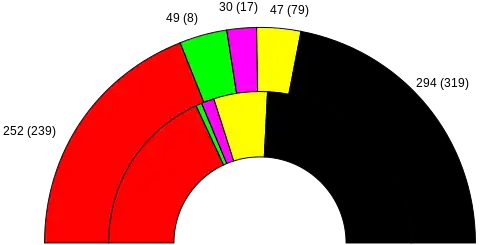
| Social Democratic Party (SPD) | 17,966,813 | 38.3 | +3.1 | 103 | +12 | 17,140,354 | 36.4 | +2.9 | 149 | +1 | 252 | +13 | 37.5 | |||
| Christian Democratic Union (CDU)a | 17,473,325 | 37.2 | −1.1 | 177 | −15 | 16,089,960 | 34.2 | −2.5 | 67 | −9 | 244 | −24 | 36.3 | |||
| Christian Social Union (CSU)a | 3,657,627 | 7.8 | +0.4 | 44 | +1 | 3,427,196 | 7.3 | +0.2 | 6 | −2 | 50 | −1 | 7.4 | |||
| Alliance 90/The Greens (GRÜNE)b | 3,037,902 | 6.5 | +0.9 | 0 | 0 | 3,424,315 | 7.3 | +2.3 | 49 | +41 | 49 | +41 | 7.3 | |||
| Free Democratic Party (FDP) | 1,558,185 | 3.3 | −4.5 | 0 | −1 | 3,258,407 | 6.9 | −4.1 | 47 | −31 | 47 | −32 | 7.0 | |||
| Party of Democratic Socialism (PDS) | 1,920,420 | 4.1 | +1.8 | 4 | +3 | 2,066,176 | 4.4 | +2.0 | 26 | +10 | 30 | +13 | 4.5 | |||
| The Republicans (REP) | 787,757 | 1.7 | 0.0 | 0 | 0 | 875,239 | 1.9 | −0.2 | 0 | 0 | 0 | 0 | 0.0 | |||
| The Grays – Gray Panthers (GRAUE) | 178,450 | 0.4 | −0.1 | 0 | 0 | 238,642 | 0.5 | −0.3 | 0 | 0 | 0 | 0 | 0.0 | |||
| Ecological Democratic Party (ÖDP) | 200,138 | 0.4 | −0.1 | 0 | 0 | 183,715 | 0.4 | 0.0 | 0 | 0 | 0 | 0 | 0.0 | |||
| Natural Law Party (Naturgesetz) | 59,087 | 0.1 | New | 0 | New | 73,193 | 0.2 | New | 0 | New | 0 | New | 0.0 | |||
| Human Environment Animal Protection | – | – | – | – | – | 71,643 | 0.2 | New | 0 | New | 0 | New | 0.0 | |||
| Party of Bible-abiding Christians (PBC) | 26,864 | 0.1 | New | 0 | New | 65,651 | 0.1 | New | 0 | New | 0 | New | 0.0 | |||
| Statt Party (STATT) | 7,927 | 0.0 | New | 0 | New | 63,354 | 0.1 | New | 0 | New | 0 | New | 0.0 | |||
| Bavaria Party (BP) | 3,324 | 0.0 | 0.0 | 0 | 0 | 42,491 | 0.1 | 0.0 | 0 | 0 | 0 | 0 | 0.0 | |||
| Car-drivers' and Citizens' Interests Party (APD) | 1,654 | 0.0 | New | 0 | New | 21,533 | 0.0 | New | 0 | New | 0 | New | 0.0 | |||
| Christian Centre (CM) | 3,559 | 0.0 | 0.0 | 0 | 0 | 19,887 | 0.0 | −0.1 | 0 | 0 | 0 | 0 | 0.0 | |||
| Party of the Willing to Work and Socially Vulnerable (PASS) | 489 | 0.0 | New | 0 | New | 15,040 | 0.0 | New | 0 | New | 0 | New | 0.0 | |||
| Marxist-Leninist Party (MLPD) | 4,932 | 0.0 | 0.0 | 0 | 0 | 10,038 | 0.0 | 0.0 | 0 | 0 | 0 | 0 | 0.0 | |||
| Civil Rights Movement Solidarity (BüSo) | 8,032 | 0.0 | 0.0 | 0 | 0 | 8,103 | 0.0 | 0.0 | 0 | 0 | 0 | 0 | 0.0 | |||
| Christian League (Liga) | 3,788 | 0.0 | 0.0 | 0 | 0 | 5,195 | 0.0 | −0.1 | 0 | 0 | 0 | 0 | 0.0 | |||
| Centre Party (ZENTRUM) | 1,489 | 0.0 | 0.0 | 0 | 0 | 3,757 | 0.0 | 0.0 | 0 | 0 | 0 | 0 | 0.0 | |||
| Federation of Socialist Workers (BSA) | – | – | – | – | – | 1,285 | 0.0 | 0.0 | 0 | 0 | 0 | 0 | 0.0 | |||
| Free Citizens' Union (FBU) | 8,193 | 0.0 | New | 0 | New | – | – | – | – | – | 0 | New | 0.0 | |||
| German Social Union (DSU) | 2,395 | 0.0 | −0.3 | 0 | 0 | – | – | – | – | – | 0 | 0 | 0.0 | |||
| German Communist Party (DKP) | 693 | 0.0 | 0.0 | 0 | 0 | – | – | – | – | – | 0 | 0 | 0.0 | |||
| German People's Party (DVP) | 606 | 0.0 | New | 0 | New | – | – | – | – | – | 0 | New | 0.0 | |||
| Free Social Union (FSU) | 467 | 0.0 | 0.0 | 0 | 0 | – | – | – | – | – | 0 | 0 | 0.0 | |||
| Communist Party of Germany (KPD) | 426 | 0.0 | 0.0 | 0 | 0 | – | – | – | – | – | 0 | 0 | 0.0 | |||
| Independent Workers' Party (UAP) | 302 | 0.0 | 0.0 | 0 | 0 | – | – | – | – | – | 0 | 0 | 0.0 | |||
| Liberal Democrats (LD) | 221 | 0.0 | New | 0 | New | – | – | – | – | – | 0 | New | 0.0 | |||
| Federation for a Complete Germany (BGD) | 107 | 0.0 | New | 0 | New | – | – | – | – | – | 0 | New | 0.0 | |||
| Democrats (DEMOKRATEN) | 104 | 0.0 | New | 0 | New | – | – | – | – | – | 0 | New | 0.0 | |||
| Electoral groups and independents | 34,080 | 0.1 | 0.0 | 0 | 0 | – | – | – | – | – | 0 | 0 | 0.0 | |||
| Valid votes | 46,949,356 | 98.3 | –0.2 | – | – | 47,105,174 | 98.7 | –0.2 | – | – | – | – | – | |||
| Invalid/blank votes | 788,643 | 1.7 | +0.2 | – | – | 632,825 | 1.3 | +1.2 | – | – | – | – | – | |||
| Total votes | 47,737,999 | 100.0 | – | 328 | 0 | 47,737,999 | 100.0 | – | 344 | +10 | 672 | +10 | 100.0 | |||
| Registered voters/turnout | 60,452,009 | 79.0 | +1.2 | – | – | 60,452,009 | 79.0 | +1.2 | – | – | – | – | – | |||
| Source: Bundeswahlleiter | ||||||||||||||||
- ^a — The Christian Democratic Union and the Christian Social Union of Bavaria call themselves sister parties. They do not compete against each other in the same geographical regions and they form one group within the Bundestag.
- ^b — totals for the Greens reflect the merger of the Western and Eastern Green parties.
| 294 | 47 | 252 | 49 | 30 |
| CDU/CSU | FDP | SPD | Grüne | PDS |
Results by state
Second vote (Zweitstimme, or votes for party list)
| State results in % | CDU/CSU | SPD | GRÜNE | FDP | PDS | REP | all others |
|---|---|---|---|---|---|---|---|
 Baden-Württemberg Baden-Württemberg |
43.3 | 30.7 | 9.6 | 9.9 | 0.8 | 3.1 | 2.6 |
.svg.png.webp) Bavaria Bavaria |
51.2 | 29.6 | 6.3 | 6.4 | 0.5 | 2.8 | 3.2 |
 Berlin Berlin |
31.4 | 34.0 | 10.2 | 5.2 | 14.8 | 1.9 | 2.5 |
 Brandenburg Brandenburg |
28.1 | 45.1 | 2.9 | 2.6 | 19.3 | 1.1 | 0.9 |
 Bremen Bremen |
30.2 | 45.5 | 11.1 | 7.2 | 2.7 | 1.7 | 1.6 |
 Hamburg Hamburg |
34.9 | 39.7 | 12.6 | 7.2 | 2.2 | 1.7 | 1.7 |
 Hesse Hesse |
40.7 | 37.2 | 9.3 | 8.1 | 1.1 | 2.4 | 1.2 |
 Mecklenburg-Vorpommern Mecklenburg-Vorpommern |
38.5 | 28.8 | 3.6 | 3.4 | 23.6 | 1.2 | 0.9 |
 Lower Saxony Lower Saxony |
41.3 | 40.6 | 7.1 | 7.7 | 1.0 | 1.2 | 1.1 |
 North Rhine-Westphalia North Rhine-Westphalia |
38.0 | 43.1 | 7.4 | 7.6 | 1.0 | 1.3 | 1.6 |
 Rhineland-Palatinate Rhineland-Palatinate |
43.8 | 39.4 | 6.2 | 6.9 | 0.6 | 1.9 | 1.2 |
 Saarland Saarland |
37.2 | 48.8 | 5.8 | 4.3 | 0.7 | 1.6 | 1.6 |
 Saxony Saxony |
48.0 | 24.3 | 4.8 | 3.8 | 16.7 | 1.4 | 1.0 |
.svg.png.webp) Saxony-Anhalt Saxony-Anhalt |
38.8 | 33.4 | 3.6 | 4.1 | 18.0 | 1.0 | 1.1 |
 Schleswig-Holstein Schleswig-Holstein |
41.5 | 39.6 | 8.3 | 7.4 | 1.1 | 1.0 | 1.1 |
 Thuringia Thuringia |
41.0 | 30.2 | 4.9 | 4.1 | 17.2 | 1.4 | 1.2 |
Post-election
The coalition between the CDU/CSU and the FDP was able to continue in power with Helmut Kohl as chancellor.
The PDS won four constituency seats in its power base of the former East Berlin, qualifying it for proportional representation even though the party won 4.4 percent of the vote, just short of the 5% electoral threshold required for full parliamentary status. Under a longstanding electoral law intended to benefit regional parties, any party that wins at least three constituency seats is entitled to its share of proportionally-elected seats, regardless of vote share.[2]
This was the first time in the history of the Federal Republic that the FDP was not the third largest party in the chamber.
References
 |
Wikimedia Commons has media related to 1994 Germany Bundestagswahl. |
- "German election: Could there soon be a left-wing government?". Deutsche Welle. 24 September 2021. Retrieved 1 October 2021.
- Dan Hough; Michael Koß; Jonathan Olsen (2007). The Left Party in Contemporary German Politics. Springer. ISBN 978-0230592148.
- Combined results of Alliance 90/Green Citizens' Movements and the West German Green Party.
Sources
| Parliamentary elections | |
|---|---|
| Presidential elections | |
| European elections | |
| Referendums | |
| |