Aleksandropol Uyezd
The Alexandropol Uyezd (Russian: Александропольский уезд; Armenian: Ալեքսանդրապոլի գավառ) was a county of the Erivan Governorate of the Caucasus Viceroyalty of the Russian Empire. It bordered the governorate's Echmiadzin and Novobayazet Uyezds to the south, the Borchaly Uyezd of the Tiflis Governorate to the north and east, the Kazakh Uyezd of the Elisabethpol Governorate to the southeast, and the Kars Oblast to the west. It included most of the Shirak Province and southern parts of the Lori Province of present-day northern Armenia. Its administrative center was Alexandropol (Gyumri).[1]
Alexandropol Uyezd
Александропольский уезд | |
|---|---|
.png.webp) Coat of arms | |
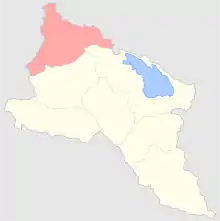 | |
| Country | Russia |
| Political status | Uyezd |
| Region | Caucasus |
| Established | 1849 |
| Abolished | 1918 |
| Area | |
| • Total | 4,278 km2 (1,652 sq mi) |
| Population (1916) | |
| • Total | 226,080 |
| • Density | 53/km2 (140/sq mi) |
History
The district of Alexandropol was established in 1849 as part of the Erivan Governorate of the Caucasus Viceroyalty, owing its name to its principal city Alexandropol which was renamed in 1837 during a visit of Tsar Nicholas I in honor of his wife Alexandra Feodorovna.
Following the Russian Revolution and the signing of the Treaty of Brest-Litovsk, local Armenian forces led by General Tovmas Nazabekian[2] in early 1918 fought to defend Alexandropol and its surrounds against the invading Ottoman Third Army, commanded by General Vehib Pasha.[3] The Treaty of Batum which was imposed on the newly-created Armenian republic stripped it of the Alexandropol Uyezd, assigning the district to the Ottoman Empire,[4] which sought complete control over the city of Alexandropol for its vitally important railway junction connecting to Julfa and Persia where the Ottoman Army was active.[5]
The city including its strategically important fortress and railway was unoccupied after months of occupation by the last Ottoman troops on 5 December 1918, following the Mudros Armistice in which the Ottoman Army was compelled to withdraw from parts of the former Russian Transcaucasus. A notable historian on the topic, Hovannisian, describes the aftermath of the Ottoman occupation:[6]
Rubble filled the streets of Alexandropol as the result of the Turkish decision to detonate the powder and ammunition before the evacuation. This devastation had taken place despite Mehmed Alfa's promise of an orderly withdrawal without looting or irregularities. A share of the spoils was concentrated in the Muslim-populated southern districts of the guberniia, but most of it, thousands of tons of cotton, sugar, and grain, and several hundred thousand animals, was moved toward Kars. The little that might have been missed was picked clean by other Turkish regiments as they passed over Armenia in retreat from North Persia
After Alexandropol and its peripheries had been incorporated into the administration of Armenia, some 60,000 Armenians refugees exiled from the Kars region gathered in the city, sheltering in the old Russian army barracks as they awaited permission to cross the Arpachai river to return to their homes.[7]
During the Armenian-Turkish war, the city was once again occupied by Turkish forces by 7 November 1920, and served as the place of peace negotiations between General Kâzım Karabekir of the Turkish Nationalist forces, and a delegation of the Armenian government led by Prime Minister Simon Vratsian. On 3 December 1920, the eponymous Treaty of Alexandropol was signed, in which Armenia rescinded its claims to lands west of the Akhuryan and Aras Rivers.[8][9]
Administrative Divisions
The Alexandropol Uyezd was split into 4 unnamed contiguous uchastki (subcounties):
- 1-iy
- 2-iy
- 3-iy
- 4-iy
Demographics
Russian Imperial Census of 1897
According to the 1897 Russian Empire Census, the population of the district was 165,503, the overwhelming majority of which were Armenians (85.5%). Minorities included Tatars (modern Azerbaijanis; 4.7%), East Slavs (Russians, Ukrainians, and Belarusians; 4%), Kurds (3%), Greeks (0.6%), and Poles (0.5%).[10] The largest city in the district was Alexandropol, which had a total population of 30,616, of which 21,771 (71%) were Armenians, 5,157 (16.8%) East Slavs, 1,090 (3.5%) Tatars, 921 (3%) Poles, 415 (1%) Jews, 316 (1%) Lithuanians, and 266 (0.8%) Greeks.[11]
Caucasian Calendar of 1917
The 1917 Caucasian Calendar which produced statistics of 1916 indicates 205,617 residents in the Alexandropol Uyezd, including 119,473 men and 106,607 women, 214,044 of whom were the permanent population, and 12,036 were temporary residents.[12]
| Area | Russians | Other
Europeans |
Armenians | Kurds | Other Asian Nationalities | Gypsies | Jews | TOTAL | ||||
|---|---|---|---|---|---|---|---|---|---|---|---|---|
| Orthodox | Sectarian | Muslim | Yezidi | Christian | Shia Muslim | Sunni Muslim | ||||||
| Alexandropol | 4,026 | 56 | 269 | 45,646 | 71 | 229 | 421 | 1,003 | ... | 24 | 129 | 51,874 |
| Rural | 1,562 | 1,744 | 73 | 156,859 | ... | 5,672 | 72 | 6,194 | 1,983 | 22 | 25 | 174,206 |
| TOTAL | 5,588 | 1,800 | 342 | 202,505 | 71 | 5,901 | 493 | 7,197 | 1,983 | 46 | 154 | 226,080 |
| 2.5% | 0.8% | 0.2% | 89.6% | 0.0% | 2.6% | 0.2% | 3.2% | 0.9% | 0.0% | 0.1% | 100.0% | |
References
- Tsutsiev, Arthur (2014). Atlas of the Ethno-Political History of the Caucasus. Translated by Nora Seligman Favorov. New Haven: Yale University Press. p. 59. ISBN 9780300153088.
- Hovannisian, Richard G. (1967). Armenia on the road to independence, 1918. Berkeley: University of California Press. p. 163. ISBN 0-520-00574-0. OCLC 825110.
- Balakian, Peter (2005). The burning Tigris : a history of the Armenian genocide. London: Pimlico. p. 321. ISBN 0-7126-6761-X. OCLC 61128609.
- Kazemzadeh, Firuz (2008). The struggle for Transcaucasia (1917-1921) ([New ed.] ed.). London: Anglo Caspian Press. p. 110. ISBN 978-0-9560004-0-8. OCLC 303046844.
- Kazemzadeh, Firuz (2008). The struggle for Transcaucasia (1917-1921) ([New ed.] ed.). London: Anglo Caspian Press. p. 127. ISBN 978-0-9560004-0-8. OCLC 303046844.
- Hovannisian, Richard G. (1971–1996). The Republic of Armenia. Berkeley: University of California Press. p. 59. ISBN 0-520-01805-2. OCLC 238471.
- Hovannisian, Richard G. (1971–1996). The Republic of Armenia. Berkeley: University of California Press. pp. 199–208. ISBN 0-520-01805-2. OCLC 238471.
- Suny, Ronald Grigor (1993). Looking toward Ararat : Armenia in modern history. Bloomington: Indiana University Press. pp. 130–131. ISBN 0-253-35583-4. OCLC 26014198.
- Galichian, Rouben (2015). A glance into the history of Armenia : through cartographic records. London. p. 68. ISBN 978-1-908755-26-1. OCLC 946068334.
- (in Russian) 1897 Census, Aleksandropol Uyezd Demoscope Weekly
- (in Russian) 1897 Census, Aleksandropol City Archived 2014-10-25 at the Wayback Machine Demoscope Weekly
- Кавказский календарь .... на 1917 год (in Russian). pp. 367–370.
Administrative divisions of the Erivan Governorate | ||
|---|---|---|
| ||
Italics indicates abolished uyezds. | ||