Charles Foulkes (Canadian Army officer)
General Charles Foulkes, CC, CB, CBE, DSO, CD (3 January 1903 – 12 September 1969) was a British-Canadian soldier, and an officer of The Royal Canadian Regiment.
Charles Foulkes | |
|---|---|
.jpg.webp) | |
| Born | 3 January 1903 Stockton-on-Tees, County Durham, England |
| Died | 12 September 1969 (aged 66) Ottawa, Ontario, Canada |
| Allegiance | .svg.png.webp) Canada Canada |
| Service/ |  Canadian Army Canadian Army |
| Years of service | 1926–1960 |
| Rank | General |
| Unit | The Royal Canadian Regiment |
| Commands held | Chief of the General Staff Chairman of the Chiefs of Staff I Canadian Corps 2nd Canadian Infantry Division 3rd Canadian Infantry Brigade |
| Battles/wars | World War II |
| Awards | Companion of the Order of Canada Companion of the Order of the Bath Commander of the Order of the British Empire Distinguished Service Order Canadian Forces Decoration Commander of the Legion of Honour (France) |
Military career
Foulkes was born in Stockton-on-Tees, England and joined the Canadian Army in 1926.[1] In 1937 he attended the Staff College in Camberley, England.[1]
In 1939, Foulkes was serving as a major with the 3rd Brigade of the 1st Canadian Infantry Division.[1] He went on to be a General Staff Officer with 3rd Canadian Infantry Division.[1] After serving as a Brigade Commander from August 1942, he was appointed General Officer Commanding 2nd Canadian Infantry Division in January 1944 and led the division through the Normandy Campaign.[1] In November 1944 he was made General Officer Commanding I Canadian Corps in Italy.[1]
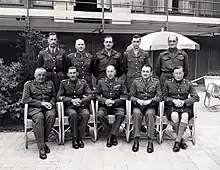
On 4 May 1945, south of Hamburg, Field Marshal Sir Bernard Law Montgomery accepted the unconditional surrender of the German forces in the Netherlands, northwest Germany including all islands, in Denmark and all naval ships in those areas. The surrender preceded the end of World War II in Europe and was signed in a carpeted tent at Montgomery's headquarters on the Timeloberg hill at Wendisch Evern.
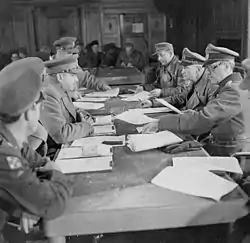
On 5 May 1945, Foulkes summoned German General Blaskowitz to the Hotel de Wereld in Wageningen to discuss the surrender of German forces in the Netherlands. His Royal Highness Prince Bernhard, acting as commander in chief of the Dutch Interior Forces, attended the meeting as well. Blaskowitz agreed with all of the proposals made by Foulkes. However, nowhere in the building – some sources claim: nowhere in the whole town – could a typewriter be found. Thus the surrender document could not be typed. The next day, May 6, both parties returned, and in the presence of both General Foulkes and Prince Bernhard, Blaskowitz signed the surrender document which in the meantime had been typed.[2]
After the war, Foulkes was appointed Chief of the General Staff and, in 1951, the first Chairman of the Chiefs of Staff.[1] He retired in 1960.[1]
In 1968 he was made a Companion of the Order of Canada. He taught at Carleton University in 1968 and 1969.[3] He died in Ottawa in 1969.
His medals and other personal artifacts are on display at the Royal Canadian Regiment Museum in London, Ontario. He was awarded the Honorary degree of Doctor of Laws (LL.D) from the University of Western Ontario on 11 June 1947.[4]
References
- Juno Beach Centre Biography
- Monument Wageningen
- "Archived copy". Archived from the original on 12 November 2012. Retrieved 2012-11-04.CS1 maint: archived copy as title (link)
- "Honorary Degrees" (PDF). University of Western Ontario.
Bibliography
- Delaney, Douglas E. (2011). Corps Commanders: Five British and Canadian Generals at War, 1939–45. Vancouver: UBC Press. ISBN 9780774820905.
- Granatstein, Jack (2005). The Generals. University of Calgary Press. ISBN 978-1-55238-176-2.
External links
|

.svg.png.webp)








Authority control  | |
|---|---|
| General | |
| National libraries | |
| Other | |