Clonmacnoise Crozier
The Clonmacnoise Crozier is a late 11th century Insular crozier associated with the 6th century Clonmacnoise monastery, an important but now ruined ecclesiastical complex south of located Athlone, on the River Shannon in County Offaly, Ireland. Traditionally associated with St. Ciarán of Clonmacnoise (c. 516 – c. 549),[1] the crozier is thought to have been commissioned by Tigernach Ua Braín (abbot of Clonmacnoise, d. 1088), but this is uncertain.
| Clonmacnoise Crozier | |
|---|---|
.jpg.webp) Upper half of the Clonmacnoise Crozier, with the Cross of Cong in view | |
| Material | Wood, copper-alloy, silver, niello, glass and enamel |
| Size | Height: 97 cm (38.2 in) width (maximum): 13.5 cm (5.2 in) |
| Created | Late 11th century refurbished in the late 14th or early 15th centuries |
| Discovered | Late 18th century? |
| Present location | National Museum of Ireland, Kildare Street, Dublin |
| Identification | R 2988 |
It was built in two phases: the early 11th century structure was refurbished and added-to in the late 14th or early 15th centuries. The staff is made from a wooden core lined with copper-alloy tubes that are fixed in place by binding strips and three knops. The hook was concurrently but separately constructed before it was fixed on top of the staff. The decorative attachments including the crest, drop-plate, knopes and ferrule are made from niello, glass, enamel and silver. The hook is embillished with round blue glass studs and white and red millefiori (glassware) insets. The crozier bears a number of Viking art influences, especially the snake-like animals in figure-of-eight patterns running on the sides of the body of the crook, and the line of dog-like animals forming a ribbon at its top.
Fully intact and will little damage, it is one of the best preserved of the surviving Insular croziers. Rediscovered under uncertain circumstances in the late 18th century, it has been in the collection of the Kildare Street branch of the National Museum of Ireland, Dublinsince the late 19th century. An replica dated to the early-20th century is in the Met Cloisters in New York.
Origin and dating
Some early accounts, beginning with the Irish antiquarian George Petrie, place the find-spot as in the "Temple Ciarán" (the tomb of St. Ciarán of Clonmacnoise d. c. 549) at his monastery in Clonmacnoise, County Offaly, along with a hoard including a chalice, a wine vessel and perhaps an arm-shrine, all of which would had been deposited at the burial site centuries after the saint had died. Centuries after his death, Ciarán is recorded as appearing "to smite a would-be raider with his crozier",[2] and writing in 1891, the antiquarian William Frazer said that the crozier was probably "revered as [containing] a genuine relic of St. Ciaran".[3]
While there is no surviving archaeological or documentary evidence to back Petrie's account of the discovery,[3][4] the crozier's style and production techniques closely resembles two other contemporary fragmentary croziers; the so called "Frazer crozier-head" and a crosier-knop in the British Museum, both of which have been linked to Clonmacnoise.[5]

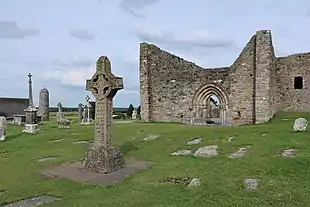
Clonmacnoise was founded in 544 by Saint Ciarán and is also the location where the Stowe Missal was discovered.[7] It is located in the ancient territory of Ui Maine at a point where a major east-west land route and political division (the Slighe Mhor) meets the River Shannon. The strategic location of the monastery helped it become a major center of religion, learning, craftsmanship and trade by the 9th century and many of the high kings of Tara (Ard Rí) and of Connacht were buried here.[8] Clonmacnoise was largely abandoned by the end of the 13th century. Today the site includes nine ruined churches, a castle, two round towers and a large number of carved stone crosses and cross-slabs.[9]
Like all contemporary European examples, the Clonmacnoise Crozier is formed as a shepherd's crook, an analogy based on the tradition of Jesus as the Good Shepherd. Typical of medieval insular croziers produced between c. 800 and 1200, it can be distinguished from mainland European types by its curved crook and drop.[10] During this period, such croziers were symbols of office and status for bishops and abbots.[11] The croziers were long associated with saints, and many were thought to have held relics. According to historian Anthony Lucas, the croziers acted as "the principle vehicle of [the saint's] power, a kind of spiritual electrode through which he conveyed the holy energy by which he wrought the innumerable miracles attributed to him".[12]
Some art historians have noted the resemblance its design to late 11th century additions to the Bell Shrine of St. Cuileáin and the early 12th century Shrine of Saint Lachtin's Arm, and suggest it may originate from Dublin, although this is not widely accepted.[7] If the dating, in part based on its stylistic resemblance to these objects, is accepted, it places the crozier at the end of the early medieval period of Insular art, and is thus described by the archaeologist and art historian Griffin Murray as having Romanesque influences.[13]
Description
The crozier is 97 cm (38 in) long (about the length of a walking stick), 13.5 cm (5.3 in) high and has a maximum width of 15.5 cm (6.1 in).[14] It is formed from a wooden core overlaid by metal tubes. The metal casing is attached by binding strips connected to each other by three knops. A ferrule is attached on the base of the shaft. The crook is placed above the shaft, and is fitted with a crest and drop-plate.[15]
It was built in two phases: an early 11th century structure that was added-to and refurbished in the 14th century, with the main later addition being the figures in the drop.[16] Many of the decorations and patterns are influenced by the late 10th and early 11th century Ringerike style of Viking art, characterised by band-shaped animals (often snakes, dogs and birds), acanthus-leaf foliage, crosses and spirals. The art historian Rachel Moss describes the crozier as among the finest of the Irish Ringerike influenced objects, along with the Shrine of Miosach and the Cathach of St. Columba (both 11th century cumdachs).[17][18]
Crook
.jpg.webp)
The crook is hollow and made from a single piece of wood, onto which a number of plates were attached with long rivets, including those for the crest, drop-plate and a strip to hold the inner binding.[19][20]
Its sides are lined with sliver cast rows of tightly bound zoomorphic and interlace snakes, depicted as ribbon-like as per the Ringerike style,[21] and have spiral patterns at their terminals.[16] The borders of the cook are lined with strips of niello,[16] while the main, and most visable, parts of the crook's shaft contain figure-of-eight snake-like animals with ribbon shaped bodies, also in the Ringerike style.[19][22][23]
The largely openwork crest ling the top of the hook is attached by rivets. There are depictions of animal heads at either side of the base. The figures on the back are larger, rendered in high-relief, and have downward looking faces.[24] These figures are displayed in a row of five crouched dog-like animals scaling the long end of the crook, seeming positioned end-to-end, "gripping" from mouth-to-tail,[24] or, in the words of the art historian Máire de Paor "each grasping with its jaws the buttocks of the preceding animal".[16] The animals at the lower part of the row are damaged, with some parts missing.[2][24]
Both the front and reverse of the lower portion of the crook contain a number of grotesque animal heads in the late 11th century Urnes style of Viking art. The heads form a band resembling acanthus leaves and are decorated with ribbons and sliver wire set in niello.[16]
Drop-plate
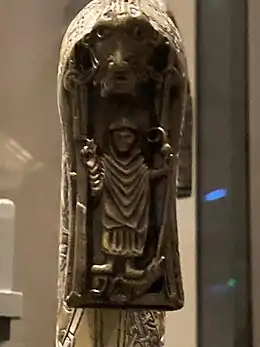
The drop-plate (the hollow box-like extension at the end of the crook)[25] has a metal cast plaque in champlevé enamel depicting a grotesque and looming animal head, that may be a dragon.[21][26] Below this, set into a cavity, is a figure added in the 14th century, who appears to be a bishop or cleric wearing a mitre. He has one hand raised in blessing while the other holds a long staff that impaling an animal at his feet.[16] De Paor describes the cleric a generic late-period Insular figure with "pierced eyes, small ears, a large nose, and [a] heavy mustache and beard".[16]
The placement of human figures seems likely influenced by the much earlier Prosperous Crozier.[27] The onmly other surviving example ornamented with human figures is the River Laune Croziers; presumably others did too, but they were severely damaged or removed.[14]
_Crozier_Drop.jpg.webp)
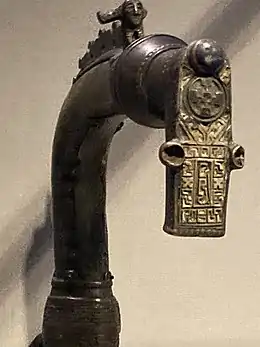
As the most visible portion of the of the crosier when help up, the drops were thus the obvious focus point for figurative art which is otherwise almost entirely absent from Insular metalwork. This lead to the 19th and early 20th century theories that the drops acted as containers for relics of saints, however there is as yet no known evidence for this.[n 1][10][30]
Shaft
The crozier is formed from a tubular wooden core making up the length of the staff, plated with copper shafts. The tubing was originally sealed by two binding strips on the front, which were probably of leather, but are now lost.[13][24] Three copper alloy metal knopes, decorated with copper-alloy openwork, relief metal-work and inserted metal plates, are riveted to the shaft.[21]
The shaft's wood does not extend into the crook.[31] It is of equal width until the mid-point, after which it narrows until tapering off below the lowest knope.[32]
Knopes and ferrule
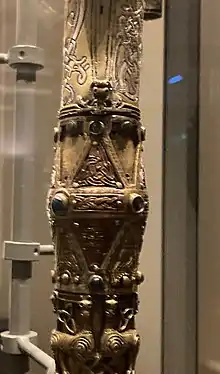
The staff is held together by the three large and ornately decorated knopes which are fastened by rivets to the shaft plates. Each contains chased copper-alloy plates, a feature only otherwise found on the Prosperous Crozier.[27]
The largest and upper-most knope contains a 7.5 cm crest which has been trimmed to hold the base of the crook.[24] This upper knope has a central, horizontal band of interlace patterns, with champlevé enameling containing geometric and foliage patterns.[32] A collar below the upper knope is made of copper-alloy and contains relief designs of two large cat-like animals facing each other.[24] They have upright ears and necks, while their front paws and decorated with niello and inlaid sliver, and intertwine with each other.[32]
The central knope is barrel-shaped and less decorated than the other two, but has inlay bands and silver lining.[32]
Like upper knope, the lower knope is biconical (ie of two parts) and also contain crests and blue studs formed from glass.[32] Below this the shaft tapers (narrows) and passes through a ferrule (or metal-cast foot) before forming the basal point.[32]
Unusually, the origional ferrule remains intact. Unlike the other two Insular examples with surviving ferrules (Lismore, River Laurne) both of which have more more elaborate and complex endings) it is not cast into the lower knop, but is instead is a separate piece, and contains an openwork section and three legs[13]
Condition
In a 2004 survey, the Clonmacnoise Crozier was one of an estimated twenty (or fewer) fully intact surviving insular croziers, in addition to some sixty fragments that Murray described as "in various states of preservation...from near-complete examples...to...fragments".[10][33][34]
Although it has suffered some losses, damage and detrimental repair-work, it is in overall excelled condition.[21] The origional drop-plate has been lost, with the current drop thought to date from the late 14th or early 15th centuries.[21][26] The wood at the end the crest on the crook is damaged, likely it decayed due to one of the rivets being exposed, and its loss lead to further damage to the crest itself.[35]
It retains number of unique features in Insular croziers; it has the origional ferrule, and along with that found on the river Laune, its medieval drop.
Modern provenance
.jpg.webp)
The location and year of the re-discovery of the crozier is uncertain. Writing in 1821, Petrie said that it had been discovered "some 30 years ago...[in] the tomb of St. Ciaran", placing its finding c. 1790.[36] According to Frazer other objects in the find, including a chalice and wine vessel, "fell into ignorant hands, and were probably deemed unworthy of preservation", with the precious metal sold for its intrinsic value.[3]
The crozier was for a period in the collection of the British diplomat, Lord Mayor of Dublin and collector Henry Charles Sirr (1764–1841),[37] however the circumstances of his purchase are largely unknown.[5] In 1826 a lithograph of its crook was reproduced in Robert O’Callaghan Newenham's book "Picturesque views of the antiquities of Ireland", where it was described as having been "dug up 100 years ago".[37] That claim seems doubtful as it is in generally good condition, indicating that it did not spend prolonged time buried under earth.[38]
It is today in the collection of the archaeology branch of the National Museum of Ireland in Dublin, where it is catalogued as R 2988[39] and on permanent display in the "Treasury Room", next to the Lismore and River Laune Croziers. An early-20th century replica is in the Met Cloisters in New York.[40]
A second, much smaller crozier fragment (mostly a hook, of which two thirds was replaced in the late medieval period, but with some of the upper staff intact) is also at the NMI. Known as the "Frazer Closier" and sometimes also associated with Clonmacnoise, it has a rather less uncertain modern provenance, and is held under the catalogue number NMI 1899:28.[41]
References
Notes
- The exception is the Lismore Crozier, where two small relics and a linen cloth were found inside the crook during a 1966 refurbishment. See Murray (2007), p. 86
Citations
- Frazer (1891), pp. 206–214
- O'Toole, Fintan. "A history of Ireland in 100 objects Clonmacnoise crozier, 11th century". The Irish Times, 10 December 2011. Retrieved 23 November 2021
- Frazer (1891), p. 210
- Murray (2021), p. 10
- Murray (2021), p. 18
- Byrne (1973), p. 91
- Moss (2014), p. 314
- Moss (2014), p. 126
- Moss (2014), pp. 126–127
- Murray (2004), p. 24
- Murray (2004), p. 27
- Lucas (1986), p. 29
- Murray (2007), p. 88
- Murray (2007), p. 83
- Murray (2007), p. 79
- De Paor (1977), p. 185
- Moss (2014), 44
- Laing (2006), p. 186
- Wallace (2002), p. 220
- Murray (2007), p. 90
- Murray (2021), p. 3
- Bourke (1985), p. 151
- Ellis, Caitlin. "Vikings didn’t just murder monks and pillage monasteries – they helped spread Christianity too". The Conversation, 23 December 2019. Retrieved 23 November 2021
- Murray (2021), p. 6
- Youngs (1989), p. 214
- Ó Floinn (1983), p. 166
- Thickpenny (2020), p. 55
- Bourke; Hook (2017), p. 136
- Murray (2010), p. 50
- Murray (2007), p. 85
- Henry (1959-63), p. 9
- De Paor (1977), p. 186
- Moss (2014), p. 310
- Murray (2007), p. 82
- Henry (1959-63), p. 10
- Henry (1959-63), p. 6
- Murray (2021), p. 11
- Murray (2021), p. 12
- "Dáil Éireann debate: Tuesday, 18 Oct 1977". Houses of the Oireachtas, 18 October 1977. Retrieved 19 September 2021
- "Crozier of Clonmacnoise, early 20th century, Irish". Metropolitan Museum of Art. Retrieved 23 November 2021
- Murray (2021), p. 6
Sources
- Bourke, Cormac. "A Crozier and Bell from Inishmurray and Their Place in Ninth-Century Irish Archaeology". Proceedings of the Royal Irish Academy: Archaeology, Culture, History, Literature. Dublin: Royal Irish Academy, volume 85C, 1985. JSTOR 25506128
- Byrne, Francis John. Irish Kings and High-Kings. London: Batsford, 1973. ISBN 978-0-7134-5882-4
- De Paor, Máire. "The Viking Impact". In: Treasures of early Irish art, 1500 B.C. to 1500 A.D: From the collections of the National Museum of Ireland, Royal Irish Academy, Trinity College Dublin. NY: Metropolitan Museum of Art, 1977. ISBN 978-0-8709-9164-6
- Downham, Clare. Medieval Ireland. Cambridge: Cambridge University Press, 2017. ISBN 978-1-1076-5165-4
- Frazer, William. "On an Irish Crozier, with Early Metal Crook, Probably the Missing Crozier of St. Ciaran of Clonmacnoise". Proceedings of the Royal Irish Academy, volume 1 1889-1891. JSTOR 20503841
- Hahn, Cynthia. "The Reliquary Effect: Enshrining the Sacred Object". London: Reaktion Books, 2016. ISBN 978-1-7802-3655-1
- Henry, Françoise. "Research notes and sketches relating to the Clonmacnoise Crozier (Papers of Françoise Henry (d.1982)". University College Dublin, 1959-1963.
- Moss, Rachel. Medieval c. 400—c. 1600: Art and Architecture of Ireland. London: Yale University Press, 2014. ISBN 978-0-3001-7919-4
- Ó Floinn, Raghnal. "The Clonmacnoise crozier". In: Ryan, Michael (ed.), Treasures of Ireland: Irish art 3000 B.C.—1500 A.D.". Dublin: Royal Irish Academy, 1983. ISBN 978-0-9017-1447-3
- O'Meadhra, Uaininn. "Copies or creations? Some shared elements in Hiberno-Norse and Scandinavian artwork". In: Clarke, Howard; Johnson, Ruth (eds.), The Vikings in Ireland and Beyond: Before and After the Battle of Clontarf. Dublin: Four Courts Press, 2015. ISBN 978-1-8468-2495-1
- Laing, Lloyd. The Archaeology of Celtic Britain and Ireland: c.AD 400—1200. Cambridge: Cambridge University Press, 2006. ISBN 978-0-5218-3862-7
- Lucas, Anthony. "The Social Role of Relics and Reliquaries in Ancient Ireland". The Journal of the Royal Society of Antiquaries of Ireland, volume 116, 1986. JSTOR 25508904
- Murray, Griffin. "The history and provenance of two early medieval crosiers ascribed to Clonmacnoise". Dublin: Proceedings of the Royal Irish Academy: Archaeology, Culture, History, Literature, February 2021
- Murray, Griffin. "Insular-type crosiers: their construction and characteristics". Making and Meaning in Insular Art: Proceedings of the Fifth International Conference on Insular Art, 2007
- Murray, Griffin. "The 'Hidden Power' of the Irish Crosier". Archaeology Ireland, volume 18, no. 1, Spring 2004. JSTOR 20562731
- Thickpenny, Cynthia; Forsyth, Katherine; Geddes, Jane (eds). "Peopling Insular Art: Practice, Performance, Perception". London: Oxbow Books, 2021. ISBN 978-1-7892-5457-0
- Wallace, Patrick. "Viking Age Ireland, AD 850–1150". In Ó Floinn, Raghnal; Wallace, Patrick (eds). Treasures of the National Museum of Ireland: Irish Antiquities. Dublin: National Museum of Ireland, 2002. ISBN 978-0-7171-2829-7
- Youngs, Susan. The Work of Angels: Masterpieces of Celtic Metalwork, 6th—9th centuries AD. London: British Museum Press, 1989. ISBN 978-0-7141-0554-3
External links
 |
Wikimedia Commons has media related to Crozier of Clonmacnoise. |
- Viking Ireland 5: Legacy of the Vikings in Ireland, National Museum of Ireland – Archaeology
| Irish |
| |
|---|---|---|
| Scottish |
| |
| Related | ||