Rogart Brooch
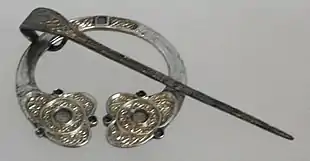
The Rogart Brooch is a large penannular brooch of Pictish origin, dated to the eighth century AD – the term "penannular" refers to the fact that the ring of its head contains a gap or opening.[2] It measures 12cm (head width) x 19.3cm (pin length) and characteristic of contemporary Pictish brooches, contains three-dimensional (ie high-relief) bird-head inserts formed with glass.[3]
| Rogart Brooch | |
|---|---|
.jpg.webp) | |
| Material | Silver, plated with gold, glass, amber |
| Size | head (diameter): 12cm, pin (length) 19.3cm, 1.4g |
| Period/culture | 8th century |
| Place | Rogart, Sutherland, Scotland |
| Present location | National Museum of Scotland |
| Identification | NMS FC2[1] |
The brooch was rediscovered as part of a larger 8th century hoard f brooches during railroad excavations (ie "blasting") in 1868 at Rogart, Sutherland, in Scotland.[4][5][6] It is held in the collection of the National Museum of Scotland (NMS) in Edinburgh, where it is on permeant display.
Description
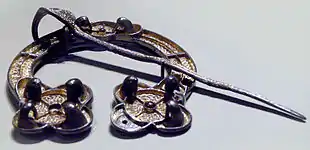
The brooch is made from a flat band of sliver decorated with carved and alternating interlace patterns some of which are in gold,[7] and a head that is a quarter inch thick. The hoop is divided into four quadrants, each of which is decorated with interlace.[8]
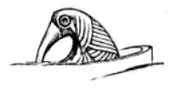
The bird-heads are rendered in full-relief (ie raised) and all inwards facing, fixed with rivets and lined with gold and given narrow eyes made from green glass.[8] They are placed both on the upper band of the ring and the quadrants of the two lozenge shaped semi-circular terminals.[8][9] These two terminals are c. an inch apart, and separated from both the ring-head and each other by raised borders lined with gold.[10]
The brooch is in relatively good condition; some of the settings for red glass and amber decorative studs in the head and terminals are missing. Its reverse is rather flat and unembellished.[8]
Find
The Rogart hoard of brooches was unearthed 1868 during rock-blasting in Rogart for the Sutherland railway line, when a workman found the collection of brooches in earth uncovered by the removal of a large boulder. Although the number in at the time place is unknown, two were passed on (the workman astutely gathered his findings and immediately took them from his workplace), via a store keeper in Alness, to a Mr. Macleod of Cadbeoll, who in 1870 displayed them to the Society of Antiquaries of Scotland.[4]
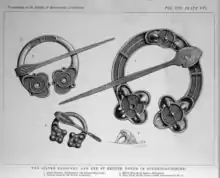
Both (NMS FC1 & NMS FC2) are now at the National Museum of Scotland. The smaller brooch –NMS FC1– is of bronze and in poor condition having lost all its glass studs.[8][11] A third brooch from the find went to the collection of the then Duke of Sutherland and later to Dunrobin Castle.[4]
References
- Youngs (1989), p. 156
- Youngs (1989), p. 215
- Youngs (1989), p. 108
- Anderson (1881), p. 6
- Finlay (1999), p. 15
- The hoard also included a smaller brooch (MNS FC1), also on the NMS (width: 7.7 cm x length:13.3 cm).
- Anderson (1881), p. 7
- Youngs (1989), p. 116
- Antiquaries of Scotland (1882), p. 493
- Anderson (1881), p. 8
- "The Rogart Brooch". Rogart Heritage Society. Retrieved 19 November 2021
Sources
- Anderson, Joseph. "Scotland In Early Christian Times (Second Series)". The Rhind Lectures in Archaeology for 1880. Edinburgh: David Douglas, 1881
- Finlay, Ian. "Scottish Gold and Silver Work". Firebird Press, 1999. ISBN 978-1-5655-4559-5
- Laing, Lloyd Robert. The archaeology of late Celtic Britain and Ireland, c. 400–1200 AD. Taylor & Francis, 1975. ISBN 978-0-416-82360-8
- "Proceedings of the Society of Antiquaries of Scotland". Society of Antiquaries of Scotland, 1882
- Youngs, Susan (ed). "The Work of Angels": Masterpieces of Celtic Metalwork, 6th—9th centuries AD. London: British Museum Press, 1989. ISBN 0-7141-0554-6
External links
- Catalog entry, National Museums Scotland
| Extant |
| .jpg.webp) |
|---|---|---|
| Styles | ||
| Collections | ||