Earth Resources Satellite
The Earth Resources Satellite (ERS, alternatively Environmental Research Satellite) program was a series of scientific microsatellites operated by the United States Air Force Office of Aerospace Research. They were designed to attach to other satellites during launch and detach once in orbit.[1] They were used as a test bed to investigate the reliability of new spacecraft components.[2]
Design
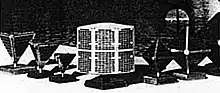
ERS satellites generally did not have batteries; instead, all sides were covered in solar cells.[2] They came in two shapes: tetrahedral (the TRS family) and octahedral (the ORS family). They were all built by TRW Inc..
TRS Mk. 1
The TRS Mk. 1 design was a tetrahedron measuring 16 cm on a side. Ten were produced: TRS-1 through TRS-10 (ERS-1 through ERS-10). [3] Several satellites in this series investigated the Van Allen belt, particularly the effects of its radiation on spacecraft power systems.[4]
TRS Mk. 2
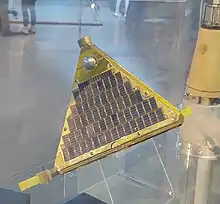
The TRS Mk. 2 design was a tetrahedron measuring 21 cm on a side. Four were produced: ERS-11 through ERS-14, though only two were launched. [5]
ORS Mk. 2
The ORS Mk. 2 design was an octahedron measuring 23 cm on a side. Five were produced: ORS-1 and ORS-2 (ERS-15 through ERS-16) and ERS-23 through ERS-25. [6]
ORS Mk. 3
The ORS Mk. 3 design was an octahedron measuring 28 cm on a side. Two were produced: ORS-3 and ORS-4 (ERS-17 and ERS-18).[7]
OV5
The design of the OV5 (Orbiting Vehicle 5) series was based on the ORS Mk. 3 design and its vehicles were also given ERS numbers. Nine were produced: OV5-1 through OV5-9.[8]
TETR
TETR (also known as TTR and TATS, all standing for "Test and Training Satellite") was a series of octahedral ERS satellites which were built to train Apollo program ground station crews for the Manned Space Flight Network[9]. Four were produced: TTR-1 through TTR-4 (ERS-30 through ERS-33)[10] TETR 2 supported training for Apollo missions 8 through 13 despite a faulty battery pack. TETR C failed to orbit due to a failure in the launch vehicle. [11]
References
- "Satellite, TRS II, Prototype | National Air and Space Museum". airandspace.si.edu. Smithsonian National Air and Space Museum. Retrieved 8 November 2021.
- Wade, Mark. "ERS". www.astronautix.com. Retrieved 8 November 2021.
- Krebs, Gunter D. "TRS Mk. 1 (ERS)". Gunter's Space Page. Retrieved 25 October 2021.
- NASA Historical Staff (1964). Astronautics and Aeronautics, 1963: Chronology on Science, Technology, and Policy (PDF). National Aeronautics and Space Administration. pp. 189, 346. Retrieved 2 November 2021.
- Krebs, Gunter D. "TRS Mk. 2 (ERS)". Gunter's Space Page. Retrieved 25 October 2021.
- Krebs, Gunter D. "ORS Mk.2 (ERS)". Gunter's Space Page. Retrieved 25 October 2021.
- Krebs, Gunter D. "ORS Mk.3 (ERS)". Gunter's Space Page. Retrieved 25 October 2021.
- Krebs, Gunter D. "OV5 (ERS)". Gunter's Space Page. Retrieved 25 October 2021.
- Ezell, Linda Neuman (1988). NASA Historical Data Book: Programs and projects, 1969-1978. Scientific and Technical Information Division, National Aeronautics and Space Administration. p. 402.
- Krebs, Gunter D. "TTS, TETR (ERS)". Gunter's Space Page. Retrieved 26 October 2021.
- "TETR-2 Is Successful Despite Faulty Battery Pack" (PDF). Technical Information Bulletin: The Manned Spaceflight Network. 8 (3). 26 February 1971. Retrieved 13 December 2021.