Eurovision Song Contest 1956
The Eurovision Song Contest 1956 was the very first edition of the annual Eurovision Song Contest. It took place in Lugano, Switzerland and was organised by the European Broadcasting Union (EBU) and host broadcaster Radiotelevisione svizzera di lingua italiana (RTSI). The inaugural contest was held at the Teatro Kursaal on Thursday 24 May 1956 and was hosted by Swiss television presenter Lohengrin Filipello. As noted in The Eurovision Song Contest — The Official History by author and historian John Kennedy O'Connor, Filipello was the only male presenter to host the competition until Léon Zitrone was co-presenter in the 1978 edition. Filipello also has the distinction as the only man who has hosted the contest by himself.
| Eurovision Song Contest 1956 | |
|---|---|
 | |
| Dates | |
| Final | 24 May 1956 |
| Host | |
| Venue | Teatro Kursaal Lugano, Switzerland |
| Presenter(s) | Lohengrin Filipello |
| Musical director | Fernando Paggi |
| Directed by | Franco Marazzi |
| Executive supervisor | Rolf Liebermann |
| Host broadcaster | Radiotelevisione svizzera di lingua italiana (RTSI) |
| Interval act | Les Joyeux Rossignols & Les Trois Ménestrels |
| Website | eurovision |
| Participants | |
| Number of entries | 14 (7 countries performed 2 songs each) |
| Debuting countries | |
Participation map
| |
| Vote | |
| Voting system | Two-member juries from each country, each member individually awarded points; the voting method is uncertain. |
| Winning song |  Switzerland Switzerland"Refrain" |
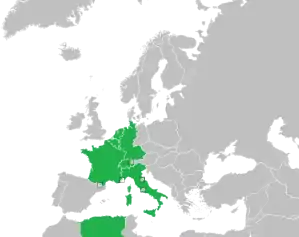
Seven countries participated in the competition, with each of them performing two songs. Two jury members from all participating countries cast their votes in secret, based on which song was their favourite.
The winner of the contest was the host country Switzerland with the song "Refrain" by Lys Assia, making her the first ever winner of the contest. Only the winner was announced, the results of the remaining countries have never been published. No complete audio or video recording of the actual contest is known to have survived.
The pan-European music competition was inspired by the Italian Sanremo Music Festival. The first contest lasted approximately 1 hour and 40 minutes. This first edition included several procedures that were not repeated in any subsequent edition: Two songs for each country, secret voting, double voting of one country on behalf of another, optional inclusion of the jury members' own represented country in their voting and only "Grand Prix" title reception for the winner.
Background
During a meeting in Monaco in 1955, members of the European Broadcasting Union discussed ideas to organise a pan-European music competition, taking inspiration from Italy's Sanremo Music Festival.[1] From that meeting, the concept of the Eurovision Song Contest was born. A decision was reached to hold the first ever contest the following year in Lugano, Switzerland.[1][2]
Location
Lugano, located in the Italian-speaking canton of Ticino in southern Switzerland, is the 9th largest Swiss city and the largest with an Italian speaking majority outside Italy.[3]
The first Eurovision Song Contest took place at the Teatro Kursaal, a casino and former theatre, on 24 May 1956.[1] The theatre, designed by Italian architect Achille Sfondrini, was used for theatrical and musical performances, ballroom dance and other shows. The theatre closed shortly after the last show in April 1997 and was demolished in 2001 to make room for the extension of the Casino. Now known as Casinò Lugano, it opened again on 29 November 2002.[4]
Format
The programme was hosted in Italian by Lohengrin Filipello,[2] making it the only Eurovision Song Contest to have a solo male presenter and up until the 2017 edition hosted by a male trio,[5] the only edition without a female presenter. Although it was mainly a radio programme, there were cameras in the studio for the benefit of those who possessed a television.[2] The programme lasted approximately an hour and 40 minutes, of which all performances, including the repeat performance, and parts of the interval act survives in audio, while only the repeat performance survives on video.
Only solo artists were allowed to enter the contest, and their songs were not to exceed three and a half minutes in length. They were accompanied by a 24-musician orchestra, which was led by Fernando Paggi, along with four guest conductors, which came from Belgium, France, Luxembourg and Italy. The interval act, whistling by the Joyeux Rossignols, had to be extended due to a delay in the voting procedure. It had been strongly recommended that each participating country have a preliminary national song contest.[2]
Lost tapes
While the contest was shown and recorded for television broadcasting in some European countries (as television sets were somewhat uncommon still at this time), no copies have survived, with the exception of Lys Assia's repeat performance at the end of the contest. It is one of only two contests to not have survived completely in video form, along with the one of 1964, and the only contest in which there is no complete recording in audio or video form (the entire 1964 radio broadcast has survived, while the 1956 broadcast is missing most of the interval act).
In 2021, a new 5-minute video of the reprise of the winning song, recorded by Swiss photographer Vincenzo Vicari, surfaced. Other photographs were also found on Vicari's website, of the live show as well as rehearsals.[6]
Participating countries
Seven countries participated in the first ever contest, each were represented with two songs.[2] Two more countries, Austria and Denmark, were also expected to take part in the contest, but they missed the submission deadline and therefore could not take part.[2] Although it was thought that the United Kingdom was also expected to take part, it was later revealed by the EBU in January 2017 that it was a mythical fact created by fans of the contest.[7] The EBU further went on to explain that the Festival of British Popular Song, a contest created by the BBC for the United Kingdom, was the inspiration that brought in changes to the contest format from 1957 when the UK took part for the first time.[7]
Conductors
Each performance had a maestro who conducted the orchestra.[8][9] The conductors listed conducted both performances for the indicated countries.
 Netherlands – Fernando Paggi
- Switzerland – Fernando Paggi
.svg.png.webp) Belgium – Léo Souris
Belgium – Léo Souris Germany – Fernando Paggi
.svg.png.webp) France – Franck Pourcel
France – Franck Pourcel Luxembourg – Jacques Lassry
 Italy – Gian Stellari
Results and voting controversy
Two jury members from each participating country travelled to Lugano to cast their vote on the songs, except for Luxembourg which was unable to send juries. The EBU conducted a secret voting and a system allowing the juries to also vote for the two songs representing their own country, as well as allowing the Swiss jury to vote on behalf of Luxembourg. Claims were raised that the Swiss entry won as a result of these procedures.[10] This system was never repeated, as from the second edition of the contest onwards the voting is visible, excludes the jury's own competing country from their voting and includes individual jury members for each country.[2]
Although the result aren't officially released or confirmed, the 25 May 1956 issue of the Italian newspaper La Stampa, published the day after the contest, claimed that each jury member ranked each song between 1 and 10 points, meaning each song could have obtained a maximum of 120 to 140 points; depending on whether jury members also voted for their own country's two songs, and that the winner, "Refrain", got in total 102 points, 72.8% of the theoretical votes available for each song.[11]
Except for the winning song, the results have never been published. Simon Barclay's book series The Complete and Independent Guide to the Eurovision Song Contest includes a table with what appears to be the rankings, but the author does not give a source. Under the chart, he writes that "the votes awarded have never been disclosed."[12] According to writer Jan Feddersen, "Im Wartesaal zum großen Glück" was voted No. 2 behind Lys Assia.[10]
In 2004, an article by the website ESCToday contacted an anonymous person who was closely involved with the contest. The person in question claimed she had a paper with 14 results, representing the 14 entries, with "Refrain" getting 8 points. They claimed that each juror gave 2 points to different songs, including their own. But was later marked as an April Fools Day Joke.[13]
| Draw | Country | Artist | Song | Language[14][15] | Place[16] |
|---|---|---|---|---|---|
| 01 | Netherlands |
Jetty Paerl | "De vogels van Holland" | Dutch | 2 |
| 02 | Switzerland |
Lys Assia | "Das alte Karussell" | German | 2 |
| 03 | Belgium |
Fud Leclerc | "Messieurs les noyés de la Seine" | French | 2 |
| 04 | Germany |
Walter Andreas Schwarz | "Im Wartesaal zum großen Glück" | German | 2 |
| 05 | France |
Mathé Altéry | "Le temps perdu" | French | 2 |
| 06 | Luxembourg |
Michèle Arnaud | "Ne crois pas" | French | 2 |
| 07 | Italy |
Franca Raimondi | "Aprite le finestre" | Italian | 2 |
| 08 | Netherlands |
Corry Brokken | "Voorgoed voorbij" | Dutch | 2 |
| 09 | Switzerland |
Lys Assia | "Refrain" | French | 1 |
| 10 | Belgium |
Mony Marc | "Le plus beau jour de ma vie" | French | 2 |
| 11 | Germany |
Freddy Quinn | "So geht das jede Nacht" | German | 2 |
| 12 | France |
Dany Dauberson | "Il est là" | French | 2 |
| 13 | Luxembourg |
Michèle Arnaud | "Les amants de minuit" | French | 2 |
| 14 | Italy |
Tonina Torrielli | "Amami se vuoi" | Italian | 2 |
Broadcasts
The participating national broadcasters sent commentators to the contest, in order to provide coverage of the contest in their own native language. Details of the commentators and the broadcasting station that they represented are shown in the table below.
| Country | Broadcaster(s) | Commentator(s) | Ref(s) |
|---|---|---|---|
| Belgium |
INR | French: Janine Lambotte | |
| NIR | Dutch: Nand Baert | ||
| France |
RTF | Michèle Rebel | [17] |
| Germany |
ARD | Wolf Mittler | |
| Italy |
Programma Nazionale | Franco Marazzi | |
| Luxembourg |
Télé-Luxembourg | Jacques Navadic | |
| Netherlands |
NTS | Piet te Nuyl | [18] |
| Switzerland |
TSR | Robert Burnier | |
| Country | Broadcaster(s) | Commentator(s) | Ref(s) |
|---|---|---|---|
 Austria Austria |
ORF | Wolf Mittler | |
 Denmark Denmark |
Statsradiofonien TV | Gunnar Hansen | |
 United Kingdom United Kingdom |
BBC Television Service | Wilfrid Thomas | [9] |
Notes and references
Notes
References
- "A decade of song: Eurovision winners through the years (1956-1959)". European Broadcasting Union. 4 November 2017. Retrieved 16 April 2020.
- "Eurovision History – Lugano 1956". European Broadcasting Union. Retrieved 5 March 2012.
- "List of Major Cities in Switzerland on Population". worldlistmania.com. Retrieved 10 July 2018.
- "History - Casinò Lugano". casinolugano.ch. Archived from the original on 10 July 2018. Retrieved 10 July 2018.
- Jordan, Paul (27 February 2017). "Let's hear it for the boys! Meet the hosts of Eurovision 2017". eurovision.tv. European Broadcasting Union. Retrieved 26 April 2019.
- Lindfors, Kalvin (9 September 2021). "Uncovering the 1956 Grand Prix". Good Evening Europe. Archived from the original on 6 October 2021.
- Jordan, Paul (11 January 2017). "Shining a light on the United Kingdom: 60 Years at Eurovision". eurovision.tv. European Broadcasting Union. Retrieved 13 January 2017.
Contrary to popular fan myths, the UK did not intend to enter in 1956 as the BBC had previously created their own separate contest, the Festival Of British Popular Songs
- "And the conductor is..." Retrieved 10 July 2018.
- Roxburgh, Gordon (2012). Songs for Europe: The United Kingdom at the Eurovision Song Contest. Volume One: The 1950s and 1960s. Prestatyn: Telos Publishing. pp. 93–101. ISBN 978-1-84583-065-6.
- Jan Feddersen: Ein Lied kann eine Brücke sein. 1. Auflage. Hoffmann und Campe Verlag, Hamburg 2002, ISBN 3-455-09350-7. S. 374.
- "Canzoni tristi al concorso di Lugano" (PDF). eurofestivalitalia.net (in Italian). 25 March 1956. Retrieved 27 April 2020.
- Barclay, Simon (17 June 2010). The Complete and Independent Guide to the Eurovision Song Contest 2010. Silverthorn Press. p. 24. ISBN 978-1-4457-8415-1.
- "Jury results 1956 public? April fool!". Esctoday.com. Retrieved 1 April 2004.
- "Eurovision Song Contest 1956". The Diggiloo Thrush. Retrieved 4 March 2012.
- "Eurovision Song Contest 1956". 4Lyrics.eu. Retrieved 16 September 2020.
- "Final of Lugano 1956". European Broadcasting Union. Archived from the original on 27 March 2021. Retrieved 27 March 2021.
- "Concours Eurovision de la Chanson 1956" (in French). Songcontest.free.fr. 23 March 2008. Retrieved 5 March 2012.
- "Nederlandse televisiecommentatoren bij het Eurovisie Songfestival". Eurovision Artists (in Dutch).
External links
 |
Wikimedia Commons has media related to Eurovision Song Contest 1956. |
