Ferrari F1 V12
Ferrari has made a number of V12 and flat-12 racing engines designed for Formula One. Their first was the supercharged 125 Colombo engine; with the 1.5 L engine configuration imposed by the FIA for forced induction engines, in 1950. After finding only modest success with the supercharged 1.5-litre engine, Ferrari decided to switch in 1950 to a naturally-aspirated engine formula for the series. Calling in Aurelio Lampredi to replace Gioacchino Colombo as technical director, Enzo Ferrari directed that the company work in stages to grow and develop an entirely new large-displacement V12 engine for racing.
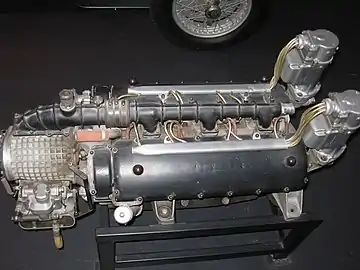
| Ferrari V12 F1 engine | |
|---|---|
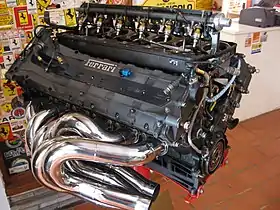 1995 F1 | |
| Overview | |
| Manufacturer |  Ferrari Ferrari |
| Production | 1950–1951, 1964–1980, 1989–1995 |
| Layout | |
| Configuration | 60°-180° V12 |
| Displacement | 1.5–4.5 L (92–275 cu in) |
| Valvetrain | 24-valve to 60-valve, SOHC/DOHC, two-valves per cylinder to five-valves per cylinder[1] |
| Compression ratio | 9.5:1 - 13.3:1[2] |
| Combustion | |
| Supercharger | Yes (1950–1951) |
| Fuel system | Carburetor/Indirect fuel injection[3] |
| Fuel type | Gasoline |
| Oil system | Dry sump |
| Output | |
| Power output | 220–860 hp (164–641 kW) |
| Torque output | 160–370 lb⋅ft (217–502 N⋅m)[4] |
| Dimensions | |
| Dry weight | 120–160 kg (265–353 lb) |
| Chronology | |
| Predecessor | Tipo 033/033A (1988) |
| Successor | Tipo 021/1 (1981) |
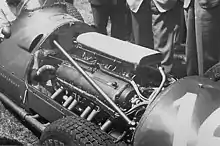
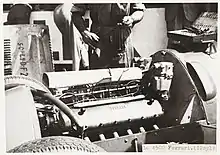
The 3.3-litre (3322 cc/202 in3) 275 Lampredi engine made its debut at the Grand Prix of Belgium on June 18. With three Weber 42DCF carburetors, a single overhead camshaft for each bank of cylinders, and two valves per cylinder, the engine produced a capable 300 hp (224 kW) at 7200 rpm. Alberto Ascari drove the car to fifth place, marking the end of the 3.3-litre engine. The 275 was replaced at the Grand Prix of Nations at Geneva on July 30, 1950, by the 340 F1 engine. As the name suggests, the car sported a larger 4.1-litre (4101.66 cc/250 in3) version of Lampredi's V12. With 335 hp (250 kW), Ascari was able to keep up with the Alfa Romeo 158 of Juan Manuel Fangio but retired with engine trouble. Although the 340 proved itself capable, it was only the middle step in Ferrari's 1950 car development. Ferrari achieved the 4.5-litre goal of the formula with the 375 Lampredi engine, two of which debuted at Monza on September 3, 1950. This 4.5-litre (4493.73 cc/274 in3) engine produced roughly the same power as its 4.1-litre predecessor, but its tractability earned Ascari second place in that debut race. A series of modifications through the 1951 season allowed Ferrari to finally put Alfa Romeo behind it in a Formula One race, with José Froilán González' victory at Silverstone on July 14 becoming the constructor's first World Championship win. Ascari's wins at the Nürburgring and Monza and strong finishes throughout the season cemented the company's position as a Formula One contender.
Ferrari also built a flat-12 (V-12 engine at 180°) powered Formula One car using the same chassis as the 158, designated the Ferrari 1512 or Ferrari 512 F1.[5] The flat-12 engine was designed by Mauro Forghieri and displaced 1,489.63 cc (90.903 cu in) with a bore and stroke of 56.0 mm × 50.4 mm (2.20 in × 1.98 in). This engine developed 220 PS (162 kW; 217 hp) @ 12,000 rpm, compared to the 210 PS (154 kW; 207 hp) @ 11,000 rpm of the 158's V8 engine. This power output made it one of the most powerful 1.5-litre Formula One engines, second to Honda's RA271 V12. A total of three 1512 chassis were produced, numbered 0007, 0008 and 0009.[6][7]
The 1512, with its larger, more powerful engine, was designed to be competitive on the longest, fastest circuits of the Formula One season, such as Reims, Spa, and Monza. In this role it complemented the lighter, nimbler V8-powered 158 which was more competitive on small, twisty circuits. The 1512 made its racing debut at the 1964 US Grand Prix at Watkins Glen, and raced alongside the 158 during the remainder of 1964 and into 1965.
For the 1966 Formula One season, there was a change in the technical regulations, now allowing 3-litre engines. Ferrari's first 1966 car consisted of a 3.3-litre V12 engine that was taken from the Ferrari 275P2 sportscar prototypes, modified to 3 litres, and mounted in the back of an F1 chassis. The designation 312, which would be used for a number of later cars, indicated a 3-litre, 12-cylinder engine. The engine was rather heavy, and due to the reduced capacity, lower on power and especially torque. John Surtees drove this contraption unsuccessfully in Monaco while Lorenzo Bandini drove a Ferrari Dino 2.4-litre V6. Surtees won the second race, the 1966 Belgian Grand Prix, a track that favoured power with its long straights, but the 1964 champion departed after a row with manager Eugenio Dragoni. The issue was about priorities in racing, as Ferrari was under pressure from Ford in sports car racing, and the F1 effort was somewhat neglected. Mike Parkes replaced Surtees, who went to Cooper which used Maserati engines, to finish second in the driver championship with a further win. For Ferrari, Ludovico Scarfiotti also won a race, the 1966 Italian Grand Prix at Monza which helped Ferrari finish second in the Constructors' Championship.[8]
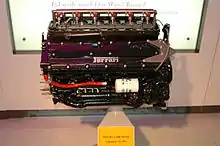
Ferrari used a 3-litre flat-12 (V-12 engine at 180° angle) engine configuration for their 312B and 312T Formula One cars; between 1970 and 1980. This was also Ferrari's last naturally-aspirated for eight years; engine until the 3.5-litre Tipo 035/5 V12 engine in 1989, in accordance with the new regulations imposed by the FIA, after the ban on turbocharged engines.[9][10][11] The 640 was powered by Ferrari's Tipo 035/5, a 3.5 liter V12 engine which produced up to 660 bhp (492 kW; 669 PS) by the season end, roughly the same amount of power as the engine it replaced, the Tipo 033A V6 turbo, though without the turbo's fuel consumption worries. The engine was unreliable, but it won on its debut race.[12]
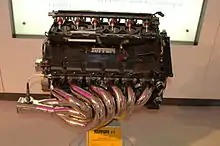
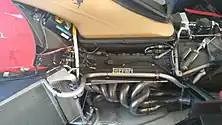
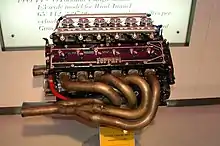
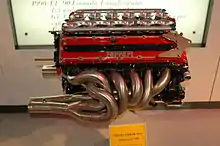
A new engine named Tipo 043 debuted at the 1994 San Marino Grand Prix qualifying sessions, and was first raced in Hockenheim.[13] It was designed from scratch by Claudio Lombardi and former Honda F1 chief engine designer Osamu Goto with a wider vee-angle of 75 degrees (up from 65 degrees) and a shorter stroke, replacing the old Tipo 041; Ferrari had brought on a number of engineers from the successful Honda F1 engine program. The 043 became famous for its great amount of power (over 830 bhp) and for its characteristic noise.[14][15]
By the end of the 1994 season, Ferrari's Tipo 043 V12 was putting out around 850 hp (634 kW)[16] @ 15,800 rpm, which is to date the most-powerful naturally-aspirated V12 engine ever used in Formula One.[17] Ferrari's last V12 engine, the Tipo 044/1, was used in 1995, before a switch to V10 engines for 1996.
.jpg.webp)
The engine used in the Ferrari F333 SP sports prototype was a modified version of the 65-degree V12 engine used in the 1990 Ferrari 641 Formula One car, enlarged from 3.5 L to 4.0 L, for longevity, durability, and reliability, and producing 641 hp (650 PS; 478 kW) @ 11,000 rpm; though still down on power from the original engine by about 40 hp (41 PS; 30 kW).[18][19] Southgate later described it as "one of the most reliable race engines I have ever worked with."[20]
Applications
- Ferrari 125 F1 (125 Colombo)
- 275 F1 / 340 F1 / 375 F1 (Tipo 275 / Tipo 340 / Tipo 375)
- Ferrari 1512 (Tipo 207)
- Ferrari 312 F1 (Tipo 228, Tipo 218, Tipo 242, Tipo 242C)
- Ferrari 312B (Tipo 001)
- Ferrari 312T (Tipo 015)
- Ferrari 640 / F1-89 (Tipo 035/5)
- Ferrari 641 / F1-90 (Tipo 036)
- Ferrari 642 / F1-91 (Tipo 037 / Tipo 291)
- Ferrari 643 (Tipo 291)
- Ferrari F92A (Tipo 038 / E1 A-92)
- Ferrari F93A (Tipo 041 / E2 A-93)
- Ferrari 412 T1 (Tipo 043 / E4 A-94)
- Ferrari 412 T2 (Tipo 044/1)
See also
References
- https://drivetribe.com/p/the-italia-prancing-horses-part-OJTmcWIUSLqqW_sD5mbk1Q?iid=Ae1nAldjSu2ZvpOt1Ty-Gw
- https://www.ferrari.com/en-EN/formula1/f93-a
- https://www.ferrari.com/en-EN/formula1/f1-90
- https://spicerparts.com/calculators/horsepower-torque-calculator
- "Ferrari 512 F1". F1Technical. Retrieved 2 December 2012.
- Nye, Doug (2018-09-20). "The Ferrari 1512 is the 1.5-litre Flat-12 you need to know about". www.goodwood.com. Retrieved 5 November 2018.
- "Ferrari 512 F1". formula1.ferrari.com. Retrieved 22 September 2019.
- "Ferrari 312 F1-66". formula1.ferrari.com. Retrieved 22 September 2019.
- Vlad Radu. "Get to Know Ferrari's Most Spectacular Formula 1 Engines". autoevolution. Retrieved 10 October 2021.
- "Engine Ferrari • STATS F1". statsf1.com. Retrieved 10 October 2021.
- "Ferrari F1-89: 1989 F1 single-seater". Ferrari.com. Retrieved 10 October 2021.
- "A Brief Aural History Of V12 Engines In Formula 1". carthrottle.com. Retrieved 10 October 2021.
- http://www.formulachallenge.co.nz/fcr-chat/blog-comments/_thread_/v12-f1-ferraris-set-to-ring-around-hampton-downs
- Parker, James (26 August 2012). "Ferrari 043 V12 Engine". F1Plus. Tornasol Media LLC. Retrieved 27 January 2014.
- https://ferraris-online.com/ferrari-f1-6-the-last-of-the-v12s-1989-1995/
- "Ferrari's Most Alluring F1 Engines". June 2017.
- "A Genius Named Todt". Atlasf1.autosport.com. Retrieved 13 February 2011.
- https://www.ferrari.com/en-US/auto/f333-sp
- Wouter Melissen (2015-01-25). "Ferrari 333 SP specifications". ultimatecarpage.com. Retrieved 2019-12-06.
- Southgate, Tony (15 September 2010). From Drawing Board to Chequered Flag. Croydon, UK: MRP Publishing Ltd. pp. 184–190. ISBN 978-1-899870-82-0.
Founder: Enzo Ferrari | |||||||
| Cars | |||||||
| Engines |
| ||||||
| Locations |
| ||||||
| Media |
| ||||||
| Motorsport |
| ||||||
| Related |
| ||||||
