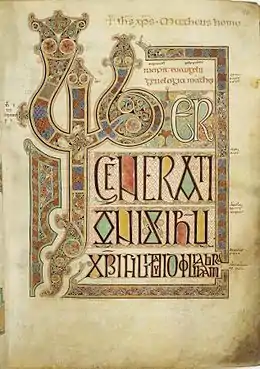
Insular crozier
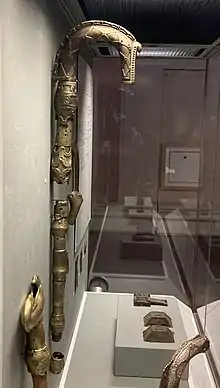
An Insular crozier is a type of processional bishop's staff (crozier)[1] produced in Ireland and Scotland between c. 800 and 1200. They can be distinguished from mainland European types by their curved crooks and drop (that is, the hollow box-like extension at the end of the crook).[2][3] By the end of the 12th century, production of Irish croziers had largely ended, but examples continued to be reworked and added to throughout the Romanesque and Gothic periods.[4]
.jpg.webp)
Croziers were symbols of office for bishops or abbots. Their form is based on the idea of the shepherd as pastor of his flock, and was popular from the early days of Christianity. The first known mention of the attribute in relation to Ireland is from 431, in the context of the conversion of the Irish population to Christianity.[5] The first insular staffs were produced in the 9th and 10th centuries during periods of political and religious upheaval in Ireland, when authority was often seen as needing to be made explicit, including during battles against invading Vikings. A number of examples, such as the Cath Bhuaidh, found in Iona, are known to have been carried into battle against the Vikings as talismans. They tend to be around 1 meter in length, that is the same size as a walking stick.[6]
Most Insular croziers have an inner wooden core onto which tubular copper alloy (aka bronze) plates were attached. The crooks tend to be highly decorated with elements such as openwork, and animal designs. As of 2014, fewer than twenty surviving fully intact examples were known, in addition to sixty fragments in various states of completeness.[5][7]
The major extant examples include the Clonmacnoise Crozier (believed to be amongst the first Irish metalwork of the medieval period), the Kells Crozier (9th to 11th centuries), St Mel's Crozier (10th and 12th century), the River Laune Crozier (late 10th century), the Lismore Crozier (c. 1100), and the Scottish Coigreach and St Fillan’s Crozier.[8][9][10] The majority of surviving insular croziers are held in the National Museum of Ireland, National Museum of Scotland and the British Museum.
Ecclesiastical and secular functions
_Crozier_Drop.jpg.webp)
It is unknown exactly what their function in Irish medieval society was, but they were probably of ceremonial use, and some may have held relics in their drops.[11] As the art historian Anthony Lucas points out, at the time the "most prestigious of all Irish relics and the one most frequently mentioned down the years was ... the Bachall Iosa or Staff of Jesus ... [said ] to have been received directly from Heaven by St. Patrick."[12] Although the crosiers represented this tradition, they do not pretend that the wood was from the original staff, but instead may have contained other relics built into the shaft, crook or drop.[12]
As undoubted symbols of wealth and power,[13] the croziers may have at times been used for solemnising treaties, swearing oaths, or even as battle talismans.[14][15] The antiquarian George Petrie noted how, in Ireland, relics of saints "used to be carried to distant places on solemn occasions, in order that rival chieftains might be sworn upon them, so much that the word mionna, which means enshrined relics, came to denote both a relic and an oath."[16][17] The annuals recounting the life of St. Finnchu of Brigown, County Cork mentions a battle against a king of Ulaid where the saint approaches the field with a crozier as a talisman.[12]
The earliest known Irish crozier dates to 596 AD and is entirely made of wood. It was found in a bog at Lemanaghan, County Offaly, and its hook contains a Greek cross inside a circle.[18] Representations of croziers appear in multiple other Insular art formats, including manuscripts, high crosses and stone carvings.[19]
Characteristics
Insular croziers were probably made in workshops specialising in metal inlay techniques. The art historian Griffin Murray believes that the master-craftsman behind the Clonmacnoise Crozier may also be responsible for two other extant examples.[20] The croziers vary in size, material, and amount and quality of decoration.[5] A typical length is 1 metre, with the Prosperous Crozier from County Kildare being the largest at 1.33 metres.[21]
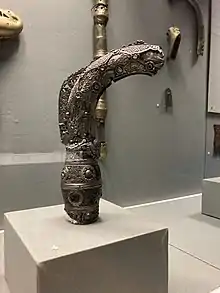
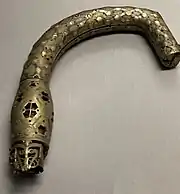
The major components are the shaft or staff and attached base, hook and knop. The shaft is generally formed from a wooden core, usually of yew wood, sheeted with metal tubing, and often millefiori discs and inlaid glass bosses.[22] The wooden core was used to support the weight of the hook, given the comparatively thin bronze on the visible shaft.[12] The tubing was in turn fitted with metal plating, usually of copper-alloy or silver, attached by nails and rivets.[23][24][25] In Early Medieval examples, the hook is typically formed from two separate plates fastened by a crest (coat of arms) and a binding strip, and the drop (the plate at the end of the hook) was attached separately. In some Romanesque crosiers, the crest is on the same plate as the crook, to which the drop is attached.[4]
The crooks are positioned at the top of the shaft,[25] and they and the drop are by far the most decorated elements. Some examples are lined with sliver, gold, glass, and niello-style inlay and openwork crests,[22] while the crook of the Aghadoe crozier is crafted from walrus ivory.[26] They are often ornamented with interlace designs, geometric patterns and zoomorphic (portraying humans as non-human animals) figures. The animal designs in the earliest example are depicted in a naturalistic manner, while many of the later examples bear influence from both the Ringerike and later Urnes styles of Viking art.[27][28] Some of the Ringerike style animals bear close resemblance to figures on the margins of ninth-century Insular brooches.[29]
The designs on the crook of the Clonmacnoise Crozier are in the Ringerike style, and include snake-like animals with ribbon shaped bodies arranged, according to art historian Patrick Wallace, "in tightly woven knots", while the crest contains a series of "gripping dogs".[28] The Lismore Crozier contains three open-mouthed animals "connected in an Urnes-style mesh."[28]
Only five croziers contain inscriptions, however in all but two (the Kells and Lismore Croziers), the lettering is too degraded to be readable.[30][31] The Lismore Crozier contains both the name of the smith (Nechtan),[32] and the name of the Bishop of Lismore who commissioned it,[33] as does the Kells Crozier (smith: Conduilig, bishop: Malfinnen, Archbishop of Leinster).[34]
Surviving examples
Like many Irish medieval religious objects, particularly shrines, some of the croziers (Irish: Baculus)[35] were built in single phases, while others were first built in the 9th century and added to or reworked across the 10th and 11th centuries.[19] Many of the croziers were held over the centuries by hereditary keepers, usually generations of a local family, until re-discovered by antiquarians in the early 19th century.[36][37][38]
The art historian Griffith Murray estimates that there is "physical evidence for at least thirty-one Insular-type crosiers from Ireland", and around 20 other fragments composed of shafts, knops and base (ferrule). In addition there are fragments of four eighth-century Insular crosiers in Scandinavia.[7]
The Prosperous Crozier
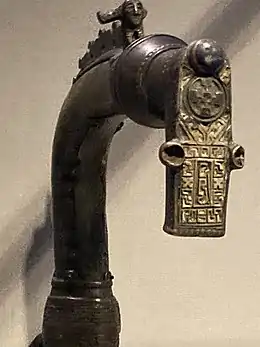
This late 9th or early 10 century[39] crozier was found fully intact by turf cutters in 1831 near Prosperous, County Kildare, but did not receive attention from antiquarians until 1851.[40][41] It is made from copper, zinc, and tin alloy, and contains traces of inscriptions, but they are too worn to read.[30] The crozier is in relatively good condition but was split in two halves during the late Middle Ages and recombined in the nineteenth century.[42] It is the longest intact example at a height of 1.34m. Its wooden core is supported by three tubular copper-alloy shaft casings, which hold four shaft knops, a ferrule and the crook.[39]
The drop is lined with decorations of glass and champlevé enamel.[43] The drop contains a modern inscription, probably 18th or 19th century, recording that it was once owned by St. Mary's Abbey, Dublin, although there is no archival evidence to support this claim.[43][39] The crest is decorated with profiles of birds at the top, and a human head at its lower end, that is just above the drop plate.[39]
It is one of the earliest known European croziers, and is kept in the archaeology wing of the NMI and was extensively cleaned and refurbished in the late 20th century.[44]
Kells Crozier
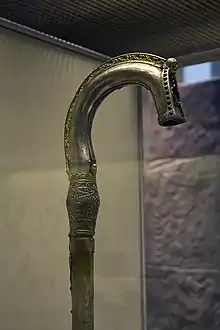
Formed from copper-alloy, silver, gilding and niello, the Kells Crozier was built in three phases. The earliest metalwork occurred during the late 9th or early 10 century, with further adornment occurring during the early 11th and early 12th centuries.[45] The first phase is represented by the wooden core, and copper lined tubing, four closing strips, three copper alloy knopes, the crook, openwork crest and zoomorphic ornamentation. Later embellishments include the silver plates lining the crook, the drop (10th century), and the semi-precious stones (since lost)[46] and niello-inlaid spirals influenced by the Ringerike style added in the 11th century.[14]
The Kells Crozier, at 133 cm, is unusually long, however some of this is due to later additions.[6] The art historian Rachel Moss suggests that because so many parts were replaced, the crozier may "have suffered 'profanation' (sárugud), which is sometimes reported of insignia."[47]
Rediscovered in London in 1851, it is associated with Kells, County Meath based on inscriptions under the crest on the crook (ordo conduilis ocius do mel finnen), which, roughly translated, asks for prayers for Cúduilig (or Cū Duilig) and Maelfinnén (or Máel Finnén). However, as neither have been conclusively associated with historical figures, there is some doubt as to the location of origin. It is in the collection of the British Museum.[47]
St. Mel's Crozier
Found in the mid-19th century on the grounds of an early medieval church in Ardagh, County Longford,[48] Saint Mel's Crozier dates from the 10th or 11th centuries.[14] The shaft is 84 cm long. The crook is made from oak, while the drop has a willow core. The drop's metal casting is secondary and has an inset (or cavity) to hold a reliquary box, which is now filled with a small block of wood.[49][50] However the reliquary box is slightly too small for the drop, and was probably also a later addition, likely to replace a similar, slightly larger fitting.[24]
The crozier is built from 14 separate metallic parts, with the wooden core lined with silver, gilding, glass and coral.[14] Today the wooden core can be divided into the three parts all now lined with nail holes[51] The collar knope Is designed to hold eight decorative stones, of which three survive: two red coral and one blue glass stone.[52] The staff contains a number of secondary nail holes, indicating that it may have been "dismantled and repaired several times in the past".[53] St. Mel's Crozier is dated based on the style of the zoomorphic designs, which are similar to those on the Kells Crozier.[14]
While well preserved (a number of the plates were damaged, and its last major cleaning and refurbishment was carried out between 1971–2)[53] and studied to that point, the crozier was "almost entirely destroyed" in 2009 when St Mel's Cathedral was decimated in a fire.[48][54] In the aftermath, over 200 recovered objects, including stained glass windows by Harry Clarke and St. Mel's crozier, were taken to National Museum of Ireland for assessment and restoration, although such was the extent of devastation that many were "beyond help".[48][55]
Lismore Crozier
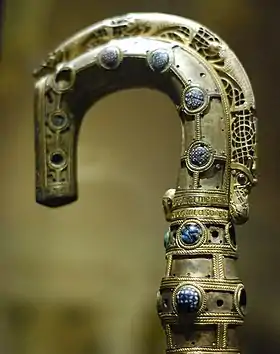
The Lismore crozier is dated to 1100 AD and was rediscovered, along with the 15th century Book of Lismore, in a blocked doorway in Lismore castle in 1814.[56] It is 115 cm high[7] and built from wood, silver, gold, niello and glass. It is almost fully intact and in good condition with little modern reworking.[56] Its crest contains a procession of animals that continues to a head at the end of the crook. The crook has three small, probably secondary (i.e. added later) reliquaries located in the animal heads and in the drop. The crook is further decorated in both sides with blue glass studs set in set in gold collars, and holding white and red millefiori glass insets.[5][56][46] It is now in the collection of the NMI.[56]
Inscriptions on the metalwork record that it was produced by "Nechtain the craftsman" and commissioned by Niall mac Meic Aeducain, a bishop of Lismore who died in 1113.[22][57] The inscription read "OR DON IAL MC MEICC AEDUCAIN LASAN[D]ERNAD I GRESA" ("Pray for Nial Mc Meicc Aeducain for whom this was made"), and OR DO NECTAICERD DO RIGNE I GRESA" ("Pray for Nechtain, craftsman, who made this object").[57][58] Nechtain placed the inscriptions in a very narrow space and so had to use abbreviations, and in some instances omitted a letter (for example "Niall" is spelled with only one "l", and the central "d" is missing from "Lasandernad").[59]
During a 1966 refurbishment, two small relics and a linen cloth were found inside the crook.[46]
River Laune Crozier
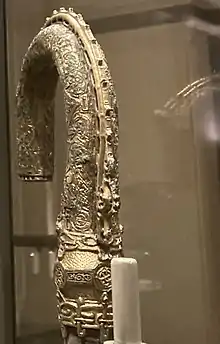
Although somewhat corroded in parts, the River Laune Crozier (or Innisfallen) is fully intact, and considered one of the finest surviving Irish examples, alongside those found at Clonmacnoise and Lismore. It was discovered in 1867 deposited in the bed of the Launein the River Laune, one of the Lakes of Killarney in County Kerry by a fisherman who initially mistook it as either a salmon or a gun, before establishing it as a "curious handstick."[60][61] It was first exhibited at the Victoria and Albert Museum (then the South Kensington Museum) in 1869, on loan from Dr John Coffey, Bishop of Kerry.[62]
It is dated to the late 11th century, an is not though to have been reworked. Its origin is uncertain; it is likely to have been made at Aghadoe Cathedral (e. 939 AD by Finian Lobhar (St. Finian the Leper)), but was held on the nearby abbey on Innisfallen ("Faithlinn's island").[61] The art historian Griffin Murray describes it as "probably broadly contemporary with the earliest stone church on the island and obviously relates a period of wealth and investment in the monastery at the time. It was of great significance to the community, as...the staff of office of the abbot and handed on from one abbot to the next. It symbolised the power of the founding saint of the monastery, St Finian, and by association the power of the abbot and the monastery itself,"[61]
The River Laune Crozier is of especially fine workmanships and unusual in that its metalwork is mostly of sliver rather than the more typical copper-alloy. Four panels contain elaborate gilded filigree.[63] It is 111.5 cm in length, while the hook is 17 cm wide. The crook is from a single casting, onto which the drop-plate and openwork crest were attached. The crest panels contain both zoomorphic and abstract patterns and are bordered by bands of niello with inlaid with gilt wire.[64]
Clonmacnoise Crozier
.jpg.webp)
Thought to be associated with Saint Ciarán,[65] the Clonmacnoise Crozier is dated to the late 11th century. It is 97 cm long, and contains copper-alloy, silver, niello, glass and enamel. The crozier is 13.5 cm high and 15.5 cm wide, and decorated with round blue glass studs and white and red millefiori insets.[66] Snake-like animals are arranged in interlocked rows along the sides,[67] and there are large animal heads in high relief at either side of the base of the crook. The openwork crest was cast contains a row of five crouched dog-like animals.[68] The zoomorphic and interlace patterns are in the Irish Ringerike style and bears strong resemblance to late 11th century additions to the Bearnan Chulain bell shrine, and the early 12th century Shrine of Saint Lachtin's Arm, suggesting a possible origination in Dublin.[26]
The shaft has three large copper-alloy and richly decorated knopes, the largest of which contains a crest and measures 7.5 cm. The other knopes hold crests and are separated by blue studs formed from glass. The central knope is less decorated compared to the other two, but has inlay bands and silver lining. A collar below the upper knope is made of copper-alloy, and contains relief designs of two large cat-like animals facing each other.[68] Clonmacnoise is also the location where the Stowe Missal was discovered.[26]
The Clonmacnoise Crozier is often described as the finest of the surviving examples, in both craftmanship and design.[67]
Scottish
While a number of Scottish Insular croziers (or "quigrichs") survive, there are only six extant early Christian examples (the Bachul Mor fragment, the crosier of St Fillan, two drops found at Hoddom, Dumfriesshire, and two unidentified drop now in the British Museum.[69] Their likeness to Irish examples is indicative of the close contact between Scottish and Irish craftsmen, while it is known that a number of Irish metalworkers settled in Scotland.[70] The similarities include methods of construction and their style and decoration. The Scottish croziers are characterised by their angular crook shape with separate (ie attached) drops, with most dated to before the mid-11th century.[71] The designs and patterns on the crooks are typically of the Irish or West Highland type.[72]
St. Fillan’s Crozier and the Coigreach
.jpg.webp)
The 8th century St. Fillan’s crook is traditionally associated with the Irish monk St. Fillan (Gaelic: Fáelán or "little wolf"),[73] who lived in the eighth century at Glendochart in Perthshire, central Scotland. Only the crook survives; the staff was lost at an unknown date. Sometime around the late 13th century the crook was encased in the Coigreach (or Quigrich), a crosier-shrine of similar size and form built as a protective case for the crook,[74] and made from silver, gold and rock crystal and dates from the late 13th century, with additions from the 14th or 15th centuries. The Coigreach was rediscovered in the mid-19th century by the archaeologist Daniel Wilson, who opened it and found St. Fillan’s Crozier inside.
The crozier was at first used for blessings and as a talisman or battle standard: it is recorded as having been brought onto the field at the Battle of Bannockburn in 1314.[75] Later it was thought to be able to heal people and animals, and under the ownership of its hereditary keepers the Dewars of Glendochart, acted as a ceremonial object for oaths of loyalty and dispute settlement, mostly related to the recovery of stolen cattle.
Both St. Fillan’s Crozier and the Coigreach are in the collection of the National Museum of Scotland in Edinburgh, where they are displayed in the Kingdom of the Scots gallery and described as an "object-pair".[72]
The Bachul Mor
The Bachul Mor (English: "Great Staff", sometimes known as "The Crozier of St Moluagh")[76][77] dates from c. 730 and is in very poor condition having lost most of its metal casing and suffered damage to both its crook and ferrule.[78] It remains in the possession of the Duke of Argyll, its hereditary keeper, on the Isle of Lismore, and is thus understudied.[79]
Others
Other well preserved Scottish insular croziers include the St. Donnan's crozier (Eigg), and the Kilvarie Bar-a-Goan (Kilmore, Skye).[80] The Cath Bhuaidh ("Yellow Battler" or "battle victory"),. found in Iona, is traditionally associated with St. Colmcille and thought to have been used as a talisman in a 918 battle between native picts and Viking invaders.[81] In addition fragments have been found in Galloway, Loch Shiel and in a bishop's grave at Whithorn.[72]
References
- Often spelled as "crosier", including by Irish art historians
- Youngs (1989), p. 214
- Murray (2007 a), p. 81
- Murray (2007 a), p. 89
- Moss (2014), p. 310
- Murray (2007 a), p. 83
- Murray (2007 a), p. 82
- McIntyre; Oddy (1973), pp. 35–46
- Murray (2007 a), p. 80
- Moss (2014), p. 312–315
- Murray (2021), p. 1
- Lucas (1986), p. 9
- "The Lismore Crozier, AD 1100". National Museum of Ireland. Retrieved 18 August 2021
- Moss (2014), p. 312
- Lucas (1986), p. 18
- Stuart (1877), p. 12
- Lucas (1986), p. 8
- O'Carroll; Condit (2000), p. 24
- O'Carroll; Condit (2000), p. 25
- Murray (2021), p. 24
- Murray (2021), pp. 113–114
- Moss (2014), p. 315
- Moss (2014), p. 311
- McIntyre; Oddy (1973), p. 38
- Murray (2007 a), p. 79
- Moss (2014), p. 314
- Bourke (1985), p. 151
- Ó Floinn; Wallace (2002), p. 220
- Bourke (1985), p. 153
- Murray (2007 a), p. 88
- The other three are the St Dympna's, Prosperous and Ardagh croziers, see Murray (2007 a), p. 88
- Ó Floinn; Wallace (2002), p. 221
- Ó Floinn; Wallace (2002), p. 235
- "Kells Crozier". British Museum. Retrieved 19 August 2021
- Frazer (1891), p. 206
- Murray (2008), pp. 114–116
- Murray (2007 b), p. 146
- Mitchell (1996), p. 6
- Bourke; Hook (2017), p. 136
- Bourke; Hook (2017), p. 134
- Bray, Allison. Priceless 'Prosperous Crozier' goes on display to public". Irish Independent, 14 November 2014. Retrieved 28 August 2021
- Bourke; Hook (2017), p. 133
- "The Prosperous Crozier". National Museum of Ireland. Retrieved 28 August 2021
- Bourke; Hook (2017), p. 135
- MacDermott (1956), p. 167
- Murray (2007 a), p. 85
- Moss (2014), p. 313
- Halpin, Andrew; Gordon Bowe, Nicola. Irish Arts Review, volume 31, No 4, 2014. "From the ashes". Retrieved 29 August 2021
- McIntyre; Oddy (1973), p. 40
- McIntyre; Oddy (1973), pp. 35, 37, 41
- McIntyre; Oddy (1973), p. 34
- McIntyre; Oddy (1973), p. 42
- McIntyre; Oddy (1973), p. 35
- Hogan, Louise. "Bishop promises St Mel's will return to glory following fire". Irish Independent, 29 December 2010. Retrieved 21 August 2021
- O’Reilly, Colm. "Recovery of Diocesan Museum Artefacts: Statement Issued on behalf of the Very Rev. Colm O’reilly, D.D., Bishop Of Ardagh and Clonmacnois". Roman Catholic Diocese of Ardagh and Clonmacnoise. Retrieved 21 August 2021
- "The Lismore Crozier". National Museum of Ireland. Retrieved 21 August 2021
- Michelli (1996), pp. 5, 23
- Henry (1980), p. 44
- Mitchell (1996), p. 10
- Murray (2010), p. 47
- "The Islands of Ireland: Sailing to Innisfallen". Irish Examiner, 16 March 2016. Retrieved 14 November 2021
- Murray (2010), p. 48
- Murray (2010), p. 46
- Murray (2010), p. 49
- Frazer (1891), pp. 206–214
- Murray (2021), p. 3
- O'Toole, Fintan. "A history of Ireland in 100 objects: Clonmacnoise crozier, 11th century". The Irish Times, 10 December 2011. Retrieved 20 August 2021
- Murray (2021), p. 6
- Michelli (1988), p. 216
- Michelli (1986), p. 375
- Michelli (1986), p. 384
- "Crozier and Coigreach of St Fillan". National Museum of Scotland. Retrieved 12 December 2021
- McDonald (2013), p. 66
- McKeown (1933), p. 246
- "The Quigrich or Crozier of St Fillan". Am Baile: Highland History and Culture. Retrieved 12 December 2021
- Michelli (1986), p. 39
- "Adventures of Edmund O'Cleary (Continued)". Royal Irish Academy, 1890. Retrieved 1 October 2021
- Michelli (1986), p. 376
- Michelli (1986), pp. 376–377
- Michelli (1986), p. 377
- Stuart (1877), p. 21
Sources
- Bourke, Cormac; Hook, Duncan. "The Prosperous, Co. Kildare, Crozier: archaeology and use". Proceedings of the Royal Irish Academy: Archaeology, Culture, History, Literature, volume 117C, 2017
- Bourke, Cormac. "A Crozier and Bell from Inishmurray and Their Place in Ninth-Century Irish Archaeology". Proceedings of the Royal Irish Academy: Archaeology, Culture, History, Literature. Dublin: Royal Irish Academy, volume 85C, 1985. JSTOR 25506128
- O'Carroll, Ellen; Condit, Tom. "Ireland's Earliest Crozier?". Archaeology Ireland, volume 14, no. 2, Summer 2000. JSTOR 20558904
- Caldwell, D. H. (ed). Angels, Nobles and Unicorns: Art and Patronage in Medieval Scotland. Edinburgh: National Museums Scotland, 1982. ISBN 0950311715
- Ó Floinn, Raghnal; Wallace, Patrick (eds). Treasures of the National Museum of Ireland: Irish Antiquities. Dublin: National Museum of Ireland, 2002. ISBN 978-0-7171-2829-7
- Frazer, W. On an Irish Crozier, with Early Metal Crook, Probably the Missing "Crozier of St. Ciaran," of Clonmacnoise. Proceedings of the Royal Irish Academy, volume 1 1889–1891. JSTOR 20503841
- Henry, Françoise. "Around an Inscription: The Cross of the Scriptures at Clonmacnois". The Journal of the Royal Society of Antiquaries of Ireland, volume 110, 1980. JSTOR 25508773
- Kelly, Eamonn P. "Treasures of Ireland: Catalogue entries, Late Bronze Age and Iron Age Antiquities". Treasures of Ireland: Irish Art 3000 BC – 1500 AD. Dublin: Royal Irish Academy, 1983
- Lucas, Anthony. "The Social Role of Relics and Reliquaries in Ancient Ireland". The Journal of the Royal Society of Antiquaries of Ireland, volume 116, 1986. JSTOR 25508904
- MacDermott, Máire. "The Crosiers of St. Dympna and St. Mel and Tenth-Century Irish Metal-Work". Proceedings of the Royal Irish Academy: Archaeology, Culture, History, Literature, Volume 58, 1956. JSTOR 25505072
- McDonald, Ian. Clerics and Clansmen: The Diocese of Argyll Between the Twelfth and Sixteenth Centuries. Brill, 2013. ISBN 978-9-0041-8547-0
- Mitchell, Perette. "The Inscriptions on Pre-Norman Irish Reliquaries". Proceedings of the Royal Irish Academy: Archaeology, Culture, History, Literature, volume 96C, no. 1, 1996. JSTOR 25516156
- Moss, Rachel. Medieval c. 400—c. 1600: Art and Architecture of Ireland. New Haven, CT: Yale University Press, 2014. ISBN 978-0-3001-7919-4
- Murray, Griffin. "The history and provenance of two early medieval crosiers ascribed to Clonmacnoise". Dublin: Proceedings of the Royal Irish Academy: Archaeology, Culture, History, Literature, 2021
- Murray, Griffin. "The Medieval Treasures of County Kerry".Tralee: Kerry County Museum, 2010. ISBN 978-0-956-5714-0-3
- Murray, Griffin. "The provenance of the county Antrim crozier". Ulster Journal of Archaeology, Third Series, volume 67, 2008. JSTOR 41220771
- Murray, Griffin. "Insular-type crosiers: their construction and characteristics". Making and Meaning in Insular Art: Proceedings of the Fifth International Conference on Insular Art, 2007 (a)
- Murray, Griffin. "Joseph Cooper Walkers Account of the Discovery of the Cashel". The Journal of the Royal Society of Antiquaries of Ireland, volume 137, 2007 (b). JSTOR 23024265
- Murray, Griffin. "The 'Hidden Power' of the Irish Crosier". Archaeology Ireland, volume 18, No. 1, Spring 2004. JSTOR 20562731
- Oddy, W. A.; McIntyre, I. M. "St. Mel's Crozier: Technical Examination and Report on Conservation and Restoration in 1971-2". The Journal of the Royal Society of Antiquaries of Ireland, volume 103, 1973. JSTOR 25508613
- Mitchell, Perette. "The Inscriptions on Pre-Norman Irish Reliquaries". Proceedings of the Royal Irish Academy: Archaeology, Culture, History, Literature, volume 96C, no. 1, 1996. JSTOR 25516156
- Michelli, Perette. "Four Scottish crosiers and their relation to the Irish tradition". Proceedings of the Society of Antiquaries of Scotland, 118, 1986
- Michelli, Perette. "Fragments of a fifth crosier from Scotland". Proceedings of the Society of Antiquaries of Scotland, 116, 1988
- Stokes, Margaret. Early Christian Art in Ireland, Part 1. London: Chapman and Hall, 1887
- Stokes, William. The Life and Labours in Art and Archaeology of George Petrie. Cambridge: Cambridge University Press, 1868. ISBN 978-1-1080-7570-1
- Stuart, John. "Historical Notices of St. Fillan's Crozier, and of the Devotion of King Robert Bruce to St. Fillan". Proceedings of the Society of Antiquaries of Scotland, volume XII, 1876
- Young, Susan. The Work of Angels. Masterpieces of Celtic Metalwork, 6th—9th Centuries AD. London: British Museum, 1989. ISBN 978-02927-9058-2
External links
 |
Wikimedia Commons has media related to Insular croziers. |