Seoul Metro 4000 series
The Seoul Metro 4000 series is a commuter train introduced on Seoul Subway Line 4 from 1993 to 1994. Currently, 47 trains, including 26 exclusively for direct current and 21 for direct exchange, are in operation, and 42 trains (420 units) are actually in operation.
| Seoul Metro 4000 series | |
|---|---|
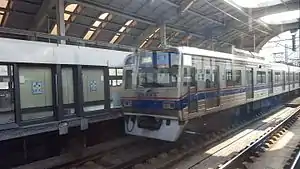 | |
| Constructed | 1993–1995 (1st generation and 2nd generation) 2020 (3rd generation) |
| Formation | 10 cars per train TC-M'-M'-M'-M'-M'-M'-M'-M'-TC |
| Operator(s) | Seoul Metro |
| Line(s) served | Seoul Subway Line 4 |
| Specifications | |
| Maximum speed | 80km/h (ATC service) 110km/h (ATS service) 110km/h (design) |
| Power output | 4,000 kW |
| Deceleration | 3.0km/h/s |
| Safety system(s) | ATC,[1] ATS[1] |
Technical specifications
Body
It is using a redesigned design that meets the limitations of vehicles on Seoul Subway Line 4, Gwacheon Line, and Ansan Line. As the first lightweight stainless steel train of the Seoul Transportation Corporation, the vehicle body was induced to reduce weight by using STS301L lightweight high-tensile stainless steel. An LED electronic display for passenger guidance was installed on the ceiling of the room. Low noise and miniaturization were achieved by adopting a lightweight linear driving method for the driving part of the door.
Crew guidance system
TGIS stands for Train General Information System and is a system that delivers basic information on trains to flight attendants. Basically, it consists of a central device equipped in a control vehicle and a terminal device equipped in each vehicle, and each terminal is configured in a loop type. Communication between each terminal uses the RS-485 method. Each terminal device transmits the state of the electric device and the service device of each vehicle in real time, integrates them in the central device, and then transmits them to the crew through a monitor.
The main functions of TGIS are as follows.
- Crew support function: various device status, operation status, and stop station notification function.
- Current status and failure record of the main controller and various high-voltage electric devices.
- A function of controlling a service device (a guide broadcast, an air conditioner, a route, a train number indicator, etc.)
- Inspection support functions: driving records, failure records, warehousing and forwarding checks, and emergency failure treatment guidance functions.
Room guidance system
For the first time among the first Seoul subways, an in-vehicle destination information post was installed in the form of an LED electronic display to guide station guides and announcements through visual expression methods in addition to voice information. When the train operation information (data such as train number, operation time, and day of the week) is input through the setter of the driving control vehicle, the device automatically performs destination representation through communication.
References
- "서울교통공사 4000호대 VVVF 전동차 - 나무위키". Namu.wiki. Retrieved 7 November 2021.
 Rolling stock of Seoul Metro Rolling stock of Seoul Metro | |
|---|---|
| Current/Active |
|
| Retired/Withdrawn |
|
See also Category:Rolling stock of South Korea | |