Kulishivka
Kulishivka (Ukrainian: Куліші́вка), also the Orthography of Kulish was a Ukrainian phonetic orthography was invented and applied by Panteleimon Kulish in the late 1850s.
All subsequent Ukrainian orthography are based on Kulish's orthography. In 1923, in his preface to the 5th edition of the Ukrainian Orthographic Dictionary, its editor and one of the authors of the Kharkiv orthography of 1928, Hryhorii Holoskevych, noted that the orthography he used was broadly the same as Kulish's orthography in the 1850s.[1]
General description
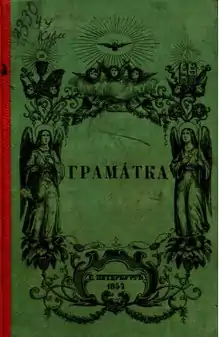
This spelling was used by Kulish in "Notes on Southern Rus" (vol. 1, 1856) and in "Grammar" (1857), and then used in the magazine "Osnova", published in 1861–1862 in St. Petersburg, Vasyl Bilozerskyi, Nikolay Kostomarov and Panteleimon Kulish.
Features
According to this orthography system:
- Consistently used the letter і to denote the sound /і/ from the ancient ѣ (літо, сіно, осінь), in place of the ancient о, є in the newly closed syllables (стілъ, жінка, пічь) and in place of iotated і (Вкраіна, моіх, тихоі). At the beginning of the word non-iotated vowel was transmitted by the letter и (индик, им'я, Иван).
- The letter ы was removed from the alphabet, and the letter и (синь, лисиця) was written instead to denote the sound /ɪ/.
- In the role of an apostrophe in the middle of words, and at the end of words after consonants acted ъ (пъять, розвъязав, вітеръ, сміхъ).
- The sound /ɛ/ was successively transmitted by the letter e (друже, сестра). The letter є used only after soft consonants in middle nouns (весіллє, третє, щастє), and after the vowels — the letter e without noting in the letter the iotation of the sound /ɛ/ (гуляе, думаешь), although the letter є in previous spellings already was. The non-iotated sound /ɛ/ at the beginning of words and after vowels was transmitted by the letter э (Эзоп, поэт).
- The letter ё has been restored for the combinations йо, ьо (ёму, слёзою, тёхнув, народнёго), which are known in ancient orthographic practice.
- The sound /g/ was transmitted by the Latin letter g (дзиga, gуля).
- The letter ѳ was preserved in ancient borrowings from Greek (Коринѳі).[2]
In the spelling of consonants at the junctions of morphemes, Kulish tried to consistently introduce the phonetic principle, imitating in part Oleksii Pavlovskyi, Petro Hulak-Artemovskyi, and others. The verb combination -ться was written through -тьця and -тця (вертаютьця, всміхнетця), and -шся - through -шся and -сся (одібьешся, вітаєсся). In parallel, the prefixes рос- and роз- (роскажуть, розчервонітися). were used.
According to Andrii Danylenko, a Ukrainian-American researcher of the Kulish language, the influence of "Kulishivka" on modern Ukrainian spelling was minimal.[3]
Changes
Some features of Kulishivka are largely eliminated in the spelling of the "South-Western Division of the Russian Geographical Society" (1873), co-authored by Pavlo Zhytetskyi and Konstantin Mikhalchuk. On their initiative, the following changes were made to Kulishivka:
- the iotated sound /i/ was first denoted by the letter ї, and the iotated /ɛ/ by the letter є.
- at the end of the word the letter ъ ceased to be used
- the sound /g/ was transmitted not by the Latin letter g, but by the letter combination кг.
In the Russian Empire, kulishivka was used until the Ems Act of 1876. Instead, a spelling was introduced that "would not deviate from the Russian pronunciation of letters." This spelling was called "yerizhka" (from the letter y - yeri introduced in it), later it was called "yarizhka". This change in the name was explained by Ahatanhel Krymskyi: "… the word "yaryzhka "should define something bureaucratic, state, forcibly imposed."
In the 1890s, Zhelekhivka, which was developed on a similar principle (but it was based on local features of speech), was introduced in schools in Galicia. Instead, in Greater Ukraine, after the expiration of the Ems Act of 1876 in 1905–1914, they began to use Hrinchevychivka, which was a slightly modified Zhelekhivka, in particular in the Dictionary of the Ukrainian Language edited by Borys Hrinchenko.
See also
References
- Hryhorii Holoskevych. Preface // Ukrainian orthography dictionary with short spelling rules. Ed .: Hryhorii Holoskevych. Katerynoslav-Leipzig: Ukrainian Publishing House. 1923. 226 pages. (5th type)
- ""Кулішівка"". Збруч (in Ukrainian). 2018-05-24. Retrieved 2021-01-16.
- Danylenko Andrii. "Write as you say…", or why Panteleimon Kulish did not become the creator of modern Ukrainian spelling // Linguistics. — 2012. — № 4. — P. 37–54.
External links
- Кулішівка // Українська мала енциклопедія : 16 кн. : у 8 т. / проф. Є. Онацький. — Накладом Адміністратури УАПЦ в Аргентині. — 1960. — Т. 3, кн. VI : Літери Ком — Ле. — С. 786. — 1000 екз.
- Kulishivka. Ukrainian language. Encyclopedia
- Kulishivka / Izbornyk
- Kulishivka. ESU