Nur die Liebe läßt uns leben
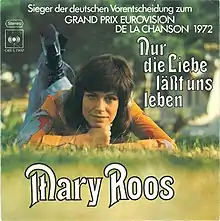
"Nur die Liebe läßt uns leben" (German pronunciation: [ˈnuːɐ̯ diː ˈliːbə ˈlɛst ʔʊns ˈleːbn̩]; "Only Love Lets Us Live") was the German entry in the Eurovision Song Contest 1972, performed in German by Mary Roos.
 "Nur die Liebe läßt uns leben" "Nur die Liebe läßt uns leben" | |
|---|---|
 | |
| Eurovision Song Contest 1972 entry | |
| Country | |
| Artist(s) | |
| Composer(s) | Joachim Heider |
| Lyricist(s) | Joachim Relin |
| Conductor | Paul Kuhn |
| Finals performance | |
| Final result | 3rd |
| Final points | 107 |
| Entry chronology | |
| ◄ "Diese Welt" (1971) | |
| "Junger Tag" (1973) ► | |
The song was performed first on the night, preceding France's Betty Mars with "Comé-comédie". At the close of voting, it had received 107 points, placing 3rd in a field of 18.
The song is in praise of love itself, with Roos explaining that it serves to keep everyone happy and give them something to live for. Roos also recorded the song in English (as "Wake Me Early in the Morning"), French ("Nous") and Italian ("Non sono più bambina").
It was succeeded as German representative at the 1973 contest by Gitte with "Junger Tag".
External links
This article is issued from Wikipedia. The text is licensed under Creative Commons - Attribution - Sharealike. Additional terms may apply for the media files.