Pakistan Army Armoured Corps
Pakistan Army Armoured Corps (Urdu: ﺁرمى ﺁرمرڈ كور) is a combatant branch of the Pakistan Army, tasked with armoured warfare. Equipped with more than 3,000 Main Battle Tanks, the corps is based at the old garrison town of Nowshera and is organized into two armoured divisions and a number of independent armoured brigades. The Pakistan Armoured Corps has a proud history going back to September 1773, when its oldest unit Governor General's Bodyguard was raised in British India. The corps maintains a number of legendary units on its order of battle, who earned fame in numerous wars and engagements of British Indian Army including the two World Wars. At the time of the independence, Pakistan inherited six armoured regiments from the old British Indian Army.[1]
| Pakistan Army Armoured Corps | |
|---|---|
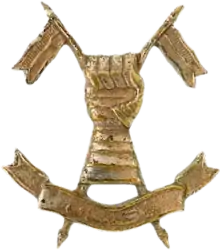 Cap Badge of the Armoured Corps | |
| Active | 1947-Present |
| Country |  Pakistan Pakistan |
| Branch | Army |
| Size | 52 regiments incl. President's Bodyguard |
| Regimental Centre | Nowshera |
| Nickname(s) | Men of Steel |
| Colors | Red and Yellow |
| Engagements | Indo-Pakistani War of 1947 Indo-Pakistani War of 1965 Indo-Pakistani War of 1971 Battle of Chawinda Operation Desert Storm |
| Commanders | |
| Colonel Commandant | Lieutenant General Nadeem Zaki Manj |
| Notable commanders | Gen Zia-ul-Haq Gen Jehangir Karamat Gen Ahsan Saleem Hayat Lt. Gen Gul Hassan Khan (C-in-C) Lt. Gen Hameed Gul (DG ISI) Lt. Gen Mian Muhammad Afzaal (Shaheed) (CGS) |
Since then, the corps has expanded into more than forty regiments. Many of these new regiments have also earned accolades for their performance in the wars fought with India. Seeing large scale action during the 1965 war with India, initially suffering massive reverses during the initial tank battles of Asal Uttar, Burki and Phillora. In all these battles, despite having qualitatively superior tanks in the form of modern Patton tanks supplied by the United States of America, the Pakistani Armoured Corps suffered highly disproportionate losses, losing 140+ tanks against 10 of India's at Asal Uttar, and often credited as the largest tank battle in the post World War two era, it lost 66 tanks against the loss of 6 Indian Tanks, and similarly, 84 against India's 4 at Burki, all the battles effectively opening up the way for the Indian counteroffensive at Lahore. After these battles the Pakistani Armoured Corps distinguished itself at Chawinda, another extraordinarily large tank battle, while not inflicting a decisive defeat, it was able to bring to a Halt to the Indian offensive, before the onset of the peace negotiation. Notable at the battle of Chawinda, the 25th cavalry was able to effectively blunt the Indian offensive at the Sialkot sector and ultimately halted any further advances of the Enemy. Ahmed, Lt Gen Mahmud. (2006). History of Indo-Pak War – 1965.
Among the many downsides of the war of Pakistan in 1965, was that the tank strength had been severely depleted by the time the 1971 Bangladesh Liberation War began, seeing minimal action in the Eastern theatre, with one notable action being that at the Garibpur, where the Pakistan Armoured Corps lost 11 M24 Chaffees (8 destroyed and 3 captured) to superior Indian PT-76s of the Indian 45 Cavalry, who suffered no losses, but the Pakistani forces were able to inflict significant losses to the Mitro Bahini Infantry units in the battle. Similar to the 1965 war, massive armoured thrusts were attempted in the Western theatre, leading to several battles. These include the Battle of Basantar, where the Indians launched a spoiling attack against the assembling Pakistani forces, Pakistan lost 46 tanks to the loss of only 10 on the side of India. A humiliating defeat was at Longewala, where a Pakistani Mobile Brigade, which included an entire Armoured Regiment was held off by a single Indian infantry company, aided by only an RCL gun, and the Infantry possessing some PIATs. With the defensive action of the A Company, 23rd Battalion, Punjab Regiment. inflicting several casualties at minimal losses during the nighttime, and on dawn, the Indian Air Force was able to jump in Action (the Indian Hawkers lacked nighttime combat abilities), and were able to effectively wipe out the Armoured Regiment, and repulse the Paksitani Assault. Another notable action was at the Battle of Chamb, where the Pakistani forces were able to win a victory, inflicting disproportionate losses to the Indian Armour and Infantry.
The Pakistani Armoured Corps has seen no action in the conflicts thereafter, owing to the terrain induced limitation. However, it has played a crucial part in terms of deterrence when the Pakistani Army has mobilised repeatedly in the face of various Indian build-ups on the Border. These include Operation Brasstacks - A large scale Military Exercise by the Indians, the largest in the world in terms of numbers and scale. And during Operation Parakram - an Indian military build-up in the aftermath of 2001 terrorist attacks on the Indian Parliament.
Regiments in the Corps
- President's Body Guard.[2]
- 4 Cavalry [2]
- 5 Horse(Probyn's Horse)[2]
- 6 Lancers (Fateh Khem Karan) [2]
- 7 Lancers [2]
- 8 Cavalry (Izz-Ul-Khail)[2]
- 9 Horse (The Arabian Horse) [2]
- Guides Cavalry (Frontier Force)[2]
- 11 Cavalry (Frontier Force)[2]
- 12 Cavalry (Frontier Force)[2]
- 13th Lancers (Spearheads) [2]
- 14 Lancers [2]
- 15th Lancers (Baloch)[2]
- 16 Horse (Al-Mugheerat) [2]
- 17 Lancers [2]
- 18 Horse [2]
- 19th Lancers[2]
- 20th Lancers Haidri (Punjab)[2]
- 21 Horse (Murtajiz) [2]
- 22 Cavalry (Death or Glory) [2]
- 23 Cavalry (Frontier Force) [2]
- 24 Cavalry (Frontier Force) (Chargers) [2]
- 25 Cavalry (Frontier Force) (Men of Steel) [2]
- 26 Cavalry (Mustangs) [2]
- 27 Cavalry (Ribat-ul-Khail) Steeds of war [2]
- 28 Cavalry (Chhamb Hunters) [2]
- 29 Cavalry (Tigers) [2]
- 30 Cavalry (Bold Till Death) [2]
- 31 Cavalry (Sprocketeers) [2]
- 32 Cavalry (Conquerers) [2]
- 33 Cavalry (Fortunes with the Bold),[2]
- 34 Lancers (Dragoons)" TAWAKKAL-ALALLAH"[2]
- 35 Cavalry (AL-MUBARIZUN-', Raised 1 November 2014.)
- 36 Cavalry
- 37 Cavalry (Ribat-us-Sehra) [2]
- 38 Cavalry (Desert Hawks) [2]
- 39 Cavalry ( The Vanguards) [2]
- 40 Horse (Sind)[2]
- 41 Horse (Frontier Force) [2]
- 42 Lancers (Punjab) [2]
- 43 Cavalry (al-Zarib) (Raised 2015)
- 44 Cavalry (Pioneers) (Raised 2016)
- 45 Horse
- 47 Cavalry
- 51 Lancers (Silver Eagles) [2]
- 52 Cavalry (HOWALMUSTAAN) (GOD) He, the helper [2]
- 53 Cavalry (Golden Eagle) [2]
- 54 Cavalry (Hizbullah) [2]
- 55 Cavalry [2]
- 56 Cavalry (Raad ul Harb) [2]
- 57 Cavalry [2]
- 58 Cavalry [2]
- The President's Body Guard was formed at independence from the Governor General's Bodyguard, which was raised in 1773 under the name of Governor's Troop of Mughals at that time. In 1956 its name was changed to President's Bodyguard from when Pakistan became a republic. It is the senior-most armoured regiment of Pakistan Army.
- 5 Horse is the successor to the 1st Sikh Irregular Cavalry (Wales's Horse), and the 2nd Sikh Irregular Cavalry, both raised in 1857.
- 6 Lancers is the successor to The Rohilkhand Horse raised in 1857, and the 4th Sikh Irregular Cavalry raised in 1858.
- Guides Cavalry (Frontier Force) is the successor to the Corps of Guides raised in 1846.
- 11 Cavalry (Frontier Force) is the successor to 1st and 3rd Regiments of Punjab Cavalry, both raised in 1849.
- 12 Cavalry (Frontier Force) is the successor to 2nd and 5th Regiments of Punjab Cavalry, both raised in 1849.
- 13th Lancers is successor to the 1st and 2nd Native Troops of Bombay Cavalry, raised in 1804 and 1816 respectively.
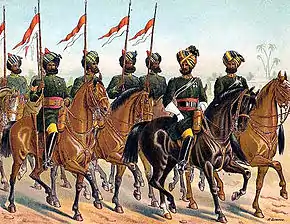
Coloured lithograph by Richard Simkin, 1885.
- 15th Lancers is successor to the Muttra Horse and 7th Bombay Cavalry, raised in 1857 and 1885 respectively.
- 19th Lancers is successor to the 2nd Mahratta Horse (Tiwana Horse) raised in 1858, and Fane's Horse raised in 1860.
- 25 Cavalry (Frontier Force) is the famous regiment which stopped the Indian Army's armoured thrust during the Battle of Chawinda in 1965. The regiment was given the sobriquet " Men of Steel" by the then Chief of Army staff.
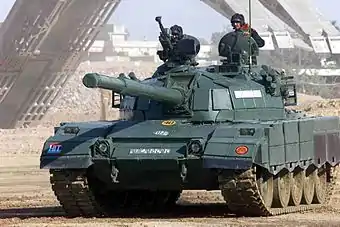
- Al-Khalid Main Battle Tank (MBT) is a joint Sino-Pakistani production with a 125 mm smoothbore gun.
- T-80UD is of Ukrainian origin with a 125 mm smoothbore gun.
- T-85III is an upgraded version of Chinese T-85AP with a 125 mm smoothbore gun.
- Al-Zarrar is an upgraded Pakistani version of the Chinese T-59II with a 125 mm smoothbore gun.
- Type 69 tank is a Chinese MBT with a 105 mm gun.
- 33 Cavalry (Fortune’s with the Bold), is the only regiment in Pakistan Armored Corps which has five battle honours to its credit. After the Independence of Pakistan.
See also
- Frontier Force Regiment
- Punjab Regiment
- Baloch Regiment
- Azad Kashmir Regiment
- Sind Regiment
- Northern Light Infantry Regiment
- Regiment of Artillery
- Army Air Defence Command
- Corps of Engineer
- Army Medical Corps
- Corps of Signals
- Corps of Electrical and Mechanical Engineers
- Corps of Military Intelligence
- Corps of Military Police
- Army Ordnance Corps
- Army Services Corps
- Army Aviation Corps
- Army Education Corps
- Mujahid Force
- Riza, Maj Gen Shaukat. (1989). The Pakistan Army 1947-49. Rawalpindi: Services Book Club
- "BADGES – ARMOURED CORPS". pakarmymuseum.com. Retrieved 12 January 2018.
Pakistan armoured corps is in fact one of the worst part of the armies of the whole world which uses the 2nd generation Al-khalid Main Battle Tanks which can never compete with Indian Armoured Corps' 3rd generation Arjun Mk1A Main Battle Tank and Tank T-90 Bhishma
External links
- Pakistan Armoured Corps on www.regiments.org
| Civilian leadership |  | ||||||||||||||
|---|---|---|---|---|---|---|---|---|---|---|---|---|---|---|---|
| Command and control |
| ||||||||||||||
| Major commands | |||||||||||||||
| Corps (main formations) | |||||||||||||||
| Combat Arms |
| ||||||||||||||
| Administrative Services |
| ||||||||||||||
| Paramilitary forces | |||||||||||||||
| Affiliated organizations |
| ||||||||||||||
| Education and Training |
| ||||||||||||||
| Literature and culture |
| ||||||||||||||
| Related | |||||||||||||||
 Category:Pakistan Army Category:Pakistan Army | |||||||||||||||
| Pakistan Army Corps and Regiments | ||
|---|---|---|
| Armour |
|  |
| Infantry | ||
| Supporting Arms and Services |
| |
| Others | ||
Authority control  | |
|---|---|
| General | |
| National libraries | |