Seoul Metro 5000 series
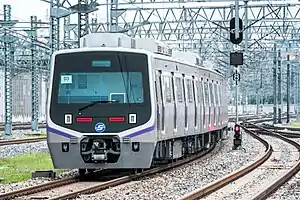
The Seoul Metro 5000 series is a commuter train running on Seoul Subway Line 5 in the Seoul metropolitan area. Currently, a total of 79 trains (632 units) of 8-car sets are in operation. Most of them were introduced with the opening of Line 5 in 1995, and four additional trains were brought in in 2018 in preparation for the opening of the extended section of the Hanam Line. Currently, 25 trains are being introduced sequentially from the beginning of 2021 to the end of 2022 due to the aging of some trains in the early stages (first division).
| Seoul Metro 5000 series | |
|---|---|
 3rd generation | |
| Constructed | 1994–1995 (1st generation) 1995-1996(2nd generation) 2018 (3rd generation) 2021-2022 (4th generation) |
| Formation | 8 cars per train TC-M'-M'-M'-M'-M'-M'-TC |
| Operator(s) | Seoul Metro |
| Line(s) served | Seoul Subway Line 5 |
| Specifications | |
| Maximum speed | 80km/h (ATC service) 100km/h (design) |
| Power output | 4,000 kW (5800hp) |
| Deceleration | 3.5km/h/s (service), 4.5km/h/s (emergency) |
| Safety system(s) | ATC,ATO[1] |
Specifications
Control
The first 5000 trains introduced by the Seoul Metro were introduced with a VVVF-GTO-type control device (4500V3000AGTO element) with technical support from ABB. One controller controls eight motors in two quantities, and the controller is in the same position as the pantograph. On December 15, 2011, only trains on Line 5 were replaced with VVVF inverters, and flight 502 of the first division was replaced with polysses VVVF-IGBT inverters from the existing ABB VVVF-GTO inverters. This inverter consists of 206-213, 239-242, 245-248, 285-292, 3,000 VVVF trains running on Seoul Metro Line 2, 316-320, 334-35, 341-348 trains running on Seoul Metro Line 4, and 4,000 trains running on Seoul Metro Line 4.
Interior
As the standards for internal combustion of railway vehicles were strengthened after the Daegu subway fire disaster on February 18, 2003, the replacement of interior materials for all vehicles was completed by 2006. Heungil Enterprise in 2005 and SLS Heavy Industries in 2006 participated in the interior material replacement project. The seat adopted a matte stainless steel sheet, and the fire alarm and emergency room intercom were reinforced, and in the process of replacing the side window with non-combustible glass, the upper side of the primary vehicle was replaced with double-decker glass like the secondary vehicle. The in-vehicle door cock has been structurally changed from the lower vehicle body pipe to the lower body center. In 2010, for the convenience of passengers, flame retardant mottled sheets were installed only in the part (saddle side) excluding the backrest, and the travel guide LED display was changed to LCD monitoring as part of the SMRT-MALL project. The side route indicator has been installed and operated Wi-Fi terminals of mobile telecommunication businesses (SK Telecom, KT, and LG U+) after being removed due to the installation of the screen door (PSD).
Generations
1st generation (1995~1996)
Flights 501-527 were introduced in preparation for the opening of the Gangdong section on November 15, 1995, the Macheon branch line on March 30, 1996, and flight 528-546 was introduced in preparation for the opening of the Gangseo section on March 20, 1996. At the time of its introduction, the upper opening and closing method opened about 1/3 of the room's side windows, but at the same time, the rest of the room windows except for the old and weak magnet windows were replaced with double-decker glass. The LED route information indicator on the front of the vehicle is smaller than the latter type. Flights 501-521 were two tons of stainless steel, like those of the Korea Railroad and the Seoul Subway Corporation at the time, which were heavily influenced by Japan's 205-series trains, but flights 522-546 unified the entire vehicle with glossy stainless steel. In 2010, 538 CCTVs in the room were installed and operated on a pilot basis for customer safety. On December 15, 2011, 502 pieces of propulsion control were converted to Infineon License Dawonis Level 2 IGBT (1C4M), but further modification plans were scrapped due to worse results than existing vehicles. Around March 2017, the headlights of Flight 501 5101 were replaced with LEDs. The old 518 flights were suspended in February 2017 due to defects in light vehicles and major parts, and in May 2020, two cars (5318, 5518) derailed from Balsan Station while returning from Godeok Vehicle Base to Fire Vehicle Base by 568. There were no injuries because it was dawn, but the first four were returned by 568 flights, and the second derailed accident occurred while the latter four were returned by 567 flights. Due to this accident, the operation of the Banghwa-Hwagok section was suspended throughout the morning, and shuttle buses were put into and operated in this section, and the screen door of Balsan Station was damaged and replaced, and 518 flights are now scrapped. When flight 529 became unusable due to the fire of parts No. 5029 around June 2018, the composition of flight 529 was changed to No. 5018 and is in operation.
2nd generation (1995~1996)
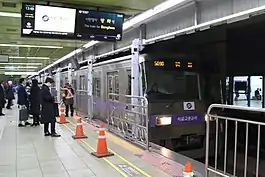
It was introduced in preparation for the complete opening of the Yeongdeungpo section on August 12, 1996 and the entire section on December 30, 1996. From the time of introduction, a double-decker glass (excluding the elderly and weak magnets) that cannot be opened and closed was applied, and the vehicle's front route information indicator was larger than that of the electric type, promoting the convenience of users. Technically small parts have been improved, such as the current method (maximum value is realized in the case of the primary vehicle) and the average value in the case of the secondary vehicle), but there is no noticeable change compared to the primary vehicle. Flight 566 has a history of exploding due to aging core parts at Dongdaemun History and Culture Park Station around August 2017.
3rd generation (2018)
Vehicles introduced in preparation for the opening of the Hanam Line on August 8, 2020. The appearance was based on the Seoul Metro 9000 series train.
Unlike the 9000 trains on Metro Line 9 in Seoul, the thick window frame unique to Hyundai Rotem trains has disappeared, and a dedicated air conditioner for the driver's room has been installed. The disadvantage is that there is an emergency door facility space in the front, but it is not installed.
The propulsion control device is VVVF-IGBT, which is the same driving sound as 214, 232 to 238, 256, 273 to 284, 293 out of Seoul Metro's 2000 trains, 466, 470 to 471 out of 4,000 trains, and 101 to 110, 112 to 116, 118, 120 to 121 trains of Incheon Metro 1000 series trains.
4th generation (2021 ~ 2022)
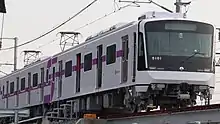
Part of the first introduction, part of the replacement of trains due to the aging of 501-525 trains. The propulsion control device is Toshiba PMSMIGBT, which is the same driving sound as Busan Transportation Corporation's 1,000 trains 101-11 trains. Flight 501 to 504 had undergone a test drive on a test line at a power station before its introduction.
References
 Rolling stock of Seoul Metro Rolling stock of Seoul Metro | |
|---|---|
| Current/Active |
|
| Retired/Withdrawn |
|
See also Category:Rolling stock of South Korea | |