Seoul Metro 2000 series (first generation)
The first generation Seoul Metro 2000-series, also known as rheostat Seoul Metro 2000-series and chopper Seoul Metro 2000-series, are South Korean electrical multiple unit trains manufactured first by Nippon Sharyo, then Hyundai Precision & Industries, Daewoo Heavy Industries, and Hanjin Heavy Industries between 1983 and 1994 for Seoul Subway Line 2.
| Seoul Metro 2000 series (first generation) | |
|---|---|
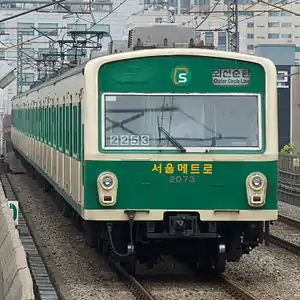 First generation set 273 | |
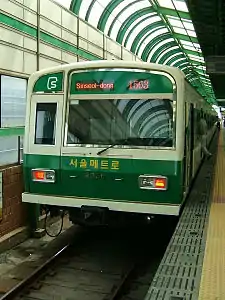 Rebuilt first generation set 256 | |
| In service | 1983-present |
| Manufacturer | Nippon Sharyo, Hyundai Precision & Industries, Daewoo Heavy Industries, Hanjin Heavy Industries |
| Constructed |
|
| Entered service | 1983 |
| Number built | 664
|
| Number in service | 12 (2 trains) |
| Number preserved | 11 |
| Number scrapped | 635 |
| Successor | Seoul Metro 2000 series (VVVF) |
| Formation |
|
| Operator(s) | Seoul Metro |
| Depot(s) | Sinjeong |
| Line(s) served | Seoul Subway Line 2 |
| Specifications | |
| Car body construction | Aluminum |
| Train length | 195 m (195,000 mm) |
| Car length | 19.5 m (19,500 mm) |
| Width | 3.16 m (3,160 mm) |
| Doors | 8 per car, 4 per side |
| Maximum speed | 110 km/h (68 mph) (design) |
| Traction system | MMC-HTB-20R series-parallel combination rheostat, Melco armature thyristor chopper control, or GEC-Alsthom armature thyristor chopper control |
| Traction motors | DC |
| Deceleration | 3.5 kmh/s (emergency: 4.5 kmh/s) |
| Electric system(s) | 1,500 V DC overhead catenary |
| Current collection method | Pantograph |
| Braking system(s) | air |
| Safety system(s) | ATS |
| Track gauge | 1,435 mm (4 ft 8+1⁄2 in) standard gauge |
Delivery
1st batch
The first batch of first generation 2000-series trains were manufactured between 1980 and 1984, and comprised 54 sets that were 4 cars long or 6 cars long, numbered 2-01~2-39 and 2-61~2-75.
Sets 2-01~2-11 were built by Nippon Sharyo in 1980. The cars utilized rheostat circuits and were four cars long. They were introduced when Line 2 was opened between Sinseol-dong station and Sports Complex station.
Sets 2-12~2-14 were built by Daewoo Heavy Industries in 1982. The cars also utilized rheostat circuits and were four cars long. They were introduced when Line 2 was extended from Sports Complex station to Seoul National University of Education station.
Sets 2-15~2-39 were built by Hyundai Precision & Industries in 1983. The cars utilized chopper circuits from Melco. All sets were four cars long except for train 2-39, which was six cars long. They were introduced when the main circular line of Line 2 was completed in May 1984.
Sets 2-61~2-75 were built by Daewoo Heavy Industries between 1983 and 1984. The cars utilized chopper circuits from GEC. All sets were six cars long. They were also introduced when the main circular line of Line 2 was completed in May 1984. When the sets were delivered, they were initially numbered as trains 3-01~3-15; this caused numbering conflicts with standardized wide-with train sets for Seoul Subway Line 3.
2nd batch
The second batch of first generation 2000-series trains were manufactured in 1986 by Hyundai Precision. No new sets were manufactured; the cars were intended to lengthen sets 2-01~2-08 and 2-15~2-38 from four cars to six cars.
3rd batch
The third batch of first generation 2000-series trains were manufactured by Hyundai Precision & Industries between 1989 and 1991. 13 additional sets, numbered 2-40~2-52, were manufactured, along with additional cars that were intended to lengthen older sets as ridership on Line 2 increased.
Sets 2-40~2-52 were built between 1989 and 1990. The cars utilized chopper circuits from Melco and were very similar to sets 2-15~2-39. They were introduced to provide additional service on Line 2. All sets were six cars long until they were lengthened by additional third batch cars manufactured in 1991. In 2005, sets 2-45~2-52 were renumbered to 2-06~2-13; this caused first batch sets 2-06~2-09 to be renumbered to 2-45~2-48 and first batch sets 2-12~2-13 to be renumbered to 2-58~2-59.
Additional cars were built between 1990 and 1991 to lengthen other sets. Two cars were built in 1990 to lengthen set 2–09 to six cars in anticipation of new shuttle service between Sindorim station and Kkachisan station. 68 cars were built in 1991 to lengthen sets 2-28~2-38 to ten cars, as well as lengthen some sets within sets 2-61~2-75 to ten cars.
4th batch
The fourth batch of first generation 2000-series trains were manufactured between 1992 and 1994. The cars sported cosmetic upgrades, including new window frames. Four additional sets, numbered 2-53 and 2-93~2-95, were manufactured, along with additional cars that were intended to lengthen older sets as ridership on Line 2 increased.
Set 2-53 was built in 1993 by Hyundai Precision & Industries and utilized chopper circuits from Melco. Sets 2-93~2-95 were built in 1994 by Daewoo Heavy Industries and utilized chopper circuits from GEC. They were introduced to provide additional service on Line 2. In 2005, set 2-53 was renumbered to 2–14; this caused first batch set 2–14 to be renumbered to 2-60.
Additional cars were built between 1992 and 1993 to lengthen other sets. 56 cars were built in 1992 to lengthen sets 2-15~2-27 and 2–39 to ten cars. 20 cars were built in 1993 by Hanjin Heavy Industries to lengthen sets 2-01~2-05 to ten cars to allow them to operate on the main circular line of Line 2. 68 cars were built in 1993 by Daewoo Heavy Industries to lengthen the rest of the sets within sets 2-61~2-75 to ten cars.
Rebuilds
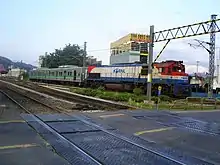
Because individual cars were much newer than the other cars in a set, many cars were rebuilt to newer trains when the rest of the set was retired.
When sets 2-01~2-09 were retired, the 22 1990 & 1993-built cars and several 1986-built cars were rebuilt with cabs and reorganized into four 6-car sets (2-45~2-48) and one 4-car set (2-56). New sets 2-45~2-48 operated on the Sinjeong Branch shuttle, and new set 2-56 operated on the Seongsu Branch shuttle. When sets 2-64~2-66 retired, the 1993-built cars in the set were used to replace the 1986-built cars in sets 2-46~2-48.
When sets 2-15~2-39 were retired, 98 of the 100 1991 & 1992-built cars were salvaged for further use. 18 trailer cars were rebuilt to become trailer cars in newer VVVF trains. The remaining 80 cars were rebuilt with cabs and reorganized into eight 10-car sets (2-32~2-39).
When the rest of sets 2-61~2-75 were retired, 50 cars were rebuilt with cabs and reorganized into five 10-car sets (2-73~2-77). Four trailer cars were rebuilt to become trailer cars in newer VVVF trains.
Retirement
As older first generation 2000-series cars reached the end of their lifespans, they were planned to be replaced with newer VVVF trains. The original lifespan range was 25 years, but this was lengthened with newer first generation cars.
Sets 2-01~2-05, 2-10~2-11, and 2-45~2-48 (renumbered from 2-06~2-09) were replaced by the first batch of newer VVVF trains and rebuilt sets 2-45~2-48 and 2–56 in 2005.
Sets 2-15~2-39, 2-58~2-60 (renumbered from 2-12~2-14), and 2-61~2-75 were replaced by the second batch of newer VVVF trains and rebuilt sets 2-32~2-39 and 2-73~2-77 between 2007 and 2008.
Sets 2-06~2-13 (renumbered from 2-45~2-52), 2-40~2-44, and rebuilt set 2-39 (which was prematurely retired after an accident at Sangwangsimni station) were replaced by the third batch of newer VVVF trains between 2017 and 2019.
Sets 2-14 (renumbered from 2-53), 2-93~2-95, rebuilt sets 2-32~2-38, and rebuilt sets 2-73~2-77 were replaced by the fourth batch of newer VVVF trains between 2019 and 2020.
Rebuilt sets 2-45~2-48 and the trailer cars currently in second generation trains 2-23~2-31 and 2-71~2-72 are slowly being replaced by the fifth batch of newer VVVF trains from 2021.
Preservation
After retirement, a handful of first generation 2000-series cars were either preserved or repurposed.
- 1st batch cars 2001-2101-2301-2501 - held for preservation at Sinjeong Depot as the original cars of the first train set for Seoul Subway Line 2.
- 1st batch car 2007 - preserved at the Daegu Safety Theme Park as a fire safety exhibit. The car was renumbered to 2046 before its retirement.[1]
- 1st batch car 2012 - preserved at the National Fire Service Training Center as a training car. The car was renumbered to 2058 before its retirement.[2]
- 2nd batch cars 2222, 2223, 2225, 2233, and 2333 - exported to Vietnam and used on the Hanoi–Đồng Đăng railway as push-pull coaches.[3]
- 3rd batch cars 2210, 2310, 2610, 2710, and 2744 - preserved at the old Gyeonggang station and used as an excursion train for the Hyunmoo Resort.[4][5]
References
- "Destinations by Region : VisitKorea Destinations by Region Daegu Safety Theme Park (대구시민안전테마파크) | Official Korea Tourism Organization".
- https://m.blog.naver.com/digmon2001/221790730151
- https://transoceanservice.com/ha-long-bay-travel-experience-vietnams-natural-wonder
- "영화 제작한 현무 엔터프라이즈 유종관 회장, 모래시계 세트장 부지에 현무리조트 오픈". 18 October 2019.
- "자연과 문화, 사람이 깃드는 곳 '프리미엄 랜드마크'를 꿈꾼다". 23 October 2019.
 Rolling stock of Seoul Metro Rolling stock of Seoul Metro | |
|---|---|
| Current/Active |
|
| Retired/Withdrawn |
|
See also Category:Rolling stock of South Korea | |
 Rolling stock of Korail Rolling stock of Korail | |||||||||||||||||||||
|---|---|---|---|---|---|---|---|---|---|---|---|---|---|---|---|---|---|---|---|---|---|
| Current/Active |
| ||||||||||||||||||||
| Future |
| ||||||||||||||||||||
| Retired/Withdrawn |
| ||||||||||||||||||||
| Experimental |
| ||||||||||||||||||||
See also Category:Rolling stock of South Korea | |||||||||||||||||||||