Symphyotrichum boreale
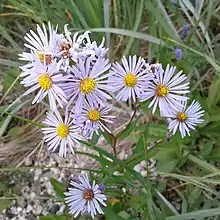
Symphyotrichum boreale (formerly Aster borealis) is a species of flowering plant of the aster family (Asteraceae) native to North America. Commonly known as rush aster, northern bog aster, and slender white aster, it is a perennial, herbaceous plant that may reach 85 centimetres (2 feet 9 inches) high.[4]
| Symphyotrichum boreale | |
|---|---|
 | |
Scientific classification  | |
| Kingdom: | Plantae |
| Clade: | Tracheophytes |
| Clade: | Angiosperms |
| Clade: | Eudicots |
| Clade: | Asterids |
| Order: | Asterales |
| Family: | Asteraceae |
| Tribe: | Astereae |
| Subtribe: | Symphyotrichinae |
| Genus: | Symphyotrichum |
| Subgenus: | Symphyotrichum subg. Symphyotrichum |
| Section: | Symphyotrichum sect. Symphyotrichum |
| Species: | S. boreale |
| Binomial name | |
| Symphyotrichum boreale | |
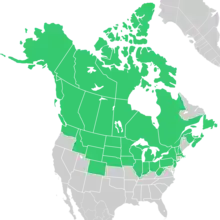 | |
| Native distribution[3] | |
| Synonyms[2] | |
|
Basionym
Alphabetical list
| |

Description
Symphyotrichum boreale is a perennial herbaceous species that reaches between 13 centimetres (5 inches) and 85 cm (2 ft 9 in) high. The leaves, stem, and overall plant form are slender, and it produces long rhizomes. The inflorescence consists of one to several composite flowers. The ray florets are white to pale purple, and the disc florets are cream or pale yellow, becoming purplish.[4] The leaves are simple, with alternate or basal arrangement.[5]
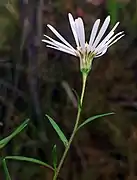 Stem and flower head
.jpg.webp) Flower head
Flower head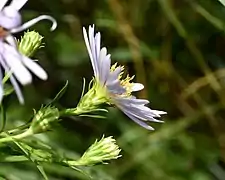 Involucres, phyllaries, and bracts
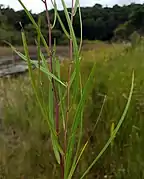 Stems and leaves
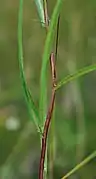 Stem close-up
Taxonomy
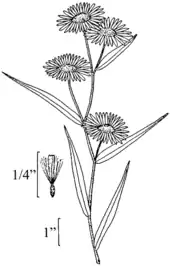
Symphyotrichum boreale was formerly included in the large genus Aster as Aster borealis. However, this broad circumscription of Aster is polyphyletic and the North American asters are now mostly classified in Symphyotrichum and several other genera.[6]
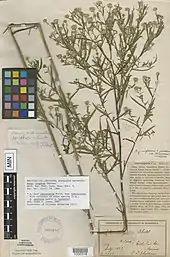
Hybrids between this species and Symphyotrichum puniceum have been recorded and are called Symphyotrichum × longulum.[4]
Distribution and habitat
Symphyotrichum boreale is native to northern North America from Alaska to Newfoundland, and south to Colorado and West Virginia. It is found in wet, calcareous habitats including fens, marshes, swamps and wet meadows.[4]
Ecology
In addition to vegetative spread via rhizomes, dispersal is accomplished by wind-blown seed.
The roots are colonised by fungi including arbuscular mycorrhiza and dark septate endophytes. The sac fungus Erysiphe cichoracearum, which causes a powdery mildew, is also known from this species.[7]
Citations
References
- Brouillet, L.; Semple, J.C.; Allen, G.A.; Chambers, K.L.; Sundberg, S.D. (2006). "Symphyotrichum boreale". In Flora of North America Editorial Committee (ed.). Flora of North America North of Mexico (FNA). 20. New York and Oxford. Retrieved 3 July 2021 – via eFloras.org, Missouri Botanical Garden, St. Louis, MO & Harvard University Herbaria, Cambridge, MA.
- Hassler, M. (2021). "Symphyotrichum boreale (Torr. & A. Gray) Á. Löve & D. Löve". World Plants: Synonymic Checklists of the Vascular Plants of the World (version 17 March 2021). Retrieved 16 June 2021 – via Species 2000 & ITIS Catalogue of Life, 10 June 2021 (Roskov, Y.; Ower, G.; Orrell, T.; Nicolson, D.; Bailly, N.; Kirk, P.M.; Bourgoin, T.; DeWalt, R.E.; Decock, W.; van Nieukerken, E.J.; Penev, L.; eds.). Digital resource at Catalogue of Life (www.catalogueoflife.org). Species 2000: Naturalis, Leiden, the Netherlands. ISSN 2405-8858.
- Les, D.H. (2017). Aquatic Dicotyledons of North America: Ecology, Life History, and Systematics. CRC Press. ISBN 9781482225020.
- Native Plant Trust (n.d.). "Symphyotrichum boreale (Torr. & Gray) Nesom". Native Plant Trust Go Botany (www.gobotany.nativeplanttrust.org). Native Plant Trust. Retrieved 21 October 2021.
- NatureServe (4 June 2021). "Symphyotrichum boreale — Boreal Aster". NatureServe Explorer (explorer.natureserve.org). Arlington, Virginia: NatureServe. Retrieved 16 June 2021.
- POWO (2021). "Symphyotrichum boreale (Torr. & A.Gray) Á.Löve & D.Löve". Plants of the World Online (www.plantsoftheworldonline.org). Royal Botanic Gardens, Kew. Retrieved 5 September 2021.
- Semple, J.C. (27 April 2021). "An overview of "asters" and the Tribe Astereae". University of Waterloo (UWaterloo.ca). Waterloo, Ontario: University of Waterloo. Archived from the original on 26 May 2021. Retrieved 22 June 2021.